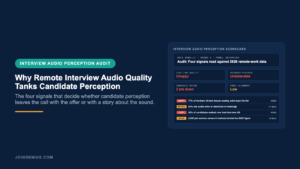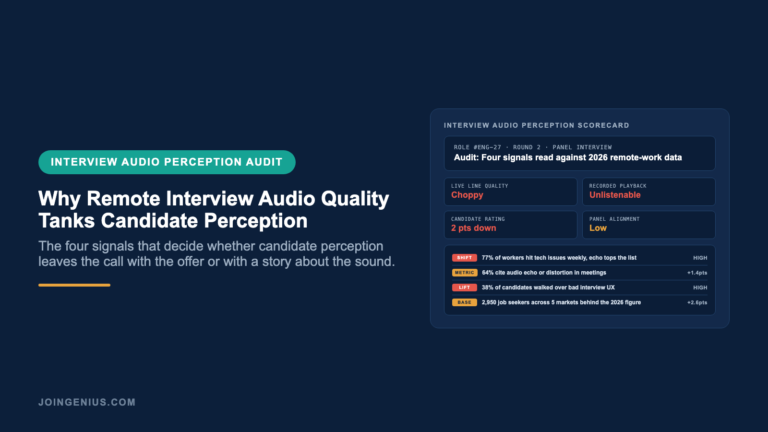
The audio quality of a remote interview is a hiring input that most talent teams still treat as an IT problem. Candidates do not experience it that way. Candidates experience it as the first signal the employer sends about its own operating standards. A line that drops or an echo that eats the second sentence of every answer is read as proof the brand cannot run its own basics. The quality bar a recruiter signs off on is the quality bar the candidate assumes applies to the whole organization. A recruiter prioritizing audio quality is making a candidate-perception call before the first question is asked.

The Audio Problem Most Hiring Teams Still Treat As IT’s Job
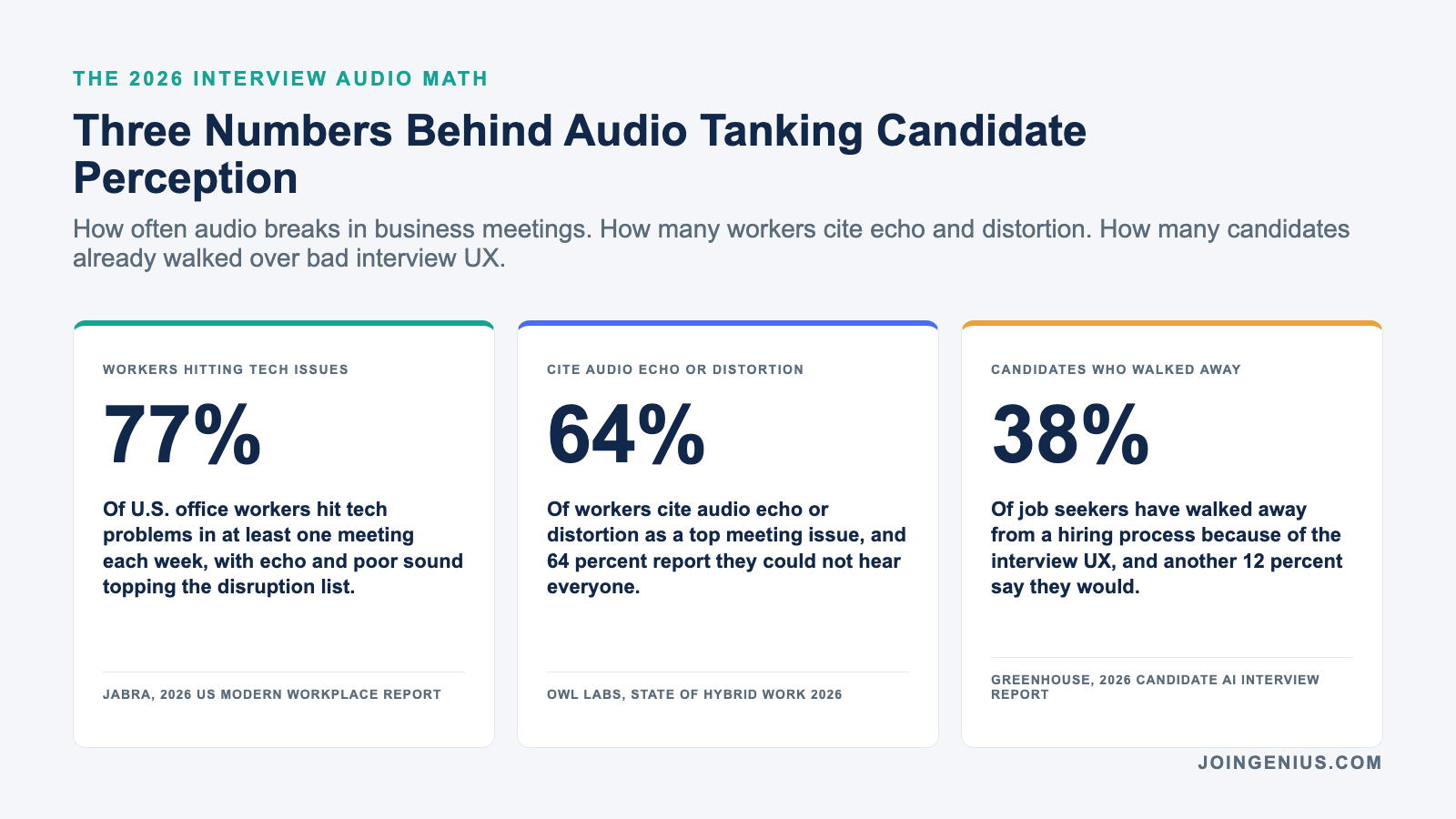
Audio issues are not rare, and they are not getting less common. The Jabra 2026 US Modern Workplace Report reports that 77 percent of office workers hit tech problems in at least one meeting every week, with echo and poor sound topping the disruption list.
The split is wider for hybrid workers at 88 percent versus 72 percent for full-time in-office workers. Jabra ran the survey through Pollfish on 1,000 employed U.S. adults in March 2026.
A hiring process running 5 interviews a week against that baseline is statistically guaranteed to lose at least one of those interviews to audio. The hiring team that treats audio as an IT problem is choosing not to measure it.
The audio problem is already happening. Treating it as somebody else’s budget line is why the perception damage compounds.
What A Broken Line Actually Costs Inside The Hour
The cost of a bad audio line shows up in the time it takes to recover from it. The Owl Labs 2026 State of Hybrid Work report, its 10th annual, found 66 percent of workers lose time to technical difficulties in meetings.
Inside that figure, 64 percent of respondents cite audio echo or distortion and 64 percent report they could not hear everyone in the meeting.
The same report puts the average time to get a meeting started at 6 minutes, with 18 percent of respondents reporting 10 minutes or more lost per meeting before the actual conversation begins.
Inside a 30-minute interview window, 6 minutes of audio troubleshooting is 20 percent of the slot. The candidate loses that time to perform and the interviewer loses it to calibrate. The perception damage lands on the brand on both sides.
The Perception Line That Already Decides The Offer
Candidate perception of the hiring process is already moving offers, and the data on it has moved past hunch. The Greenhouse 2026 Candidate AI Interview Report, published 1 May 2026, surveyed 2,950 active job seekers across five markets and found 38 percent have walked away from a hiring process because it included an AI interview.
Another 12 percent say they would. And 63 percent of respondents have been interviewed by an AI, up 13 percentage points in six months. The share of candidates who will drop out over a bad interview UX is above a third of the funnel.
Audio quality is upstream of that drop-off. A candidate forming a perception during a cracked line or a muffled interviewer voice is forming it against the same patience budget that decides whether to walk from the AI segment. The hiring team losing candidates on the AI interview is also losing them on the audio.
Why The Interviewer’s Microphone Signals Employer Quality
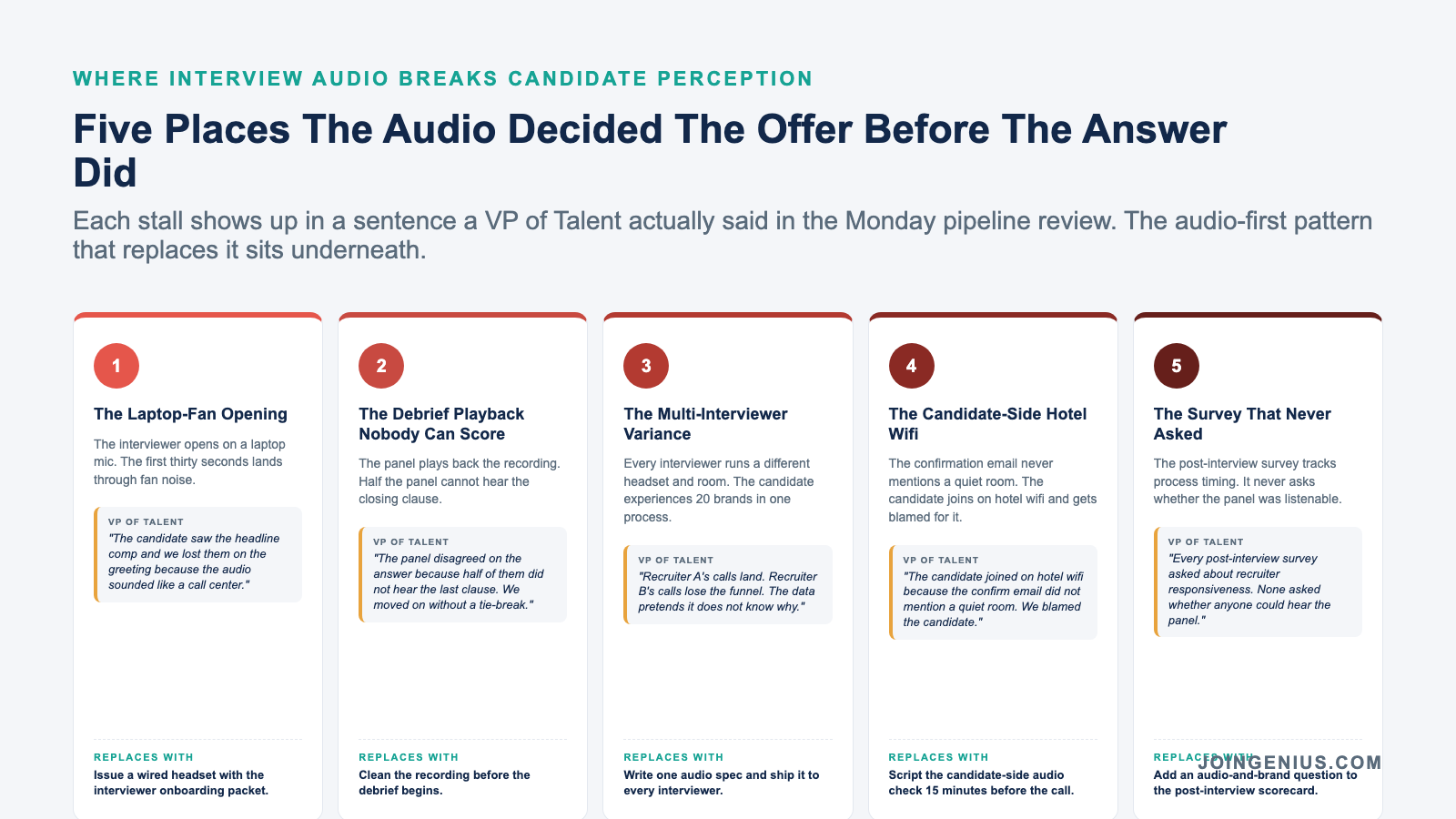
A candidate forms an impression of the employer in the first thirty seconds of the call, and the audio is the lead variable in that impression. The interviewer’s voice arriving clean is read as competence. The interviewer’s voice arriving through laptop fan noise and keyboard clicks is read as cost-cutting.
Neither inference is fair. Both are predictable. The hiring brand decides which one shows up on every call by deciding which microphone every interviewer uses by default.
The signal is not the equipment line item. The signal is the fact the team thought about it before the candidate did. A hiring org that standardizes the audio stack is not buying equipment, it is deciding which brand story lands first.
The interviewer who shows up with a wired headset and a quiet room is already giving the candidate a reason to lean toward the offer. The interviewer who shows up through a laptop mic has already handed the next competing employer a thirty-second lead.
The Audio The Hiring Panel Actually Hears
The audio that decides the hire is rarely the live audio. It is the recorded audio the panel plays back during debrief. A live call with mild noise plays back as unlistenable, because the panel does not have the context the interviewer had in the room.
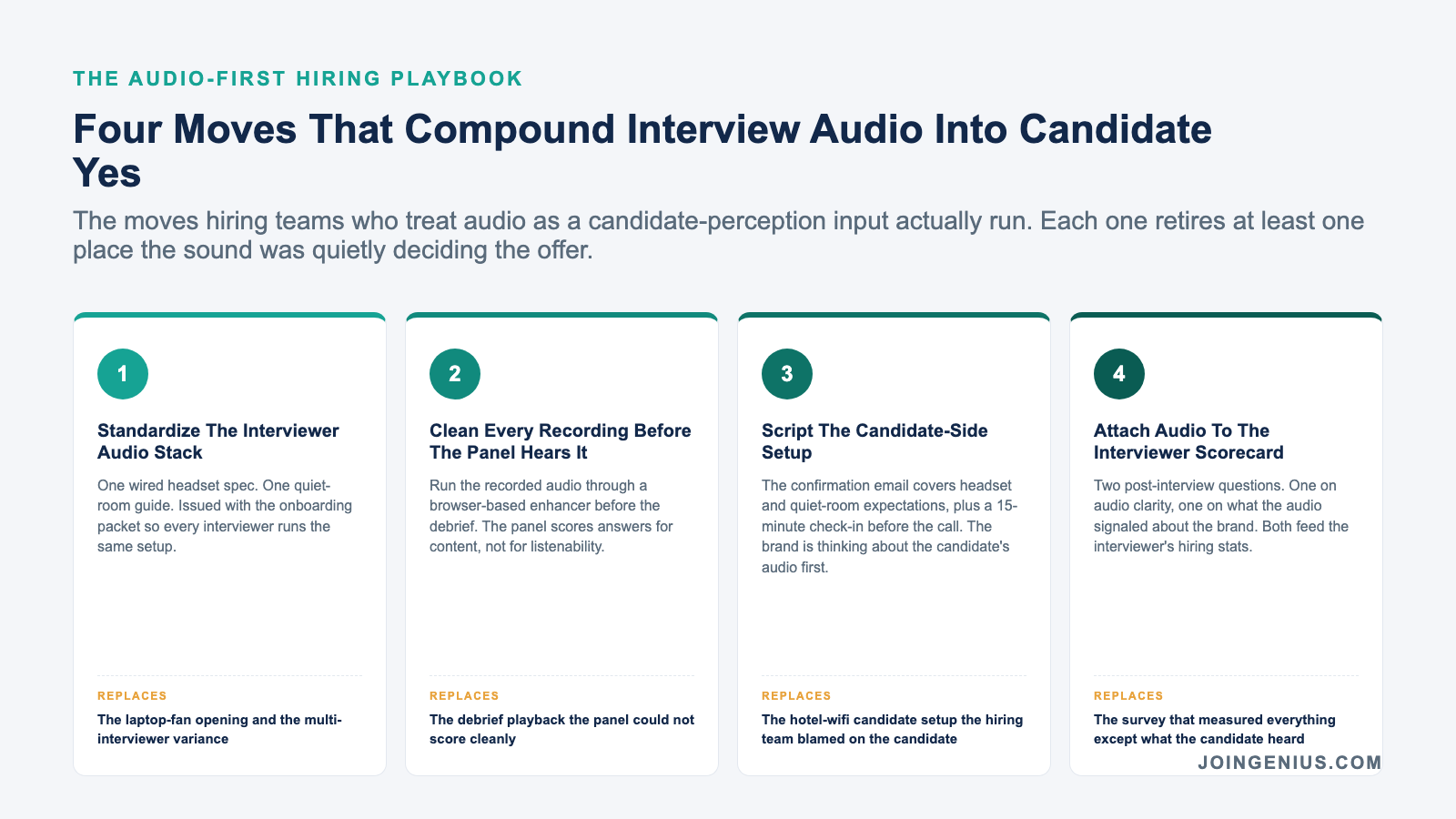
That is the lever most hiring teams miss. The interview audio can be cleaned before it ever reaches the debrief.
Platforms like Audo publish an audio enhancer that pulls background noise and restores voice clarity, usable in the browser or through a free REST API, so a recruiter can clean a recorded interview before the hiring panel ever listens to it.
That reframes audio from an in-call constraint to a post-call decision the recruiter owns. The debrief is where the candidate’s answers get re-weighted against the words the panel actually hears. A clean recording is the one that gets scored for content, not for how hard it was to listen to.
The Standardization Problem Recruiters Already Feel
A hiring org running 20 interviewers across 4 teams is running 20 different audio setups. Every interviewer has made their own choice about which headset and which laptop and which room. The candidate experiences the variance as inconsistency. The hiring data pretends it does not exist.
The fix is not a bigger procurement budget. The fix is a standard. An operations manager who writes the interview-audio spec and orders the same wired headset across the panel, shipping it with the onboarding packet, closes the variance in a week.
The spec does not need to be expensive. It needs to be the same for everyone, which is how the hiring team gets permission to measure audio quality across interviews instead of blaming the interviewer who happened to draw the bad connection.
The Employer Brand Cost Of A Bad First Thirty Seconds
Employer brand teams spend quarters on careers-page copy and referral program design, with offer-package storytelling on top. The first thirty seconds of the live interview sits above all of them in a candidate’s memory. A broken mic cancels a quarter of brand work.
A marketing manager treating the hiring funnel as a brand touchpoint is budgeting against audio quality the same way they budget against careers-page load time. Audio is not an IT line, it is a brand latency metric.
The experience the candidate carries from the interview becomes the review on Glassdoor and the warning they share in a Slack channel of 500 peers.
The brand case for fixing audio is not that it wins the one hire. It is that the candidate who did not get the offer tells six others what the interview sounded like.
The Candidate-Side Setup Nobody Is Scripting
Half the audio problem is on the candidate’s side of the call, and most hiring teams do nothing to help. The confirmation email says “join the Zoom link at 2pm” and nothing else. The candidate joins through a hotel wifi connection on a laptop mic and the interviewer blames the candidate for the setup.
A virtual assistant assigned to the candidate-side of the interview workflow fixes this with a few extra lines in the confirmation email. Those lines cover headset availability and a quiet-room check-in call 15 minutes before the interview starts.
The signal to the candidate is also what the signal is to the employer. The brand is thinking about the candidate’s experience before the candidate had to ask. That signal lands in the same patience budget the audio quality lands in.
The Feedback Loop That Closes The Perception Gap
Candidates form perception. Employers rarely ask them to share it. The post-interview survey most hiring teams run asks about process timing and recruiter responsiveness, not about whether the audio on the panel call was listenable.
A copywriter rewriting the post-interview survey adds two questions. The audio question asks whether the candidate was able to hear every interviewer clearly. The brand question asks what the audio quality signaled to them about the company. Both responses feed the same scorecard the interviewer gets.
The feedback loop is the forcing function. Once the audio scorecard is attached to the interviewer’s hiring stats, the audio gets fixed. Nothing changes without the measurement, and the measurement comes from asking the candidate what they heard.
The loop also raises the floor across every interviewer at once. The interviewer whose audio sits at the bottom of the scorecard gets the equipment upgrade and the room check they needed in month one. The interviewer whose audio sits at the top of the scorecard gets kept on the panel.
Conclusion
The remote interview is now the default first impression the employer gets to make. The audio quality of that first impression is the first thing a candidate judges and the last thing most hiring teams measure.
The gap is wide enough that it is the explanation for an entire class of pipeline leak the hiring team has been attributing to pay or location, when the real cause was already on the call.
Fixing it is not expensive. It requires a standard and a cleanup tool, plus a feedback loop that closes it. What it earns is a candidate perception line that no longer sits as the quiet reason good people walk.
Talent teams scoping that rewiring can shortlist operations and recruiting talent through Genius.