Recruiting video is one of the few assets that still moves candidate behavior in 2026. The problem is not that it fails to work. The problem is that every talent team wants to scale recruiting video content and nobody has a production budget to match the role count.
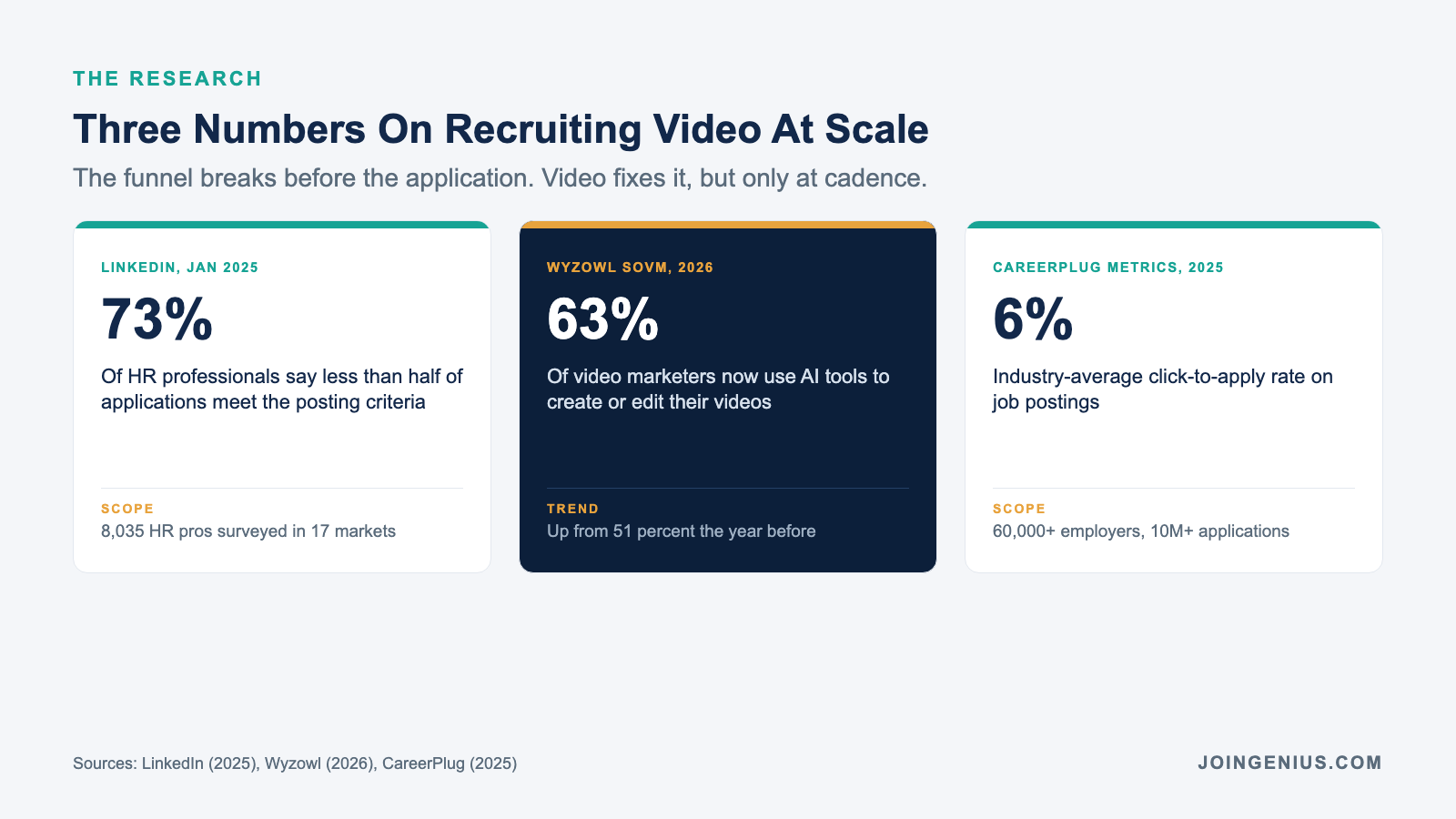
In January 2025, LinkedIn reported that 73 percent of HR professionals say less than half of the applications they receive meet all the criteria listed on their postings. The video that would pre-qualify those candidates is sitting on a wishlist, blocked by a quote from an agency.
The fix is not to spend more. The fix is to make video that fits the funnel and not the film festival. The rest of this guide lays out how a lean team ships recruiting video at role-level cadence, without a studio or a six-figure brief.
Why Recruiting Video Is Where The Funnel Actually Breaks
Most recruiting funnels still look the same at the top. CareerPlug’s 2025 Recruiting Metrics Report, built on data from more than 60,000 small-business employers and over 10 million applications in 2024, pegs the industry-average click-to-apply rate at 6 percent. Only 3 percent of applicants reach interview. One in 180 applicants gets hired.
The job description text is doing almost all the work at the top of that funnel. A candidate scrolling at speed reads a wall of copy that reads like every other posting on the page. If 94 percent of job viewers never click apply, the posting is not a selection problem. It is a conversion problem.
Video closes some of that gap without any help from the ATS. A 20-second clip of the hiring manager explaining the actual job often outperforms a static posting. It works the same way a product video outperforms a product-page paragraph.
The team already has the talent on staff. What they do not have is the cadence to film one of these for every open role every month, and that cadence is the only thing that converts a one-off video into a funnel improvement.
Scale is the real missing piece. If one role gets a video and the next twenty do not, the video does not improve the funnel. It improves one posting. Scaling recruiting video means making it as cheap and repeatable to produce as the job description itself.
That is where the production budget conversation goes sideways. The budget is sized for a flagship brand video, so the per-role video does not get made at all. The ambition kills the throughput, and the funnel stays broken at the same 6 percent click-to-apply rate as before.
What A Production Budget Really Buys You
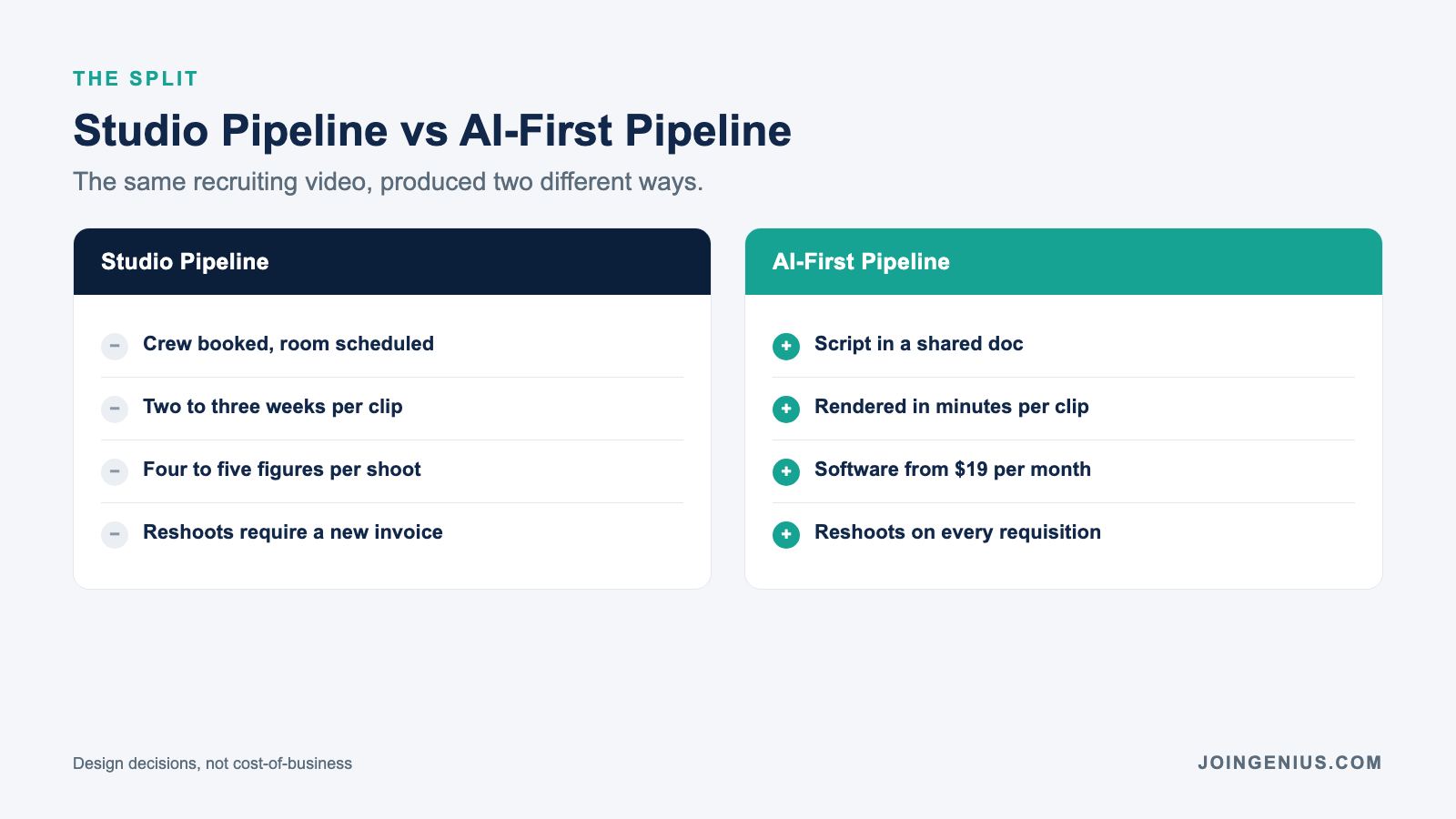
A traditional production budget covers three line items that do not all deserve their place. The crew is one of them. A two-person crew with a camera and a pair of lights produces broadcast-quality footage. For a recruiting video, that quality is above spec, and the day rate is the single biggest line in the quote.
The second line is time. Scheduling a shoot with a hiring manager and editing a two-minute final cut usually takes two to three weeks from brief to delivery. If the role is time-sensitive, the video arrives after the first wave of applicants have already decided for or against the posting.
The third line is iteration cost. If the role changes or the hiring manager leaves the company, the video is sunk. Reshooting means another crew call and another invoice on top of it. The sunk-cost problem is why most companies film an “employer brand” video once and then run it for three years past its expiry date.
Pull the crew and the iteration tax out of the quote, and you are usually left with a few hundred dollars of software and a prompt template. See our guide to hiring remote employees for the kind of role count that makes this math obvious.
Where AI Video Replaces The Studio
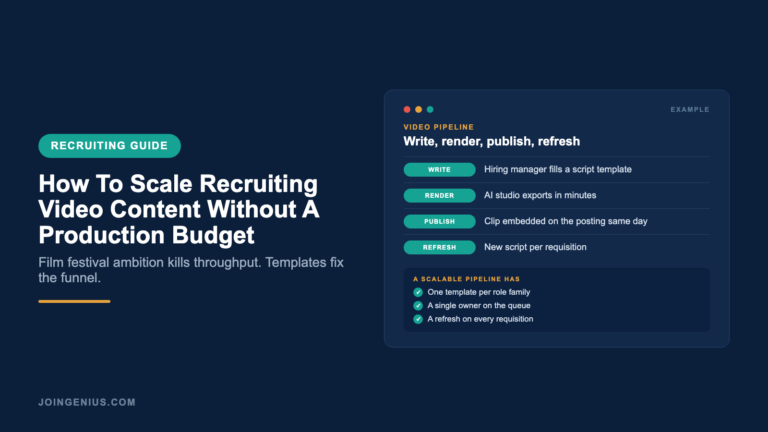
The pattern that holds up at scale is a template-driven video pipeline. The hiring manager writes a short script and picks a voice and avatar. The template renders the video in minutes. The crew is replaced by a software stack with a prompt library on top of it.
Wyzowl’s State of Video Marketing 2026 report found 63 percent of video marketers now use AI tools to create or edit their videos, up from 51 percent the year before. The recruiting side of the house usually lags marketing by about a year, which is the gap between a tool arriving and a talent team being asked to run it.
VideoGen’s AI studio is one example of this pipeline in action. It ships a free tier with paid plans from $19 per month and text-to-speech in more than 40 languages. AI avatars let a hiring manager narrate a role without ever being on camera, and “professional videos in minutes” is the public claim.
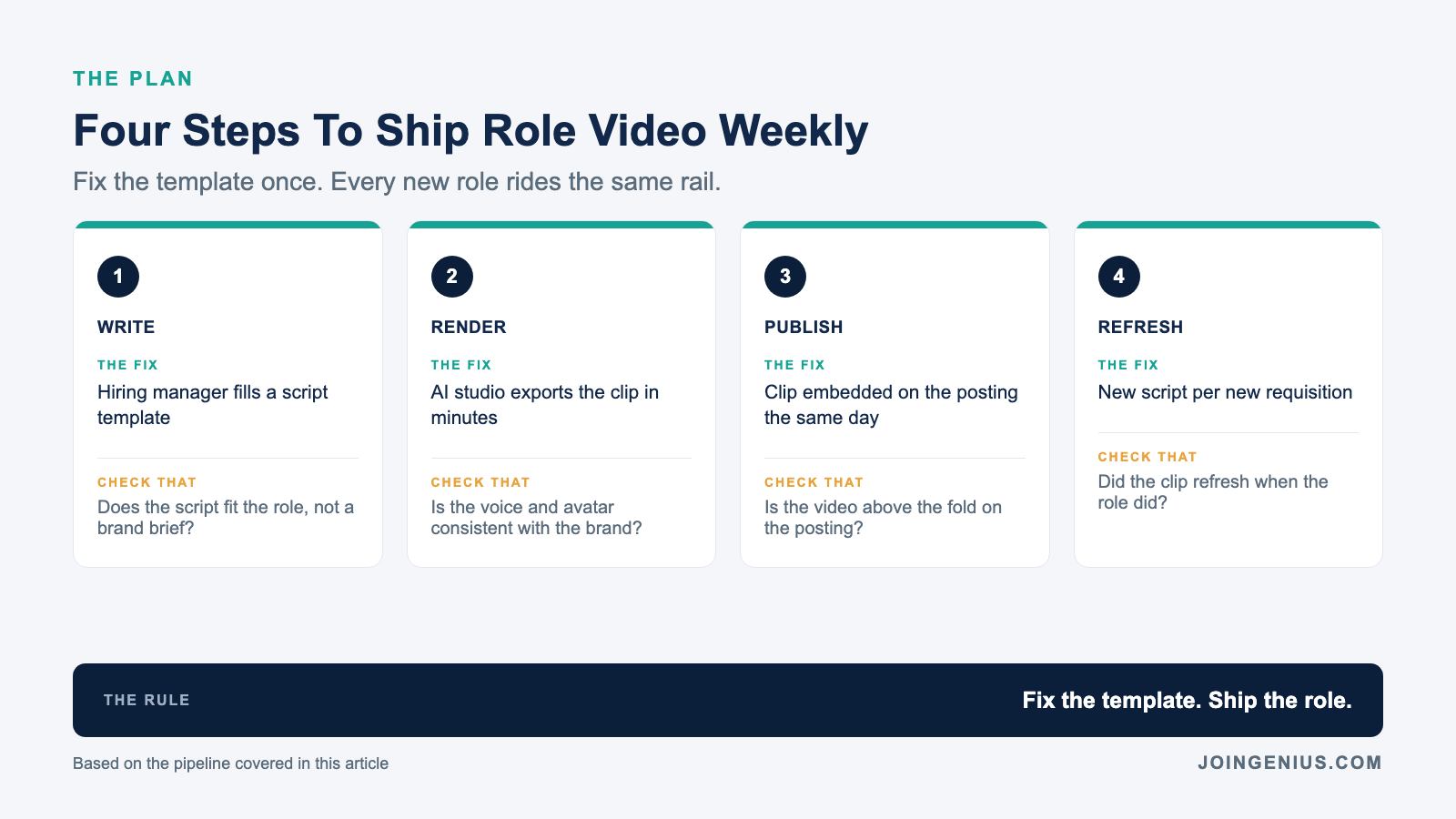
The point is not the specific tool. It is the shape of the pipeline. A role brief lands in a shared doc on Monday. The template renders a 45-second posting video by Monday afternoon. The role goes live on Tuesday with the clip embedded. Twenty roles can ship in a week with one owner on the pipeline.
The quality ceiling is lower than a studio shoot. That is a feature, not a bug. A recruiting video is a conversion asset and not a showreel. If 20 scrappy clips outperform one polished video on a per-role basis, the polished video is the one that was over-engineered for the job it had to do.
A Template System That Scales Without The Agency
Build the system around three video types. The role-level video explains the specific job and runs 30 to 60 seconds. The team-level video explains the hiring manager and runs 45 to 90 seconds. The culture video explains the environment and runs under two minutes. Nothing on the recruiting site needs to be longer than that.
| Video Type | What Makes It Work |
|---|---|
| Role-level | One hiring manager, one role, one script template |
| Team-level | Reused across all roles on the same team |
| Culture | Shot once per quarter and refreshed on cadence |
Build the three templates once. After that, every new role costs minutes of writing time and not days of shoot time. For engineering roles, the hiring manager fills a script template that already asks the right questions. For sales roles, a different template exists. The template is the asset. The video is the output.
See our types of HR outsourcing guide for the operational version of the same pattern, where repeatable playbooks replace one-off engagements, and where the ownership of each template is explicit from the start.
What To Shoot Live Versus What To Automate
Not every recruiting video belongs in a template. A live shoot still earns its budget when the subject is a real person doing real work and the clip will live on a careers page for a year or more. The live-shot video is a brand asset, not a per-role asset, and the production value is doing part of the job.
The automation lives at the role and team level. Script templates and AI studio tools are the right fit for anything that gets refreshed with every requisition, because the cost of a reshoot is close to zero. Our global outsourcing guide covers the mindset shift of putting repeatable work on an automatable rail.
Where teams get this wrong is by trying to automate the culture video and trying to shoot the role video. Culture needs the real human face. Role postings need the fast refresh. Swap those around and the system breaks on both ends at once.
The practical split is simple. Automate what the ATS already treats as variable. Shoot what the ATS treats as fixed. A role is variable. A values page is fixed. Match the production method to the stability of the content and not to the ambition of the brief.
Our payroll outsourcing explainer covers a parallel case. The cost of a reconfigured run is the metric that decides what gets automated and what stays bespoke, and the same math applies to a role video that may need a reshoot every quarter.
Scale Recruiting Video Without The Film Crew
Recruiting video content does not need a production budget to work. It needs a pipeline and a cadence that matches the role count. The teams that get this right in 2026 are not spending more on video. They are shipping more of it with less, and the funnel improves one role at a time.
Genius places the top 1 percent of remote talent from the Philippines and Latin America into roles that would otherwise cost roughly 80 percent more locally. There are no monthly platform fees and a six-month replacement guarantee if the fit is wrong.
Pair the AI video pipeline with a remote content role on your team. The video ships every week on a predictable cadence. The budget stays small. The funnel improves at every open seat, and the next hire helps make the one after it.