Every operations lead in 2026 has the same backlog. Orders fall out of sync between the storefront and the ERP. Someone spends four hours a week moving data by hand. The fix is to vet workflow automation specialists who can clear the backlog, and the hiring market has made that harder than it used to be.
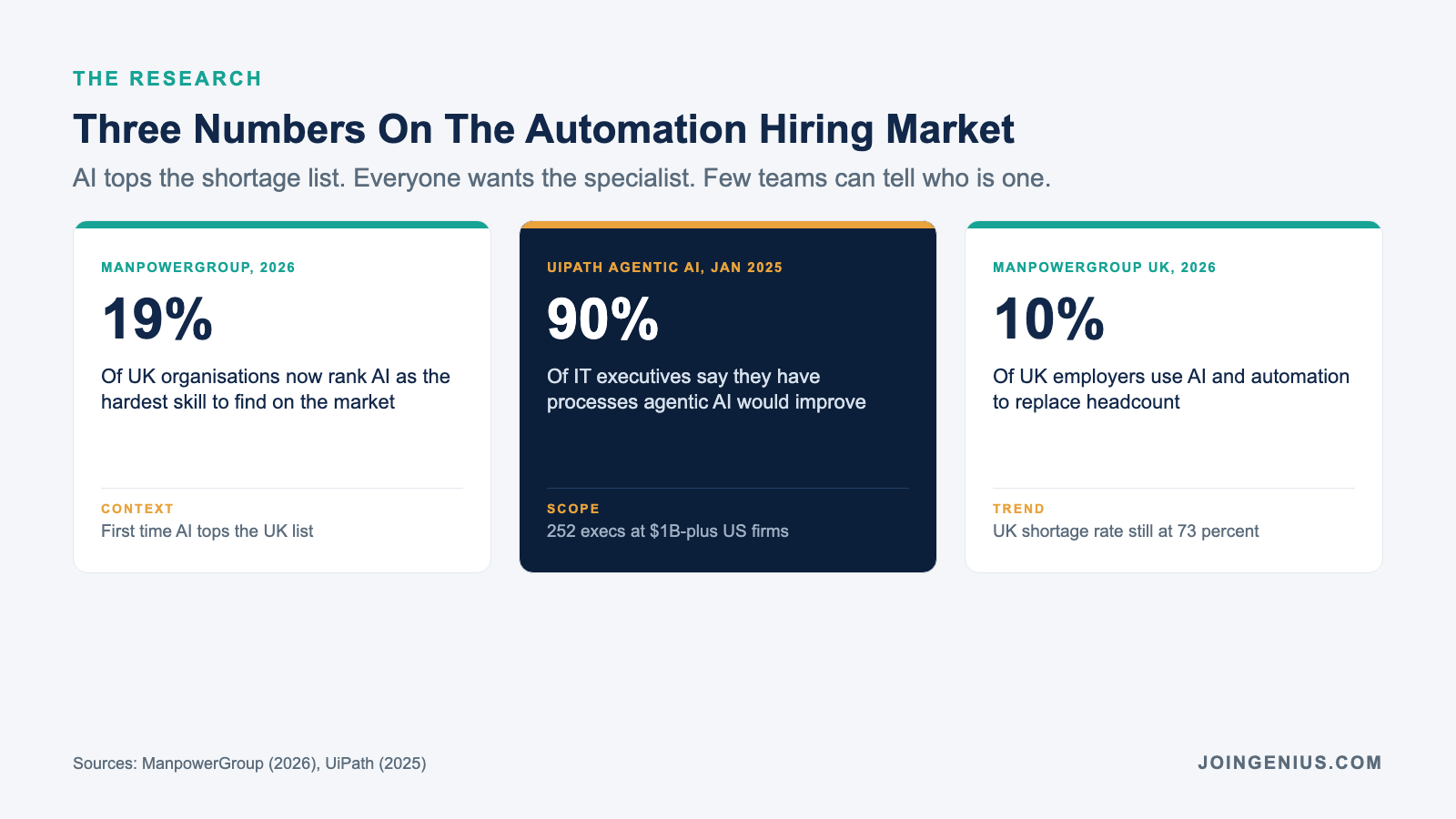
ManpowerGroup’s 2026 Talent Shortage Survey reports that AI skills are now the hardest category to hire for globally. In the UK, 73 percent of employers say they struggle to find skilled talent. The hiring difficulty is high and the signal on resumes is low. Buzzwords are everywhere. Working automations are not.
The job of a workflow automation specialist is not to list tools. It is to connect systems that were never meant to talk and keep that connection quiet. In this guide we lay out how to tell the real ones from the ones who passed a Zapier tutorial last week.
Why Automation Hiring Fails Before The Interview
Most automation hires fail at the brief, not at the interview. The hiring manager writes a job description built around a single tool. Zapier shows up in the title. The ad attracts candidates who have run that tool and nothing else, which is useful if the backlog is a Zapier backlog and a problem if it is anything bigger.
The real backlog usually spans three or four systems. An order lands in Shopify, posts to NetSuite, triggers a workflow in HubSpot, and ends in a QuickBooks ledger. A specialist who can only do one hop can automate one step. The remaining hops stay manual, and the backlog clears by a tenth of what the hire was supposed to deliver.
The second failure is scope confusion. “Automation specialist” means something different at a 15-person agency than it does at a 500-person operations team. One role writes small scripts to clean a weekly report. The other role designs an integration layer that handles millions of records a month. The resume rarely tells you which role you are looking at.
The third failure is the AI premium. Candidates who tag themselves as agentic-AI practitioners command rates that scale with the tag and not with the work. UiPath’s January 2025 Agentic AI Report, built on 252 US IT executives at $1B-plus firms, found 90 percent say they have processes that agentic AI would improve. Everyone wants that hire.
Few teams can tell who actually has it. The resumes land in the same inbox, all tagged the same way, and the recruiter has no reliable filter.
What A Workflow Automation Specialist Actually Does
Strip away the tools and the role has three jobs. The first is to read a tangled business process and name the steps. “The sales team closes a deal” is not a step. “The deal moves from Stage 4 to Closed Won and triggers a provisioning record in the ERP” is the one you can automate.
The second job is to map the systems. A specialist knows which fields the storefront and the accounting tool each store, and which fields do not line up across the two. They can tell you where a timestamp will drop a timezone.
They can also tell you where a customer ID will not match across two platforms. See our remote hiring guide for the kind of role that often spans this many systems.
The third job is to build the connection and keep it quiet. The quiet part is the hardest. A junior builds the happy path. A senior writes retries, idempotency keys, dead-letter handling, and a dashboard that fires an alert before the finance team notices anything is off. The dashboard is the asset. The connection is the output.
None of those three jobs are tool-specific. The tool is a vehicle. A good specialist on Zapier can also be a good specialist on n8n, Make, or Workato with a week of ramp. A specialist who can only do what the tutorial covered is not actually a specialist at all.
The Signal On Their Resume And In The Call
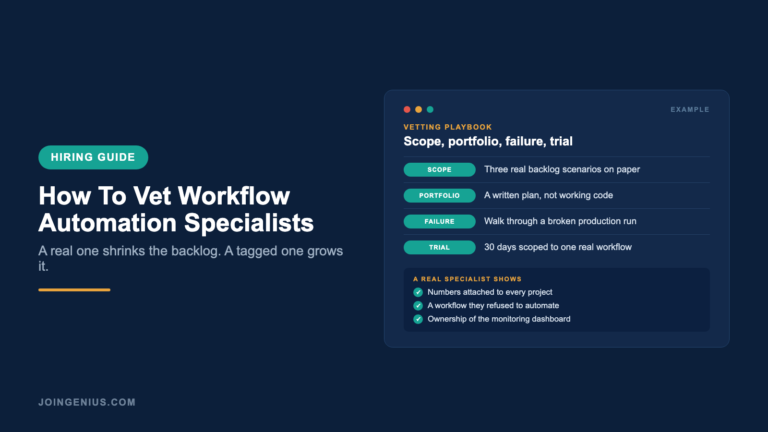
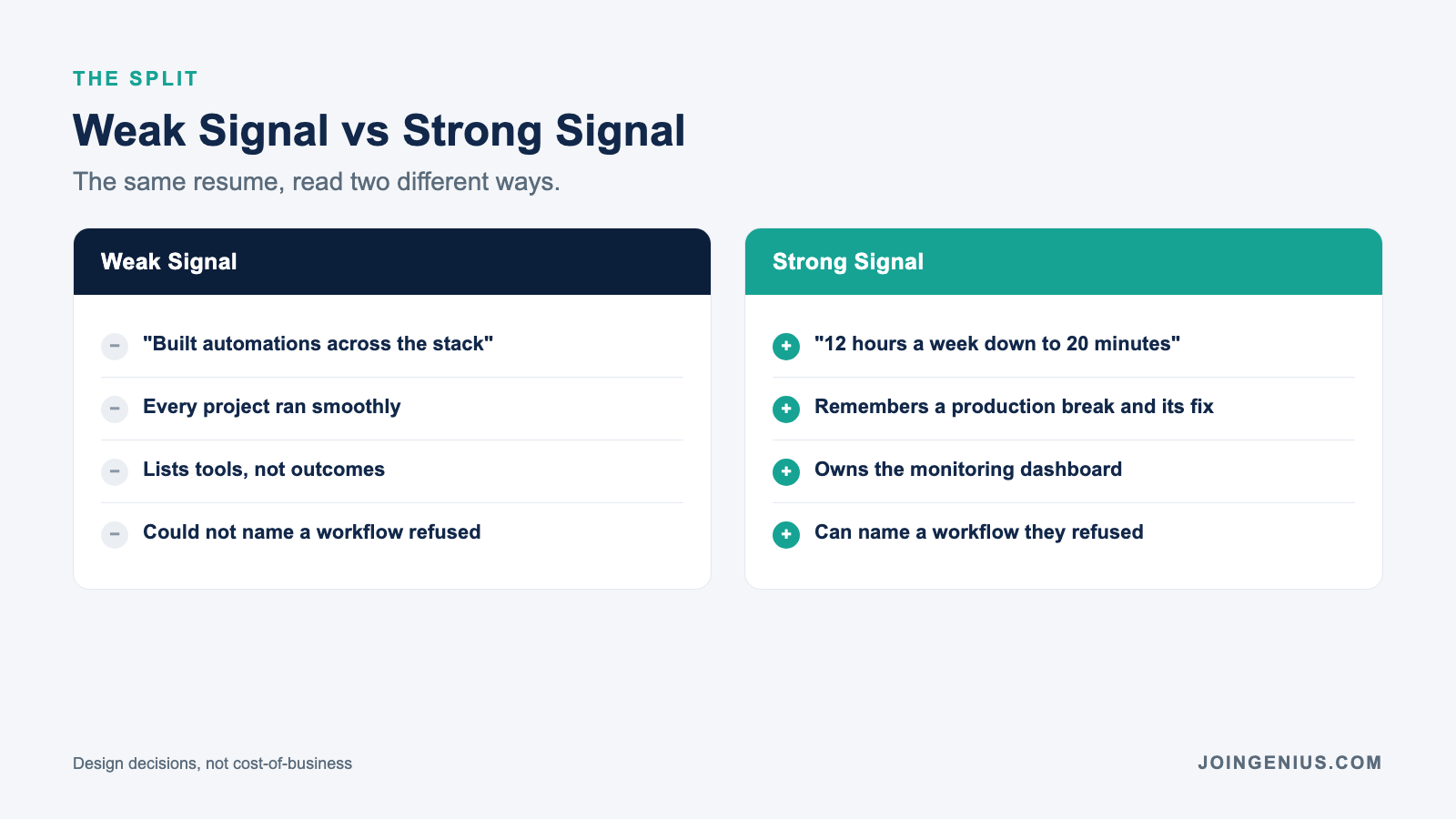
Three signals tell you the resume is real. The first is specificity. A real automation ships with numbers attached. “Reduced manual order entry from 12 hours per week to 20 minutes per week” is signal. “Built automations across the stack” is noise. If the candidate cannot name the before and after, they did not own the project.
The second signal is about failure. Ask them to walk through an automation that broke in production. The ones who matter will remember the error, the fix, and what they changed in the monitoring afterward. The ones who do not will describe how smoothly everything went, which means they were never on call for anything that mattered.
The third signal is scope boundaries. A real specialist knows the few workflows that are worth automating and the many that are not. Ask them for a workflow they refused to automate. “The spec was unclear” is weak. “The process was changing next quarter so the automation would be a sunk cost” is strong.
A Portfolio Test That Beats The Interview
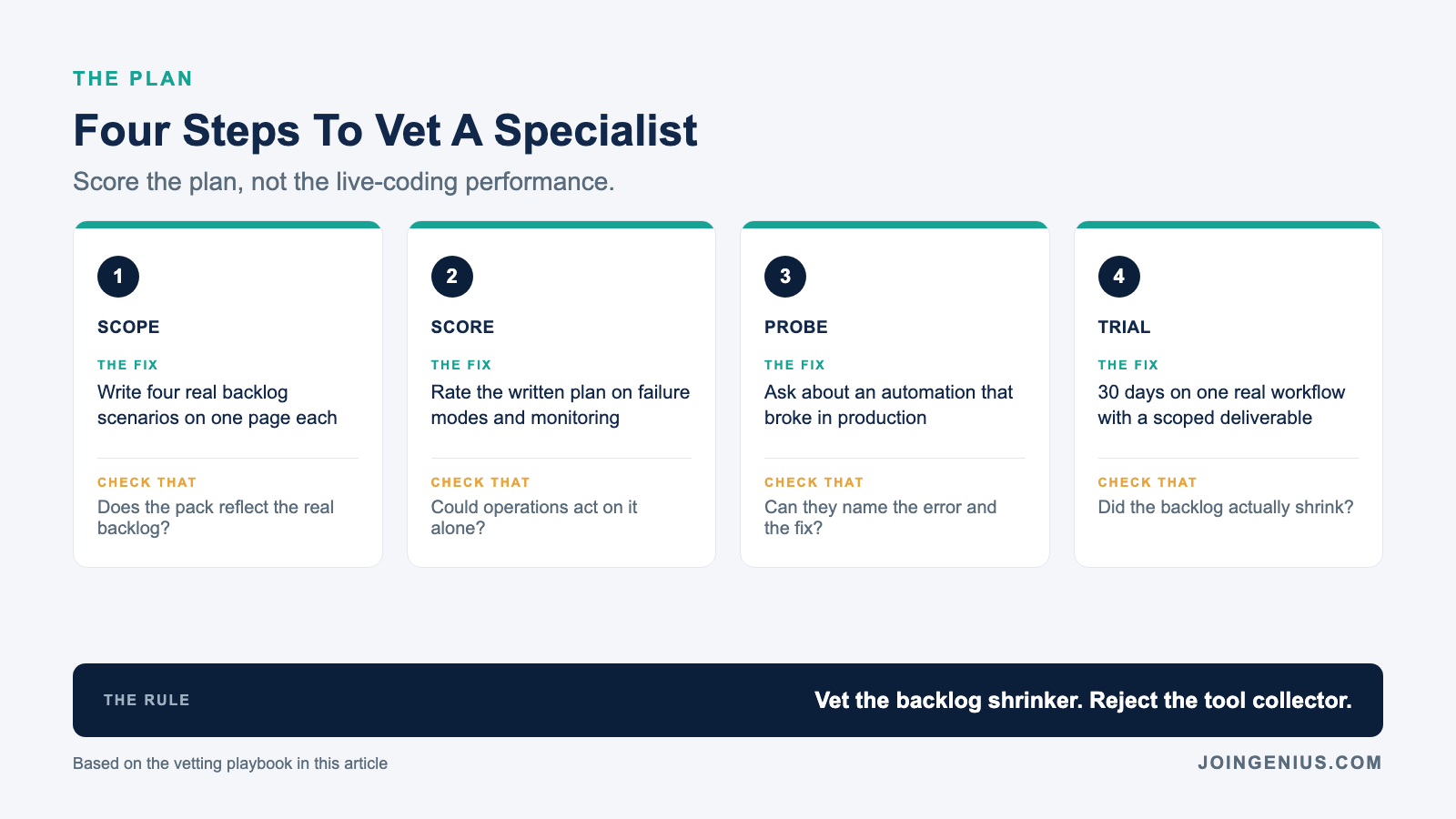
Interviews are weak signal for this role. The portfolio test is better. Give the candidate four short scenarios on one page each. Ask them to pick two and write a short plan. Not working code. A plan the operations team could actually act on.
| Scenario | What You Are Looking For |
|---|---|
| Sync lag | How they design idempotency and retries |
| Field mismatch | How they map fields that never align cleanly |
| Spike handling | How they protect downstream systems from a flood |
| Rollback | How they undo a bad run without losing records |
Score the plan on four things. Can the operations team follow it without the candidate in the room? Does it name the failure modes before it names the happy path? Does it include a monitoring step? Does it say what the specialist will not automate and why?
A candidate who nails those four questions on two scenarios will outperform three others who passed a live-coding interview. See our global outsourcing guide for the kind of operations work this type of hire absorbs over the first quarter.
When A Platform Beats A Full-Time Hire
Not every automation backlog deserves a specialist. If the backlog is bounded, the systems are standard, and the volume is steady, a managed integration platform ships the result faster than a hire does. The hire is better when the backlog is open-ended and the systems are custom.
MindCloud’s integration platform is one example of this build-vs-buy option. The company sells full-service managed integrations plus a Universal API that connects to 3,400 or more apps, with a visual builder on top. A team that wants the connection without owning the specialist can buy the connection as a service, with a delivery team on the vendor side.
The vetting question changes when a platform is in the mix. Instead of “can this candidate build the connection,” the question becomes “does the problem need a human owning this connection or a vendor owning it.” The right answer depends on how often the mapping changes and how custom the data is.
If the mapping changes every month and the records carry fields no vendor template covers, hire the specialist. If the mapping is stable and the data is standard commerce or finance records, pay the platform and move on. Our types of HR outsourcing guide covers the same decision from a people-ops angle.
Where teams get this wrong is by hiring a full-time specialist to run a problem that a managed service would solve for less. The specialist then goes looking for problems that justify the salary, and the automation footprint grows past what the business actually needs.
The reverse mistake is cheaper to spot but just as costly. A team pays a managed platform for a steady stream of custom mappings that would be better owned by one internal engineer. The vendor rate climbs with every bespoke request. The vetting question answers both directions at once.
Run the question before the first interview on the panel. A clear answer saves a quarter of hiring effort and the resulting bad fit, and it also saves the operations team from a tool proliferation that nobody owns.
Hire Automation Specialists Who Shrink The Backlog
A workflow automation specialist is a backlog-shrinker, not a tool collector. Vet for specificity on past work, honesty about failures, and judgment about scope. Pair that with a portfolio test that produces a plan the operations team can read, and the hire gets much easier.
Genius places the top 1 percent of remote talent from the Philippines and Latin America into roles that would otherwise cost roughly 80 percent more locally. There are no monthly platform fees and a six-month replacement guarantee if the fit is wrong. See our payroll outsourcing explainer for the operational handoff that follows the hire.
The right specialist shrinks the backlog in a quarter. The wrong one grows the backlog by adding new automations faster than the old ones can be maintained. Hire for the first. Reject the second.