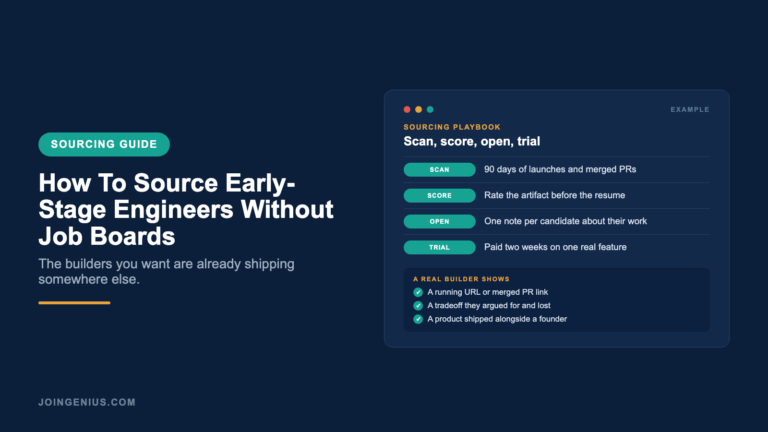
You want to source early-stage engineers who can walk into a 12 person team and ship something that matters in week one. Traditional job boards are the wrong tool for that job. They optimize for applicant volume, not builder signal.
The resumes that come through a job board look identical by week three of a search. If you are rebuilding your talent acquisition pipeline for the first half of 2026, early-stage engineering is the role that most rewards a different sourcing surface.
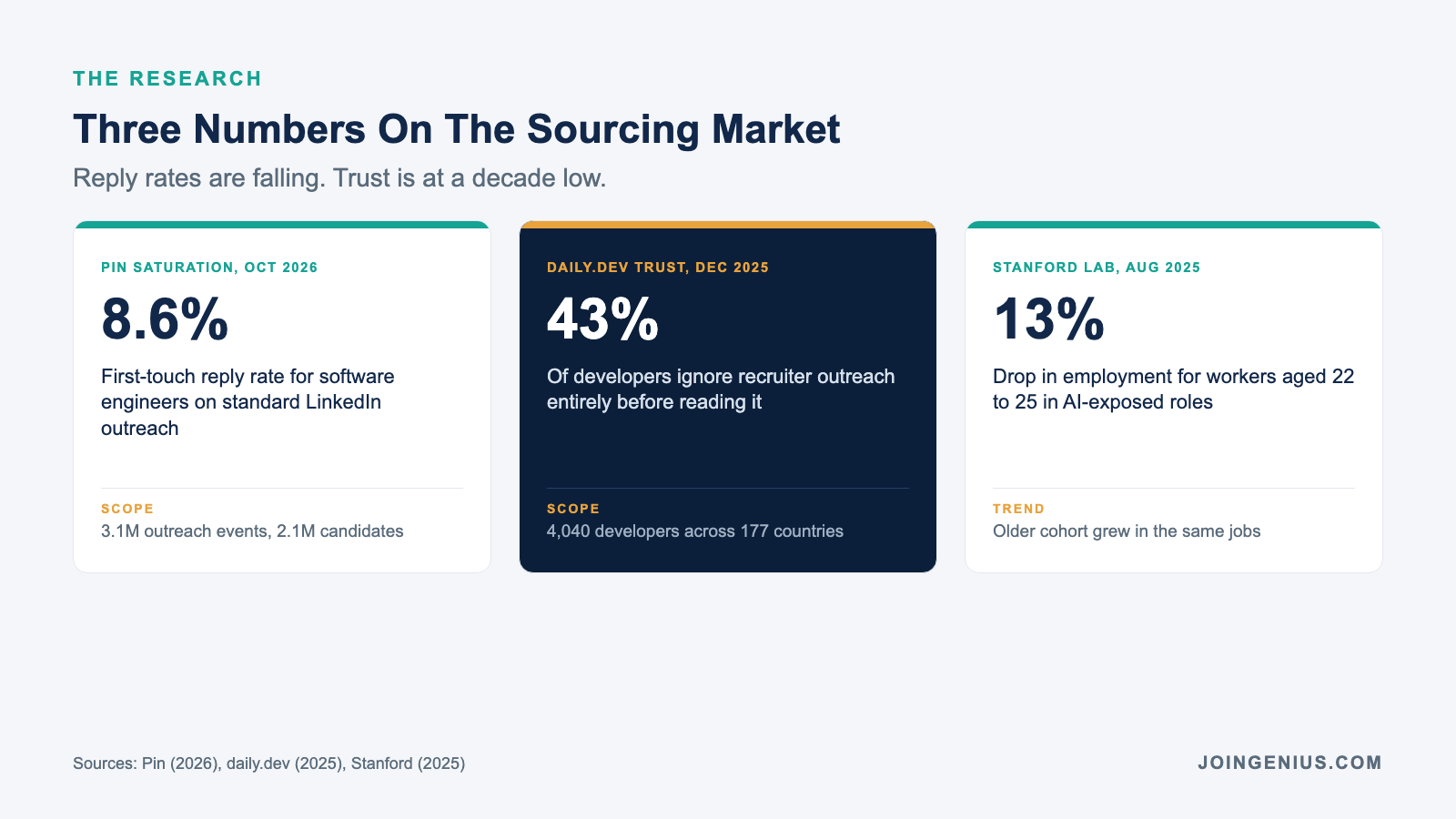
The hiring market has shifted under the role too. Stanford economists published “Canaries in the Coal Mine” on August 27, 2025 using ADP payroll data through July 2025. They found employment for workers aged 22 to 25 in AI-exposed occupations fell 13 percent, with software development named as one of the three roles taking the biggest hit.
Older workers in the same roles grew. The signal has moved out of the funnel and into the work itself. If you cannot see what a candidate has built, you cannot tell whether the drop reflects their market or their output.
Why Traditional Job Boards Fail Early-Stage Hires
A traditional job board gives you volume and almost nothing else. The applicants are the ones who were already looking. Early-stage engineers worth hiring are usually not looking. They are heads-down on a side project or a design partner build, and your post sits unread next to a thousand others.
LinkedIn outreach has its own problem. Pin released a saturation report on October 27, 2026 covering more than 3.1 million first-touch outreach events to 2.1 million candidates. Software engineers posted the lowest reply rate of any role group they measured, at 8.6 percent.
The deeper number is competition. Pin found 56.9 percent of contacted software engineers heard from two or more employers inside 90 days, with an average of 3.12 teams per candidate. In New York that climbs to 68 percent, and the local reply rate drops to 6.3 percent. You are not sourcing. You are standing in a crowd shouting.
What You Are Actually Looking For
Early-stage engineers are not a seniority level. They are a disposition. The engineer you want has shipped something end-to-end under constraint. They have made a database schema decision that mattered. They have broken a deploy on a Friday and fixed it before the weekend.
The resume rarely shows this. A standard job board filters on titles and years. It cannot see the Discord bot a candidate shipped on a weekend. It cannot see the open source library they maintain for 400 users.
Those artifacts live outside the resume. They are also the strongest predictor of whether someone will survive the first 90 days at an early-stage company. A tenured engineer at a late-stage firm may have shipped less in the past year than a 23 year old maintaining a well-starred side project.
The daily.dev 2025 State of Trust survey, released December 10, 2025 with 4,040 developers across 177 countries, found 80 percent of developers are open to hearing about roles. Only 15 percent believe recruiters fully understand the roles they pitch. The talent is open. The channel is broken. That is the gap you are trying to close.
Go Where The Builders Already Live
The highest signal sourcing surface for early-stage engineers is the place where they are already shipping work in public. The builder community overlaps with product launch directories and open source maintainers. It also overlaps with hackathon alumni and small Discord guilds around specific tools.
Launch directories are the fastest surface to filter. The product itself is the portfolio.
The engineers who show up in a launch directory like Pitchwall are already building, often alongside a founder, which gives recruiters an early signal of their hands-on experience before the first call and makes it a more targeted sourcing channel than a traditional job board for roles that require builder instinct from day one.
Pitchwall carries 65,000 products posted since 2015 and 500,000 monthly visitors from the AI product audience. The engineers who ship there are already making decisions about what to build and how to position it, which is the same muscle you are hiring for.
The sourcing move is simple. Pull the last 90 days of launches in the space adjacent to your product. Note who submitted and who the technical co-founder is on each listing.
Then reach out based on the actual work rather than the title on their profile. The response rate is not 8 percent. It is closer to the reply rate you get from a warm referral, because the opener names the thing they built last month.
Open source is the second surface. Pick two or three repositories that touch your stack. Read the pull request history for the last six months. The maintainers who merge thoughtful PRs under 500 lines are usually better hires than the ones with the loudest commit counts. Reach out based on a specific merge, not a template.
Signals That Separate Builders From Resume Writers
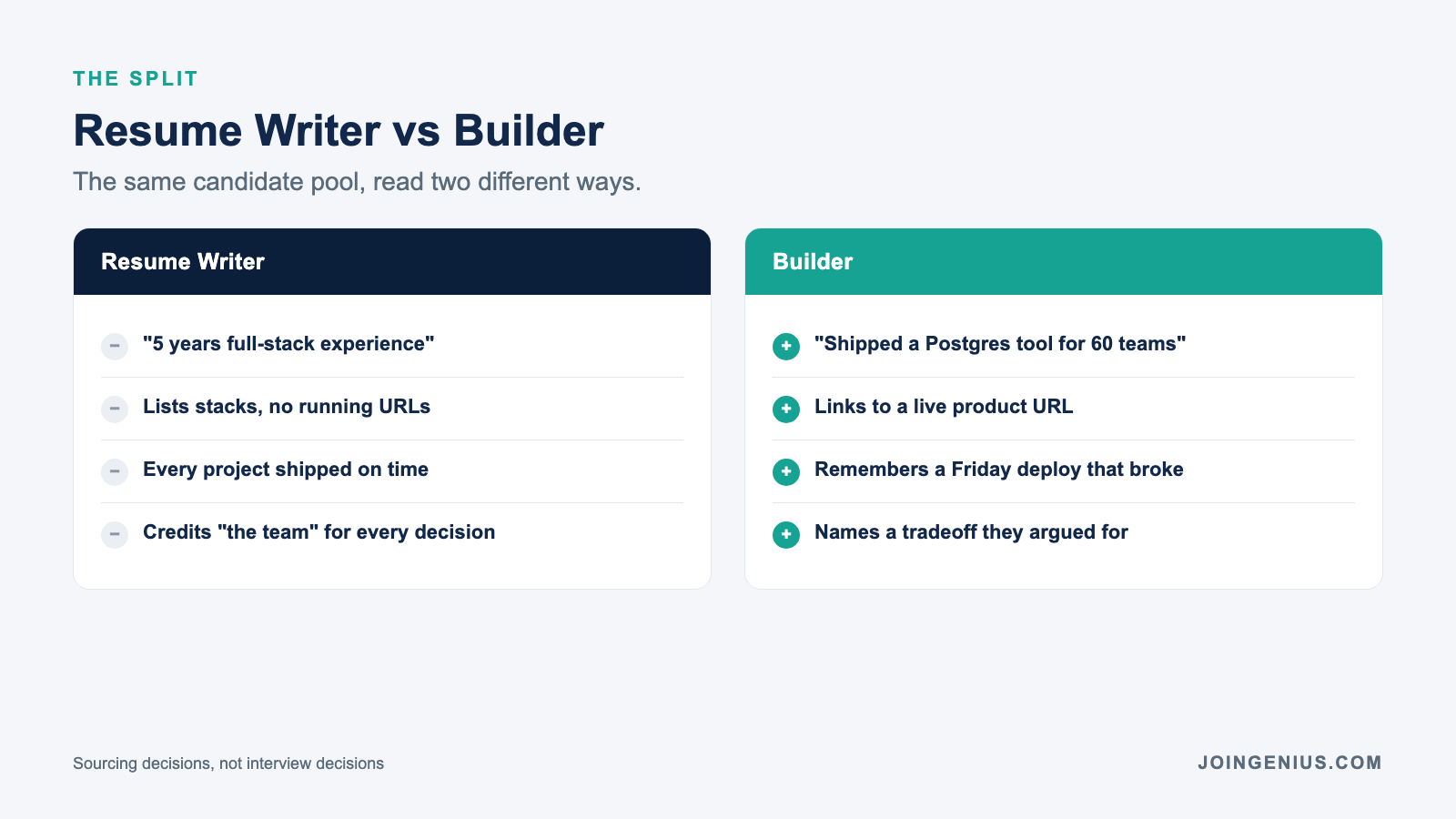
A weak resume lists stacks and years. A strong one names the artifact. “Shipped a Postgres backup tool used by 60 teams” tells you more than three years of generic experience. The specific number is the signal. The absence of a number is also a signal, pointing the other way.
Public artifacts matter more than private claims. Ask every candidate for a link to something they built that is still running. A deployed side project. A merged pull request on a repo with real users. A technical blog post with code that compiles. If they cannot produce one, you are hiring on their self-description, not on their work.
Scope ownership is the third signal. Ask the candidate who made the hardest tradeoff on the last project. If they say “the team,” they were a passenger. If they can name a decision they argued for and lost, you have an engineer who thinks about scope.
The daily.dev survey found 43 percent of developers ignore recruiter outreach entirely. The ones who respond to a note grounded in their actual work are the ones you want. The filter is the opener itself, not a resume screen downstream of it.
A Portfolio-First Sourcing Playbook
Replace the pipeline you built for 2022. The new one starts with a backlog of 50 candidate artifacts, not 500 resumes. Each artifact is a shipped project, a merged PR, or a public launch. Score the artifact first and the resume second. Hire from the top five.
Step one is a 90-day scan of three surfaces. Pull from your preferred launch directory. Pull from two open source projects adjacent to your product. Pull from one developer community thread, usually a monthly hiring post. Combine into a single sheet with a link to the artifact for each name.
Keep the sheet shallow on first pass. A row has a name, a link, a one-line note on what you saw. Do not pull a resume yet. The point of the scan is to measure output, and a resume will anchor you on the wrong signal.
| Surface | What To Pull | Signal To Read For |
|---|---|---|
| Launch directory | Products shipped by small teams | Named technical builder |
| Open source repo | Merged pull requests under 500 lines | Thoughtful reviews and tests |
| Developer community | Monthly hiring and showing threads | Specific project, running URL |
| Hackathon archive | Finalist projects in your category | Deployed demo past the event |
Step two is a note grounded in the artifact. Reference the specific thing they shipped. Name one question you have about their decision. Do not pitch the role in the first note. Developers rank cold outreach lowest in their trust hierarchy, so the first note has to look like a peer reading their work.
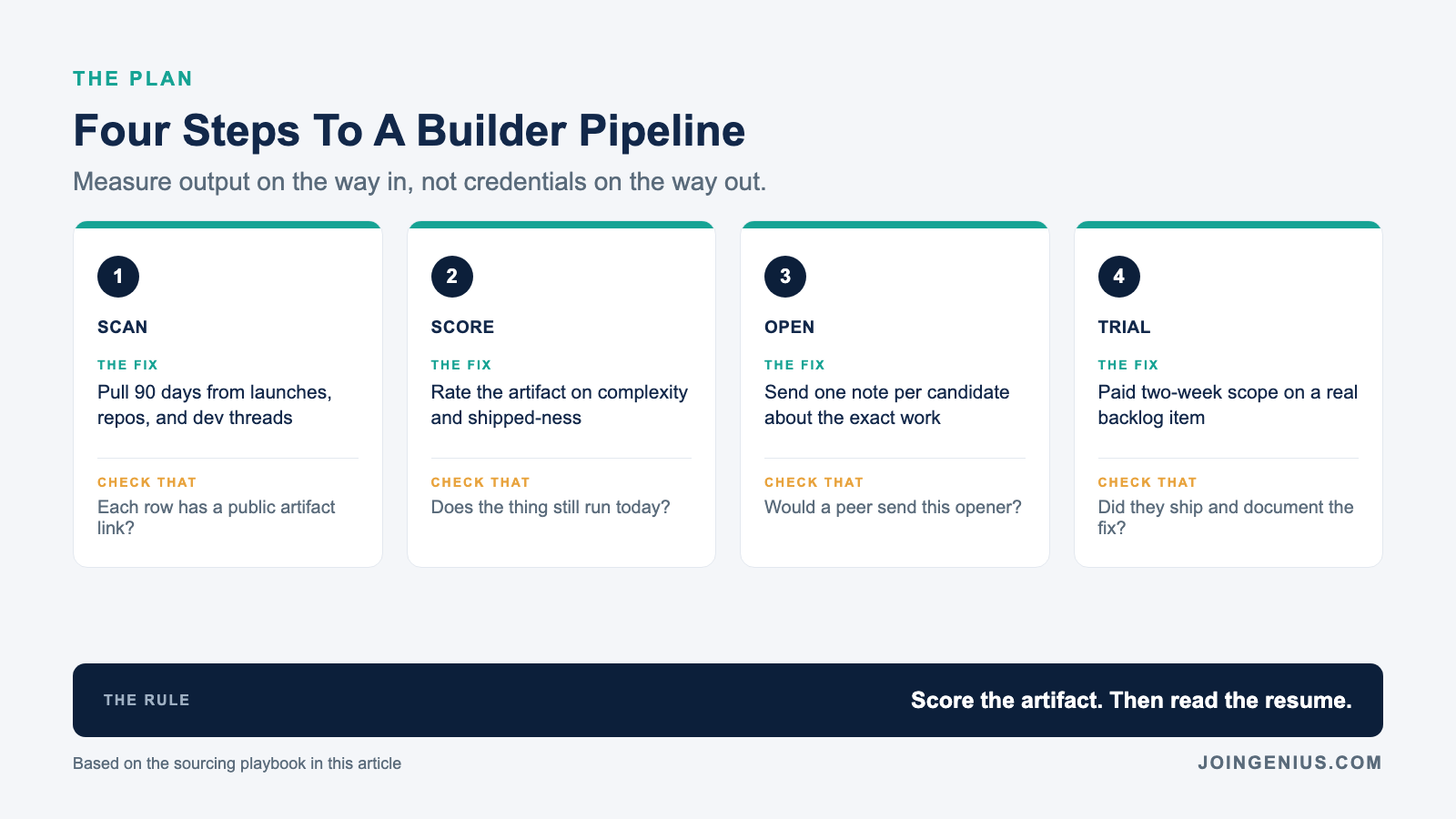
Step three is a scored shortlist. Rate each artifact on complexity, shipped-ness, and solo decision count. Interview only the top five. The sourcing funnel is now one tenth the size of a job board funnel. The hit rate is the opposite ratio.
Step four is a paid two-week trial on a real deliverable. Pick a scoped feature from your actual backlog. Pay fair market rates. If the engineer ships and documents the work, you have your hire. If they stall, you learned it in two weeks instead of two quarters.
Source Early-Stage Engineers Who Ship In Week One
The engineers you want have never applied to a traditional job board for a role at your stage. They are shipping, teaching, or quietly building a company on the side. Your sourcing channel has to meet them in that mode. The launch directories and open source repos are not a hack. They are the actual signal.
If you want to source that engineer faster than the local market will allow, Genius sources the top 1 percent of engineering talent from the Philippines and LATAM. The roles come in at about 80 percent less than US rates. No monthly fees. A six month replacement guarantee.
We vet for builder signal, not just credentials. Explore how global outsourcing and payroll work when you are hiring engineers across borders. The search for an early-stage engineer who ships in week one becomes a tractable project.