
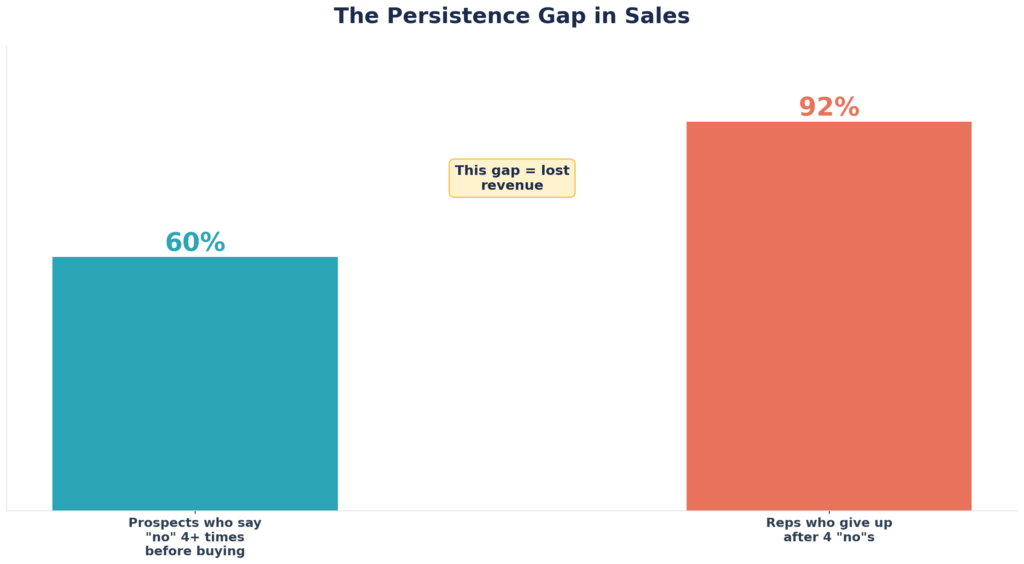
60% of customers say “no” at least 4 times before saying “yes.” But 92% of sales reps give up after hearing “no” 4 times.
That gap is where deals go to die.
The truth is, most reps treat objections like rejection. Top closers treat them like buying signals. When someone pushes back on price, timing, or need, they’re telling you exactly what they need to hear before signing. Your job is to listen and respond. Not argue.
This guide breaks down the exact objection handling techniques used by reps who consistently hit 120%+ of quota. You’ll get a proven framework, word-for-word scripts, and the psychology behind why certain responses work.
Why Sales Objections Are Actually Good News
Most reps panic when they hear “your price is too high” or “we need to think about it.” That panic costs them deals.
Here’s a reframe that changes everything: an objection means the prospect is still in the conversation. A truly uninterested buyer doesn’t object. They ghost you. They say “just send me some info” and disappear. When someone takes the time to push back, they’re telling you they care enough to raise the issue.
95% of companies say objection handling is a key competency for customer-facing roles. And organizations using structured objection handling frameworks see close rates jump from 20-30% to 50-64% within 6 months.
That’s not a marginal improvement. That’s a 2X increase.

The data makes the pattern clear. Nearly half of all objections are about budget or perceived value. Another third involve timing. That means roughly 80% of the pushback you’ll face falls into just 2 categories. Master those 2, and most of your sales calls get dramatically easier.
💡 Quick Tip
When a prospect says “it’s too expensive,” they rarely mean the literal price is too high. What they usually mean is: “I don’t see enough value to justify this cost.” Shift from defending your price to building your value case, and the objection often dissolves on its own.
The 4 Objections You’ll Hear 80% Of The Time
Every sales objection falls into 1 of 4 categories. Recognizing which type you’re facing is the first step to handling it. Most reps waste time giving the wrong answer because they misidentify the objection.
For high-ticket service businesses, price is the most common objection category by volume. The fastest resolution isn’t discounting, it’s removing the upfront payment barrier entirely. Finturf connects home service and renovation businesses to a multi-lender financing network at the point of sale, converting price objections into a conversation about monthly terms while letting contractors control which offers they present.
Here’s the breakdown of what you’ll hear on nearly every sales call, and what prospects actually mean when they say it.
1. “It’s Too Expensive” (Budget & Price)
This is the most common objection in the entire sales process. Nearly 6 in 10 buyers want to talk pricing on the first call. And here’s the interesting part: many of these prospects fully intend to buy. They’re testing your confidence.
When someone says “we don’t have the budget,” ask yourself: is the price genuinely too high, or have I failed to connect price to value? 9 times out of 10, it’s the second one.
What to say: “I hear you. Let me ask this. If we could show a 3X return on this investment within 6 months, would the budget concern go away? Or is there something else?”
You can also reduce friction by offering flexible payment structures.
2. “Now Isn’t the Right Time” (Timing & Urgency)
Timing objections are tricky because they feel polite. The prospect isn’t saying no. They’re saying “later.” And “later” almost always means “never.”
Your job isn’t to pressure them. It’s to help them understand the cost of waiting. If your solution fixes a problem they already have, every week they delay has a real price tag attached to it.
What to say: “Totally understand. Quick question though. The problem we discussed earlier. Is that going to get better on its own, or worse? Because most teams I talk to wish they’d started 3 months earlier.”
Building a strong talent acquisition strategy follows the same logic. Delaying hiring decisions doesn’t make finding great candidates easier. It makes it harder.
3. “We’re Fine With What We Have” (Need & Relevance)
This one means the prospect doesn’t feel enough pain yet. Or more accurately, they don’t realize how much pain they’re in. The status quo feels safe, even when it’s costing them money.
What to say: “That’s great to hear. Out of curiosity, what would need to change for you to explore alternatives? I’m not trying to replace something that works. I’m just curious what ‘better’ would look like for your team.”
4. “I Need to Run This By My Boss” (Authority & Trust)
When you hear this, you’ve likely been selling to the wrong person. Or the person you’re talking to doesn’t feel confident enough to advocate for your solution internally. Either way, you have a decision-maker problem.
CFOs hold the final decision-making power in 42% of software purchases. So if you haven’t mapped the full buying committee, you’re flying blind.
What to say: “Of course. Would it help if I put together a 1-page summary with the key points and ROI numbers? That way your boss gets the highlights without needing a full demo. And would it make sense for me to join that conversation?”
The same principle applies when you’re hiring for a startup. Every hire involves stakeholders. Understanding who says yes (and who can say no) determines whether you close the deal.
📊 By the Numbers
35% of sales leaders say objection handling is the single biggest challenge for their reps. And only 44% of reps follow up after a single “no.” The math is simple: persistence plus preparation equals pipeline.
The LAER Framework: 4 Steps That Turn “No” Into “Tell Me More”
You need a repeatable system for handling prospect objections. Memorizing scripts helps, but scripts break when prospects go off-script (which they always do).
The LAER framework gives you a flexible structure that works regardless of what the objection is. It was created by Jack Carew in 1976, and top sales teams still use it today because it works.
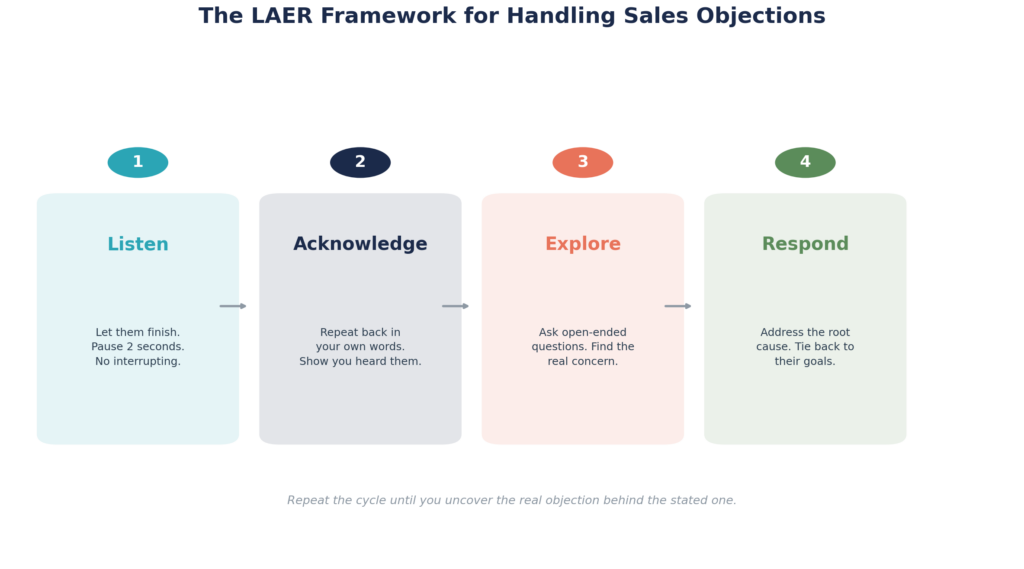
Step 1: Listen (Really Listen, Don’t Just Wait To Talk)
Most reps start formulating their response the second an objection hits. That’s the wrong move.
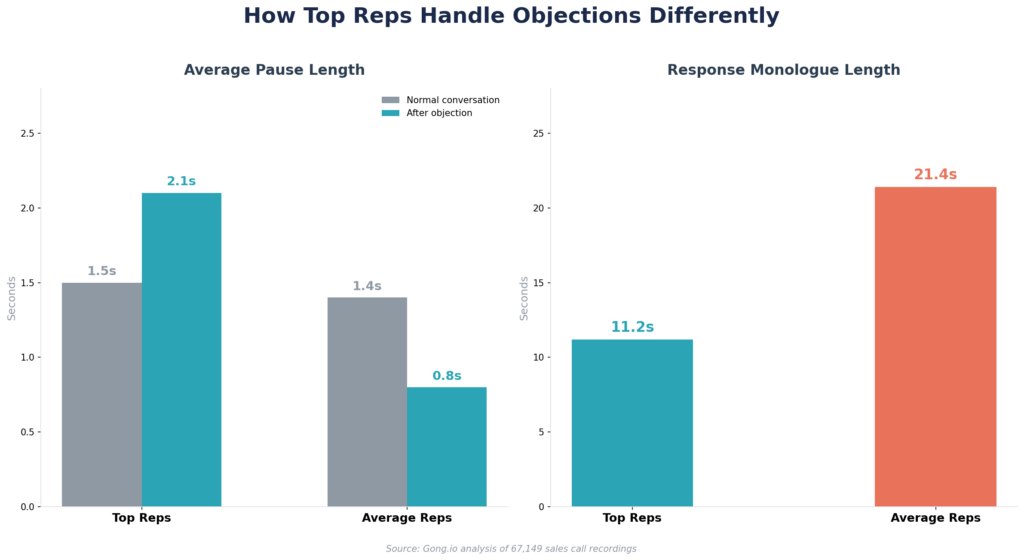
Gong analyzed 67,149 sales call recordings and found that top-performing reps actually pause longer after hearing an objection than during normal conversation. Average reps do the opposite. They speed up and start talking faster.
Let the prospect finish completely. Then wait 2 full seconds. Often they’ll keep talking and reveal the real concern behind the surface objection. The same active listening skills that make great interviewers also make great closers.
Step 2: Acknowledge (Show Them You Actually Heard It)
Repeat the objection back in your own words. This does 2 things. It proves you listened. And it gives the prospect a chance to correct you if you misunderstood.
Example: “So if I’m hearing you right, your main concern is that the implementation timeline might overlap with your Q3 planning. Is that the core issue?”
This is where most reps fail. They skip straight to their rebuttal. But acknowledgment builds the trust that makes your response land.
Step 3: Explore (Dig Until You Hit the Real Objection)
The stated objection is rarely the real objection. “It’s too expensive” might actually mean “I tried something similar and it didn’t work.” Or “my boss will never approve this.”
Ask open-ended questions to uncover customer pain points:
- “What specifically concerns you about the pricing?”
- “Have you tried solving this problem before? What happened?”
- “If budget weren’t a factor, would this be the right solution?”
When you’re building a talent acquisition process, the same principle applies. Surface-level feedback from hiring managers rarely reveals the real requirements. You have to dig.
Step 4: Respond (Address the Root Cause, Not the Surface)
Now and only now do you give your response. Because you listened, acknowledged, and explored, your answer addresses what the prospect actually cares about. Not what you assumed they cared about.
Tie everything back to their goals. Not your features. Not your pricing structure. Their goals.
📌 Key Takeaway
Average reps respond to objections with 21-second monologues. Top reps keep it under 12 seconds and follow up with a question. Shorter responses show confidence. Long responses signal insecurity.
Word-for-Word Scripts For The 5 Toughest Sales Objections & Rebuttals
Frameworks are great. But when you’re on a live sales call and your stomach drops, you need exact words. Here are scripts that top closers use for the most common sales objections.
These aren’t theoretical. They’re built from patterns across thousands of recorded calls.
| Objection | What They Mean | Your Response |
| “Your price is too high” | They don’t see enough value | “I hear you. Most of our clients felt the same way initially. Can I walk you through what the ROI looks like for a team your size?” |
| “We already use [competitor]” | They need a reason to switch | “Nice. What do you like most about them? And if you could change 1 thing, what would it be?” |
| “Send me an email” | They want to end the call | “Absolutely. So I send you something relevant, what’s the biggest challenge you’re dealing with right now?” |
| “I need to think about it” | Something specific is holding them back | “Of course. Just so I know, what’s the main thing you’re weighing?” |
| “We’re not interested” | You haven’t shown relevance | “Fair enough. Before I go, can I ask what you’re currently doing for [specific problem]?” |
The key pattern across all of these: ask a question. Never end your response with a statement. Questions keep the conversation alive. Statements kill it.
If your sales team handles cold calling objections regularly, keep this table printed next to every phone.
⚠️ Common Mistake
Don’t offer a discount the moment someone says “too expensive.” Discounting before understanding the objection trains prospects to push back on price every time. Build the value case first. If you must adjust pricing, tie it to a concession like a longer contract term or reduced scope.
How To Prevent Objections Before They Ever Come Up
The best objection is the one you never have to handle. That sounds obvious. But most reps spend 90% of their energy reacting to objections and 10% preventing them.
Flip that ratio, and your close rate changes fast.

Run A Real Discovery Call (Not a Feature Demo)
Most objections come from gaps in your discovery call. If you don’t uncover budget, timeline, authority, and need upfront, those gaps become objections later. Teams that invest in talent acquisition analytics know that data-driven discovery prevents mismatches down the road. The same applies in sales.
Ask these 5 questions before you ever pitch:
- What’s the problem costing you right now? (in dollars or hours)
- Who else is involved in this decision?
- Have you tried to solve this before? What happened?
- What does your ideal timeline look like?
- Is there a budget allocated for this, or would we need to build the case?
Arm Your Champion With Ammunition
In B2B, the average technology purchase involves 8-13 stakeholders. You won’t talk to all of them. So you need to equip the person you do talk to with everything they need to sell internally.
That means a 1-page ROI summary, a competitive comparison, and answers to the objections their boss will raise. If your champion has to wing it in the internal meeting, the deal dies.
The same concept applies when you’re managing talent acquisition. Hiring managers who can articulate exactly why they need a role filled get headcount approved faster.
🎯 Pro Insight
Build an “objection bank” from your last 50 lost deals. Categorize every reason a prospect said no. You’ll find 3-5 objections account for 80% of losses. Address those proactively in your sales pitch, and your pipeline health improves within weeks.
Practice Handling Objections Until It’s Muscle Memory
Knowing the LAER framework is one thing. Using it when your prospect throws a curveball you didn’t expect is another. The gap between knowing and doing is practice.
Role-Play Weekly (Yes, Really)
The data on this is clear. Top reps pause longer, respond shorter, and ask more questions after hearing an objection. Those aren’t natural instincts. They’re trained behaviors.
Reviewing recorded objection-handling moments is one of the fastest ways to bridge that gap. Avoma’s conversation intelligence platform surfaces these moments automatically across the full call library, so managers can build training sessions around real examples rather than hypothetical scripts.
Set up 15-minute role-play sessions with your sales team. One person plays the prospect, one plays the rep. Rotate through the 4 most common objection types. Record the sessions and review them. If your team uses talent sourcing tools to find candidates, you already know automation improves efficiency. Apply the same mindset to sales training.
Review Your Recorded Calls
Every objection you’ve ever faced is sitting in your call recordings. Pull the last 10 deals you lost. Listen for the exact moment the prospect raised their first objection. How did you respond? Did you listen or jump to a rebuttal?
Most reps who review their own calls find 2-3 patterns they can fix immediately.
Build A Team Objection Playbook
Create a shared doc with your top objections, the best responses, and real examples of what worked. Update it monthly. Make it the first resource new reps study during their onboarding process.
| Playbook Element | What to Include | Update Frequency |
| Top 10 objections | Exact wording prospects use | Monthly |
| Winning responses | Scripts from top closers | Monthly |
| Lost deal analysis | Why the deal stalled or died | Quarterly |
| Competitive intel | How to respond to competitor mentions | Monthly |
| Industry-specific objections | Verticals have unique pushback | Quarterly |
💡 Quick Tip
When practicing, don’t just rehearse the words. Rehearse the pauses. Top reps pause 2+ seconds after hearing an objection. That pause signals confidence. Practice being comfortable with silence during your role-plays.
Turn Every “No” Into Your Competitive Advantage
Objections aren’t roadblocks. They’re the prospect telling you exactly what they need to hear before they buy.
The reps who close more deals aren’t luckier. They’re more prepared. They use a framework like LAER instead of winging it. They prevent objections through better discovery calls. And they practice handling pushback until it becomes second nature.
Start with 1 change this week. Pick the most common objection your team faces and write a LAER-based response. Role-play it 3 times. Then use it on your next call.
The gap between average and elite in sales is smaller than you think. It’s just consistency