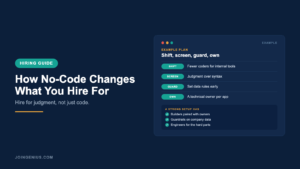
No-code platforms have quietly changed what you should hire for, and most org charts haven’t caught up. The marketing ops lead who needs a dashboard no longer files an engineering ticket and waits a sprint. They build it themselves in an afternoon. When that becomes normal, the old assumption that software means engineers starts to break.
That doesn’t mean you stop hiring engineers. It means the roles you need and the risks you carry both shift. AI is already reshaping who companies hire across functions, and no-code aims squarely at who builds internal software. Below, we cover what changes and what to screen for, then the risks that follow.
What No-Code Really Changes About Building Software
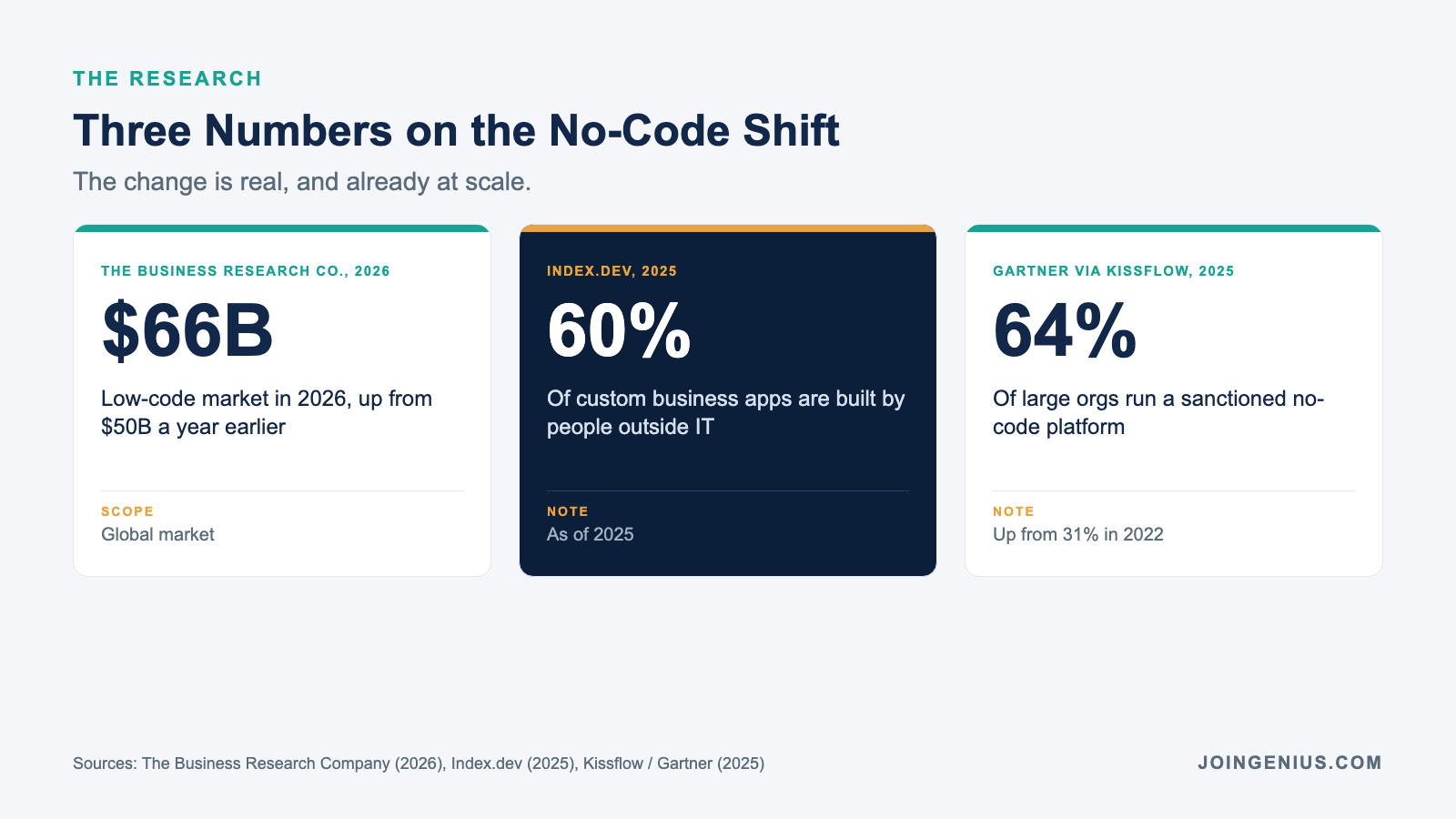
The shift is bigger than one new tool. The low-code market grew to roughly $66 billion in 2026, up from about $50 billion the year before. That momentum is moving where the bottleneck sits.
The Bottleneck Moves From Writing Code to Deciding What to Build
For years the constraint was engineering capacity. An idea waited in a backlog behind ten other things. Tools like Floot now let a team describe an app in plain language, inside ChatGPT, Claude or Floot’s own editor, and ship it with the database, logins and hosting handled for them
That changes which tasks need a developer at all. The scarce skill is no longer typing code; it is deciding what is worth building.
Internal Tools Stop Being an Engineering Ticket
The clearest change is internal software. Dashboards and simple workflow apps used to mean a ticket and a wait. Now the person who feels the problem can build the fix the same week. That collapses the distance between needing a tool and having one, and it removes a whole category of work from the engineering backlog.
The backlog that used to gate every small request simply gets shorter.
“Builder” Becomes a Skill, Not a Job Title
The person who builds the app may sit in ops or finance, not engineering. Building stops being something only one team does and becomes a skill spread across the company. That is a real change in how work gets done, and it is why the hiring questions shift. You are no longer hiring builders into a single department.
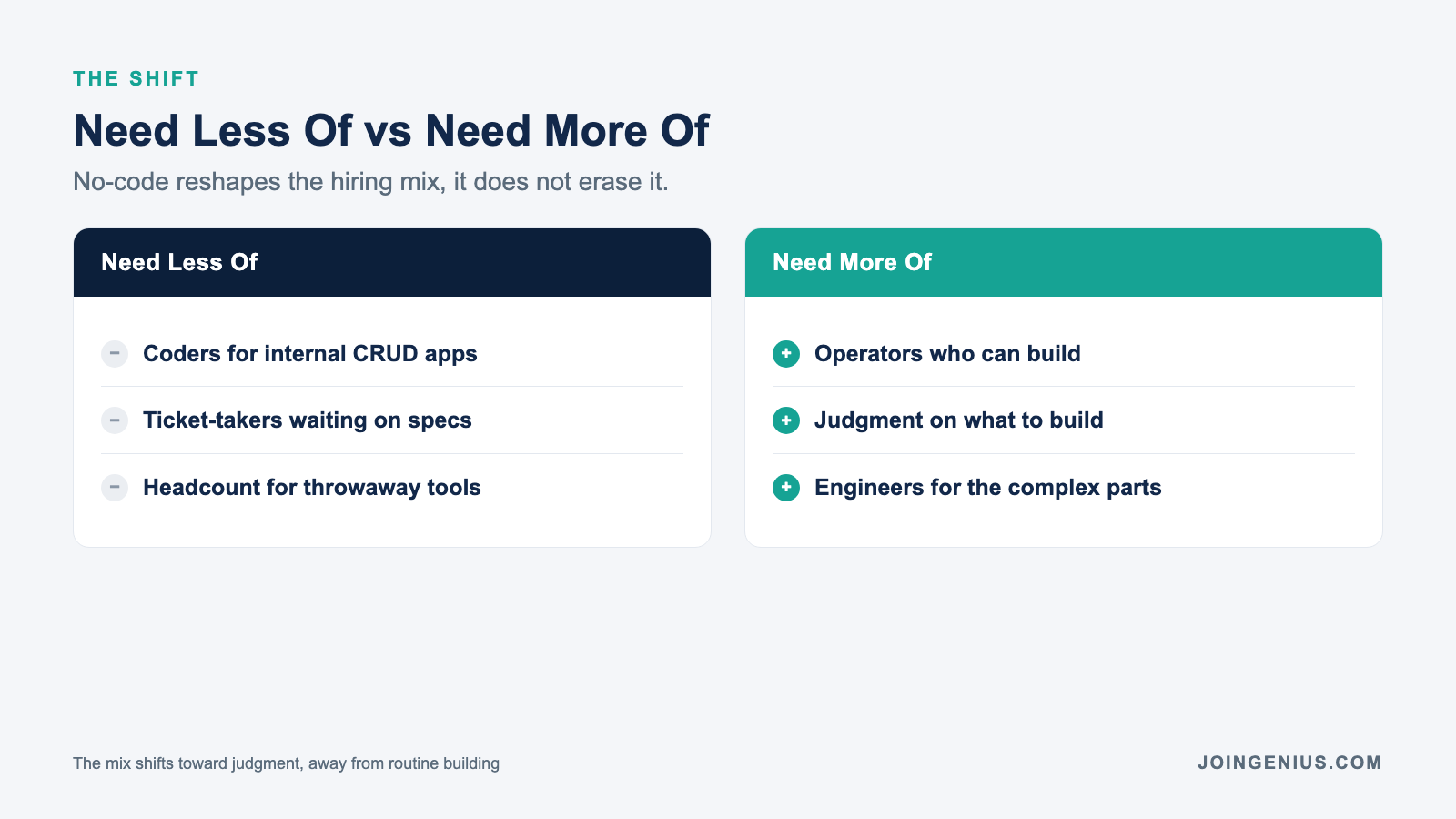
The Roles You Need Less Of, and the Ones You Need More Of
Once building spreads, the headcount math changes. Some roles get lighter, and others get far more valuable.
Fewer Engineers for Internal CRUD Apps
Not every engineer, but a specific slice of the work. The internal tool that would have taken a junior engineer a sprint is now an ops person’s afternoon. By 2025, nearly 60% of custom business apps were already being built by people outside the IT team. The demand for engineers to hand-build routine internal software is quietly shrinking.
That is a structural change in demand, not a temporary dip.
More Product-Minded Operators Who Can Ship
The role that gets more valuable is the operator who understands the business and can build. They do not need to pass a coding interview. They need to see a broken process and stand up a working fix without a six-week project.
That profile barely existed on org charts five years ago. Now it is one of the most useful hires you can make.
The Engineers You Keep Get More Valuable, Not Less
This is where the nuance matters. No-code handles the first version and the simple cases. When a product grows complex, you still need real engineering for the hard parts, like scale and deep integrations. The engineers you do hire spend less time on throwaway internal tools and more on problems that actually need them.
What to Actually Screen For Now
If the role changed, the interview has to change too. A coding test tells you little about an ops person who builds.
Judgment About What Is Worth Building
The most valuable skill is knowing what not to build. Anyone can spin up an app now, which means the risk is a pile of half-useful tools nobody asked for. Screen for people who start from the problem and the smallest fix, not the shiniest build. This matters most at a fast-growing startup, where wasted building is expensive.
Fluency With Tools Over Mastery of a Language
You are not hiring for syntax anymore. You are hiring for someone who picks up a new tool fast and bends it to the job. Ask a candidate to show something they built and walk you through the choices. How they reason about the build tells you more than any language on a resume.
Knowing When a Problem Has Outgrown No-Code
The best no-code builders know their own ceiling. The dangerous ones keep stretching a tool past the point where it should become real software. Screen for that self-awareness directly.
- Ask when they chose to stop and bring in an engineer instead.
- Look for a clear sense of where no-code stops being safe.
- Favor builders who document what they made for the next owner.
- Reward knowing the limits over claiming a tool can do anything.
A quick way to picture the signal you want:
| What to Check | Weak Signal | Strong Signal |
|---|---|---|
| Starts from | The coolest tool | The smallest real fix |
| Knows the limits | Claims no-code does anything | Says when to call an engineer |
| After building | Leaves it undocumented | Documents it for the next owner |
| Measures success by | Apps shipped | Problems actually solved |
The pattern is simple: hire the judgment, not the enthusiasm.
The New Risks No-Code Hiring Introduces
More builders is not a free win. By 2025, 64% of large organizations ran at least one sanctioned no-code platform, up from 31% in 2022, so these risks now show up at real scale.
Shadow Apps Nobody Owns or Maintains
The same ease that lets an ops person build also lets them leave. When they move teams, the app they made keeps running with no owner. A year later something breaks and nobody knows how it works. Unowned tools are the quiet debt of a no-code program.
Multiply that by every team that builds, and the debt adds up fast.
Security and Data Governance Gaps
A non-engineer building fast may not think about who can see the data. Logins and permissions get handled by someone without a security background. The platform covers some of this, but not the judgment of what should connect to what. That gap is where the real exposure sits.
The “Works Until It Doesn’t” Scaling Wall
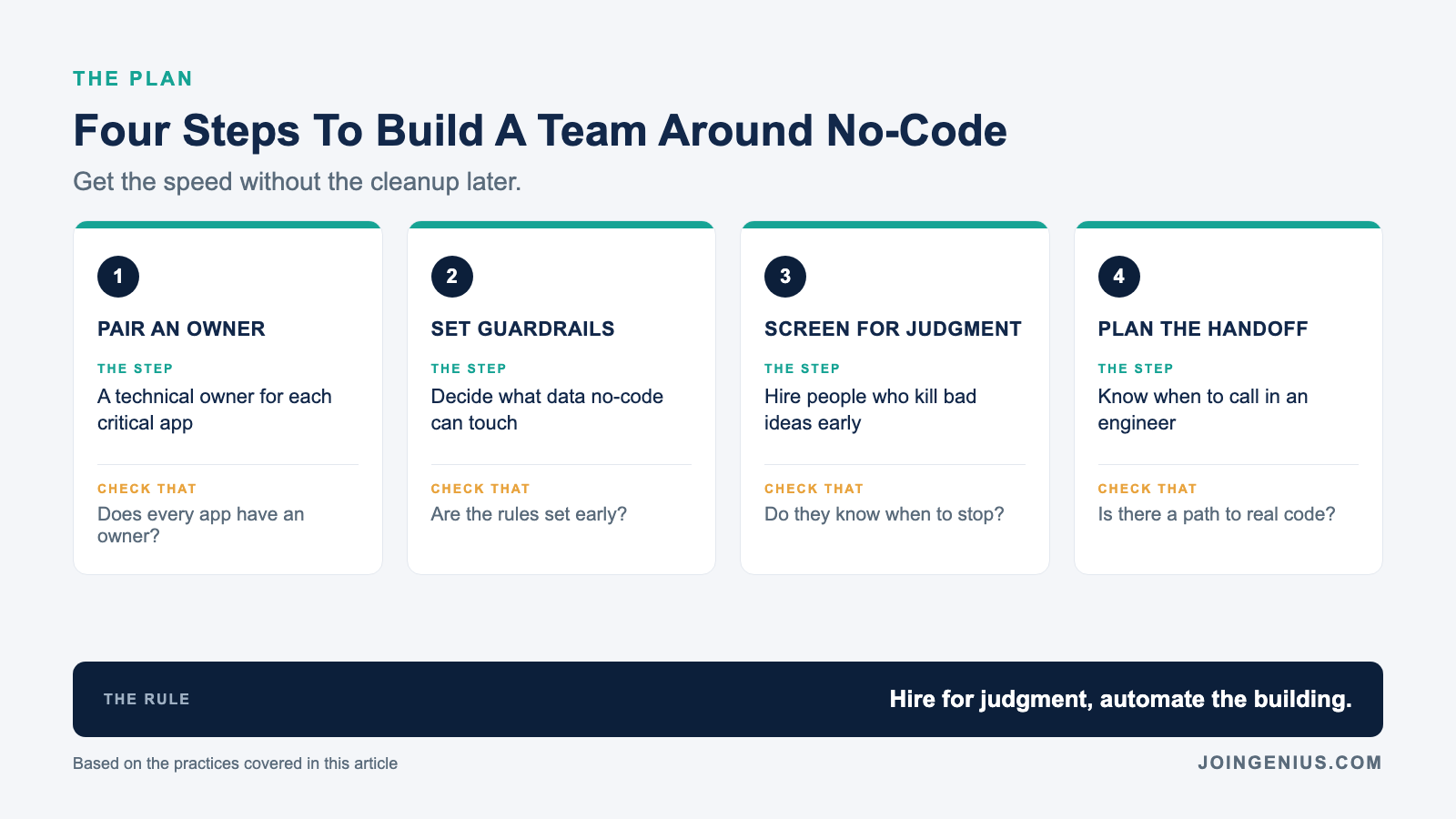
No-code is great until the app has 10,000 users or a gnarly edge case. Then the thing that took an afternoon needs a real rebuild. The fix is not to avoid no-code; it is to know when to bring in real engineering help before the wall, not after. Hiring has to plan for that handoff.
How to Structure a Team Around No-Code
The goal is to get the speed without the cleanup later. A little structure makes no-code a strength instead of a liability.
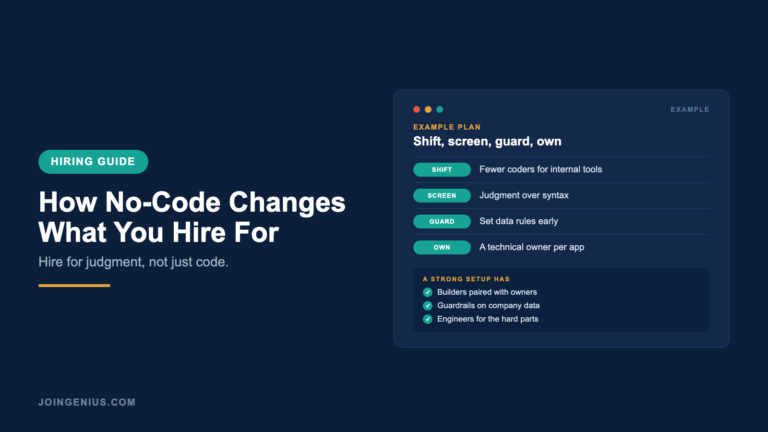
Pair Every Builder With a Technical Owner
Builders should not operate with no backstop. Give each team or each critical app a technical owner who reviews what gets built and when it needs to graduate to real code. This is less about control and more about clear ownership, so nothing important runs unwatched.
Set Guardrails Before You Scale Usage
The time to set rules is before half the company is building. Decide what data no-code apps can touch and what has to stay with engineering. Light guardrails up front beat a frantic audit after something leaks. Make the safe path the easy path, so builders follow it by default.
The rules are cheap to write now and costly to retrofit later.
Hire for the Judgment You Cannot Automate
The tools will keep getting better at the building. What they cannot do is decide what deserves to exist and when to stop. That judgment is the thing to hire for.
- Screen for people who kill bad ideas early, not just ship fast.
- Value knowing when to hand a project to an engineer.
- Reward documentation and clean handoffs over clever one-off builds.
- Hire operators who own outcomes, not just the apps they make.
Conclusion
No-code platforms do not remove the need to hire well; they change what hiring well means. The valuable people are the ones with judgment about what to build and the sense to know when it needs an engineer.
Chase pure coding skill for every role and you will overpay for the wrong thing. Hire for judgment and you get the speed and the guardrails at once.
If the harder problem is finding operators and engineers with that judgment at a price that lets you move fast, that is worth solving at the source. At Genius, we help companies hire the top 1% of operations and engineering talent from the Philippines and Latin America, at around 80% less than comparable local hires.
You keep the relationship direct, with no monthly agency fees and a 6-month replacement guarantee on every placement. If building the right team around no-code is the hire you keep getting wrong, see how we source and place talent.