
A frontend architect is one of the hardest engineering hires to price. The title is senior, the work is hard to see on a CV, and a well-known employer on the résumé is an easy shortcut for “this person must be good”. That shortcut costs money, and it does not tell you whether the person can make the decisions you need them to make.
This guide shows how to hire a frontend architect for the decisions they will own rather than the logos they have collected. It covers what the role involves, where brand premiums creep into hiring, how to scope the role before you set pay, a trade-off question that exposes real judgement, and a process that puts evidence ahead of pedigree. It ends with a table of warning signs to check before you make an offer. It is general information, and pay differs widely by market, so check local data before you set a range.
What a Frontend Architect Actually Owns
Start with the job, because “architect” means different things at different companies. One published posting for a React front-end architect describes a platform role. The person designs a frontend architecture that supports multiple independently deployed modules, builds shared tooling and frameworks, sets standards for scalability, performance and maintainability, improves build and deployment pipelines, handles platform concerns such as authentication and observability, and mentors other engineers. The posting is blunt about what the role is not: “This is not a feature delivery role.”
Your own role may be smaller or larger, but the pattern is useful. An architect is paid to make decisions that many people will live with: how code is structured, which shared components teams build on and which standards hold. Those decisions are what you should be hiring and paying for. If you are still deciding whether you need an architect or a strong senior engineer, the guide on how to hire a software engineer covers the wider process.

Where Brand Premiums Creep In
Brand enters hiring quietly. A candidate’s last employer sets an expectation for their pay, a recognisable name shortens the screening conversation, and a panel that is unsure how to judge architecture falls back on reputation.
Pay data shows how much employers differ. The 2024 pay report from Levels.fyi ranks the top-paying companies at each level, and the leaders change from level to level. Databricks leads the senior ranking at $600,000 in median total yearly compensation, and OpenAI leads the staff ranking at $860,000. The report covers only top-paying companies, says its figures “may not reflect compensation for the rest of the market” and has no frontend breakdown. Treat it as a reminder that the same level can be priced very differently, not as a benchmark for your offer.
Evidence on pedigree itself is limited, and none of it is about architects. A 2021 field experiment by Georgiana Mihut, published in Studies in Higher Education, sent 2,400 fictitious applications for IT and accounting jobs in the US, UK and Australia. Applications with a high skills match were 79 per cent more likely to get a callback, while university prestige was not a statistically significant predictor. The study covered entry-level roles and university names, not employer brands, so it proves nothing about senior hires. It does suggest that clear evidence of skill can matter more than a prestigious name. Panels carry their own preferences too, so build a process that limits interviewer bias.

Scope the Role Before You Set the Pay
Pay should follow what the role owns, not who the candidate has worked for. Before you open the role, write down the five or six decisions the architect will own, who each one affects and what good looks like after a year. Examples include the component and token strategy, the build and release pipeline, the rules for performance and accessibility, and how teams choose and approve new libraries. A guide to competency mapping can help you turn those decisions into the skills you will score.
Then set the range from that scope and your local market, and apply it to every finalist. The posting described earlier, which asks for platform-level work, states a range of $100,000 to $125,000 per year. That is one posting for one role, not a market rate, but it shows a useful habit: publishing a range tied to a defined scope. Before you make an offer, compare it with what you pay current engineers who carry similar responsibility. A quick pay equity analysis will show whether a brand-driven premium for one hire would open a gap with people already on the team.
Test for the Decisions an Architect Owns, Not the Logos on Their CV
The strongest way to separate judgement from reputation is to ask a candidate to make a real decision in front of you. Pick a choice with genuine trade-offs, no obvious right answer and a visible cost to getting it wrong.
Choosing a primitive library for a component system is a good example. Shadcnblocks, which sells component libraries built on shadcn/ui, documents how a project can build on Radix UI, Base UI and React Aria, and the page shows how many small constraints sit behind one choice. According to that page, the version a project installs is decided by a single style setting in its components.json file. React Aria is labelled beta, and the page warns that some of its pieces are newer and their APIs may still change. The page recommends none of the three, which is what makes it a good interview prompt: the candidate has to supply the reasoning.
Ask how they would choose, what would make them take the beta option, how they would record the decision and how they would roll it out to several teams. Listen for the factors they weigh, such as stability, accessibility, migration cost and the skills your team already has. Listen for whether they name what could go wrong and how they would contain it. A candidate with a famous employer on their CV and no trade-offs in their answer has told you something. So has a candidate with a modest CV who walks through the risks without being asked.
Rollout is its own signal. A Thoughtworks article on governance describes models that run from top-down control, which it says often leads to over-engineering, to a middle path where architects approve a small set of suitable stacks and invite developers to share their experience. An architect who can describe that middle path has thought about people as well as code.

Run the Process: Work Sample, Written Decision, Scorecard
Turn the trade-off conversation into a repeatable process so every candidate is judged on the same evidence.
Ask for a short written decision. The documentation for the Wikimedia Codex design system describes an architecture decision record as a document that explains the context and consequences of an important software design decision. Give finalists a realistic scenario, such as choosing how three teams will share a component base, and ask for a one-page record with the options, the choice and the consequences. Keep the exercise to about an hour so it respects their time.
Agree the scorecard before the first interview. Score the same criteria for every candidate, such as trade-off reasoning, clarity of the written decision, rollout thinking and mentoring, and have each interviewer score independently before the panel talks. An HR scorecard keeps the criteria visible, and interview feedback examples help interviewers write down evidence rather than impressions.
Finally, use references for decisions, not for reassurance. Ask a former colleague which decision the candidate led, what they weighed and what they would have done differently. The answer is worth more than the name of the company.
Warning Signs You Are Paying for Brand, and What to Do About Each
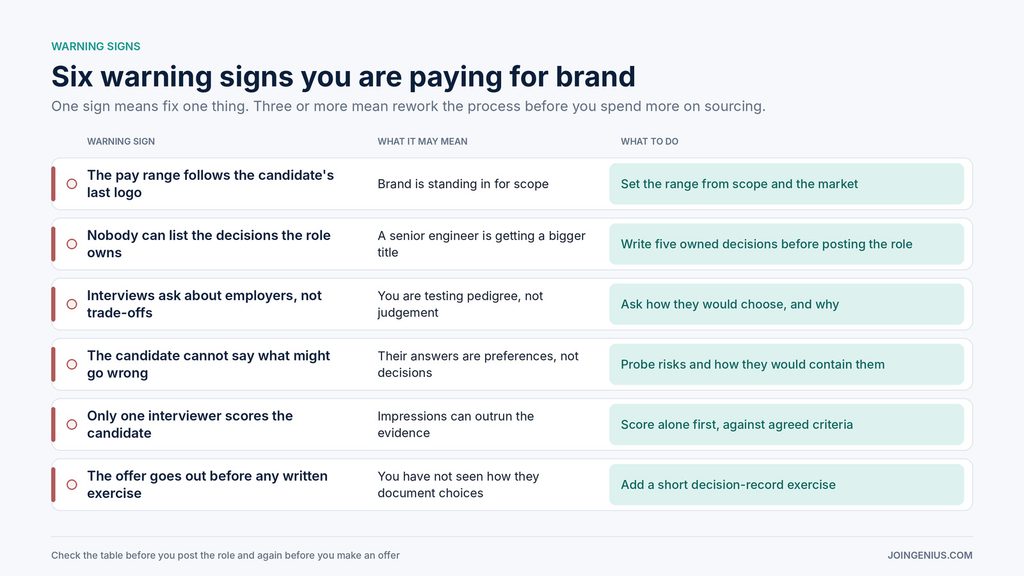
Check this table before you post the role and again before you make an offer. One sign means fix one thing. Three or more mean pause and rework the process before you spend more on sourcing.
Pay for Judgement
A good frontend architect makes decisions that a dozen engineers will live with for years. Scope those decisions, ask candidates to make one in front of you, record the reasoning and set pay from the scope. Then run one last test before the offer: if the logo were removed from the CV, would the evidence still make the case? If it would, you are probably paying for the right thing.