A team hires a QA automation engineer who delivers hundreds of automated tests in a single quarter. Within weeks, some of them start failing at random. People rerun the build until it passes, a red result stops meaning anything, and a real regression ships past a build that everyone had learned to ignore. This is an illustration, not a case study, but any team that has automated its tests will recognize it.
This guide explains how to hire QA automation engineers who understand testing and not just tools. It covers what the role involves, what research shows about why automated tests become unreliable and how to assess candidates, a paid exercise built around a flaky test, a four-step plan and a table of warning signs. It builds on our guide to why technical hiring fails, which covers the general mistakes behind a bad technical hire.
What a QA Automation Engineer Actually Does
A QA automation engineer decides what is worth automating, writes tests that check it, structures those tests so others can maintain them, reads the results, and keeps the suite healthy as the product changes. Writing the test is the smallest part of that list.
Understanding shows up in the other parts. An engineer who understands testing can explain why each test exists, which failure it would catch, and which failure it would miss. They can say which checks belong in an automated suite and which a person should do by hand. They treat a failing test as information to investigate and not as noise to silence.
Before you source anyone, write down what the engineer must be able to explain: which flows carry the most risk, which deserve automation first and how you will know the suite can be trusted.
What Research Says About Why Tests Flake
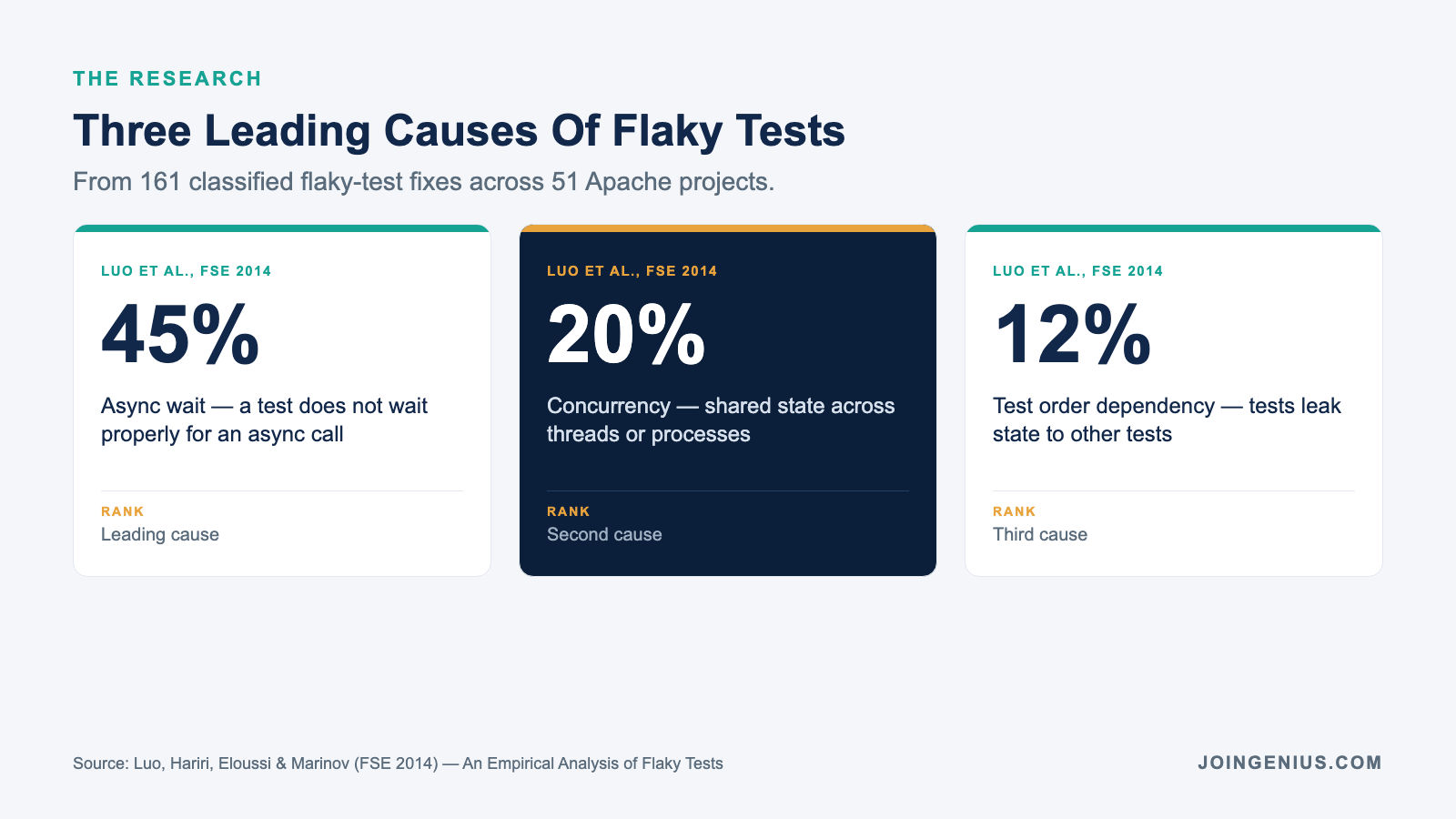
A flaky test passes on some runs and fails on others without any change to the code. Qingzhou Luo and colleagues studied how teams fix them in a paper at FSE 2014, the ACM SIGSOFT Symposium on the Foundations of Software Engineering.
They examined 201 commits that likely fix flaky tests from 51 open-source projects of the Apache Software Foundation, and they classified the root causes of 161 of them. Async wait, where a test does not wait properly for an asynchronous call to finish, accounted for 45%. Concurrency accounted for 20%, and test order dependency for 12%.
The authors note that Apache projects contain few GUI tests and mobile applications, so some findings may not carry over to those settings.
John Micco described the same problem at Google in a 2016 post on the Google Testing Blog. About 1.5% of all test runs reported a flaky result, almost 16% of tests had some level of flakiness, and about 84% of the transitions from pass to fail involved a flaky test.
The post also warns that quarantining a flaky test, which removes it from the critical path and files a bug, could easily mask a real race condition or some other bug in the code being tested. The figures come from one company’s codebase.
For a hiring manager, the point is direct. A badly built suite does not fail loudly. It fails sometimes, and the people who built it have to work out why. The leading cause in the first study is timing, which a test author controls by deciding what a test waits for.
An engineer who reaches for a longer wait or an automatic rerun treats the symptom. An engineer who finds the cause treats the suite. That difference is what you are hiring for.
What Research Says About Assessing Candidates
Paul Sackett, Charlene Zhang, Christopher Berry and Filip Lievens revisited the validity of hiring methods in a 2022 Journal of Applied Psychology paper. A HumRRO summary reports validity of .42 for structured interviews, .40 for job knowledge tests and .33 for work sample tests.
The authors report that earlier estimates were inflated by range restriction corrections, and that validity varies across settings. The figures describe general job performance across many roles, not QA automation specifically.
They support asking every candidate the same structured questions and giving every candidate a comparable piece of real work. The exercise below does both.
Give Candidates a Real Application and a Flaky Test
The best way to find out whether someone understands testing is to watch them handle a test that does not behave. Prepare a small web application, either a simplified version of your own product or a public demo app, and a short list of flows to check, such as signing in and checking out.
Pay for the time, since unpaid exercises ask people to work for nothing and may put off experienced candidates. About two hours is enough.
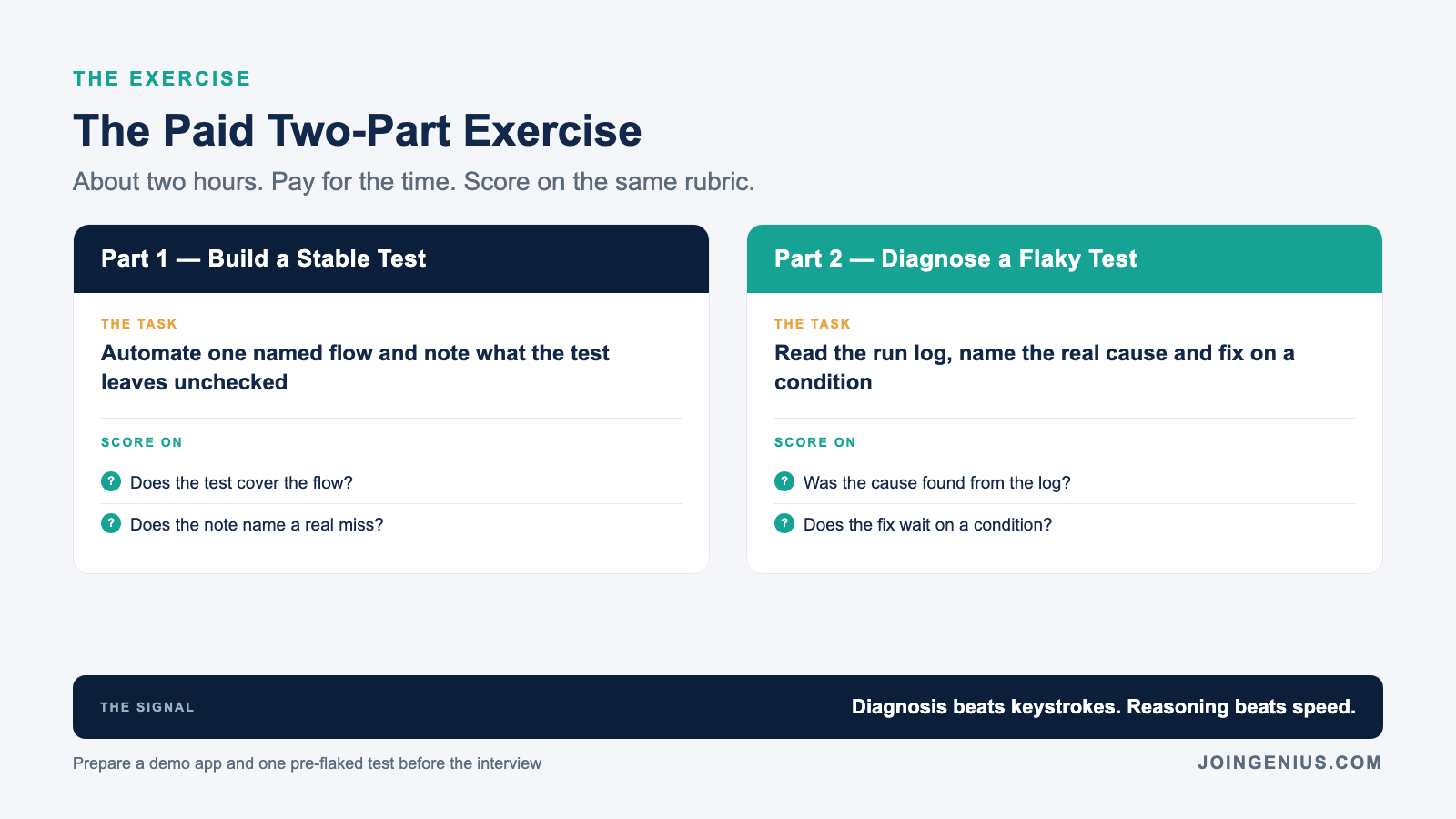
The exercise has two parts. In part one, ask the candidate to build one stable automated test for a flow you name, and to write a short note on what the test protects and what it leaves unchecked.
In part two, hand over a second test that you have prepared to fail on some runs, for example because it clicks an element before the page has finished loading, and ask for the cause and a fix. Ask the candidate to explain the cause from the run log and not from a guess.
If you want candidates to work in a tool whose run logs make the cause of a failure easy to show, QF-Test is one option: its debugger, run logs and HTML reports with screenshots show exactly where a run failed, and a free trial license covers the exercise.
Score both parts on the same rubric. Does the stable test cover the flow? Does the note name something the test misses? Does the candidate find the real cause of the flaky failure? Does the fix wait on a condition and not on a fixed delay? Does the candidate say what they would not automate? Our guide to hiring browser automation engineers covers a related role.
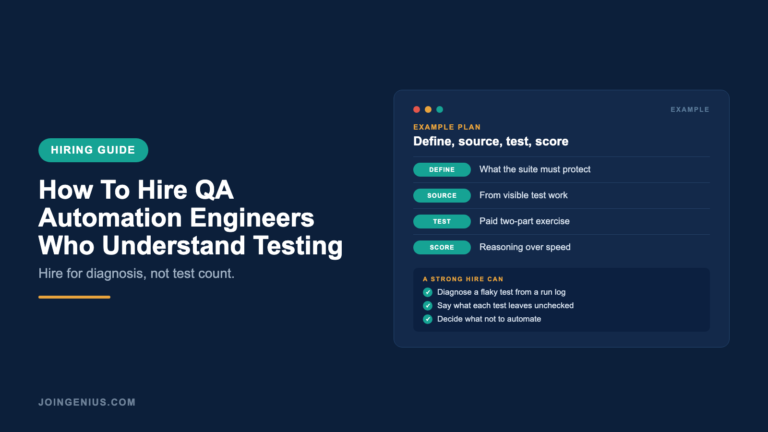
A Four-Step Plan to Hire QA Automation Engineers
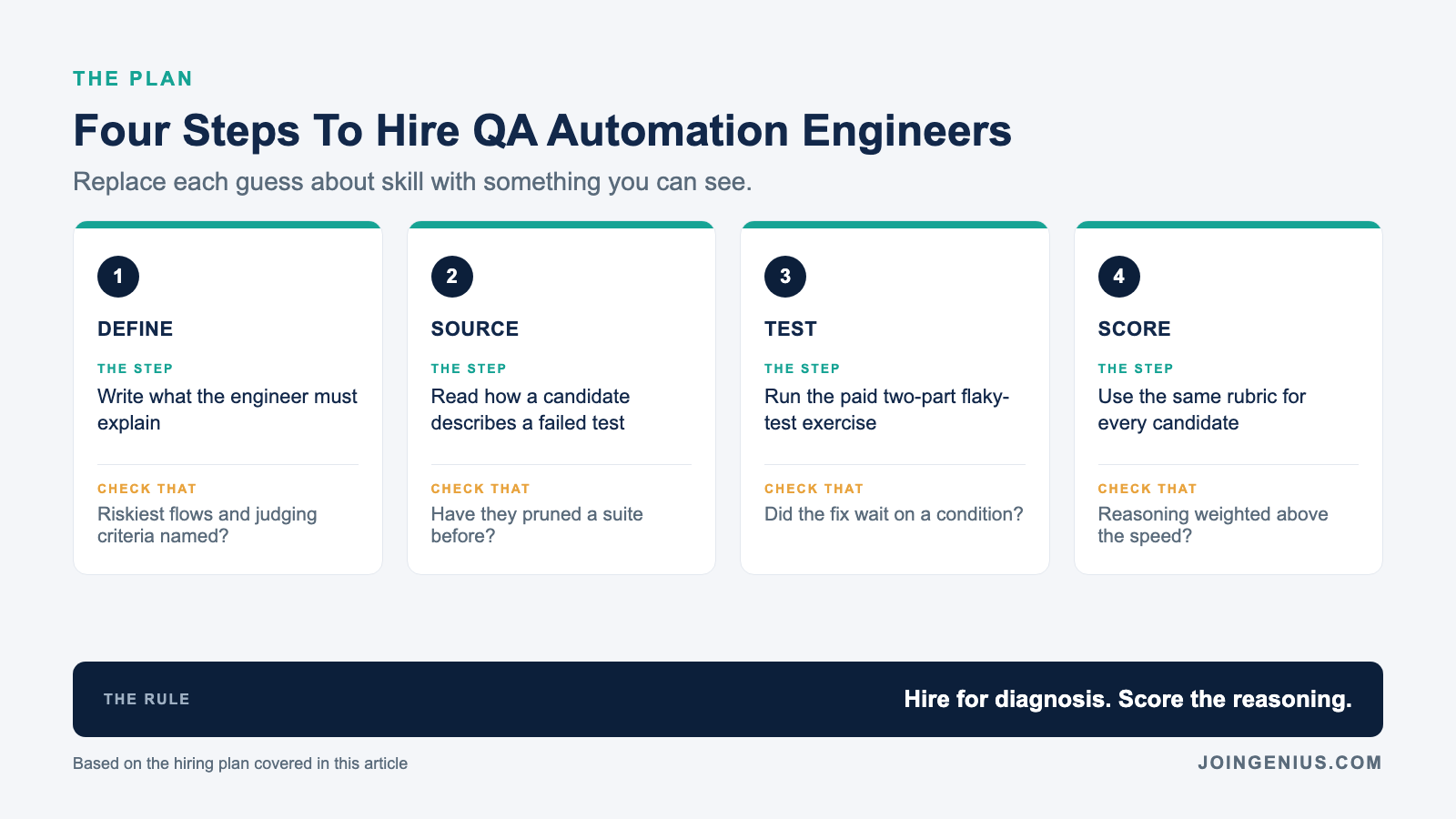
Use this four-step plan for each search.
- Define. Write what the engineer must explain: the riskiest flows, what to automate first, and how you will judge the suite.
- Source. Review public test repositories, bug reports, and talks, and read how a candidate describes a failed test.
- Test. Run the paid exercise with one stable test and note, and one flaky test diagnosed.
- Score. Use the same rubric for everyone, and weight the reasoning above the speed.
Step two deserves a closer look. In a repository, look at the history of the tests and not just the tests themselves. Did the author delete tests that stopped earning their place? Did a fix for a failing test change what the test waited for, or only how many times it ran?
In an interview, ask each candidate the same question: describe a flaky test you fixed, what the cause was, and how you confirmed the fix. Our guide to screening interviews shows how to structure the first call.
Measure Whether the Hire Works
Track the flaky-test rate in your suite, the time from a failed run to a named cause, the share of failures traced to a cause and not simply rerun, and the hours spent each month maintaining tests. Compare each number with the one you recorded before the hire.
At 90 days, ask the engineer to name the three tests they would delete and the three they would add. The answer shows whether they understand what the suite is for.
Warning Signs a QA Automation Hire Does Not Understand Testing
Check this table at each interview stage and again at 90 days. One sign means fix one thing. Three or more mean pause before you decide.
| Warning Sign | What It May Mean | What To Do |
|---|---|---|
| Wants to automate every test | Cost is not weighed against value | Ask which tests they would skip |
| Fixes flakes with longer waits | Symptoms treated, not causes | Ask for the root cause |
| Cannot say what a test protects | Tests may exist for the count | Ask what failure each catches |
| Counts tests as the success measure | Coverage may hide weak checks | Ask how they judge a suite |
| Never mentions maintenance | Upkeep cost goes unseen | Ask about the last suite they pruned |
| Blames the tool for unstable runs | Diagnosis may stop early | Have them read a failed run log |
Hire for Understanding, Then Test for It
A QA automation engineer who understands testing can say why each test exists, what it misses, and what to do when it fails at random. Research on flaky tests shows that timing, concurrency, and test order caused most of the fixes studied.
Define what the engineer must explain, source from visible work, run a paid exercise that includes a flaky test, and score the reasoning. Each step replaces a guess about skill with something you can see. If a candidate can read a failed run, name the cause, and say what they would leave unautomated, you have found someone who will make the suite more trustworthy. For more on judging technical candidates, see our guide to talent assessment.