Every event operator running a second season knows the pattern. The staff list from last year gets dusted off in February. The hiring manager sends a round of texts in March. Fewer than half reply. Fewer than a third actually show up for the first shift. The operator writes it off as the nature of seasonal work and starts the recruiting cycle from zero.
The reason is not the pay. The pay was the same last season and the season before. Three specific operational breakdowns show up in nearly every event program that cannot keep its staff for year two, and the fix for each one is operational rather than a comp conversation.
This post walks through the three breakdowns, the scheduling layer where most of the leak hides, and what to actually change before the next season starts.
The Three Breakdowns That Keep Seasonal Event Staff From Year Two
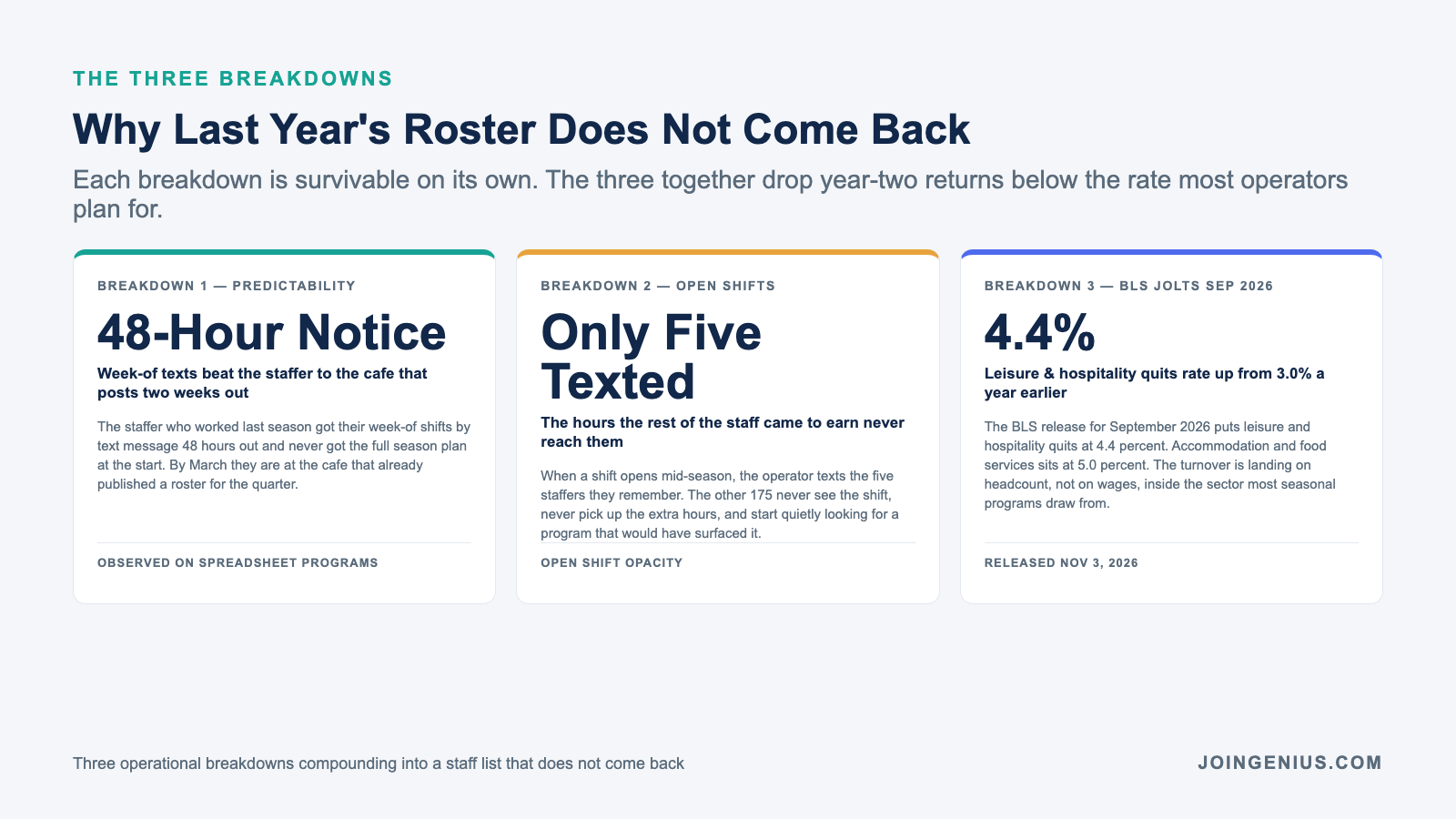
Breakdown one is schedule unpredictability. The staffer who worked last season got their week-of shifts by text message 48 hours out, had a shift canceled Saturday morning after they already arranged childcare, and never got the full season plan at the start. By the time the next season’s recruiting call lands in March, the staffer has quietly taken a job at a cafe that posts the schedule two weeks out.
Breakdown two is open shift opacity. When a shift opens up mid-season because someone else called out, the operator texts the five staffers they remember. Three of them miss the text. The other two are not available. The shift gets filled by a stressed manager who does the shift themselves. The remaining staff never see the open shifts and never build up the extra hours they came to earn.
Breakdown three is communication fragmentation. The schedule lives in a spreadsheet. The shift swaps happen in a group text. The event-day updates land in a different group text. The payroll questions go to a fourth channel. Every staffer has to rebuild the context from scratch every time they show up, and the ones who leave are the ones who got tired of being the person in the loop.
The signal that the three breakdowns have already compounded is in the industry turnover data. The BLS JOLTS release for September 2026 puts the leisure and hospitality quits rate at 4.4 percent, up from 3.0 percent a year earlier. Accommodation and food services sits at 5.0 percent. The quits rate inside the sector most seasonal event employers draw from jumped 1.4 points year over year, and the turnover is landing on headcount rather than wages.
Why The Staff List Looks Full But Year Two Does Not Show
The pattern is visible in the hourly workforce data. Legion’s 2025 State of the North American Hourly Workforce Report, released June 4, 2025 and drawn from a survey of over 1,200 hourly workers and 750 managers in North America, puts 61 percent of hourly employees citing schedule flexibility as the top non-pay reason they would stay at a job. The report is produced by a workforce software vendor, and the figure should be read against that context.
Even on the conservative read, six in ten hourly staff are telling their employer the same thing. The scheduling surface is what keeps them. The staff list looks full in February because last year’s roster is still in the spreadsheet. The year-two show-up rate is low because last year’s roster already found a job with a better scheduling surface.
The surface metric that hides this is signed-up headcount. A seasonal program with 200 staffers on file and 60 of them returning for year two gets reported to the leadership team the same way as a program with 80 staffers on file and 60 returning. The first program spent six months rebuilding the roster from the signup form. The second program spent six months keeping the people it had.
The pay inside the two programs is usually within a dollar of each other. The gap is on the scheduling and communication layer, which is the layer most seasonal operators do not treat as a retention problem at all.
The Scheduling Layer Where Year-Two Retention Actually Breaks
The quiet place where the loss lives is the week-to-week schedule experience. The event operator lives or dies on whether the staffer who closed last Saturday’s shift knows what their next three shifts are by Sunday morning, and most seasonal operators have no system that gets them there.
Running the schedule on a shift scheduling platform like ZoomShift closes the predictability and communication gaps that otherwise show up as a staff list that does not come back in year two. The platform publishes the next season’s roster from recurring templates in minutes. Open shifts post to the whole team for one-tap pickup. All shift communication stays inside the same app the staffer already opens for their schedule.
Fixing the scheduling surface is the single highest return move an event operator can make on year-two retention. It does not require a new comp structure or a bigger payroll. It requires one program lead who treats the first 30 days of every new staffer as a predictability problem rather than an onboarding one.
The economics are direct. An event program that lifts its year-two return rate from 20 percent to 50 percent on the same recruiting spend cuts its hiring cost for the next season by more than half, because the recruiting funnel at the top is the most expensive part of the program and the returning staffer costs almost nothing. The macro turnover numbers are moving against operators who treat scheduling as an afterthought, and the ones compounding are the ones that already fixed it.
Day 180 Before And After On A Rebuilt Program
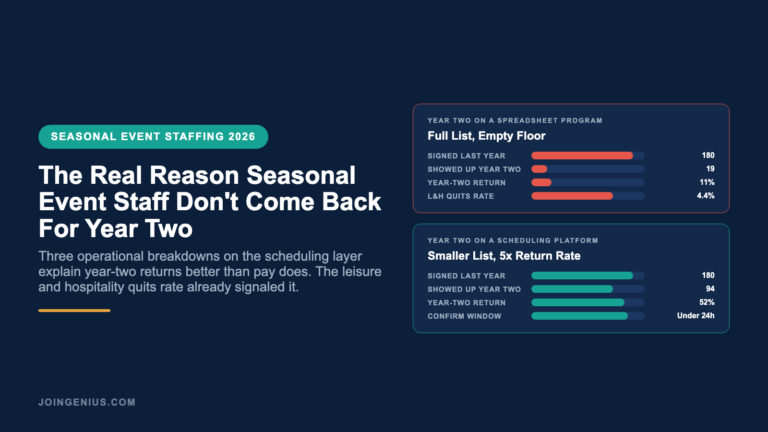
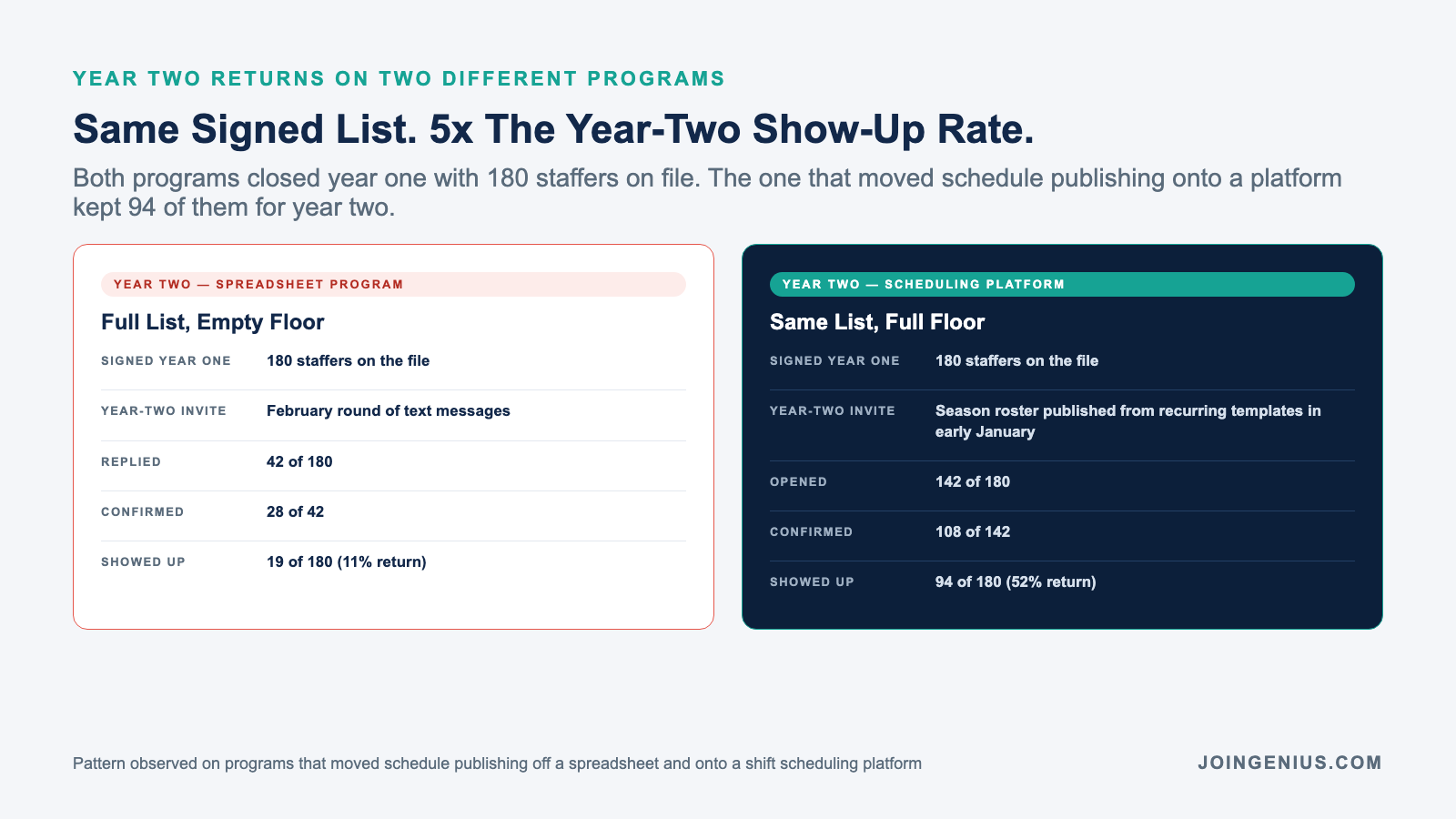
The before picture is the one most seasonal operators describe. The program closes season one with 180 staffers on the file. February of year two begins with a round of text messages. Of the 180, 42 reply. Of those, 28 confirm. Of those, 19 actually show up for the first shift. Year-two return rate is 11 percent. The recruiting funnel reopens at the top.
The after picture at day 180 looks different on every metric. The program closes season one with 180 staffers on the file. The scheduling platform publishes the season-two roster from last year’s recurring templates in early January, and sends the message through the same app every staffer already uses. Of the 180, 142 open the invite. Of those, 108 confirm. Of those, 94 show up for the first shift. Year-two return rate is 52 percent.
The signed-up headcount at the top of year two is roughly half of what the operator would normally plan for, and the show-up number is higher. The team got that result by moving schedule publishing, open shift pickup, and team communication onto one surface instead of four.
The number that changed first was time-from-schedule-publish-to-staff-confirmation. It moved from a week of back and forth text to under 24 hours on the same scheduling app. Every downstream number moved on the lag of that one.
The Four Move Playbook For Fixing Year-Two Returns
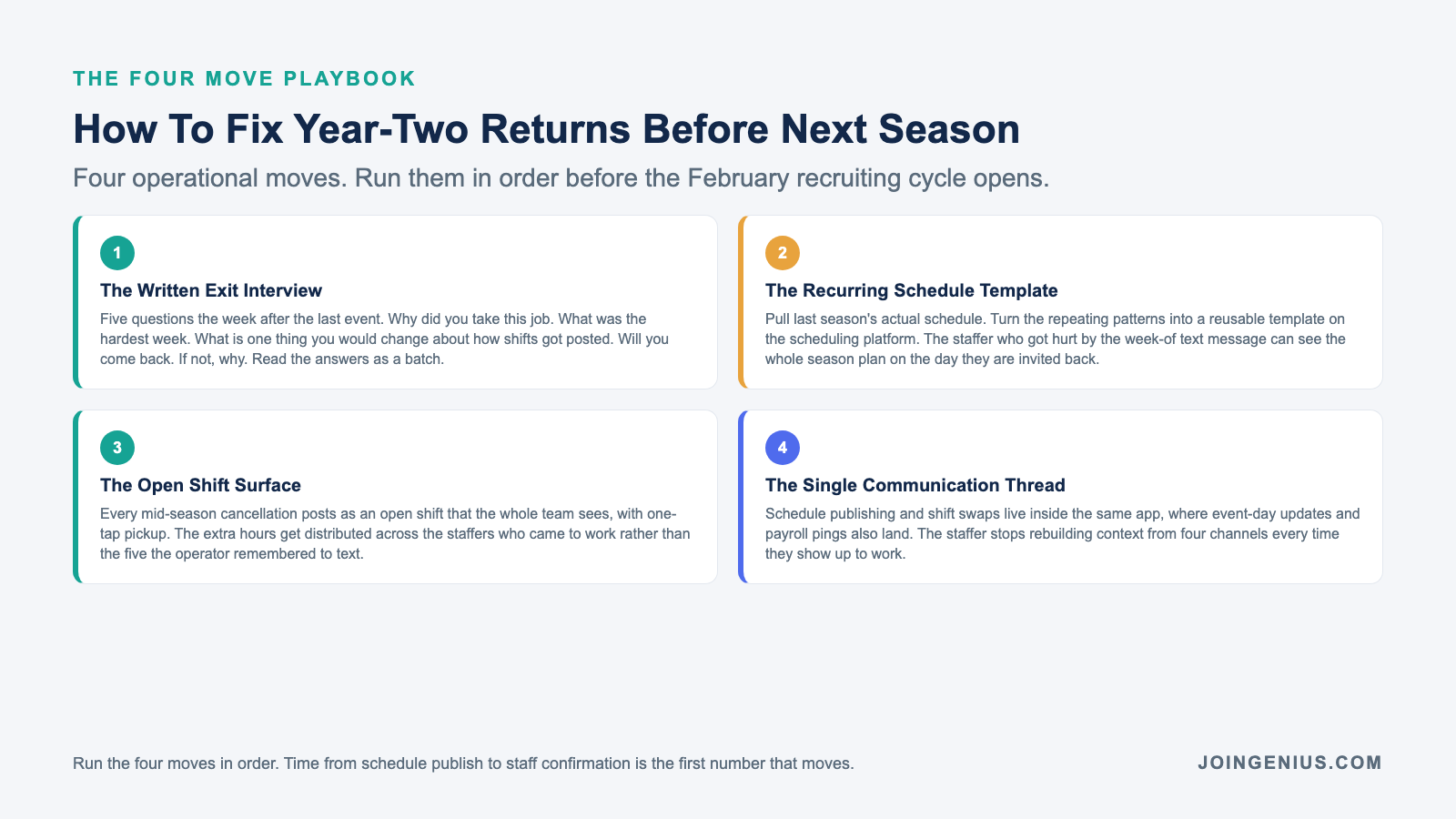
Move one is the exit interview the week after the last event of season one. Five questions. Why did you take this job. What was the hardest week. What is one thing you would change about how shifts got posted. Will you come back. If not, why. The answers from the staffers who are leaving tell the operator exactly which of the three breakdowns is theirs. Do this in writing and read the results as a batch.
Move two is the recurring schedule template. Pull last season’s actual schedule and turn the repeating patterns into a reusable template on the scheduling platform. Every week that looked the same last year becomes a template this year. The staffers who got hurt by the week-of text message can see the whole season plan on the day they get invited back.
Move three is the open shift surface. Every mid-season cancellation gets posted as an open shift that the whole team sees, with one-tap pickup. The extra hours get distributed across the staffers who came to work rather than the five the operator remembered to text. The stressed manager stops covering the shift themselves, and the staff build up the hours they came to earn.
Move four is the single communication thread. Schedule publishing and shift swaps live inside the same app, where event-day updates and payroll pings also land. The staffer who worked last Saturday does not have to rebuild the context on Sunday from four channels. The communication pattern now matches the pattern the staffer uses to get their shift in the first place.
A One Page Weekly Check On The Program
The replacement for the spreadsheet most seasonal operators run is a weekly five metric read owned by the program lead. The point is to make the real signal visible before the staffer leaves, not after.
Metric one is percent of shifts published more than seven days in advance. Metric two is average time from schedule publish to staff confirmation. Metric three is open shift fill rate inside 24 hours. Metric four is the count of staffers who picked up a shift beyond their baseline schedule this week.
Metric five is the active communication rate inside the scheduling app, measured as the percent of staffers who read a program message in the last 7 days. A staffer who stops reading the messages is a staffer who is already leaving. The weekly read catches it before the February text round does.
Scan these five every Monday, flag the two biggest week over week moves, and walk the team through the hypothesis before the operations meeting. The conversation changes from “how many staffers do we have on the list” to “which specific staffer stopped engaging this week,” which is the only conversation that moves year-two retention. Build this into your interview rubric for the program lead role.
Hire Event Managers Who Can Rebuild The Scheduling Layer
The seasonal programs that compound in year two are the ones that stopped running the schedule on a spreadsheet and started running it on a platform their staff actually opens. They are the ones that moved the three retention breakdowns onto one surface. They are the ones with a program lead who owns the first 30 days of every new staffer as a predictability problem.
The hiring window is tight. The US Bureau of Labor Statistics counts 172,100 meeting, convention, and event planner jobs in 2025, with a 6 percent growth projection through 2035 and a median wage of $61,160. That is a seller’s market for the operational program lead archetype you need to hire against.
Genius hires top one percent operations and program management talent from the Philippines and LATAM at roughly 80 percent less than local comp. There are no monthly fees and the placement comes with a six month replacement guarantee.
We screen on the four program lead tests described on this page before any candidate reaches a hiring manager, so your sourcing funnel brings you people who will fix the scheduling surface before season two starts rather than people who will present another recruiting plan after year two already failed.