
Most of us have sat through a work trivia night that felt like a meeting with a scoreboard. Attendance was expected, the questions favored the three people who know everything, and the host kept asking whether everyone was having fun. Nobody was.
It does not have to go that way. A team trivia night works when people choose to join, the stakes stay low, and the format fits the team you actually have. Get those three things right and the rest is logistics.
This guide covers how to pick a format, write questions that include everyone, run the night smoothly in person or online, and avoid the habits that make it feel forced. If trivia is one piece of a bigger plan, our list of employee engagement ideas has more activities worth pairing with it.
Why Most Team Trivia Nights Feel Forced
Forced fun usually comes from design choices, not from the people in the room. Four causes show up again and again:
- Attendance is mandatory, or might as well be. When people know their manager is noticing who shows up, the night becomes one more obligation.
- The questions suit only a few people. A round on 1990s film or obscure sports history leaves half the group out within five minutes.
- The host performs. Over-the-top energy from the front of the room makes everyone else feel they need to match it.
- The prizes raise the stakes. Once a gift card is on the line, friendly competition turns into something people feel awkward about.
None of these is hard to fix. Keep it voluntary, keep it short, mix the difficulty, and play in teams so no single person carries the pressure of answering alone. The graphic below shows how each choice tips a night one way or the other.
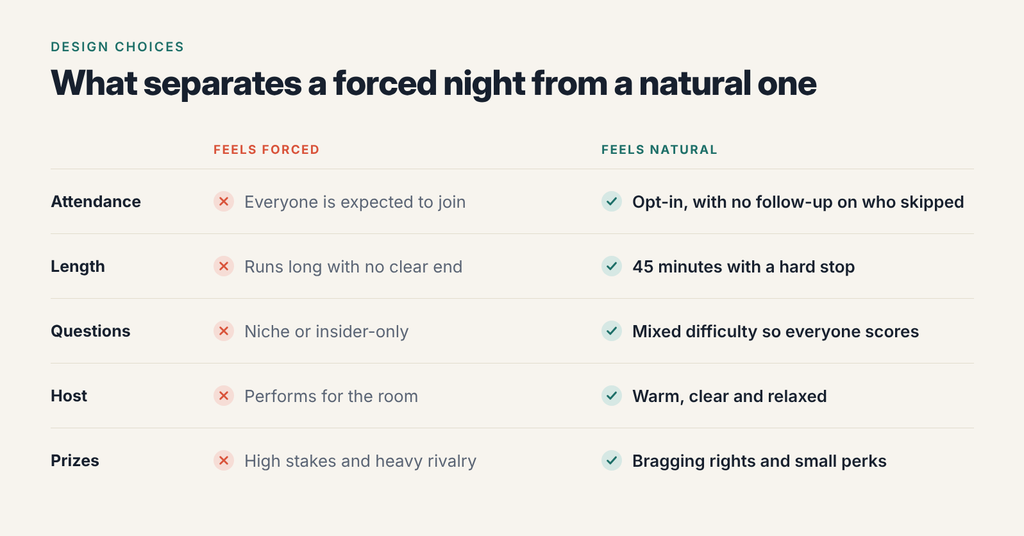
Five design choices that decide whether a trivia night feels forced or natural.
One caution. Trivia is a good way to give a healthy team a reason to talk, but it will not repair low morale on its own. If people are already disengaged, deal with the cause first, then add the fun.
Start With the Goal and the Format
Before you write a single question, decide what the night is for. A trivia night meant to help new hires meet people looks different from one meant to give a busy team a 45-minute break. Most nights serve one of three goals: connection across departments, a mental break from work, or a warm welcome for new people.
Your goal points to a format. Here are the three that work best.
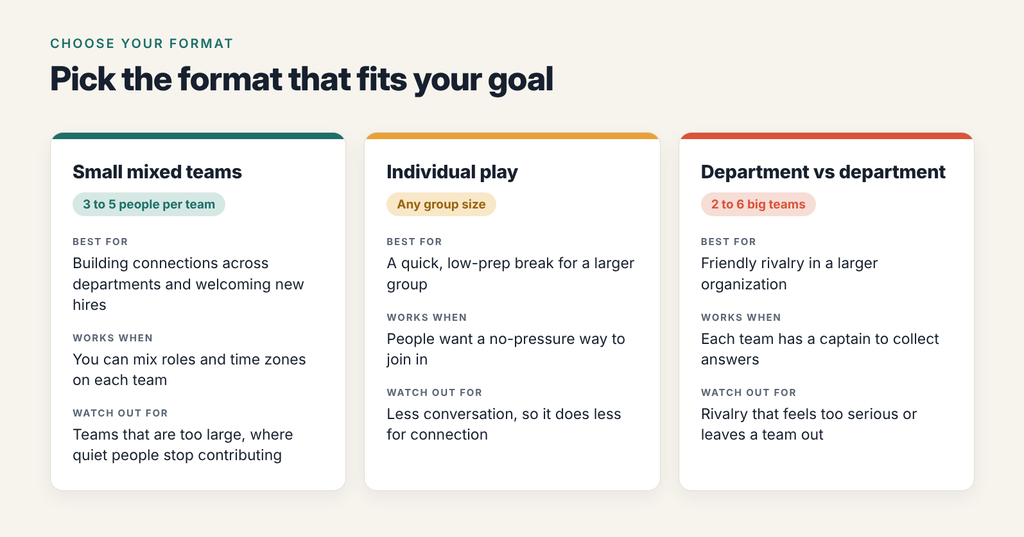
Match the format to the goal, not the other way around.
Small mixed teams of three to five suit most groups. Mixing roles, departments and time zones on each team creates the conversation you are after. Individual play is easier to run for a large group, but it produces less talk, so it does less for connection. Department against department can be fun in a larger organization, as long as the rivalry stays friendly and each team has someone to speak for it.
Two practical choices finish the setup. First, length: aim for 45 to 60 minutes and set a hard stop. Second, timing: hold it during work hours or in a protected lunch slot. Evening events quietly exclude people with families, long commutes or different time zones.
Build Questions Everyone Can Answer
The question set decides whether the night works. The goal is not to stump people. It is to give every team a few moments where they get one right and a few where they argue happily over an answer.
A simple structure holds up well: four rounds of seven questions. Build each round on a difficulty ladder with three easy questions, three medium ones and one hard one. Easy questions build confidence, medium ones start debate, and the hard one gives competitive people something to chase without deciding the winner on its own.
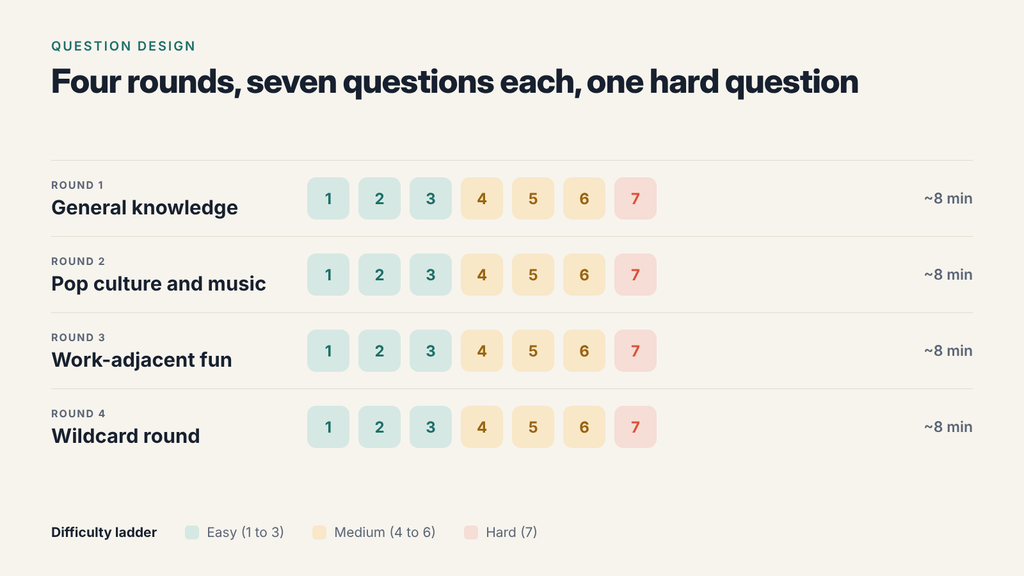
Each round follows the same ladder, so pacing stays predictable.
Give each round its own flavor. A good mix is general knowledge, pop culture and music, work-adjacent fun, and a wildcard round. Work-adjacent questions can cover the tools, history or quirks of your industry, as long as they stay funny and not insider-only. The wildcard can be a picture round, a team-written question, or a round of guess the coworker.
Here is one sample question from each step of the ladder:
- Easy: Which planet is the largest in our solar system? (Jupiter)
- Medium: In which country would you find the city of Marrakesh? (Morocco)
- Hard: What is the only letter that does not appear in the name of any US state? (Q)
If you run guess the coworker, get consent first. Ask people to submit a light fun fact in advance, such as a first job or a favorite snack, and let anyone opt out. Skip anything personal.
Finally, check every question for blind spots. If an answer depends on a decade, a country or a show that only some people have seen, add a hint or swap it out.
Remote Teams Can Play the Same Game as an In-Person Room
Distance does not change what makes trivia work. People need a shared moment, some friendly competition and room for banter. A video call provides all three, and most of the in-person format carries over unchanged.
The setup has three parts. You need a video call so people can see and talk to each other. You need a place for players to submit answers from their own device, so nobody has to crowd around one screen. And you need a shared screen for the questions and the leaderboard.
Using an online quiz maker lets you build the questions ahead of time, share a join code, QR code or link, and have everyone play from their own phone or laptop without creating an account. It works over Zoom, Teams or Meet by sharing your screen. Check the participant limit on the plan you choose, since the free plan is capped at 20 live players.
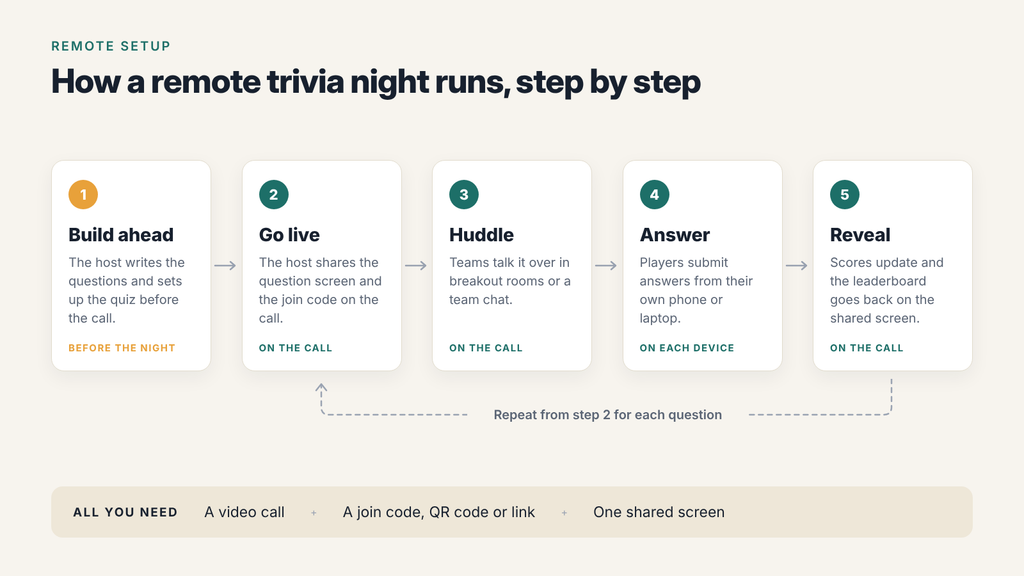
A remote night follows the same loop as an in-person one: question, huddle, answer, reveal.
A few habits keep remote nights smooth:
- Test the setup 10 minutes early. Open the quiz, share your screen and confirm the join code works before anyone arrives.
- Use breakout rooms or a team chat for huddles. Small groups talk more freely than a full call does.
- Rotate the start time if your team spans time zones, so the same people are not always playing at the edge of their day.
- Keep a backup plan. If someone’s connection drops, a teammate can submit for them, or they can rejoin at the next round.
The pacing, the rounds and the scoring all stay the same. Only the room changes.
Run the Night: Hosting, Pacing and Scoring
A tight run of show matters more than a clever host. Here is a 45-minute plan that leaves a little slack at the end.
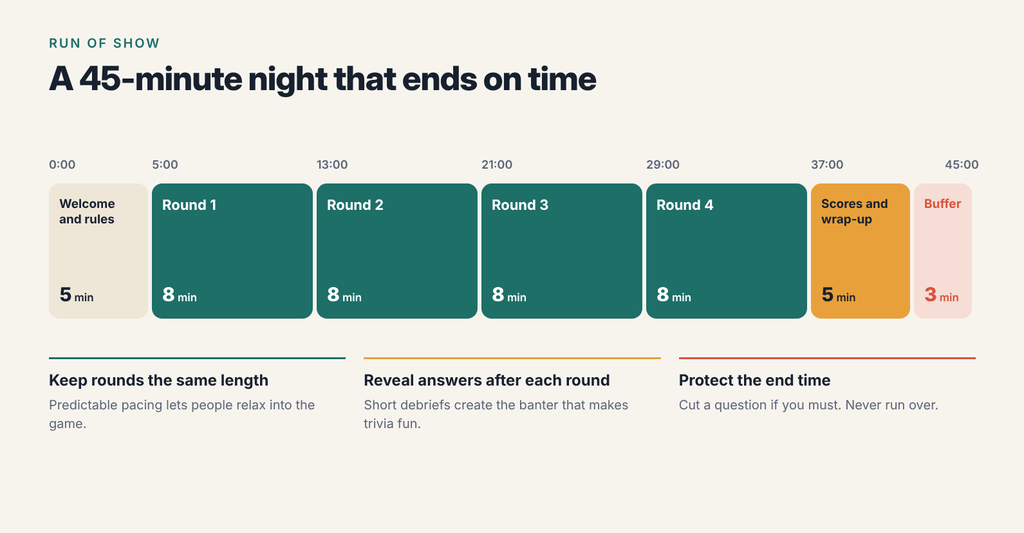
Five minutes to welcome, four rounds of eight, five to wrap up and three of buffer.
In the welcome, explain the rules in under two minutes, remind people that playing is optional and start on time. During the rounds, read each question clearly, repeat it once, and give teams a moment before you reveal the answer. Warm and relaxed beats loud and theatrical. Reveal the answers after each round, not each question, so the debrief stays short and the banter has room to happen.
Keep scoring simple and visible. One point per question, with an optional bonus point for the hard one, is plenty. Decide how you will handle disputes before the night starts. The simplest rule is that the host makes a quick call and the game moves on.
For ties, use a single tiebreaker such as a closest-number question. And if you are running a recurring event, rotate the host so it never becomes one person’s unpaid job.
Keep It From Feeling Forced
Most of what makes trivia feel natural happens before and around the questions.
- Invite, do not assign. Say plainly that skipping is fine, and do not track who did not come.
- Let people join late or leave early. A flexible night feels like an offer, not an obligation.
- Keep prizes small. Bragging rights, a silly trophy or choosing the next round’s category are enough.
- Give quieter people a way in. A team can answer through a chat or a rotating captain, so contributing does not mean speaking up in front of everyone.
- Ask for feedback once. One anonymous question afterward, such as “Would you play again?”, tells you what to change.
Trivia does not need to carry all of your team culture, either. For the weeks in between, these small, low-effort activities fit into a coffee break and keep the habit of connecting alive.
5 Common Mistakes to Avoid
- Running over time. A night that ends early leaves people wanting more. A night that runs long makes them look at the clock.
- Writing questions that are too hard or too niche. If nobody can answer, nobody is having fun.
- Turning it into a performance review. Leaders should play like everyone else and keep opinions about who participated to themselves.
- Skipping the tech check for remote events. Five minutes of testing saves fifteen of troubleshooting.
- Doing it too often. Monthly or quarterly keeps it fresh. Weekly turns it into a chore.
Conclusion
A good team trivia night is short, voluntary, inclusive and well paced. Start small: one 45-minute session, a few mixed teams and questions most people can answer. Ask for honest feedback, then adjust the next one. Trivia also works best as one of several ways a team connects, alongside other team building activities, and it suits remote work setups as easily as an office.