
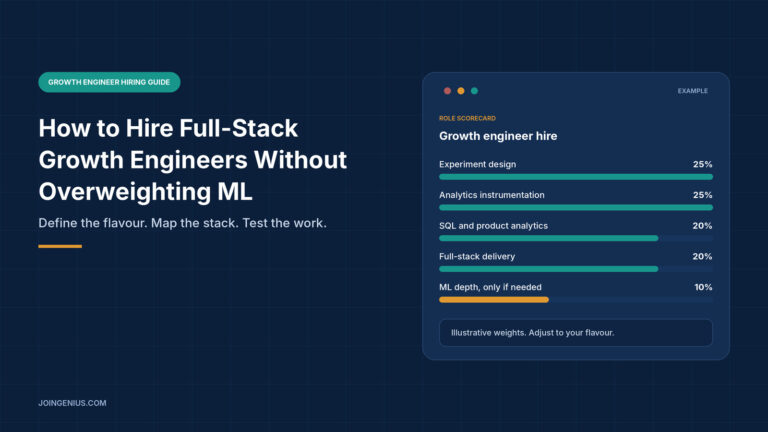
Growth engineering is easy to hire for the wrong skill. The title sounds technical and data-heavy, so job specs drift toward machine learning, and candidates with impressive model-building backgrounds rise to the top of the pile. Yet most growth engineers are hired to ship landing pages, wire up tracking, run experiments and connect marketing tools.
This guide explains how to hire a full-stack growth engineer without letting ML dominate the process. It covers what the role does, the three flavours it comes in, what real job postings ask for, how to map the growth stack the person will touch, which skills to test and where ML does earn a place. It ends with a table of warning signs. We found no study that measures how often employers overweight ML in growth hiring, so treat this as practical reasoning rather than a statistical claim. It is general information, and the right profile depends on your product and stage.
What a Full-Stack Growth Engineer Actually Does
Ian Vanagas of PostHog, writing in April 2023, describes growth engineers as people who “focus entirely on projects dedicated to driving as much growth as possible”. They generate growth ideas, build them and measure the results. His examples include SEO and landing pages, signup funnel optimisation, A/B tests on activation and onboarding, and messaging systems. He adds that growth engineers “care more about real results from experiments than designing the perfect experiment”.
Growth.Talent’s 2026 role guide, which shows no author or date, describes similar work and a similar skill set: TypeScript and React, SQL and product analytics, A/B testing experience, API design and what it calls marketing-side empathy. It says output “is measured in lift, not code shipped”. Machine learning is not on its skills list.
Neither source says ML is irrelevant, and neither is a survey. The common thread is a full-stack engineer who ships quickly, measures honestly and works close to marketing. PostHog also notes that growth engineers need an existing product to optimise, so hiring one makes more sense once you have traction. The guide to hiring for startups covers the wider timing question.
Define the Flavour Before You Write the Spec
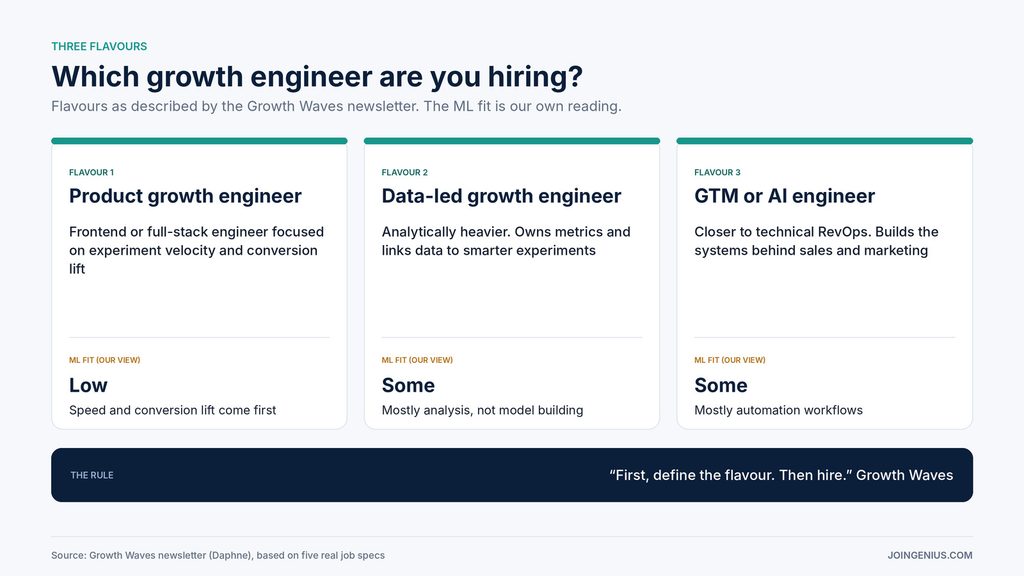
Growth Waves, a newsletter by Daphne, read five real job specs and found a consistent base: experimentation, full-stack feature development, analytics instrumentation and cross-functional work. Beyond that base, it sees three flavours. A product growth engineer is a frontend or full-stack engineer focused on experiment velocity and conversion lift. A data-led growth engineer is analytically heavier and owns metrics and the link between data and smarter experiments. A GTM or AI engineer is closer to technical RevOps and builds the systems behind sales and marketing.
Its advice is blunt: “First, define the flavour. Then hire.” Mixing flavours, it warns, produces a stretched hire who underperforms. Notice where ML might sit. At most it belongs in the data-led and GTM or AI flavours, and even there the newsletter describes metrics ownership and sales and marketing systems, with AI automation workflows in some specs, rather than model building.
To choose, list the five things you most want this person to spend time on in their first six months, then see which flavour they map to. Decide the reporting line too. Growth Waves notes that engineering-led roles tend to be held to engineering standards, while growth or marketing-led roles tend to be more strategic but can struggle to get prioritisation. Write the outcomes and criteria into an HR scorecard so every interviewer scores the same things.
What Job Postings Ask For, and Where ML Sits
Apollo.io’s posting for a growth engineering lead asks for A/B testing and experimentation platforms, SQL and data pipelines, CRO, SEO and performance engineering, and modern web skills. Machine learning appears only once, as a responsibility: “Leverage automation and machine learning to optimize user engagement”. It is not listed as required or preferred.
Seamless.AI’s posting for a growth engineering role that also leads a team asks for production experience with React, Node.js and PostgreSQL, a record of improving onboarding, activation or retention, and experience designing and running A/B tests and feature flags. It does not mention ML.
Two postings are an illustration, not a survey, and both are for senior roles at software companies. They do match the Growth.Talent skill list: experimentation, analytics and full-stack delivery come first. If your own spec leads with model training, ask whether the problem you described needs it. If it does, a different hire fits better, and the guide to hiring an AI developer covers that profile.
Map the Growth Stack the Role Will Actually Touch
Before you interview anyone, write down the tools and systems the person will work in. This is where the ML question usually answers itself, because most of a growth stack is plumbing: tracking, pages, integrations and reports.
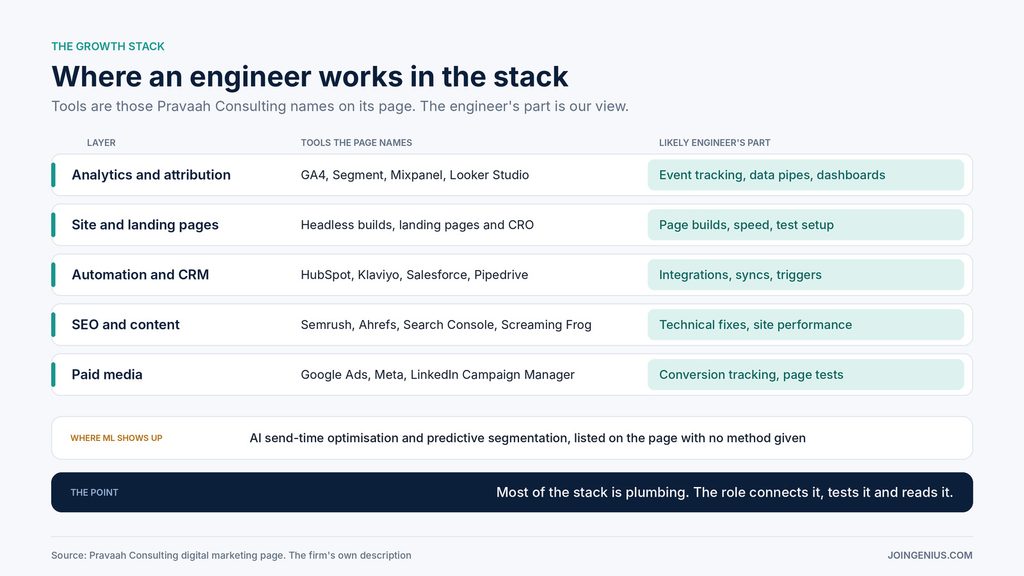
Pravaah Consulting’s growth and revenue acceleration page shows what a growth stack can contain. It describes four practices: SEO and content, paid media, GTM strategy and sales enablement, and marketing automation and CRM. It covers the funnel from top to bottom and names tools by category, including GA4, Looker Studio, Segment and Mixpanel for analytics, HubSpot, Klaviyo and Salesforce Marketing Cloud for automation, and HubSpot CRM, Salesforce and Pipedrive for CRM. It says tracking and attribution are built before launch and that measurement happens weekly. The page is an agency’s description of its own services and says nothing about hiring, and its results are self-reported, so use it as a map rather than a benchmark.
The page also mentions “AI send-time optimisation” and “predictive segmentation” without explaining how they work. ML often arrives inside the tools as a feature to switch on and measure, and the engineer’s job is to connect the data, set up the test and check whether it worked.
Run the same exercise for your company. List every tool in the funnel, mark who owns each integration, and mark the steps that need an engineer rather than a marketer: event tracking, landing page builds, test setup, CRM syncs and attribution. Those marked steps become the job. If you are unsure how your tracking should feed reporting, the guides to marketing analytics and marketing attribution models are a good place to start.
Test Experimentation and Instrumentation, Not Model Building
Once you know the work, test it. Give finalists a realistic exercise of about an hour. Describe a signup funnel and ask them to list the events they would track, design a test for one step, write the SQL that would read the result and explain how they would respond to an unclear outcome.
Ask for a test that lost. A 2013 Microsoft post on experimentation at Bing, which includes remarks from Harry Shum, says “less than a third” of ideas move the metrics they were designed to improve, and that in an optimised domain like Bing the number is lower. That is one search engine at scale, more than a decade ago, so it is no benchmark for your company. It does show why comfort with null results matters. Ask what they tested, what happened and what they changed afterwards. Growth.Talent adds that having shipped an A/B test framework is “a strong signal in interviews”.
Score the same criteria for every candidate: instrumentation design, test design, SQL, handling of unclear results and how clearly they explain trade-offs to a marketer. Add a separate line for ML depth only if your flavour needs it, and weight it to match. A structured interview guide keeps the conversation consistent, and interview feedback examples help interviewers write down evidence rather than impressions.
[IMAGE PLACEHOLDER: Body image 3 | file: body-3-work-sample-scorecard.jpg | alt text: Scorecard for a growth engineer work sample, six criteria with what a strong answer looks like and what overweighting ML may look like]
Where ML Does Earn a Place
None of this means ML never matters. If your growth work depends on recommendations, scoring or personalisation that you build yourself, you need someone who can do it.
The practical test is proportion. Ask how much of the first six months would involve training or tuning a model. If the answer is small, make ML a nice-to-have, ask for one example of using it responsibly and put the weight on the skills above. If the answer is large, you may be hiring an ML engineer with an interest in growth, which is a different search.
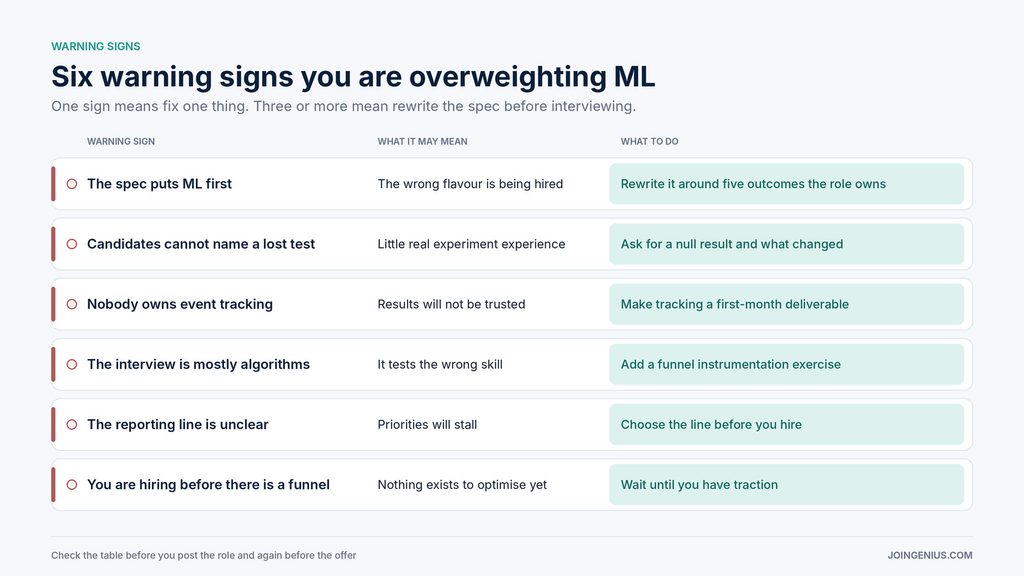
Warning Signs You Are Overweighting ML, and What to Do About Each
Check this table before you post the role and again before you make an offer. One sign means fix one thing. Three or more mean pause and rewrite the spec before you interview anyone else.
Hire for the Problem, Not the Buzzword
The best growth engineer is the one who can move the funnel you actually have. Define the flavour, map the stack, test the real work and add ML only where the role needs it. If the spec, the exercise and the scorecard all point at experiments, tracking and shipping, you are probably hiring for the right thing.