A company launches an AI support agent and hires an analyst to report on it. The first dashboard shows the agent is up 99% of the time and answers in under two seconds. A month later, customers are still phoning the support line, and nobody can say why. That is an illustration, not a case study, but it describes the gap this guide covers: an analyst who reports on whether an agent is running is not the same as one who can explain what it did for the customer.
This guide explains how to hire data analysts who can translate AI agent behavior into something a product or support team can act on. It covers what the skill involves, what the evidence says about measuring agents, how to test candidates, how to judge the hire and a table of warning signs. We found no study showing what makes an analyst good at interpreting AI agent behavior, or how best to hire one. The advice rests on a vendor glossary, benchmark and survey research, selection research and our reasoning. It is general information, and what works varies by team.
What It Means to Translate Agent Behavior
We would split the skill into three parts. The first is reading conversations: seeing what the customer asked for, what the agent did and how the exchange ended. The second is tying those conversations to outcomes the business already tracks, such as repeat contacts or completed purchases. The third is explaining the result to people who do not read logs. That split is ours, not a validated standard, so use it to organise your questions and not as a checklist.
The reason to separate these skills is that a candidate can be strong at one and weak at another. An analyst with deep SQL skills may never have read a transcript, and an experienced support lead may not know how to join conversations to outcomes. Our guide to hiring a data analyst covers the general profile, and this guide adds the agent-specific layer.
Why Uptime Is Not the Customer’s View
Three independent sources show why a system-side view falls short. None of them is about hiring, and each has limits.
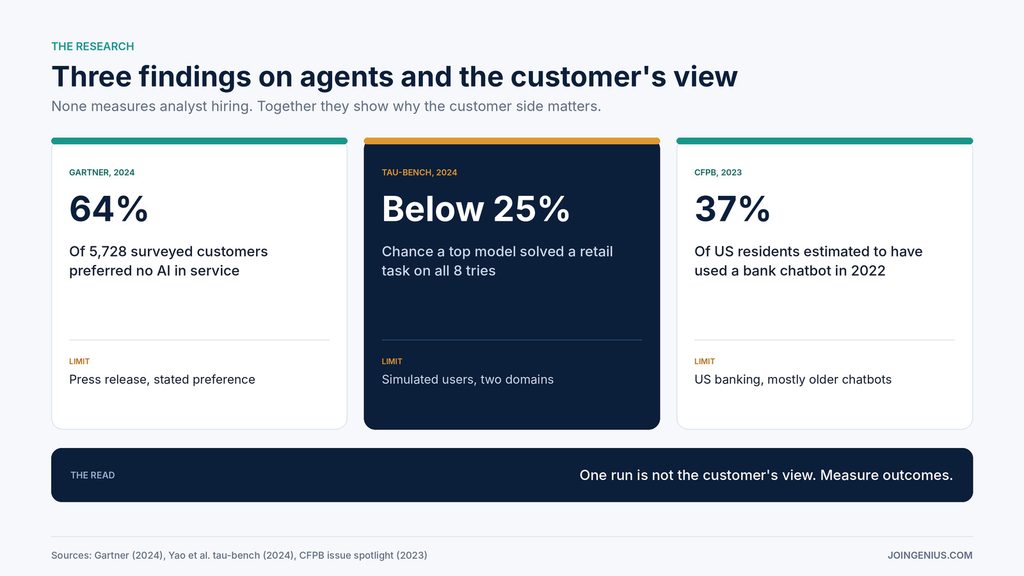
The first is a research benchmark. Shunyu Yao and colleagues at Sierra built τ-bench in 2024, which tests language agents in multi-turn conversations with a simulated user who needs help with retail or airline tasks. The best model they tested, gpt-4o with function calling, completed about 61% of retail tasks and 35% of airline tasks. In retail, its chance of succeeding on every one of eight repeated tries of the same task fell below 25%. The users were simulated by a language model, the benchmark covers two domains, and the authors note that its rule-based scoring is necessary but not sufficient for correct behaviour. The tested models are also from 2024. It shows that a single successful run can hide inconsistency, which an analyst should check.
The second is the US Consumer Financial Protection Bureau’s 2023 issue spotlight on chatbots in banking. It estimated that about 37% of the US population used a bank’s chatbot in 2022, and it warned that “Instead of finding help, consumers can face repetitive loops of unhelpful jargon.” It covers banking, and much of what it describes involves rule-based chatbots, not current language models.
The third is a Gartner survey of 5,728 customers from December 2023. Gartner reported that 64% would prefer companies not use AI in customer service, and 53% would consider switching if they learned a company was going to use it. The top concern was that AI would make it harder to reach a person. It is a press release, it gives no country breakdown or question wording, and “would consider switching” is a stated intention, not behaviour.
Together these suggest that customers judge agents by whether they get help, and that average success can mislead. That is our reading of the evidence, not a finding about analysts.
Analysts Who Can Measure an Agent From the Customer’s Side Are the Ones Worth Hiring
Conviva’s glossary defines agent experience analytics as “the practice of measuring how AI agents perform from the customer’s perspective.” The page, published by Conviva’s editorial team on 1 April 2026, contrasts it with monitoring of uptime, latency and error rates. It lists five components: conversation quality, task completion and resolution, escalation and handoff, frustration signals such as repeated rephrasing, and outcome attribution to measures like conversion or churn.
That list is a useful interview map. A candidate who can explain what each component means and how they would measure it understands the customer’s side. The page also says good analytics “distinguishes between true resolution and false completion,” which is a sharp test: ask candidates how they would tell the difference.
Read the page for vocabulary, not for evidence. It is a vendor glossary. Its eCommerce example, with a conversion gap and a 22% lift, is presented as hypothetical and cites no source. Its claim that the platform analyses 100% of agent conversations is Conviva’s own, and we found no independent evaluation of it. The page also lists privacy and the difficulty of defining “good” among its challenges, and those are fair things to raise in an interview.
Test Candidates With a Work Sample
A work task shows reasoning that a CV hides. Selection research supports it, with a limit. A HumRRO summary of Sackett, Zhang, Berry and Lievens (2022) reports revised validity estimates in which structured interviews were highest at .42 and work sample tests were .33. The authors argue that earlier estimates were inflated by range restriction corrections, and the summary says structured interview validity varies considerably. These figures concern job performance in general, not analysts or AI agents. They support a modest point: asking every candidate the same questions and scoring them the same way beats improvising. Our interview guide covers how to structure the conversation.
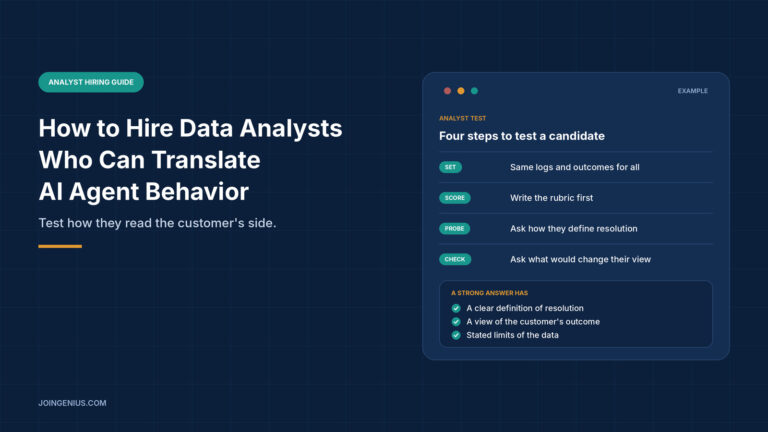
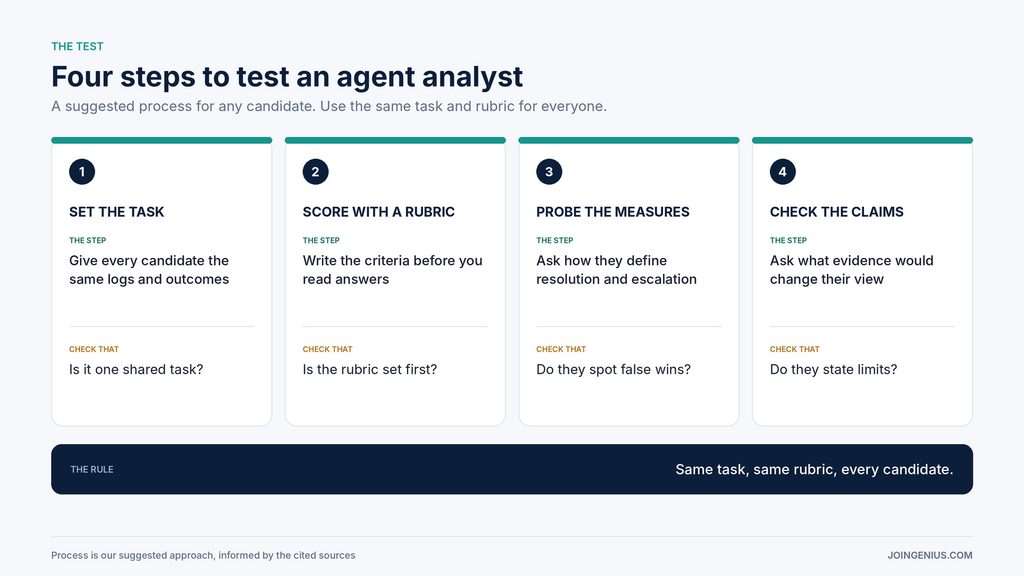
Use this four-step test for every candidate. It is our suggested process, informed by the sources above.
- Set the task. Give everyone the same anonymised conversation logs and the same outcome table.
- Score with a rubric. Write the criteria before you read any answers.
- Probe the measures. Ask how they would define resolution, escalation and frustration.
- Check the claims. Ask what evidence would change their view and what the data cannot tell them.
A strong answer names a specific conversation, separates a finished conversation from a solved problem and says what it does not know. A weak answer reports an average and stops. Because the logs may contain personal data, check with your privacy lead before sharing any, and use synthetic or anonymised conversations if you cannot. Give candidates a fixed time limit, such as one hour, so the task shows how they prioritise and not how long they will work for free. Offer to pay for any longer exercise, and keep the data in your own systems.
Measure Whether the Hire Works
Track how many of the analyst’s findings lead to a change in the agent or the process, how often their resolution labels agree with a human reviewer on a sample, how quickly they can explain a drop in outcomes and whether product and support teams use their reports. Judge the hire over several quarters, since a few findings prove little and agent behaviour changes with each release.
Ask the analyst to state what each report cannot show. A candidate who has found a pattern in repeated runs, as τ-bench does, is better placed than one who reports a single week. For related reading, our piece on hiring a data scientist covers the modelling side, the guide to hiring a Power BI expert covers dashboards, and our AI agents statistics give context on adoption. If you are building the wider team, the technical talent pipeline guide shows where to look.
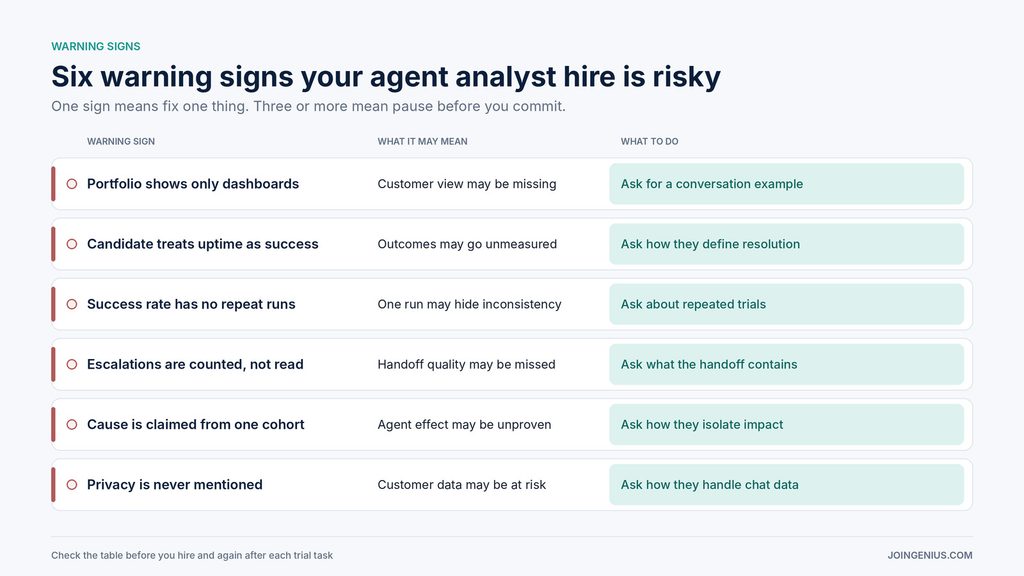
Warning Signs Your Agent Analyst Hire Is Risky, and What to Do About Each
Check this table before you hire and again after each trial task. One sign means fix one thing. Three or more mean pause before you commit.
Hire for the Customer’s View, Then Test It
An analyst who can translate AI agent behavior can read a conversation, link it to an outcome and say what the data cannot show. Give every candidate the same logs, score the answers against a rubric written in advance and ask how they would tell a solved problem from a finished conversation. Treat a vendor glossary as a source of vocabulary and not as proof of skill. If the candidate can explain a result and name its limits, you have a better reason to hire them than any dashboard in their portfolio.