A marketing operations manager joins a growing company to run the marketing stack. In her first months, she cleans up the CRM and sets up lead routing.
By month nine, requests from sales, campaigns, finance, and the executive team arrive through chat, email, and hallway conversations, and the quarterly strategy project has slipped twice. By month fifteen, she is answering recruiters. That is an illustration, not a case study, but many teams will recognize the pattern.
This guide explains why marketing ops hires may leave early and what to do about it. It covers why the early period is risky, how to define the role, what research says, how to settle reporting questions before day one, a first-year-and-a-half plan, and a table of warning signs.
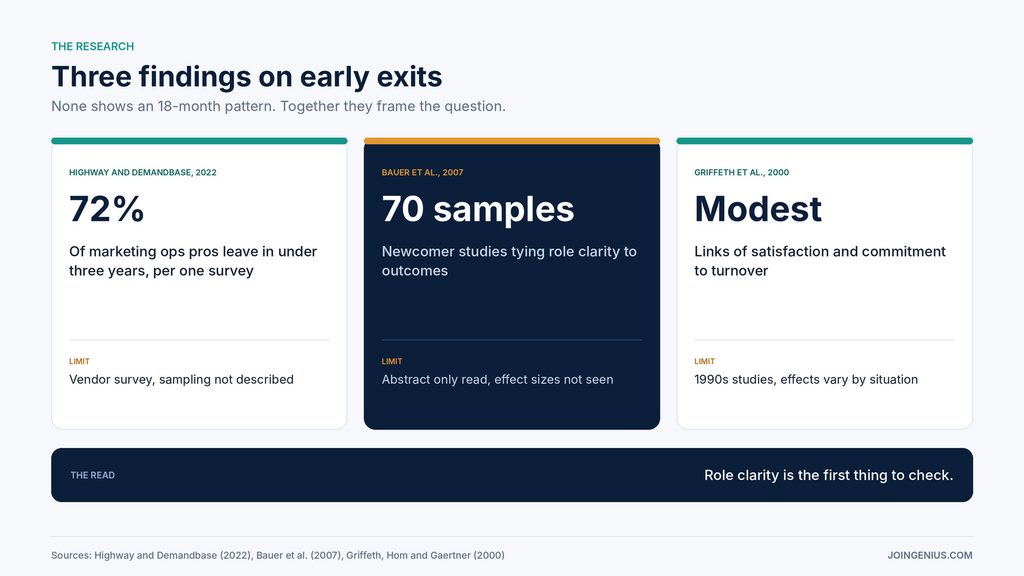
We found no study showing that marketing ops hires leave around the 18-month mark, so 18 months is an illustrative window, not a finding. The one marketing operations survey we found says 72% leave their company in under three years, and its sponsors sell related services.
The advice rests on research about newcomers and turnover in general and on our reasoning, which we label as such. It also differs from our guide on why full-stack developers leave agencies after their first year, because marketing ops has its own problems of scope, request routing, and reporting.
Why the First Year and a Half Is a Risky Window
Joining a company is a period of adjustment, and part of it is about the job itself. Talya Bauer and colleagues meta-analyzed 70 samples of newcomers in a 2007 Journal of Applied Psychology paper.
They measured adjustment through role clarity, self-efficacy, and social acceptance, and tested how it relates to outcomes that included job satisfaction, commitment, performance, intentions to remain, and turnover. We read the abstract only and did not see effect sizes, and the samples were not marketing operations teams.
The point is modest: how clear the role is early on appears to matter. Our reasoning is that marketing ops is a role where clarity is hard to come by, because the first months go to cleanup and the later months are when requests multiply. That is an inference, not a finding. Our reasoning is that the risk is higher where marketing ops serves several teams at once, because each team can define the job differently.
Define What “Marketing Ops” Means Before You Hire
Marketing operations can mean several jobs. Some teams want a platform administrator who keeps the CRM and automation tool running. Others want a reporting specialist who builds dashboards. Others want a process owner who decides how campaigns move from request to launch, and some want all of that plus campaign execution.
When a posting asks for everything, the hire discovers the real job after joining. That gap between the job described and the job done is a likely reason for early exits. This is our reasoning, not a measured effect.
A useful step is to write down the three to five things the role owns and the things it does not, including who can ask for work and how. Our guides to job design and to hiring a marketing automation expert are places to start.
What the Research Says About Why People Leave
We found three more sources that bear on the question. None tests an 18-month pattern in marketing operations, and each comes with limits.
In 2022, Highway Education and Demandbase published The State of Marketing Operations, a survey of more than 800 marketing operations professionals. It reports that 72% leave their company in less than three years, that 57% struggle with burnout, and that 93% learned on the job.
Treat the figures with care. Highway sells beginner marketing ops training, and Demandbase sells go-to-market software, so both have an interest in the topic, and the report does not describe its sampling. Its text and chart also disagree on company size, and its headline restates the turnover figure as a job change every two years. The numbers suggest high churn and little formal training. They do not show an 18-month pattern.
Rodger Griffeth, Peter Hom and Stefan Gaertner updated earlier turnover research in a 2000 Journal of Management meta-analysis that added correlations from 42 studies in the 1990s.
Job satisfaction and organizational commitment both related to turnover, but only modestly, with correlations of about -.19 and -.23. The authors caution that effects vary widely across situations and populations. Our reading is that no single feeling explains why people leave, so a retention plan needs to look at the role and not only at morale.
David Allen, Phillip Bryant, and James Vardaman wrote in Academy of Management Perspectives in 2010 that research and practice on turnover remain disconnected. They offer a comparison of how strongly different predictors matter and a summary of evidence-based retention strategies. We read the abstract only.
Settle Reporting and Tooling Questions Before Day One
Reporting is where scope tends to creep in marketing ops. Everyone wants a dashboard, and each requester wants something different. Some teams respond by putting reports and the work behind them in one place. A marketing execution platform like Slingshot can help here by combining analytics, reporting, and work management, with tasks, owners, and a marketing calendar next to performance dashboards.
Whatever tool you use, the same questions apply. Before day one, agree on five things for each report: who owns it, who reads it, what decision it supports, where its data lives, and who may ask for changes. This is our suggestion.
A hire who inherits ten reports with no owner and no audience is likely to spend the first year rebuilding and defending them. Writing the answers into a shared document costs little, and it gives the new hire something concrete to question in the first week, before habits form. Our guide to marketing attribution models is one place to start on the measurement questions behind those reports.
A First-Year-and-a-Half Plan to Keep a Marketing Ops Hire
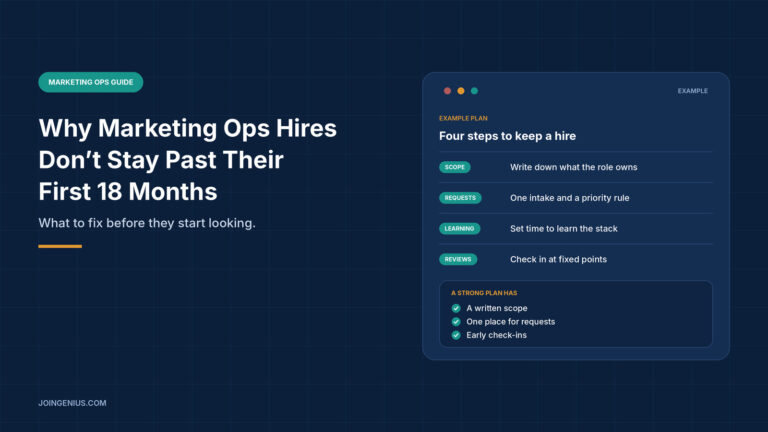
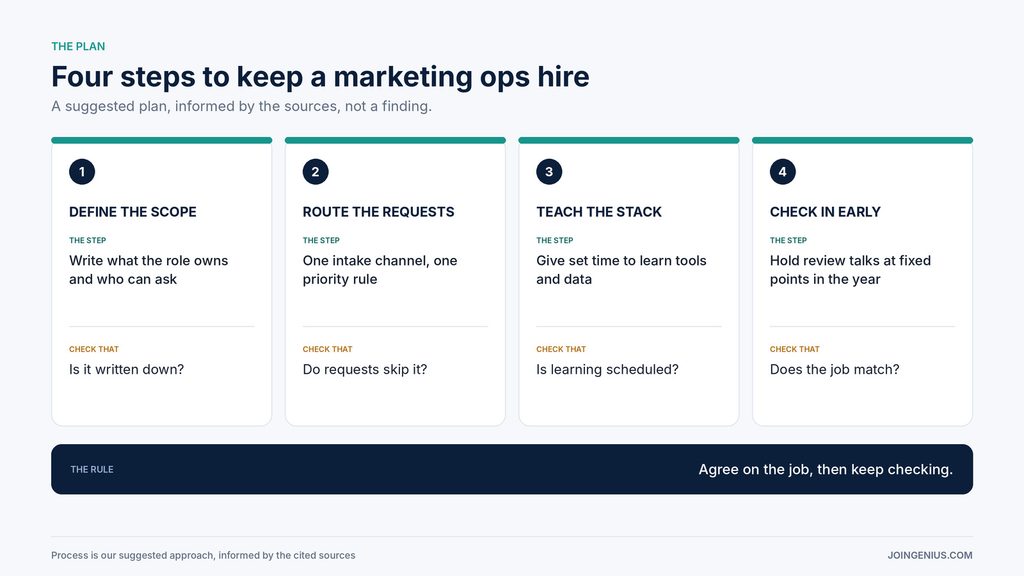
Use this four-step plan for any new marketing ops hire. It is our suggested process, informed by the sources above, and the month markers are not findings.
- Define the scope. Write what the role owns, what it does not, and who can ask for work.
- Route the requests. Set one intake channel and a simple priority rule, so requests do not arrive by hallway.
- Teach the stack. Since the survey above says most people in the field learned on the job, give the hire set time and a named person to learn your tools, your data, and the history behind how they were set up.
- Check in early. Hold conversations at fixed points, such as months 3, 9, and 15, and ask what the job turned out to be and what is missing.
The last step matters because early exits often start with a surprise, and a conversation at month nine is cheaper than a resignation at month fifteen. That is our reasoning. Our guides to preboarding and why onboarding courses fail cover the start of the process.
Measure Whether It Works
Track the age of the oldest open request, the share of requests that arrive through the intake channel, and what the hire says in each check-in about the gap between the posting and the job. Compare retention at 12 and 18 months across your marketing ops hires over time, and note whether the people who left had the same complaints.
On a small team, the numbers will be tiny, so read them as prompts for a conversation and not as proof. These measures are our suggestions, not findings. Our guide to turnover versus attrition helps define the terms, and our guide to low morale covers what to do when signs appear.
Warning Signs Your Marketing Ops Hire May Leave, and What to Do About Each
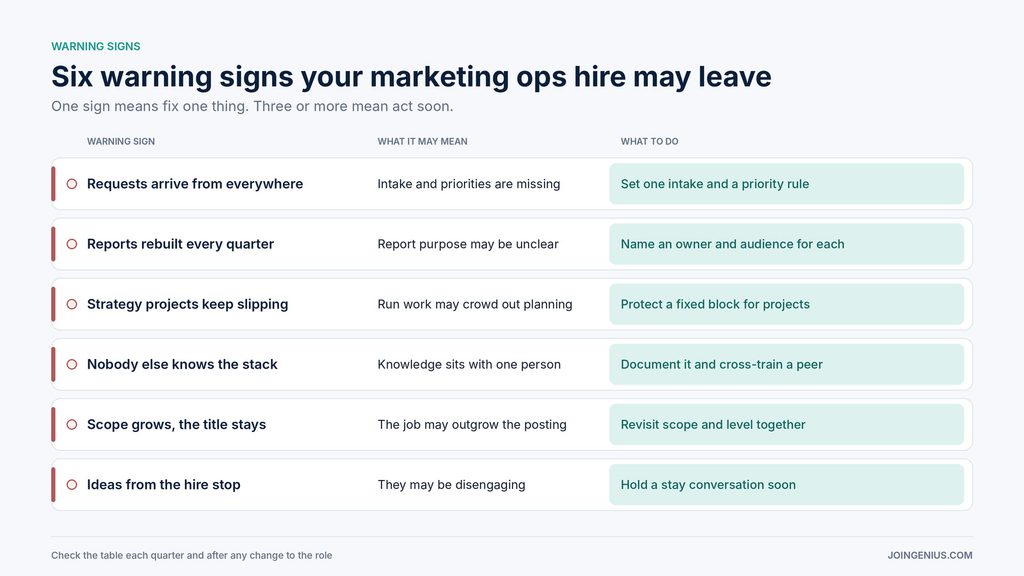
Check this table each quarter. One sign means fix one thing. Three or more mean act soon.
| Warning sign | What it may mean | What to do |
|---|---|---|
| Requests arrive from everywhere | Intake and priorities are missing | Set one intake and a priority rule |
| Reports rebuilt every quarter | Report purpose may be unclear | Name an owner and audience for each |
| Strategy projects keep slipping | Run work may crowd out planning | Protect a fixed block for projects |
| Nobody else knows the stack | Knowledge sits with one person | Document it and cross-train a peer |
| Scope grows, the title stays | The job may outgrow the posting | Revisit scope and level together |
| Ideas from the hire stop | They may be disengaging | Hold a stay conversation soon |
Clarify the Role, Then Check In Early
Marketing ops hires may leave early for ordinary reasons: a job that differs from the posting, requests with no owner, and little time to learn the stack. We found no study proving that fixing these keeps people past 18 months, and the sources behind our advice have limits. But each step replaces a surprise with an agreement you can check. If the new hire can say what the role owns, who can ask for work, and what happens to a request that arrives sideways, you have given them a better reason to stay than a title change alone.