An agency hires a full-stack developer to be the one person who can do it all. By month ten, that developer is fixing one client’s front end, migrating another client’s database, handling a hosting incident and patching a plugin for a third, and nobody has talked about what comes next. At month twelve, the developer hands in notice. That is an illustration, not a case study, but it describes the pattern this guide looks at.
This guide explains why full-stack developers can leave agencies after their first year and what can keep them. It covers why the first year is risky, how a vague “full stack” role causes trouble, what research says about why developers leave, a first-year plan, how to measure it and a table of warning signs. We found no study of why full-stack developers leave agencies after a first year, so the evidence here is general research on turnover and role stress, and the link to agencies is our reasoning. It is general information, and results vary by team.
Why the First Year Is a Risky Window
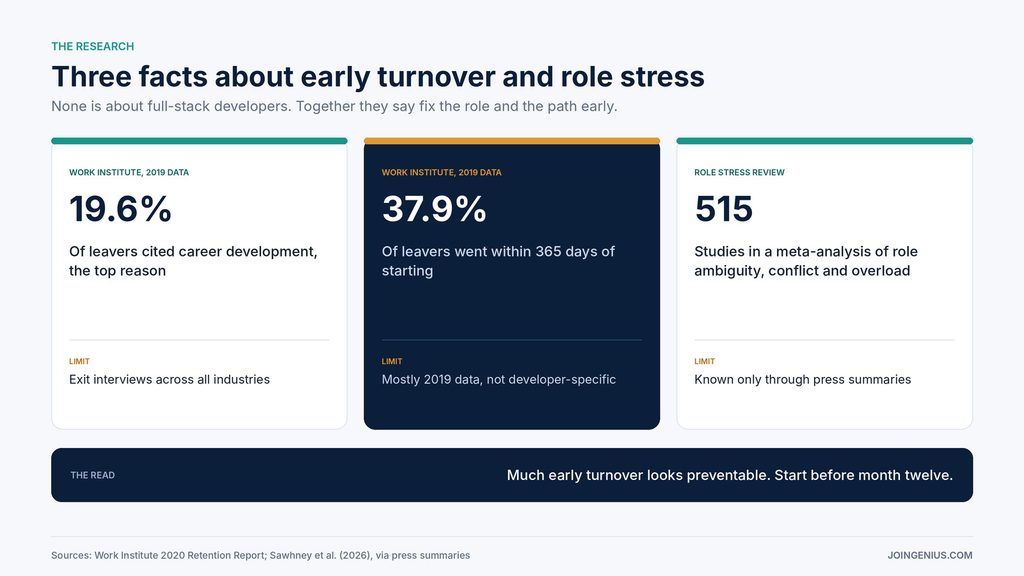
The Work Institute’s 2020 Retention Report draws on exit interviews with more than 233,000 employees from 2010 through 2019. It found that 37.9% of people who left in 2019 did so within 365 days, and that two out of three first-year leavers left in the first six months. It lists career development as the most common reason for leaving at 19.6%, and as the most cited reason in the first 90 days. It judged 77.3% of 2019 turnover to be more preventable. SHRM’s 2025 summary of the institute’s later report puts first-year attrition at roughly 40% of all turnover and names lack of work and life integration as the top reason for first-year departures, though it gives no sample size.
Read these with care. The data covers all industries, not developers or agencies, comes mostly from 2019 and rests on what leavers say in exit interviews. It is also about leaving within the first year, not shortly after it, and we found no data showing a spike at the twelve-month mark. What it supports is a narrower point: career-development problems surface early, and most of the turnover was judged preventable.
For an agency, that matters because a developer’s first months set the picture of what the job will be. That is our reasoning, but it explains why a plan that starts at the annual review can be too late.
Define What “Full Stack” Means in Your Agency Before You Hire One
A vague role is the first thing to fix. Oflox’s guide to full stack web development defines the field as “building and managing both the front-end and back-end parts of a website or web application,” and its FAQ describes the developer as someone who can work across the browser interface, server logic, database and deployment. The guide adds that full-stack developers are not always dedicated DevOps engineers, and it warns about unrealistic employer expectations, saying the title should mean “cross-functional capability” and not unlimited responsibility. The page is a general introduction published on 26 August 2026 by the company’s editorial team. It has no data on agencies or retention, so we use it for the definition and the warning only.
Role stress research gives a reason to care. A meta-analysis in the Journal of Vocational Behavior by Gargi Sawhney and colleagues (2026) reviewed 515 studies of three role stressors: role ambiguity, role conflict and role overload. Press summaries describe role ambiguity as the most damaging overall and link role stress to burnout and intent to quit. We could not open the paper, and the summaries disagree on details such as the number of participants, so treat the findings as reported, not verified. They also concern employees in general, and intention to leave is not the same as leaving.
For an agency, the practical fix is a one-page role scope. List the layers the developer owns, the layers they support and the work that is out of scope, such as infrastructure or design. Name who decides when a client asks for something outside it. This is our suggestion, not a tested method, but it turns “full stack” from an open-ended title into a defined job. Our guide to hiring full-stack growth engineers shows how specific a full-stack brief can get.
What the Research Says About Why Developers Leave
A study by Tiago Massoni and colleagues surveyed 78 software developers in Brazil who had voluntarily left a job. Autonomy was the lowest-scoring job characteristic, with a mean of 3.75 on a 1 to 7 scale, and 52.6% of answers fell below 4. It used a convenience sample, it did not separate agencies from product companies and it did not cover tenure, and its authors say the results cannot be generalised. It suggests autonomy deserves attention, not that it explains your departures. In agency work, a client’s deadline can decide what a developer does each day, which is our reasoning, so ask developers how much say they have over how the work gets done and not only what the work is.
Agency data is thin. The Drum’s 2022 Agency Wellbeing Census surveyed over 200 UK advertising and marketing agencies and found that the most common reasons staff left were moving for higher pay, more responsibility or a change of location. It covers marketing agencies, not development agencies, and the article gives no method, so we use it only as a hint that responsibility and pay both matter.
The Work Institute adds a caution about pay. It lists compensation at about 9% of reasons for leaving and says pay is a cause sometimes but not always. So a raise on its own may not fix a role or career problem.
What Keeps Them: A First-Year Plan
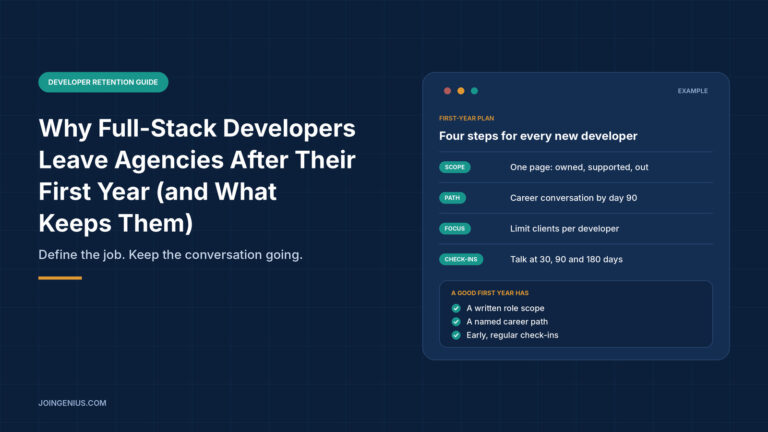
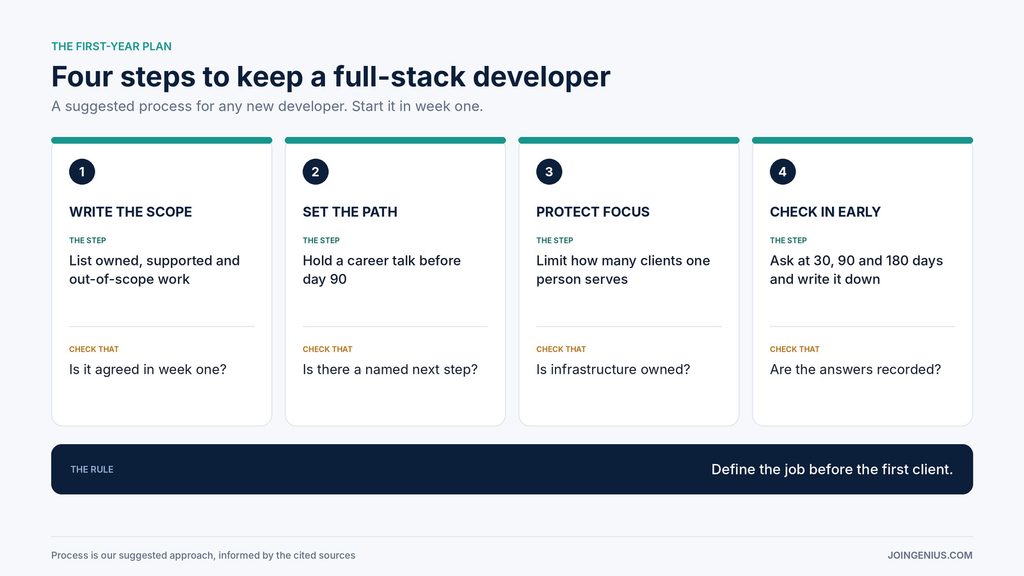
Use this four-step plan for any full-stack developer in their first year. It is our suggested process, informed by the sources above.
- Write the scope. Put the owned, supported and out-of-scope work on one page and agree it in the first week.
- Set the path. Hold a career conversation by day 90, since the Work Institute found career development the most cited reason in that window.
- Protect focus. Limit how many clients one developer serves at once, and keep a named owner for infrastructure work.
- Check in early. Ask at 30, 90 and 180 days what is working, what is not and what they want next, and write down the answers so the same questions can be compared across developers.
The third step is the one agencies find hardest, because client demand is uneven. We found no research on how many concurrent clients a developer can handle well. A reasonable first step is to track it, notice when a developer is covering several at once and ask whether that is by choice.
Preparation starts before day one, and our guide to preboarding employees covers what to send. For early signals, the onboarding and retention statistics give context, and the employee retention strategies guide covers the wider picture. If the role is a junior one, see how to source junior developers who can ship code.
Measure Whether It Works
Track the share of developers still in the role at 90 days, six months and twelve months, the share who have a written scope and the reasons given by each leaver, coded the same way every time. On a small team, one departure proves little, so look for a pattern over several. Compare leavers’ stated reasons with what stay conversations told you, because people often say different things at different moments. Review the written scope each quarter as well, since client work changes and a scope that was fair in month one can quietly stretch.
A different pull, such as freelance work, can also take developers away, and our piece on retaining senior designers who want to write code covers a similar tension for another role.
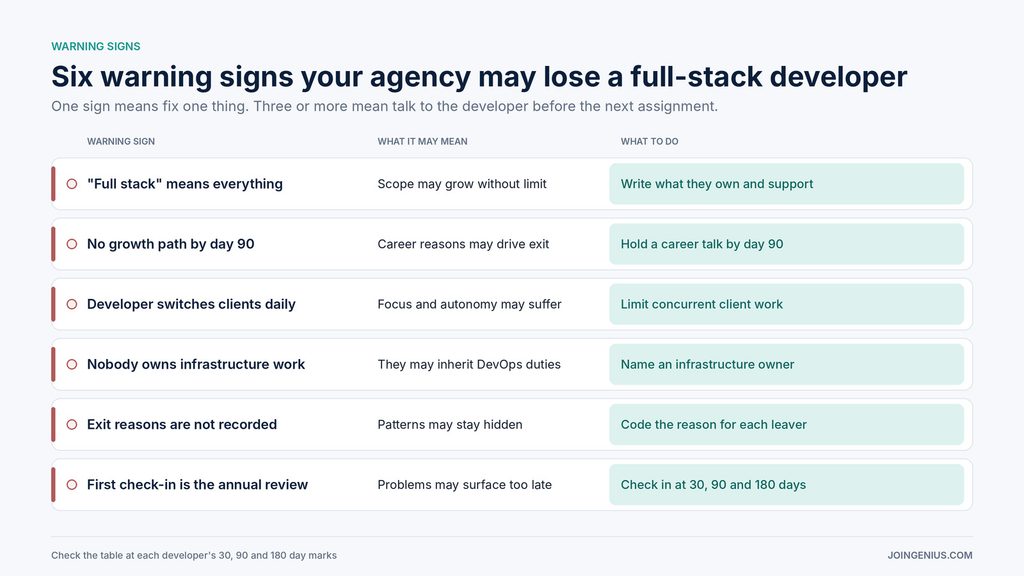
Warning Signs Your Agency Is About to Lose a Full-Stack Developer, and What to Do About Each
Check this table at each developer’s 30, 90 and 180 day marks. One sign means fix one thing. Three or more mean pause and talk to the developer before the next client assignment.
Define the Job, Then Keep the Conversation Going
Full-stack developers can leave agencies for reasons the general research suggests are often preventable: an unclear role, a missing career path and too little say over their work. We found no study that proves this for agencies, but the pieces point the same way. Write the scope, hold the career conversation early, limit how many clients one person carries and keep checking in. If the scope, the path and the stated reasons for leaving line up, you have a better basis for keeping developers than any guess about why they go.