The résumé looked right. The course list was long, the portfolio had a few projects, and the interview went smoothly. Then the new junior developer started, and a small change that should have taken a day stretched into weeks. Not because they were lazy or unintelligent, but because finishing and delivering code is a different skill from studying it.
That gap is the heart of junior hiring. Certificates and course lists show what someone has learned. They say very little about whether that person can take a small task from start to finish, test it, fix what breaks, and hand it over in a state the team can use. If you are building a technical talent pipeline, the juniors who matter most are the ones who have already shown they can deliver.
This guide covers what “ships code” really means, where to find juniors who have practiced it, how to test for it fairly, and how to help them deliver in their first month.
Why Many Junior Developers Struggle to Ship
Most training teaches people to write code in isolation. A lesson gives a clear problem, a clean environment, and a known answer. Real work looks different. The problem is vague, the codebase already exists, and nobody hands over the answer.
Several gaps show up again and again. Many juniors have little experience with version control beyond the basics, so branching, merging, and resolving conflicts feel risky. Many have rarely read someone else’s code, which makes any existing project intimidating. Many have not learned how to debug methodically, so when something fails they guess instead of narrowing down the cause.
There is also a habit gap. Juniors often wait too long to ask for help, either because they fear looking weak or because they do not yet know what a good question looks like. A task that should have taken an afternoon quietly turns into a week of silent struggle.
None of these gaps is fatal. They are all learnable, and the right junior closes them quickly. The goal of sourcing is to find people who have already started closing them.
What “Ships Code” Actually Means
Shipping is more than writing code that works on one machine. It is the whole loop of taking a task, building it, checking it, and delivering it so that others can rely on it.
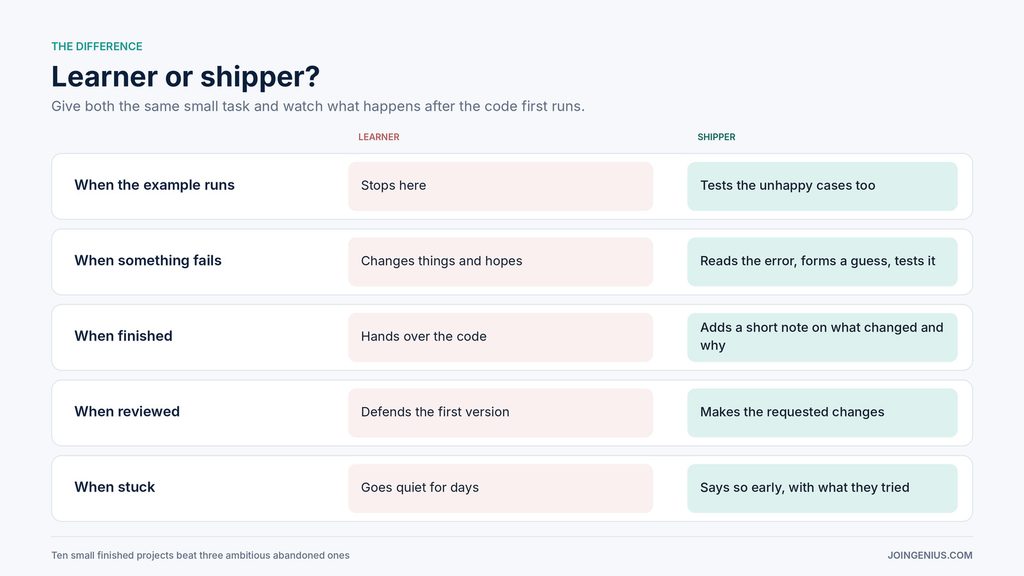
A learner follows the steps in a guide and stops when the example runs. A shipper keeps going. They test the unhappy cases, clean up the result, and write a short explanation of what changed and why. They respond to review comments without defensiveness and make the requested changes. When they get stuck, they say so early and describe what they have already tried.
A shipper also finishes small things. A junior who has completed ten small projects, even simple ones, usually has more practical value than one who has started three ambitious ones and abandoned them. Look for evidence of completion: a working app someone can use, a repository with a clear readme, a merged contribution to someone else’s project.
This matters because teams do not need juniors to be brilliant on day one. They need juniors who can pick up a small task, finish it, and learn from the feedback. Those habits compound quickly.
Where to Find Junior Developers With Real Output
The best sourcing channels are the ones where people have to produce something, not just attend something.
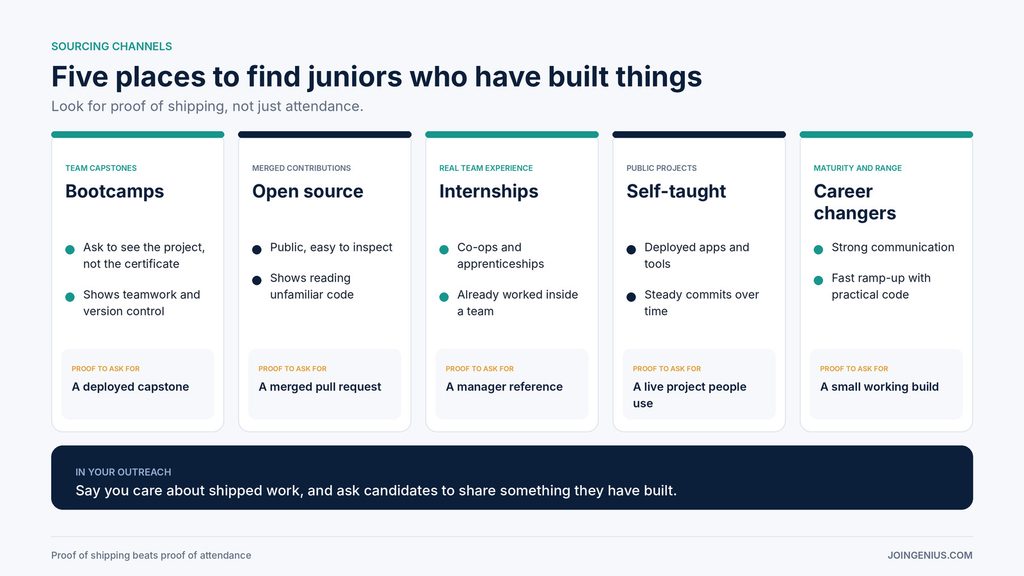
Bootcamps are a useful starting point, particularly those that end with a capstone project built by a team. Ask to see the project, not just the certificate. A team project shows how someone works with others, uses version control, and handles disagreements about design.
Open source contributors are another strong source. Even a small, merged contribution shows that someone can read an unfamiliar codebase, follow contribution rules, and respond to review. Their public history is also easy to inspect.
Internship and apprenticeship programs produce juniors who have already worked inside a real team. Universities with co-op placements, and local employers who run apprenticeships, are worth building relationships with.
Self-taught builders with public projects can be excellent. Look for a deployed app, a tool that other people use, or a record of steady commits over time. The habit of finishing and maintaining a project is more important than where the person learned.
Career changers bring maturity and often strong communication skills from a previous field. Pair that with evidence of practical coding, and they can ramp up fast.
When your own team does not have time to run a broad search, a specialist partner can help. This guide to IT staffing agencies explains how to compare agencies and what to ask before you sign. Whatever the channel, say in your outreach that you care about shipped work, and ask candidates to share something they have built.
Let Candidates Write, Run, and Debug Code Before You Decide
A résumé shows what someone claims. A short practical task shows what they can do. For juniors, this is the most reliable screen you can run.
A short task in a browser-based online compiler and debugger lets you watch a candidate write, run and debug a small program while you talk it through.
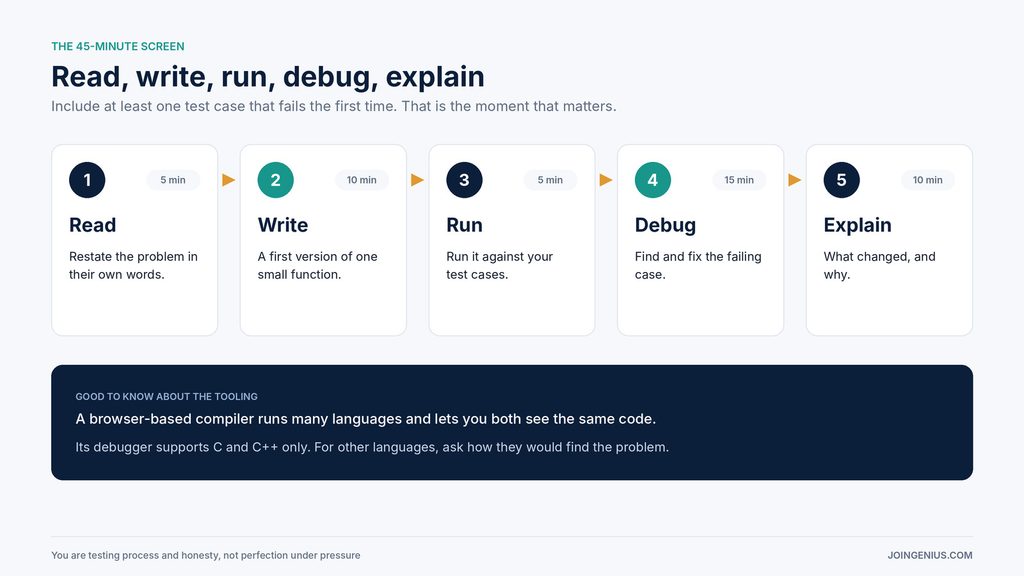
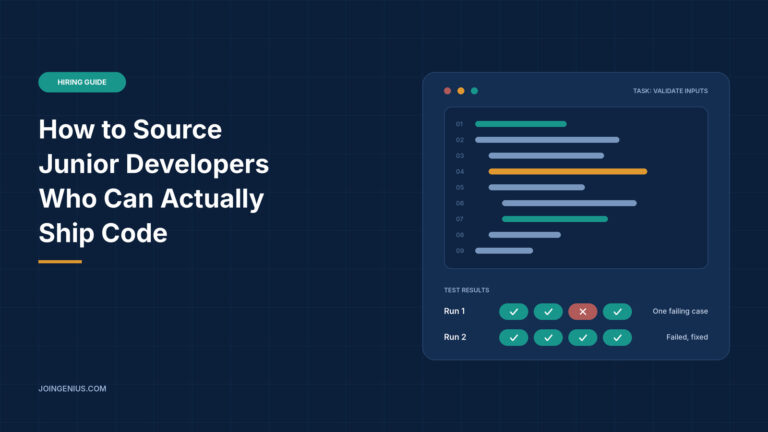
Keep the task small and realistic. Forty-five minutes is enough. Give the candidate a short description and a function to write, such as cleaning up a list of records or checking whether a set of inputs is valid. Include a few test cases and make sure at least one of them fails the first time the code runs. That moment matters most, because you want to see what the candidate does when something breaks.
Run the session in five steps. First, ask them to read the problem aloud and restate it in their own words. Second, let them write a first version. Third, have them run it against your test cases. Fourth, watch how they debug the failing case. Fifth, ask them to explain what they changed and why.
A browser-based tool keeps the session simple, because the candidate can share a link and you can both see the same code. It is also worth knowing the limits. OnlineGDB runs many languages, but its debugger currently supports only C and C++. For other languages, the candidate can still run code, and you can ask them to talk through how they would find the problem, using print statements or reasoning step by step.
Be clear about what you are testing. You are not looking for a perfect solution under pressure. You are looking for a clear process, honest communication, and the ability to recover from an error.
How to Assess What You See
The best signals come from how a candidate behaves, not only from the final answer.
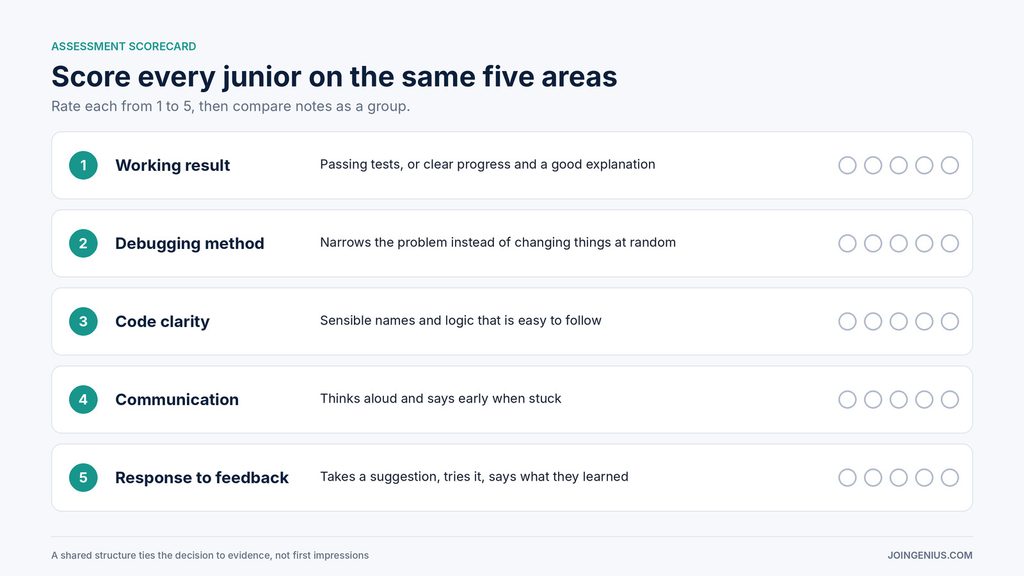
Start with the working result. Did they reach code that passes the tests, or at least make clear progress? A partial solution with a good explanation is better than a finished one the candidate cannot describe.
Look closely at the debugging method. Strong juniors narrow the problem. They read the error, form a guess, test it, and move on if it is wrong. Weaker candidates change things at random and hope. Watching this for ten minutes tells you more than any quiz.
Check code clarity. Are the names sensible, is the logic easy to follow, and did they leave the code tidier than they found it? Small habits show up here.
Pay attention to communication. Do they think aloud, ask a clarifying question, or tell you when they are stuck? A junior who communicates early is far easier to manage than one who goes quiet.
Finally, test their response to feedback. Offer a small suggestion near the end and see what happens. Candidates who take it, try it, and say what they learned are the ones who will improve fastest.
Score every candidate on the same five areas and compare notes as a group. A shared structure keeps the decision tied to evidence. It also helps you avoid a common trap, which is described in this article on why technical hiring fails when roles are described vaguely: if your job description and your screen do not match the real work, you will select for the wrong skills.
Setting Juniors Up to Ship in the First 30 Days
Sourcing the right person is only half the job. The first month decides whether they ship or stall.
Give them a small first task, ideally one that can be finished in the first week. Name a reviewer who will respond quickly and kindly. Define what “done” looks like, including tests and a short description of the change. Then encourage them to ask questions early, and make clear that doing so is expected.
A first merged change builds confidence and momentum. From there, increase the size of the tasks gradually, and keep reviews constructive so the junior learns the team’s standards without feeling judged.
Hire for Evidence of Finishing
The juniors who ship are rarely the ones with the longest list of courses. They are the ones who have finished things, learned from feedback, and kept going when the first attempt failed. Look for that evidence, source from places where people build real things, and give candidates a fair way to show you what they can do.
A practical first step is to replace one résumé screen with a 45-minute practical task, scored on the same five areas for every candidate. If you are deciding whether to grow juniors from within or to bring in new talent, this comparison of internal vs external recruitment can help you weigh the trade-offs before you start the search.