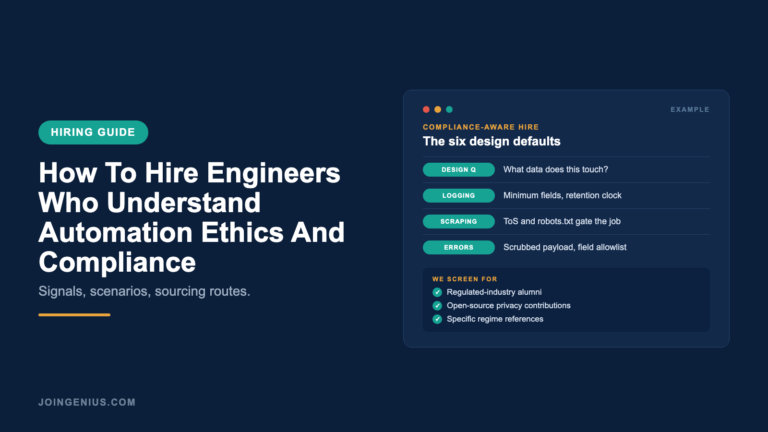
An engineer who automates well can push a scraper or pipeline before anyone in legal reacts. That speed turns into a liability the moment the code brushes against user data or a competitor’s terms of service. Hiring engineers who understand automation ethics and compliance means recruiting people whose first design question is where the limits are.
What follows is the competency breakdown and the resume signals that reveal it. Interview questions and sourcing routes come next, then the mistakes that produce compliance blind spots — the stuff modern hiring for startups depends on getting right.
What “Automation Ethics And Compliance” Actually Means For An Engineer
The phrase “automation ethics and compliance” sounds vague until you watch the same engineer make 30 small decisions a day. Each one quietly moves the company closer to or further from a regulatory letter.
The Three Failure Modes Without Compliance Instincts
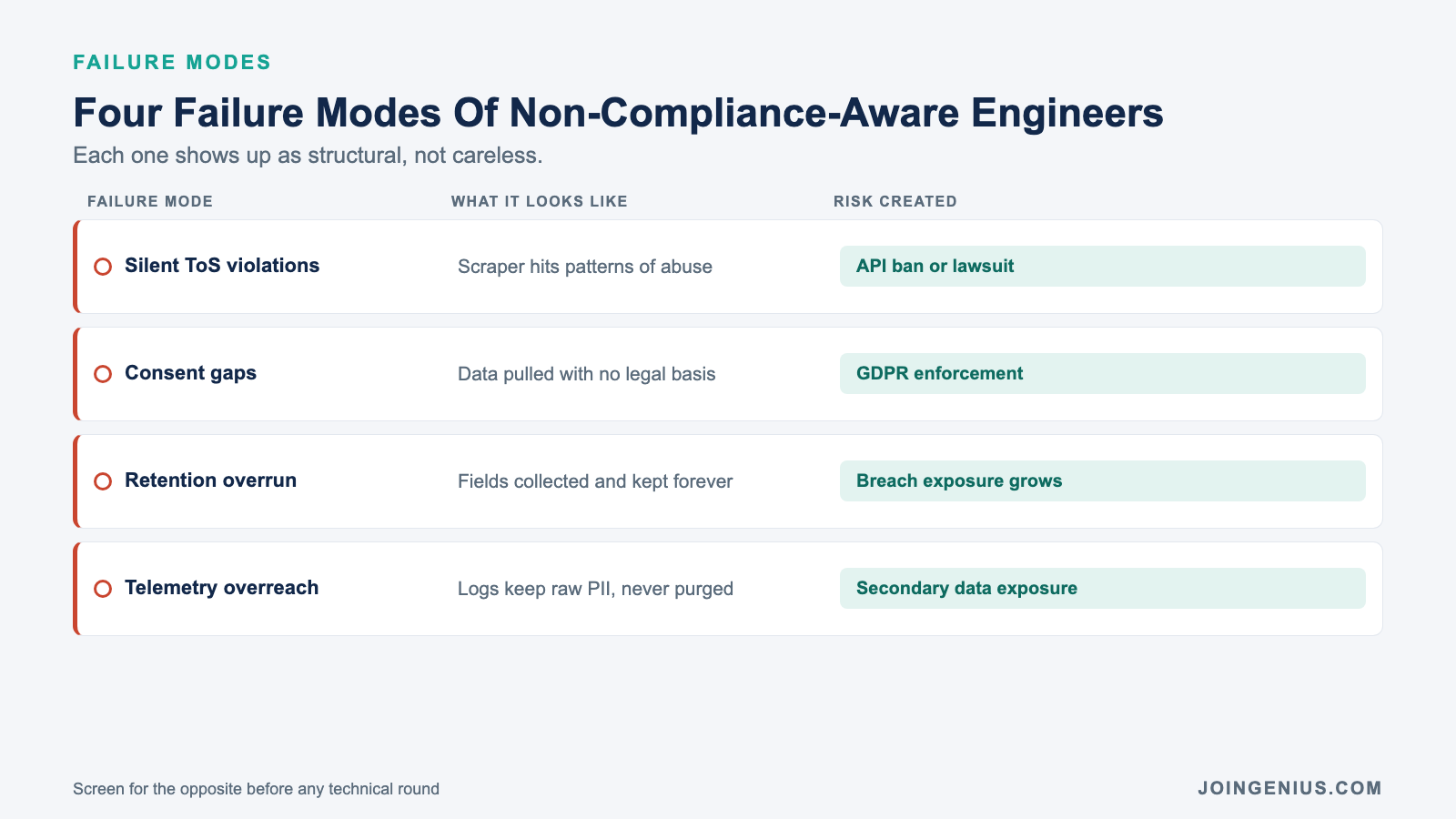
Engineers who lack this instinct fail in four repeatable ways. The failures are structural, not careless, which is why screening spots them before the hire.
- Silent terms-of-service violations: scraping or API usage that pattern-matches to abuse before anyone notices.
- Consent gaps: data pulled without a clear legal basis, especially across EU users.
- Retention overrun: automation that collects more fields than the privacy notice promised, forever.
- Telemetry overreach: log pipelines that keep raw PII the system never needed.
Where Ethics Shows Up In Day-To-Day Engineering Decisions
Day-to-day, this looks like deciding whether a scraper respects robots.txt and polite rate limits. It also means asking whether a retry queue preserves raw user emails or hashes them. The same question extends to whether a webhook strips headers that could leak a session token, or whether a user-export job honors deletion requests.
Teams running web-scraping workloads often route bot-challenge handling through specialized vendors — CAPTCHA-solving services with a defined compliance perimeter are one example — because keeping that logic in-house makes it harder to audit which domains the automation hits and under what terms.
A senior engineer reads that choice as a design decision with legal implications, not just a performance one.
Why This Is A Technical Competency, Not A Soft Skill
A common mistake is treating compliance as something legal handles later. In practice, it shows up as specific code: field-level encryption and consent-token checks before any outbound call. It also means kill switches that work when something misfires.
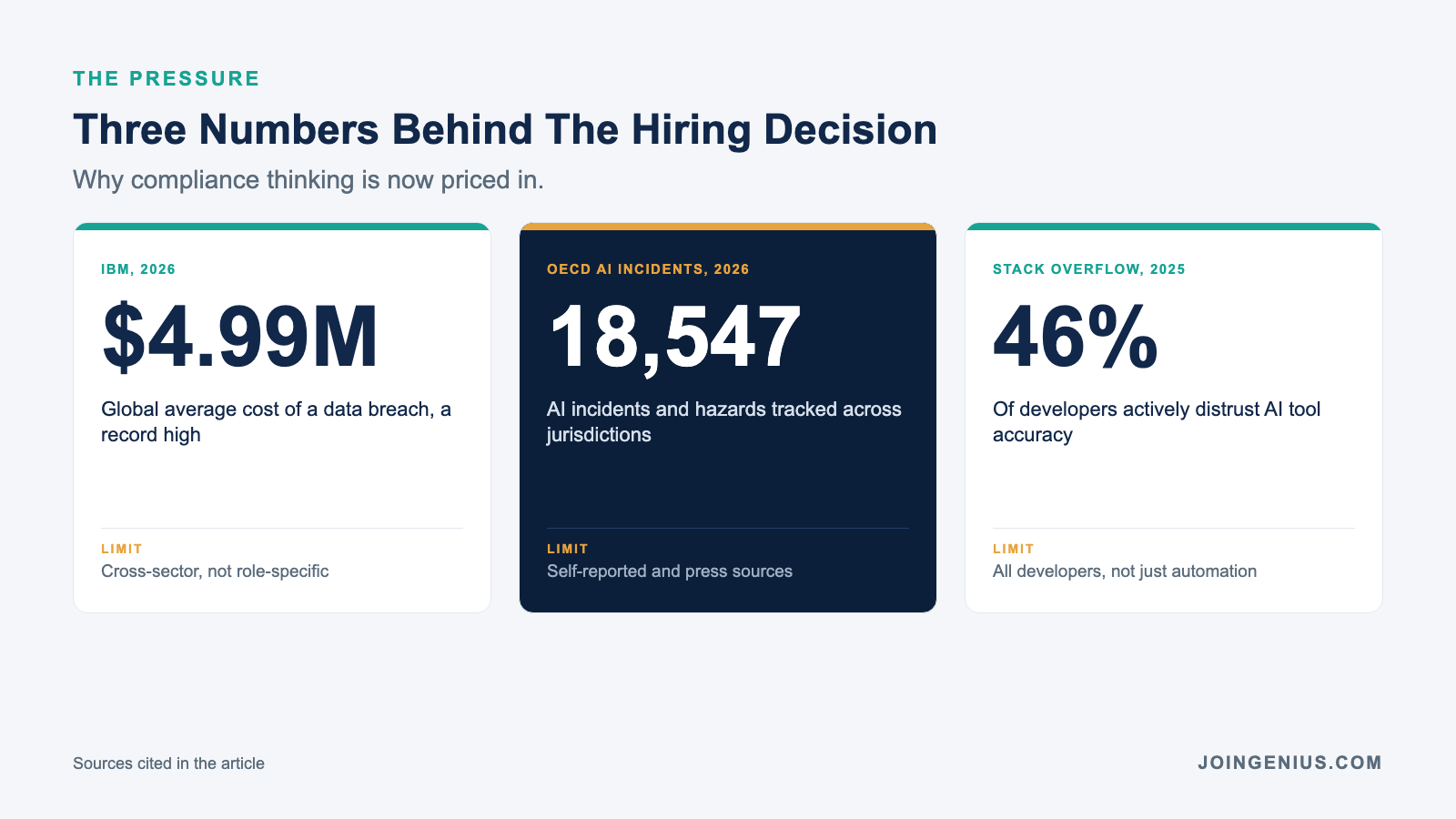
An engineer who treats ethics as architecture writes different services than one who treats it as paperwork. IBM’s 2026 Cost of a Data Breach Report puts the global average breach at $4.99 million, a 12% jump and a record high — numbers that trace back to code-level decisions senior engineers make.
Resume And LinkedIn Signals That Reveal The Right Instincts
Most engineers with real automation ethics and compliance instincts do not label themselves that way. The signals are indirect, and knowing which ones to read saves hours of interview time with candidates who were never going to pass the privacy conversation.
Projects That Reference Specific Regimes
Candidates who have shipped under GDPR or SOC 2 usually mention the regime by name alongside a specific control they implemented. HIPAA and PCI DSS show up the same way on healthcare and payments resumes.
A line like “reduced data-residency violations by 83% via a region-aware worker pool” says more about compliance maturity than a dozen certifications. Formatting matters too — a weak resume hides these signals, so strong recruiters correct for how resume formatting kills strong candidates before dismissing anyone.
Open-Source Contributions And Policy Memos
Public work tells you how someone thinks when no one is grading them. Pull requests to privacy libraries or consent-management SDKs are a start. Merged RFCs that debated a data-retention tradeoff in public are stronger — they show how the candidate argues for user limits under pressure.
Red Flags Worth Taking Seriously
The strongest negative signals are generic. Resumes that claim “best-in-class security practices” without citations usually mean the candidate inherited the practices rather than built them.
The Stanford AI Index 2025 report counts 59 AI-related regulations introduced by U.S. federal agencies in 2024, more than double the 2023 number — a candidate whose only compliance language is “best practices” hasn’t tracked what shipped. Side projects that scrape without acknowledging source ToS are the other classic red flag.
Interview Questions That Separate Theory From Practice
Scenario questions beat trivia on frameworks because trivia rewards the people who read a GDPR summary once. The scenarios should mirror a Monday morning at the candidate’s last job.
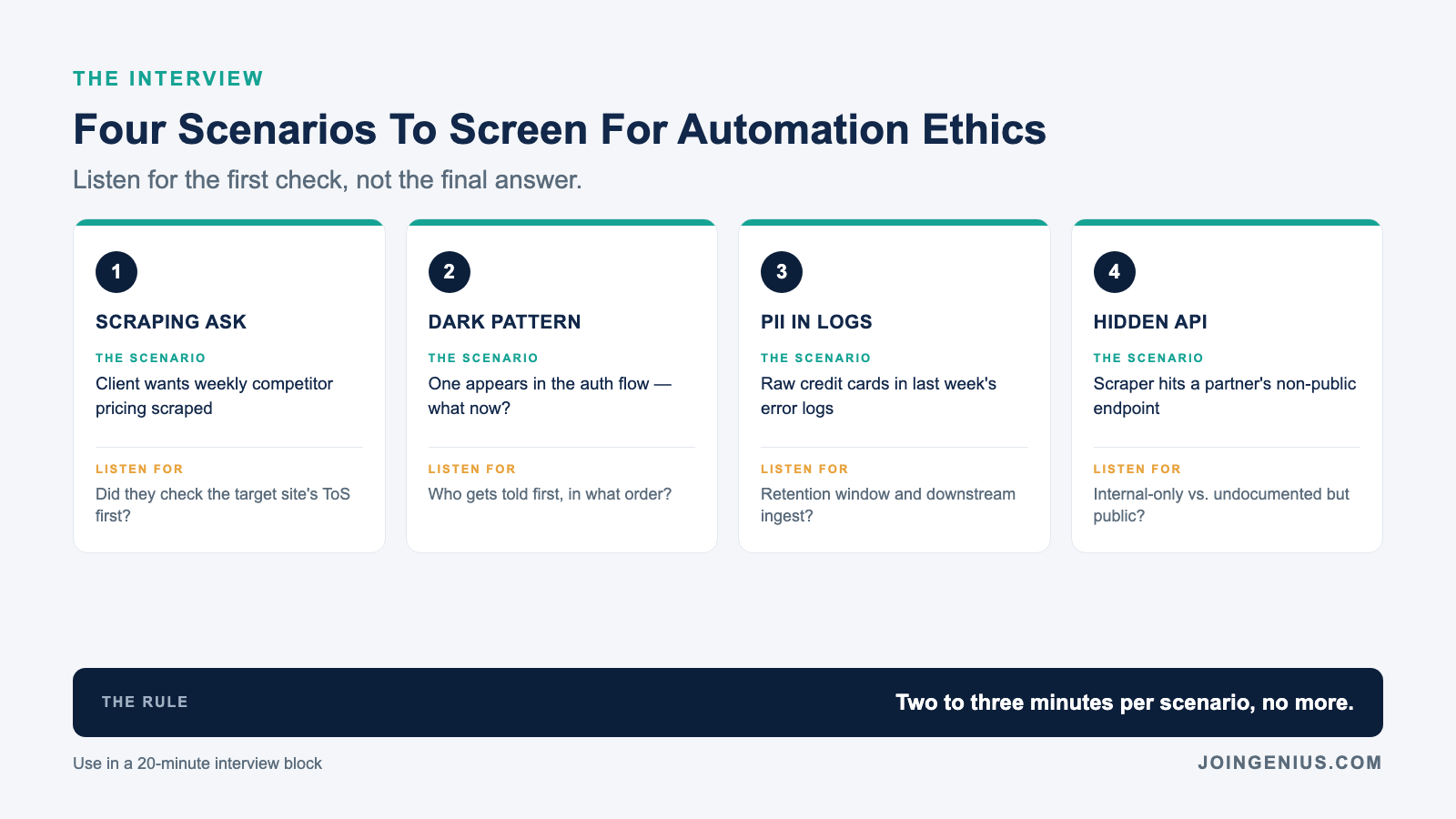
Four Scenarios Worth Asking
These fit a 20-minute technical interview block. Give the candidate two to three minutes per scenario and listen for the first thing they check, not the final answer.
- Scraping: client asks for weekly competitor pricing scraped — what do you check first?
- Dark patterns: one appears in the auth flow — what is your first move?
- PII in logs: you discover raw credit card numbers in last week’s error logs.
- Undocumented API: a scraper hits a partner’s non-public endpoint — defend or stop it?
How To Grade The Answers
The strong candidate’s first move on scraping is to ask what the site’s ToS say about automated access and what data the client needs. On dark patterns, they describe who gets told first and in what order, before they touch any code.
On the PII-in-logs case, they want retention windows and whether downstream systems ingested the logs. On the undocumented API, they separate an endpoint that is undocumented but publicly exposed from one clearly meant to be internal.
Engineers themselves are losing trust in the automation they ship. The Stack Overflow 2025 Developer Survey found 46% of developers actively distrust AI tool accuracy, and security or privacy concerns rank first among reasons they reject a new tech — a candidate who shrugs off these scenarios is further from the mainstream than they realize.
Where To Source Engineers Who Already Think This Way
The right candidates rarely come from a cold search for “automation ethics and compliance.” They come from pools where compliance work was the default job, not an afterthought.
Regulated-Industry Alumni
Alumni of fintech and healthtech have usually shipped inside controls someone else wrote for at least 18 months. Adtech engineers who came up after GDPR took effect carry the same habits. They ask about audit trails before anyone requests them, and default to opt-in flows because the opposite was expensive at their last job.
Communities And Signal-Rich Conferences
OWASP chapters and the PETS symposium reliably produce engineers who argue about threat models in public. The FOSDEM privacy track adds a European open-source angle useful for GDPR-shaped work.
Open-source maintainers of consent and privacy tooling are a smaller but higher-yield pool. Finding them often means sourcing founding engineers in reverse — tracing commits and merged RFCs back to names rather than pushing a req to a job board.
Offshore Markets Worth Rethinking
The Philippines and LATAM are deeper than most US hiring managers expect on compliance work. BPO sectors in both regions have shipped under PCI DSS and SOC 2 for over a decade. The fintech boom across Mexico and Brazil has produced engineers whose first jobs were under CNBV or Bacen scrutiny.
Treating remote hiring from other countries as a compliance upgrade — rather than a cost play — changes a company’s defaults. The OECD AI Incidents Monitor already tracks around 18,547 AI incidents and hazards, which is why engineers who grew up inside active regulatory regimes are a direct hiring advantage.
Hiring Mistakes That Produce Compliance Blind Spots
The mistakes are usually structural, not personal. Each one looks reasonable in isolation and compounds across the first three hires on an automation team.
The Four Mistakes That Keep Showing Up
These patterns keep repeating in post-incident retros, even at companies that otherwise take compliance seriously.
- Hiring purely on throughput metrics like PRs merged weekly or records scraped daily.
- Letting legal review happen after launch, when a redesign costs ten times more.
- Scoring “move fast” culture-add signals that implicitly penalize candidates who ask hard questions.
- Outsourcing compliance to the DPO alone, so engineering never owns the decisions it ships.
Shipped-Fast Hire Vs. Compliance-Aware Hire
The clearest way to see the gap is to compare six decisions as each archetype would answer them.
| Decision | Shipped-Fast Hire | Compliance-Aware Hire |
|---|---|---|
| First design question | How fast can this run? | What data does this touch? |
| Logging default | Everything, forever | Minimum fields with a retention clock |
| Retry handling | Retry blindly | Retry with idempotency and PII masked |
| Scraping targets | Public URL is fair game | ToS and robots.txt gate the job |
| Error reporting | Full payload to Sentry | Scrubbed payload with field-level allowlist |
| Vendor choice | Cheapest API that works | Cheapest API that documents its data flow |
Clean recruiting metrics make the gap visible. Measuring recruiting ROI at 90 days shows how compliance-aware hires cut incident costs that would never appear on a throughput dashboard.
Conclusion
Hire engineers who understand automation ethics and compliance by hiring for the instinct — the one who asks “should we?” before “can we?” That instinct is harder to teach than any framework, and it carries the automation layer long after the current compliance regime gets replaced by the next.
At Genius, we place offshore engineers across the Philippines and LATAM at roughly 80% less than US salaries, targeting the top 1% of each market. Placements come with a 6-month replacement guarantee and no monthly fees, which is why operators building regulated automation teams come to us first. For engineers who read these signals before shipping, talk to us.