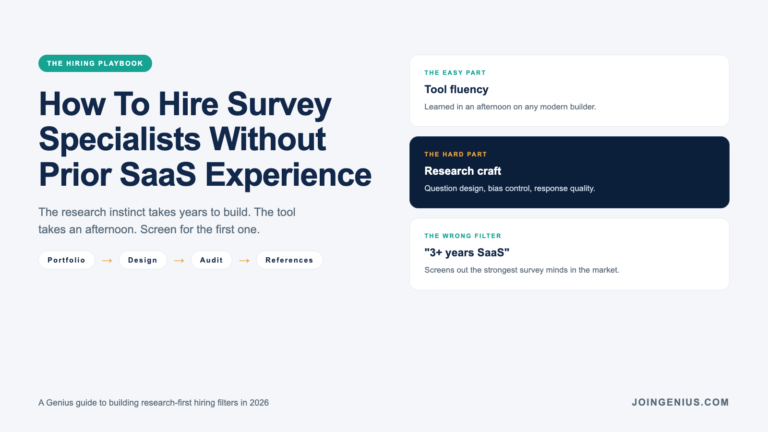
The “3+ years SaaS experience required” line at the top of your survey specialist job post is quietly filtering out the people who would actually make the function work. The ones who stay in the pipeline know the tools you used in your last job. The ones you lose know how to ask a question that produces a usable answer. These are not the same skill, and in 2026 the second one is far harder to find and far harder to teach.
That gap is widening. Modern hiring workflows have made it easier than ever to pattern-match on logos and tool stacks, which is exactly why the hiring teams that beat the market now screen for research instincts first and tool background second. Below, we cover why the SaaS filter is quietly costing you senior candidates and what actually predicts a strong survey specialist. We also cover the screening process that surfaces them, plus the hiring moves to stop making before the next bad hire slows a quarter of research work.
Tool Fluency Is The Easy Part
The research instinct is the part that takes years to build. It means knowing which question to ask and when the sample is lying before the data lands. The tool is the part a smart hire owns by the end of their second week.
Modern Builders Collapse The Learning Curve
Twenty years ago, a survey specialist needed to know a specific vendor stack because every platform worked differently. In 2026, drag-and-drop builders and AI-assisted question generation mean that the tool side of the role is nearly interchangeable across platforms.
What That Changes For Hiring
A survey specialist from a non-SaaS background can learn a modern builder like Youform in an afternoon. Screening on the research craft (question design and bias control) pays off far more than screening on prior SaaS logos, and the signal that holds up across industries is response quality on the surveys they have actually fielded.
Where The SaaS Filter Hurts You Most
A requirement of “3+ years at a B2B SaaS company” filters out academic researchers and government surveyors. It also filters out market research agency staff and journalism-adjacent researchers. All four groups usually have more rigorous training on question design than the median SaaS insights hire, and the filter is cheap to apply but expensive to live with.
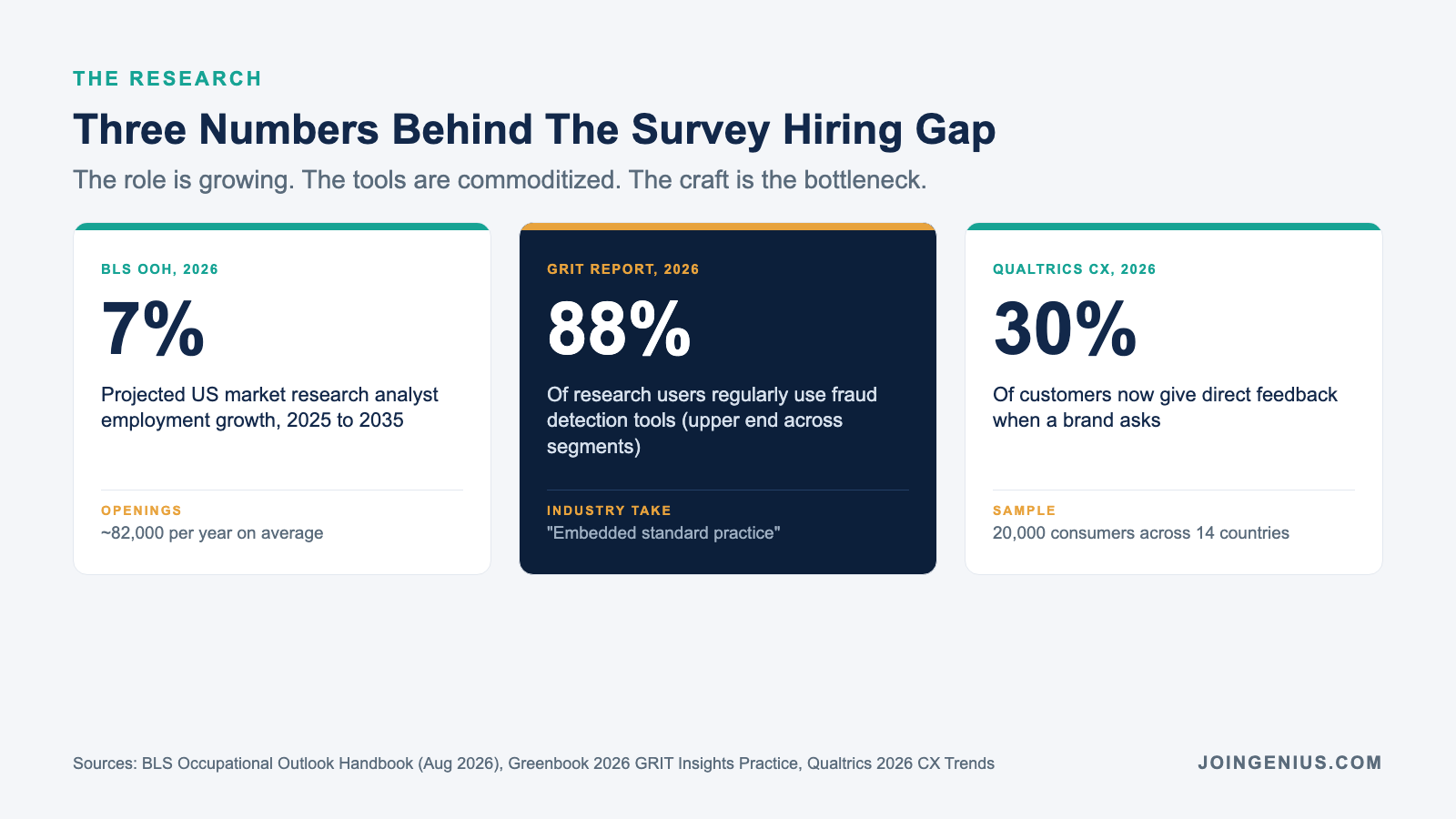
The US Bureau of Labor Statistics Occupational Outlook Handbook for Market Research Analysts, last updated August 2026, projects 7% employment growth for the role from 2025 to 2035 and roughly 82,000 openings per year on average over the decade. The research function is a growth role, not a shrinking one, and the SaaS filter is the thing standing between you and the people who already know how to run it.
What Actually Predicts A Strong Survey Specialist
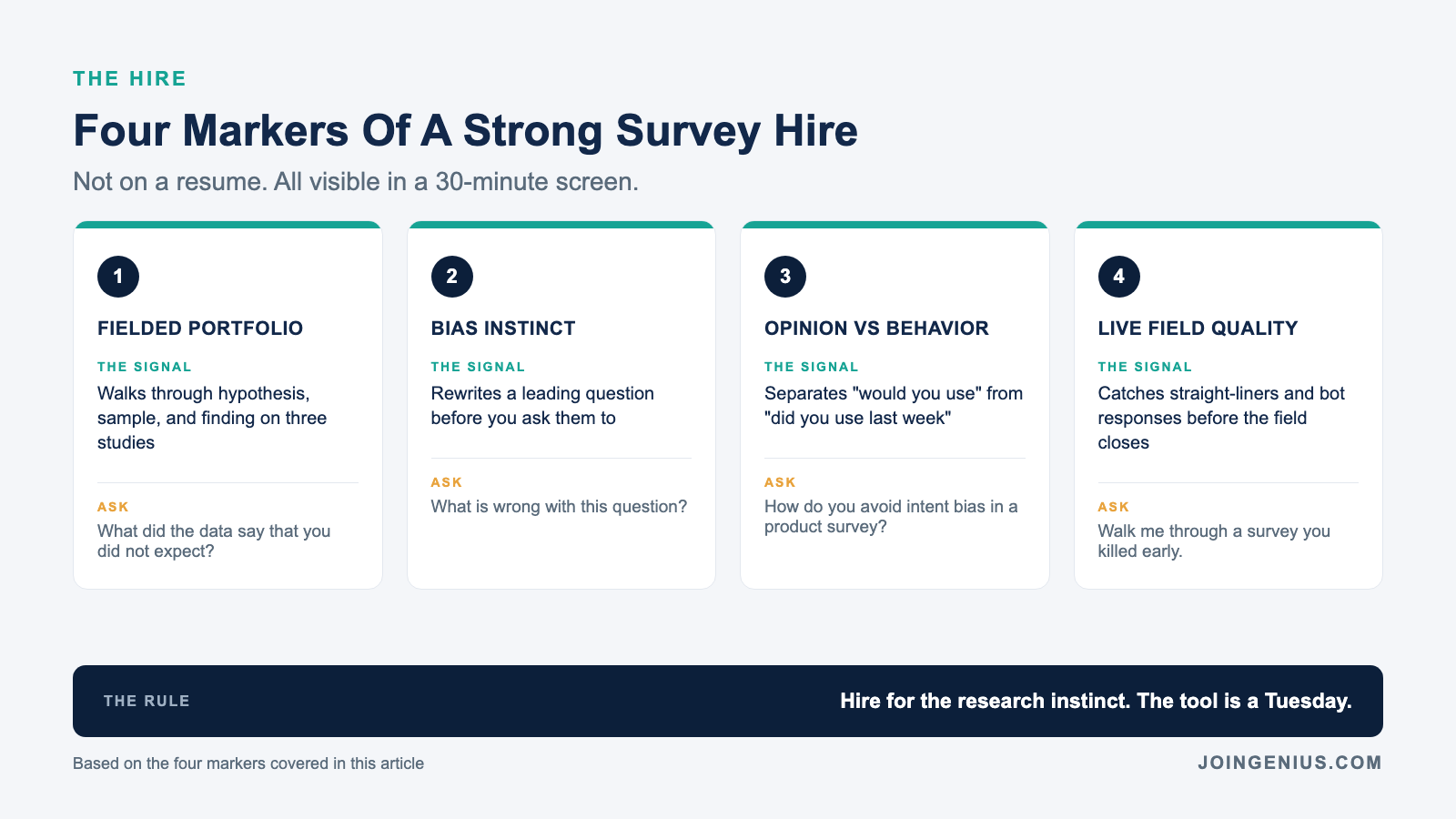
If prior SaaS tenure is not the signal, what is? Four markers consistently separate strong survey hires from average ones, and only one of them appears on a resume.
A Portfolio Of Fielded Surveys, Not A List Of Platforms
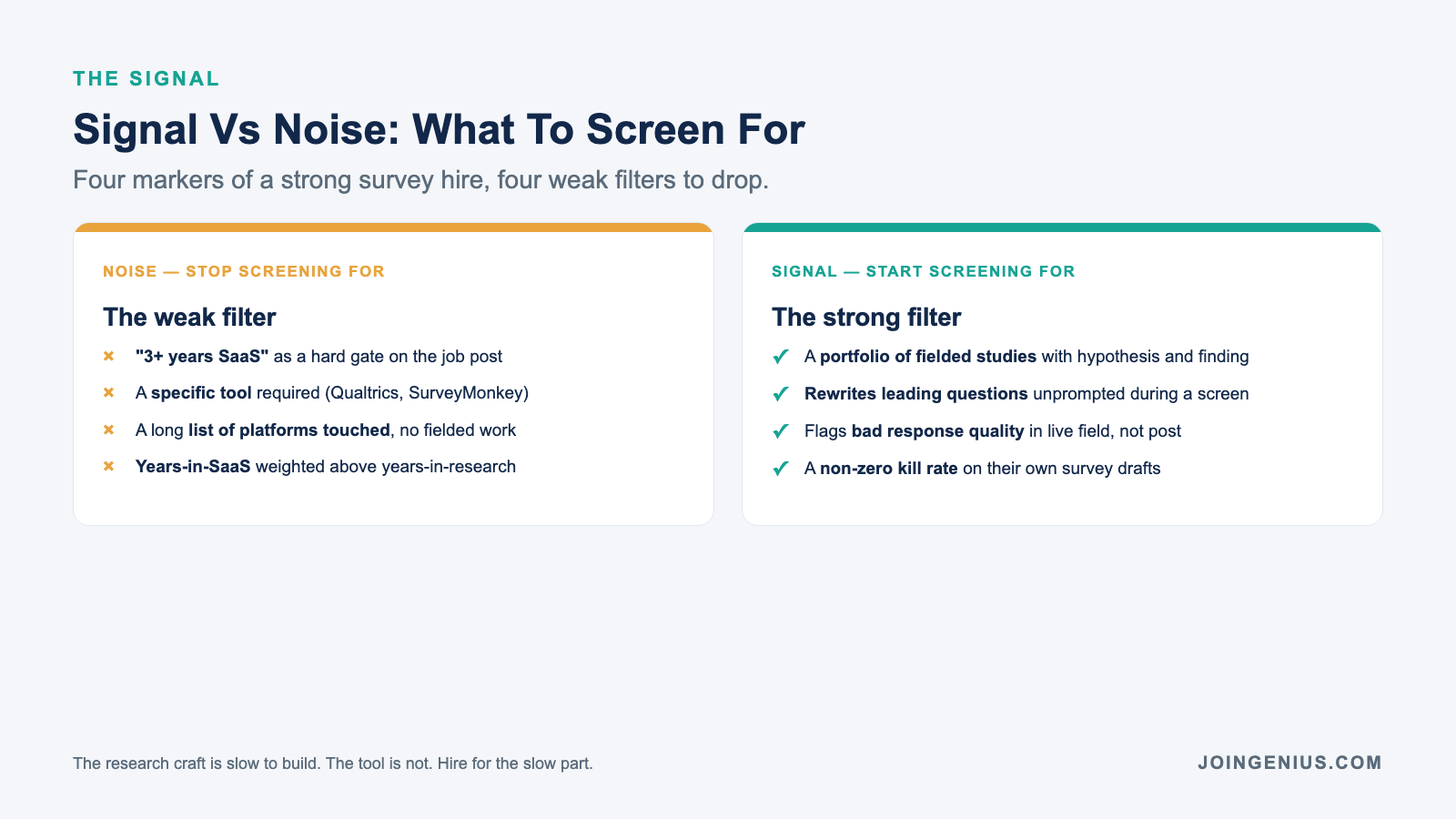
The specialist who can walk you through three fielded studies (hypothesis to finding) is the specialist who will do the same for you. The one who can list every tool they have touched but cannot name a single hypothesis they tested is the one who will produce surveys that generate noise.
Instinct For Question Bias
Hand a candidate a leading question and watch what they do. The strong ones rewrite it unprompted. The weak ones answer the leading version faithfully and ship it.
A Clean Separation Of Opinion And Behavior
A survey that asks “would you use this feature” is a survey that will tell you yes. A survey that asks “which of these did you use last week” is a survey that will tell you the truth. Strong specialists know the difference reflexively.
Pattern Recognition On Response Quality
A strong specialist flags straight-liners and speeders during a live field. They also catch inconsistent attention checks and bot responses before the sample is corrupted. A weak specialist finds all of it in post, if at all.
Greenbook’s 2026 GRIT Insights Practice Report, published June 2026, found that between 70% and 88% of users across every segment of the research industry now use fraud detection tools regularly, which the authors called embedded standard practice. The tools are table stakes. The craft of knowing when to trust a sample is what separates a good hire from an average one.
The Screening Process That Finds Them
A screen built around the four markers above beats a resume filter on prior employers. Here is the sequence that works in 2026.
Open With A Portfolio Review, Not A Resume Scan
Ask the candidate to walk you through one fielded survey end to end. The ones who can do it in 10 minutes know their craft. The ones who stall are the ones who ran reports, not research.
Give Them A Live Design Prompt
Hand them a product problem and 20 minutes to sketch the survey that would answer it. You are not grading the sketch. You are watching how they reason about sample and scale as they build it.
Audit One Of Their Own Questionnaires
Have them bring an actual questionnaire they have shipped and walk you through the trade-offs they made. The honest ones name three things they would change in hindsight. The ones who defend every choice are the ones who do not learn from a field.
Reference-Check On Field Quality, Not Volume
Ask the reference how many surveys the candidate killed before launch, not how many they shipped. The ones who kill bad surveys early are the ones you want.
What to Stop Doing (It’s Costing You Good Candidates)
The hiring moves that quietly cost you the best survey specialists are rarely the ones hiring managers audit. These are the four to cut first.
Requiring A Specific Tool On The Job Post
A hard “must have Qualtrics” or “must have SurveyMonkey” requirement filters out candidates who learned research on different stacks and can learn yours by Friday. Make tool fluency a learnable skill, not a gate.
Weighting Years-In-SaaS Over Years-In-Research
Ten years running surveys at a market research agency beats three years at a B2B SaaS company for almost every research outcome you care about. Weight the research years higher.
Screening Out Qualitative-First Researchers
A specialist who comes from a qualitative-heavy background often builds better quantitative instruments because they understand what the words in the question are doing. Low morale at work in a research team often traces back to specialists who were hired on tool skill and discovered the work is not the work they were sold.
Treating The Role As A Reporting Function
If the job description reads “produce weekly dashboards” instead of “design the studies that answer the hardest product questions,” the role will attract reporters and not researchers.
How to Measure the Hire After You Make It
A good hire shows up in the data within one quarter. These are the four signals to track.
Field Kill Rate
The share of surveys the specialist pulls before launch after their own review. A healthy number is non-zero. Zero means they are not actually reviewing their own work.
Response Quality Rate
The share of responses that pass attention and straight-lining checks. A strong specialist pushes this number up quarter over quarter.
Study-To-Decision Lag
The number of days between the survey closing and a decision being made from it. A good specialist shortens this because the write-up lands with the right people in the first draft.
A Short Survey-Hire Scorecard
| What To Measure | Weak Signal | Strong Signal |
|---|---|---|
| Portfolio | Lists platforms used | Walks through three fielded studies |
| Question bias | Answers leading questions as asked | Rewrites them before fielding |
| Response quality | Flags issues in post | Flags issues in live field |
| Tool background | Prior SaaS tenure required | Learned tools inside two weeks |
Qualtrics’ 2026 Consumer Experience Trends Report, based on 20,000 consumers across fourteen countries and eighteen industries, found that only three in ten customers now give direct feedback when asked. When only 30% of customers answer, the quality of every single response matters far more than the quantity, which rewards specialists who can measure recruiting ROI without spreadsheet chaos and apply the same discipline to response quality.
Conclusion
A survey specialist with the wrong SaaS logos and the right research instincts will out-produce a specialist with the right logos and shallow instincts every quarter of the year. The filter that keeps you from meeting the first candidate is the filter that keeps your research function average. Drop the SaaS prerequisite, screen on fielded work, and the specialist you hire next is the one who answers the question that actually moves the roadmap.
We built Genius so research-first teams can staff that kind of role with specialists they otherwise would not meet. We place the top 1% of research and operations talent from the Philippines and Latin America, at around 80% less than comparable local hires. The relationship stays direct, with no monthly agency fees and a 6-month replacement guarantee on every placement. If the next survey specialist you hire is the one who makes the function finally produce decisions, see how we source and place the research talent that actually asks the right question.