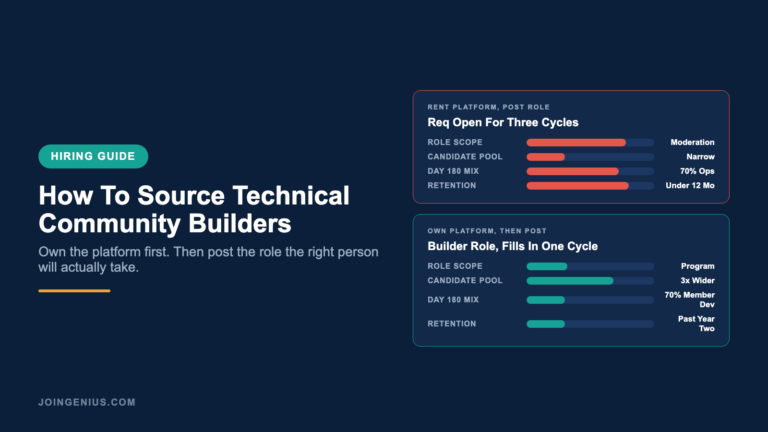
Most technical community reqs do not fail because the candidate pool is empty. They fail because the role is posted against a surface the hire does not own, which turns the job into moderation theater and chases off the exact person the org said it wanted to hire. A technical community builder who can read a Discord thread for product signal, pattern-match member intent and route it to engineering is the same person who will decline an offer that asks them to do forum cleanup on a surface the company rents.
The right move almost never starts with the req. It starts with the platform decision, because the surface area the hire inherits decides the role scope and the pool at once, and it sets the retention curve on top of both. Modern hiring workflows have cut time to hire sharply, but speed does nothing if the role itself is posted against a rented surface the hire has no control over. This piece is about who the real pool actually is and where the role scope goes wrong, plus the one platform-first move that reliably makes the role fillable.
The Technical Community Builder Market Is Smaller Than The JD Suggests
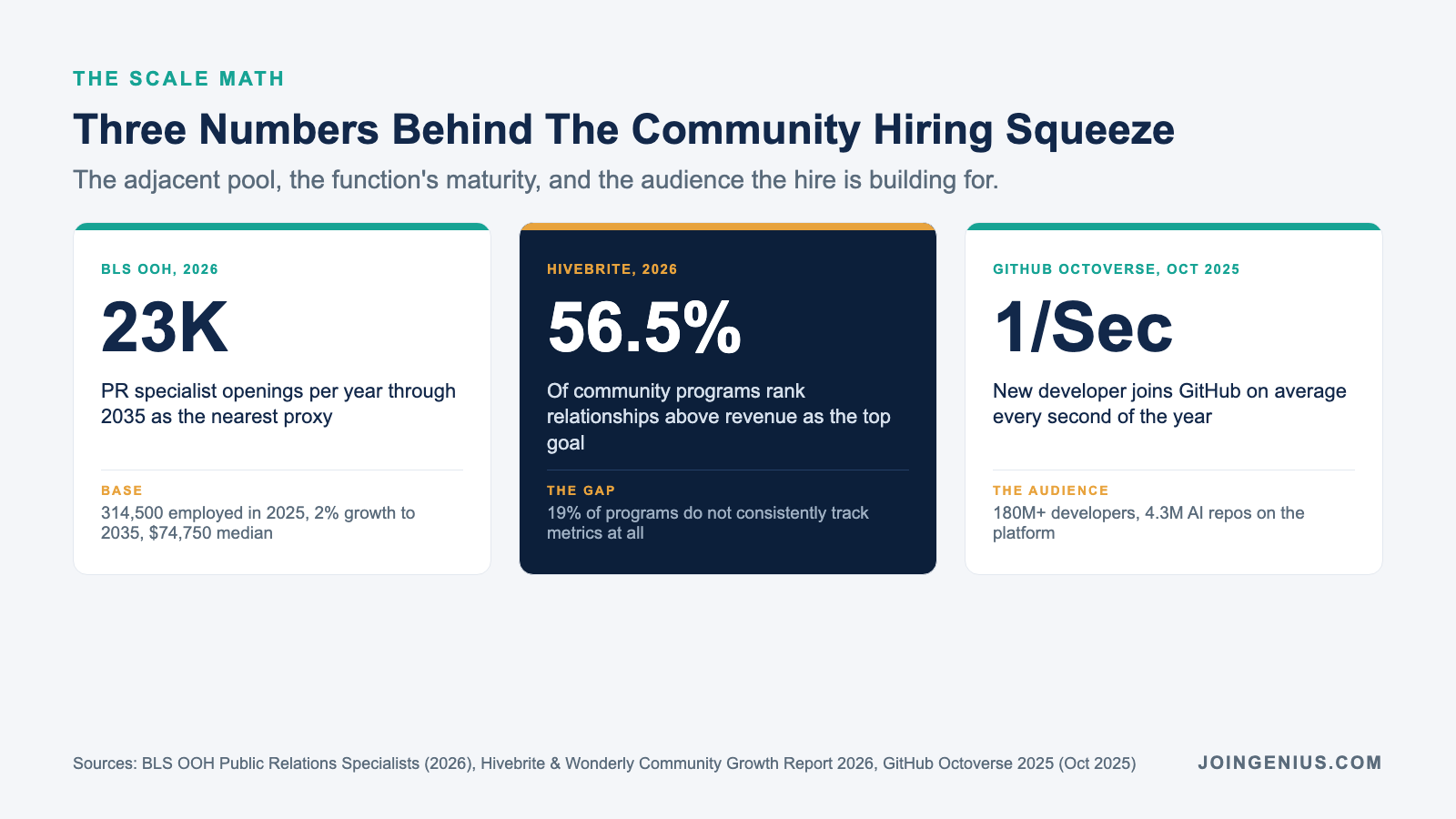
The US Bureau of Labor Statistics Occupational Outlook Handbook for Public Relations Specialists, the closest adjacent SOC code to a technical community role, lists about 314,500 US specialists in 2025 and projects just 2% employment growth from 2025 to 2035, with about 23,000 openings per year at a $74,750 median wage as of May 2025. Most of those 23,000 openings are replacement against people leaving the field, not new seats being created. The adjacent pool is roughly flat, so hiring managers are not riding growth, they are competing for people already in it and already employed.
The Role Has No SOC Code, Which Hides The Supply Problem
Technical community builder is not a BLS occupation. The closest proxies are PR Specialist and Marketing Manager, and neither is what a dev-focused community actually needs. The real supply pool is a cross-section of DevRel and developer advocacy, plus technical writing and community ops. That pool is small and mostly employed, and most of it is not looking in traditional job-board pipelines.
The Pool That Does Exist Is Already Running A Community Elsewhere
The strongest technical community builders are already maintaining a Discord or a GitHub discussion, and the next tier down is already running a newsletter or a working repo. They are findable but they are not in a resume database. A req that waits for applicants is a req that selects for the weakest half of the pool by default.
The Role Scope Expands To Swallow Everything Community-Adjacent
The role absorbs every community-touching task the rest of the org does not want to own. Event logistics. Content calendar. Social replies. Partner outreach. Bug intake. By the time the req is written, the role reads like four jobs, and the person who could actually do all four is going to go run a product team instead.
What Actually Separates A Community Hire Who Ships From One Who Burns Out
Three forces compound each other. Any one of them would be a hiring challenge. The three together create reqs that stay open for cycles.
The Platform Decides The Day 180 Mix
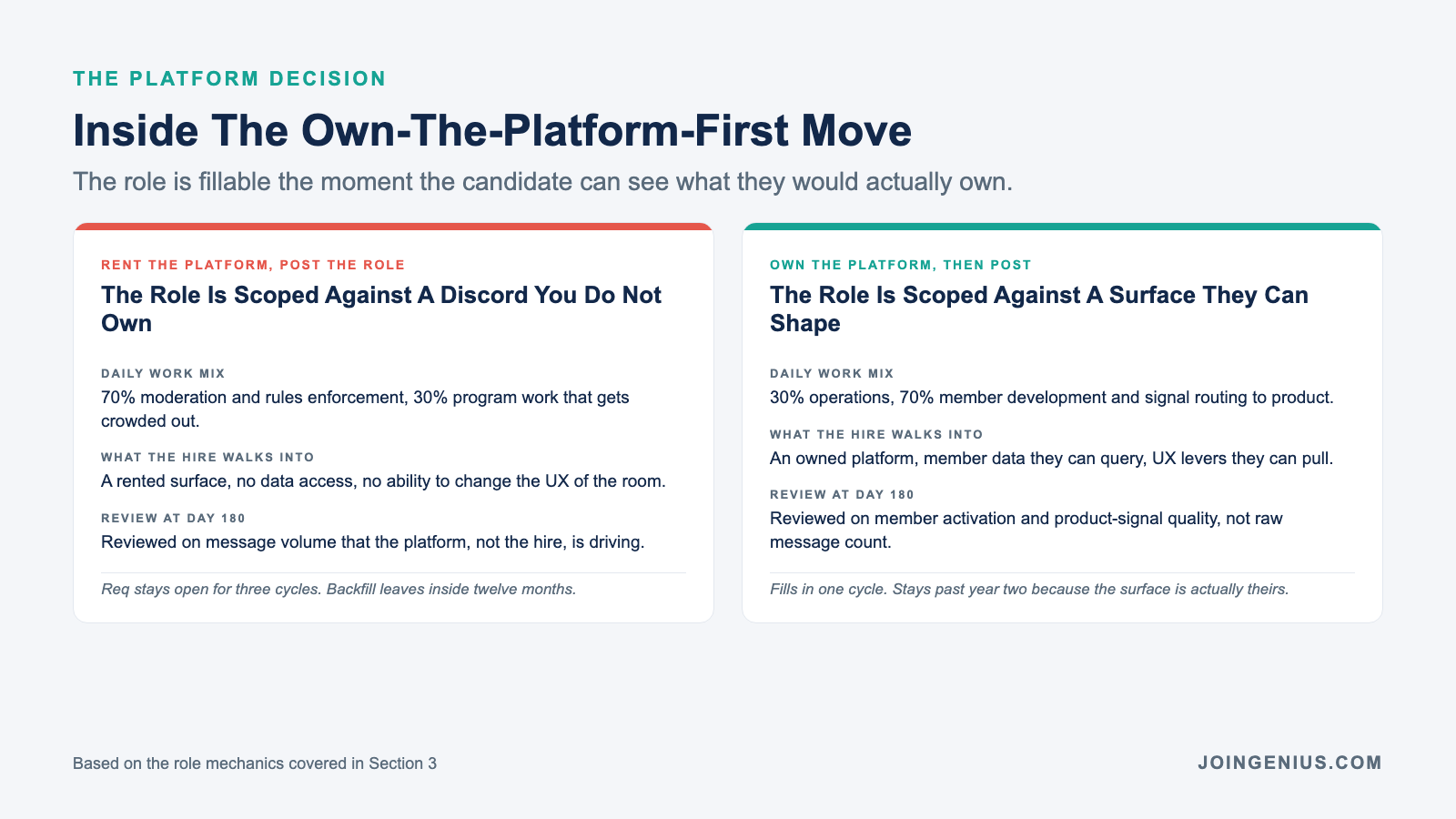
A hire on a rented Discord spends their days on moderation, rules enforcement and bot config. A hire on an owned community platform spends their days on member development and signal routing to product. The daily work mix is a platform decision made before the req opens, not a performance outcome measured at the review. Hiring managers who do not make the platform decision upstream will inherit the mix downstream.
The Metric Decides Whether The Role Reads As Operations Or Product
Community roles reviewed on message count and response time read as support. Community roles reviewed on member activation and product-signal quality read as product. The second review conversation keeps the strong hire past year two. The first one loses them to a product team inside twelve months, which puts the org back in the same candidate pool it just struggled to clear.
The Ownership Of The Data Decides Whether The Role Can Grow
If the hire cannot query who is engaged and which threads drove adoption, the role has a ceiling the hire will notice on day 30. A platform the company owns, with member data the community lead can actually work with, is the thing that lets the role have a year two instead of a quiet backfill conversation at eighteen months.
The Hivebrite and Wonderly Community Growth and Benchmark Report 2026, based on a survey of 186 community professionals and C-suite leaders conducted in early 2026 against analysis of over 1,000 Hivebrite communities in 2025, found that 19% of community professionals do not consistently track metrics at all and that 56.5% rank stronger relationships and trust as the single most important goal of their community program, above both retention and revenue outcomes. The function is still immature inside most orgs, which is why the hiring spec gets written against a loose job description and the role goes unfilled against candidates who do have a metrics lens.
The Lever Most Teams Miss
Give Them A Platform They Own Before You Write The JD
Before you open the req, stand up a community platform like FluentCommunity that lives on your own stack and puts member data and moderation controls under your team’s control along with the member UX, rather than a rented surface. For WordPress-based product orgs, the platform plugs into the same site your docs and courses already run on. Product marketing lives there too, which makes the candidate’s day one measurably faster and the role scope measurably clearer.
The point is not that an owned platform replaces Discord for every org. The point is that the role you can post against an owned surface is a very different and much more fillable role than the one you can post against a rented Discord where the hire has no data access and no UX control. The job description reads as member development with product signal routing, not moderation with a side of event logistics, and the candidates who show up for those two postings are not the same people.
GitHub’s Octoverse 2025 report, published October 28, 2025 against platform telemetry from September 1, 2024 through August 31, 2025, found that more than 180 million developers now work on GitHub, with more than 36 million joining in the Octoverse period and more than 4.3 million AI-related repositories now on the platform. The ratio lands as roughly one new developer joining GitHub every second on average. The audience the technical community builder is hiring to serve is compounding that fast, and the strongest candidates for the role are already on the exact surfaces where that growth is showing up, which is why a source-off-the-loop approach outruns a job-board approach on this hire.
What Day 180 Looks Like When You Get It Right
The difference between the two approaches shows up at the day 180 review, which is also the moment the hiring manager finds out whether they posted the right role.
The Before Version
In the before version, the new hire has spent six months enforcing rules on a rented Discord and running a content calendar on borrowed infrastructure. Their program work is behind, and the review conversation is about message volume and response time that are a platform decision rather than a performance outcome. The role stays open as a backfill risk inside twelve months, which puts the org back in the same candidate pool it just struggled to clear. Low morale at work often sits highest on community teams whose hires are reviewed on metrics the platform, not the person, is driving.
The After Version
In the after version, the new hire has spent six months on the work only a strong community builder should own. Member development on the top 100 power users comes first. Routing high-signal threads into product discovery and the engineering backlog comes second. Shaping the UX of the surface itself so engagement compounds comes third. The review conversation is about member activation and product-signal quality, which is the conversation that keeps a strong hire past year two.
A Four-Move Playbook For Technical Community Hiring
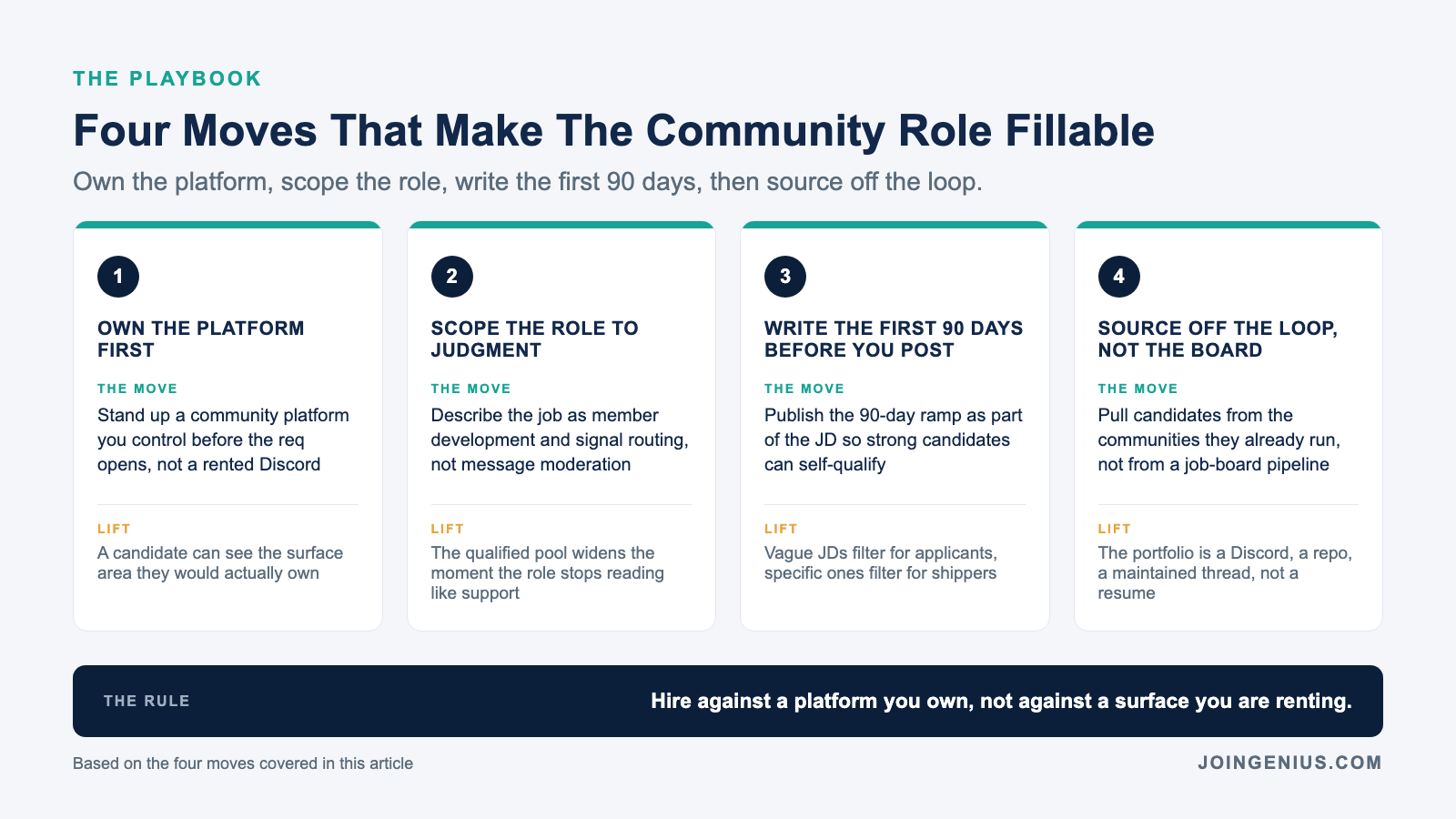
The four moves in order.
1. Own The Platform First
Stand up a community platform you control before the req opens. Not a rented Discord, not a public Slack, not a vendor your team cannot query. The platform choice is a hiring decision made upstream of the role, because it decides the role scope downstream.
2. Scope The Role To Judgment, Not Moderation
Describe the job as member development and product-signal routing, not message moderation. The headline competencies should be pattern recognition on member intent and the taste to decide what belongs in the roadmap, not throughput on replies. A structured hiring process is worth zero if the role it hires for is still scoped against moderation work.
3. Write The First 90 Days Before You Post
Publish the 90-day ramp as part of the job description. The strong candidates self-qualify against a specific plan, and the weak ones self-select out before the first interview. Vague JDs filter for applicants. Specific ones filter for shippers.
4. Source Off The Loop, Not The Board
The pool is on the surfaces where the work already happens. Repos they maintain and Discords they already moderate come first. Newsletters they already write and threads where they are already the loudest voice come next. Source from the loop. The job board is a distant second.
The playbook is in the image below.
The One-Page Check Before You Post The Role
Before you post the next technical community role, ask one question. If you stood up a community platform you owned before the req opened and rewrote the JD against what that surface actually makes possible, would the role you are left with be fillable in the pool as it stands?
If the answer is yes, the pool was never the problem. The platform was. Fix the platform by moving the community onto a surface you own, then post the role against the work that surface actually makes possible. The hire you make against that role will stay longer and ramp faster, and they will move the product signal the business needs. The hire you make against the rented-surface role will leave inside twelve months and you will be back where you started.
Conclusion
Technical community hiring is a platform problem that most teams misdiagnose as a sourcing problem, and the misdiagnosis costs an open req for cycles and a backfill who leaves inside twelve months. Own the platform. Scope the role to judgment. Write the 90-day ramp into the JD. Source off the loop. Then post the role you actually need, which is a member-development hire on a surface you own, not a moderation hire on a surface you rent.
We built Genius so operators can staff the judgment work their owned community platform uncovers. We place the top 1% of community and operations talent from the Philippines and Latin America, at around 80% less than comparable local hires. The relationship stays direct, with no monthly agency fees and a 6-month replacement guarantee on every placement. If the next technical community hire is the one who finally stays past year two, see how we source and place the community talent that compounds.