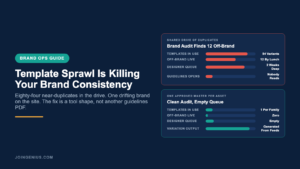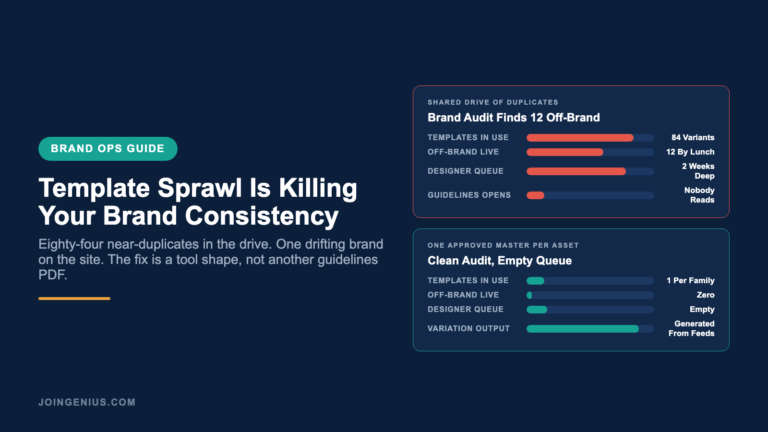
Most brand consistency problems do not start in the design system. They start in the shared drive, where an approved master template got duplicated by a product marketer who needed a slightly different header. The growth team duplicated it again a week later for a different CTA color, and a third duplicate landed in the drive when the campaign brief changed on Friday afternoon. Six months later the team has eighty-four templates that look almost but not quite the same, and the brand on the live site has drifted a full percentage point off the guidelines no one is still reading.
The right fix is almost never another guidelines PDF. It is a tool-shape decision that collapses the sprawl back to one approved source, because the surface area the creative team pulls from decides the brand consistency downstream of every brief. Modern marketing workflows have accelerated creative production sharply, but speed does nothing if the template layer the team pulls from drifts every week. This piece is about why template sprawl compounds and where the drift actually costs the most, plus the one creative-ops move that reliably rebuilds a single source of truth.
Template Sprawl Is A Volume Problem That Reads As A Brand Problem
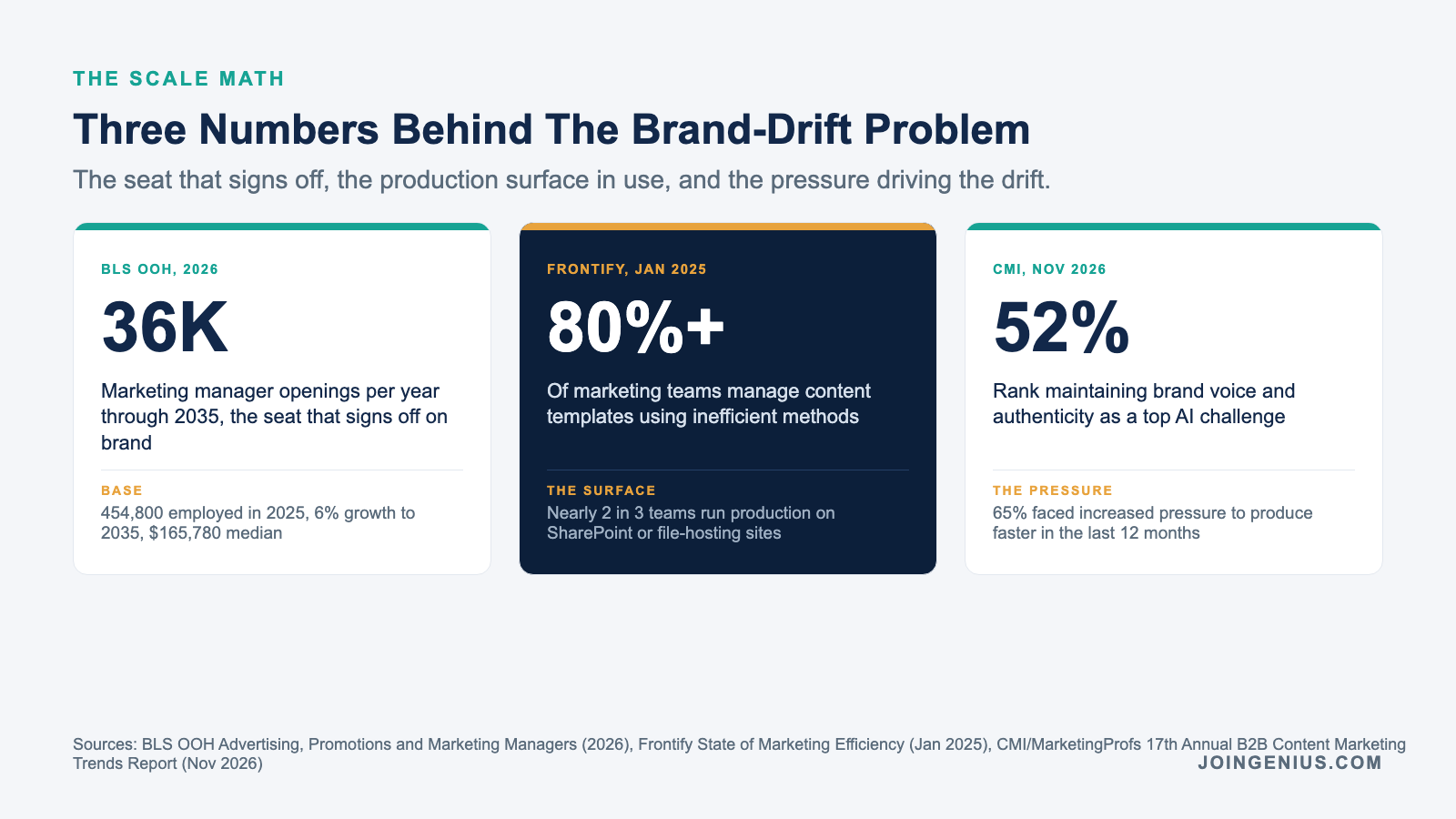
The US Bureau of Labor Statistics Occupational Outlook Handbook for Advertising, Promotions, and Marketing Managers lists about 454,800 US marketing managers in 2025 and projects 6% employment growth from 2025 to 2035, with about 36,300 openings per year at a $165,780 median wage as of May 2025. Those 454,800 seats are the people signing off on brand work, and their templates are the production surface the rest of the marketing team pulls from every day. The template layer is not an infrastructure problem for a design-ops specialist. It is the daily production surface of the entire function.
Every Rushed Brief Creates A New Template, Not A New Asset
A rushed brief that could have been solved with an edit to the approved master almost always ends up as a duplicate instead, because duplicating is faster than asking for permission on a Friday. The team ships the campaign, and the duplicate stays in the shared drive forever. Multiply by every rushed brief in a year, and the drive is sprawl.
Nobody Deletes An Old Template
Deleting a file that someone might still be using is a social cost no marketer wants to pay, so templates accumulate. The last-modified date on a duplicate is more recent than the approved master, which means the next person searching the drive grabs the duplicate, not the source. The drift compounds because the newest file wins, and the newest file is almost never the right one.
The Guidelines Are Static, The Templates Are Not
The brand guidelines PDF is updated once a year. The templates are updated every day. Even a well-maintained guidelines doc cannot keep up with the pace of real campaign work, so the templates diverge from the guidelines by default. Consistency is a maintenance problem, not a documentation problem, and most teams are trying to solve it with documentation.
What Actually Separates A Consistent Brand From A Drifting One
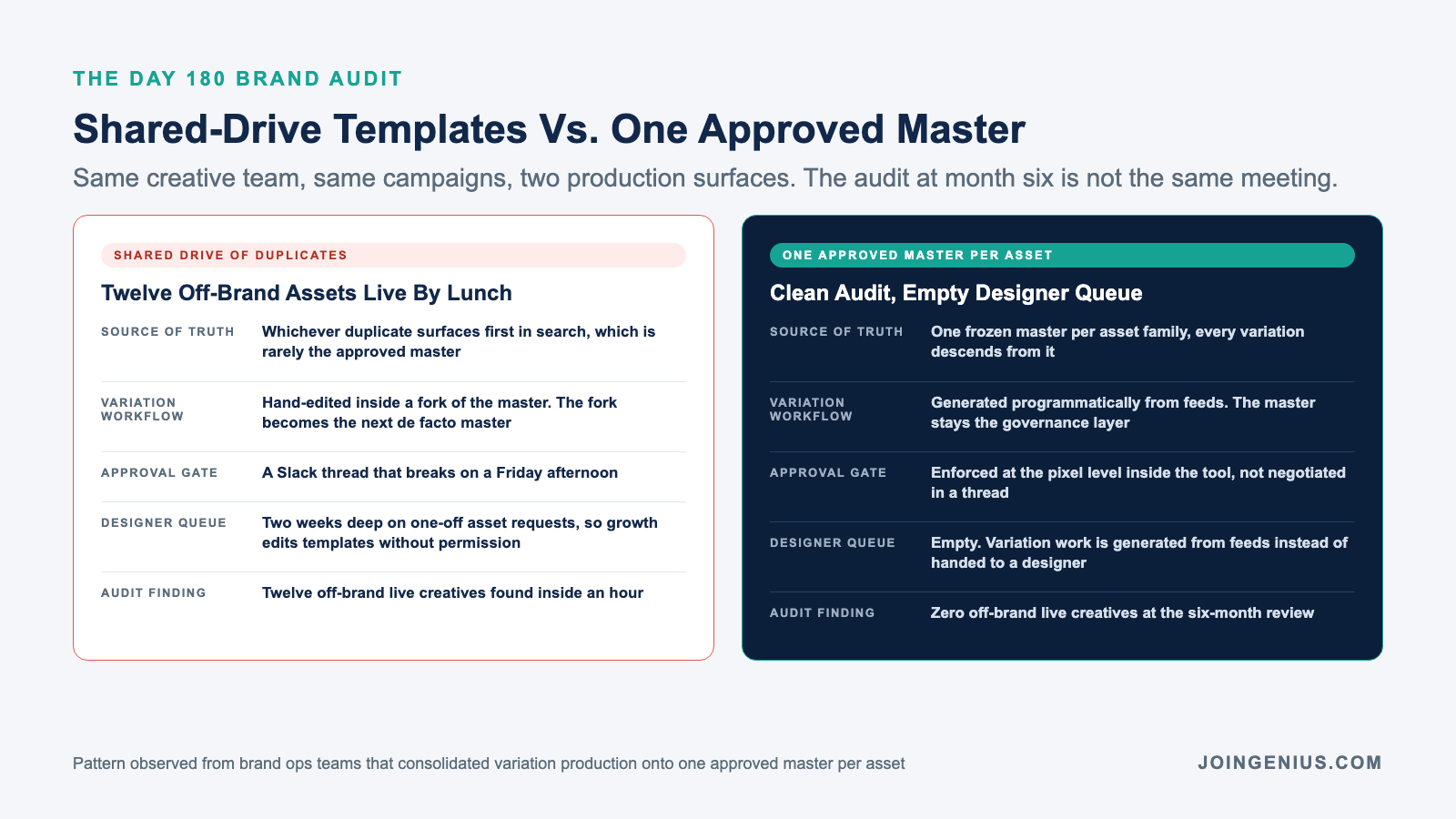
Three forces compound each other, and any one of them would be a consistency problem. The three together produce brand audits where the team finds a dozen off-brand assets live on the site before lunch.
The Source Of Truth Decides What The Team Pulls From
A creative team with one approved master per asset pulls from it. A creative team with eighty-four near-duplicates pulls from whichever file surfaces first in search. Which file is the source of truth is a tool decision made before the brief is written, not a judgment call made at the deadline.
The Variation Workflow Decides Whether The Master Stays Approved
Every brand has thirty variations of its hero visual. Different aspect ratios, different localizations, different seasonal color overlays. A creative ops setup that generates variations from the approved master keeps the master as the source. A setup that forks the master into thirty new files to be edited by hand turns the master into one of thirty-one options, and the variation becomes the new de facto master inside a quarter.
The Approval Gate Decides Whether Off-Brand Work Ships
If an asset can ship without touching the approval gate, it will. If the only way to produce an asset is through a template that enforces brand rules at the pixel level, off-brand work is a workflow exception, not a workflow default. The gate shape decides the drift rate.
Frontify’s State of Marketing Efficiency report, based on a survey of 400 senior marketing leaders and published in January 2025, found that more than 80% of marketing teams manage content templates using inefficient methods and 41% still create templates fully by hand in-house. Nearly two-thirds rely on outdated DAM alternatives like SharePoint or file-hosting sites as the production surface. The template layer is the production layer, and most teams are running production on a shared drive.
The Lever Most Teams Miss
Consolidate The Brand Team On A Single Creative Source Of Truth
Before you ship another guidelines refresh, consolidate the brand team on a creative automation platform like Abyssale that generates every variation from one approved master template, rather than a shared drive of near-duplicates. For marketing ops teams, the platform plugs into the spreadsheet feeds and automation tools the growth team already uses. Designers stay engaged because the master template stays protected and the variation work stays programmatic, which makes every brief measurably faster and every shipped asset measurably more on-brand.
The point is not that creative automation replaces the design editor for every org. The point is that the template surface your creative team pulls from decides the brand consistency downstream of every brief, so consolidating that surface is the lever that moves the audit result. The creative workflow reads as approved variations at scale, not one-off edits at the deadline, and the teams with consistent brands are the ones who treat the template layer as production infrastructure instead of a shared drive.
The Content Marketing Institute and MarketingProfs 17th Annual B2B Content Marketing Trends Report, based on 861 B2B marketer responses fielded between June and August 2026 and published November 4, 2026, found that 65% of marketers faced increased pressure to produce content faster over the last 12 months. 52% now rank maintaining brand voice and authenticity as a top AI-related challenge, even as 88% have already adopted AI content creation tools. The faster the production, the more the brand drifts without a template layer that enforces the rules.
What Day 180 Looks Like When You Get It Right
The difference between the two approaches shows up at the day 180 brand audit, which is also the moment the CMO finds out whether the team actually solved sprawl.
The Before Version
In the before version, the team has spent six months adding duplicates to the drive and firefighting off-brand assets in production. A brand audit finds twelve inconsistent live creatives inside an hour. The design team is reviewing one-off asset requests full time, and the growth team is editing templates without permission because the designer queue is two weeks deep. The guidelines deck has been refreshed twice and nobody opens it. Low morale at work often sits highest on creative teams whose weeks are spent on sprawl firefighting instead of the brand work they were hired for.
The After Version
In the after version, the team has spent six months routing every variation through one approved master per asset. The brand audit finds no off-brand live creatives. The designer queue is empty because non-brand variation work is generated from feeds instead of handed to a designer. Growth and lifecycle ship campaigns inside the hour the brief lands, which is the conversation that turns creative ops from a cost center into a growth lever.
A Four-Move Playbook For Killing Template Sprawl
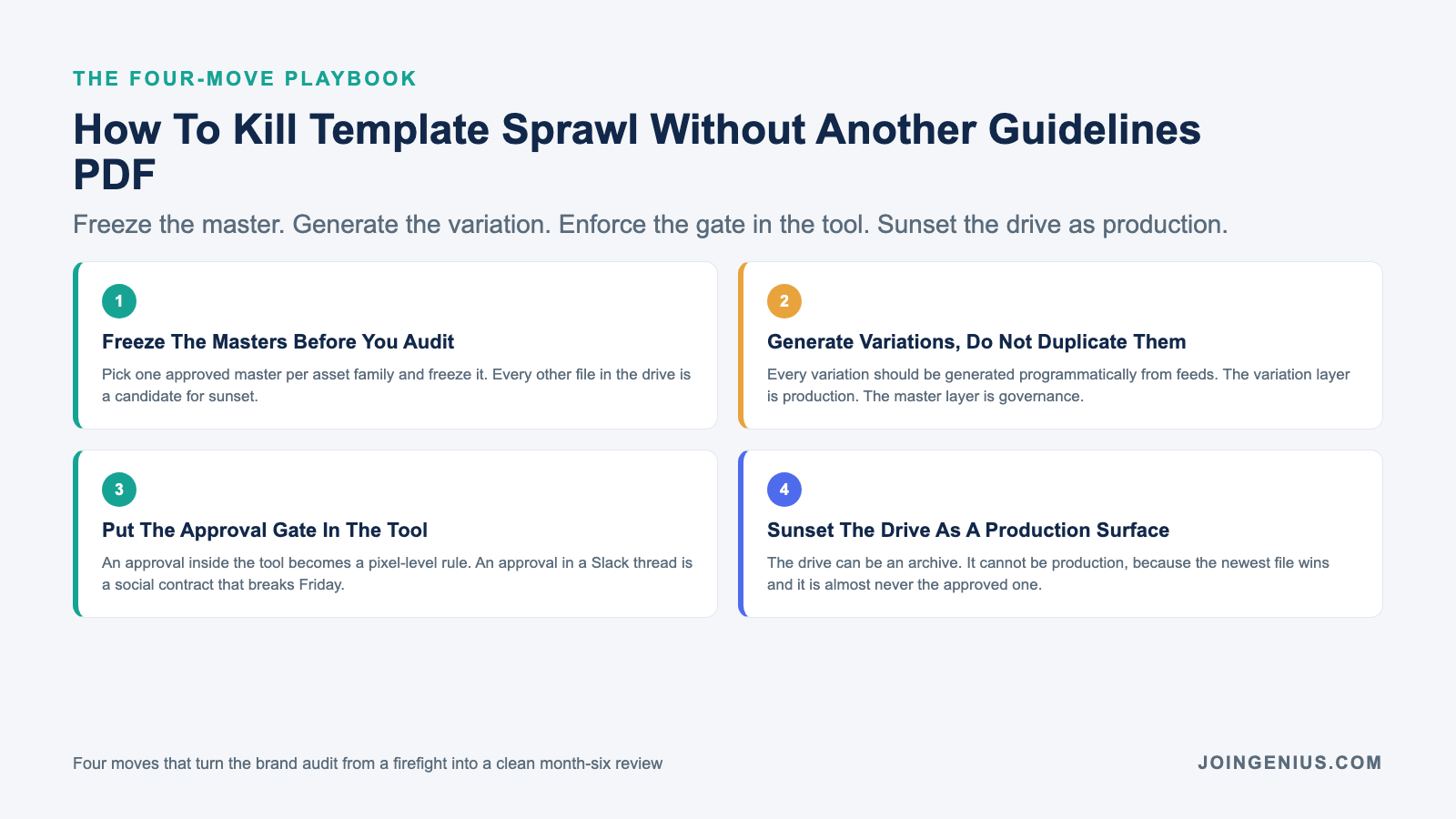
The four moves in order.
1. Freeze The Masters Before You Audit The Drive
Pick the one approved master for every asset family and freeze it. Every other file in the drive is a candidate for sunset. The audit is not where you decide what the master is. The audit is where you prove that every live asset descends from the one you froze.
2. Generate Variations, Do Not Duplicate Them
Every variation of the master should be generated programmatically from feeds, not hand-edited inside a duplicate of the master. The variation layer is the production layer. The master layer is the governance layer. If the two collapse into one, sprawl restarts inside a quarter. A structured creative ops process is worth zero if production and governance share a surface.
3. Put The Approval Gate Inside The Tool, Not Inside Slack
An approval that lives inside the creative automation tool becomes a pixel-level rule that cannot be bypassed. An approval that lives in a Slack thread is a social contract that breaks on a Friday afternoon. The gate shape decides whether off-brand work can ship.
4. Sunset The Shared Drive As A Production Surface
The shared drive can be an archive. It cannot be a production surface, because the newest file always wins and the newest file is almost never the approved one. Production has to live somewhere the tool enforces the rules, which is the only place where consistency compounds instead of drifts.
The playbook is in the image below.
The One-Page Check Before The Next Brand Refresh
Before you kick off the next brand refresh, ask one question. If you consolidated the team on one approved master per asset and generated every variation programmatically against that master, would the next brand audit still find twelve off-brand assets live on the site?
If the answer is no, the guidelines were never the problem. The template surface was. Fix the surface by moving every variation into the tool that generates it from the approved master, then let the guidelines document what the tool already enforces. The brand you ship against that setup will stay on-brand past the next launch and the designer queue will stay empty past the next quarter, and the audit will stop being the meeting everyone dreads. The brand you ship against a shared drive will drift into the next refresh cycle and you will be back where you started.
Conclusion
Template sprawl is a creative-ops problem that most teams misdiagnose as a guidelines problem, and the misdiagnosis costs a brand audit full of off-brand assets and a designer queue that never clears. Freeze the masters. Generate the variations. Put the gate in the tool. Sunset the drive as a production surface. Then ship the campaign you actually planned, which is the one that stays on-brand through the next hundred variations, not the one that drifts at the deadline.
We built Genius so operators can staff the brand and creative-ops work their template layer surfaces, without expanding the local headcount their budget cannot support. We place the top 1% of creative and operations talent from the Philippines and Latin America, at around 80% less than comparable local hires. The relationship stays direct, with no monthly agency fees and a 6-month replacement guarantee on every placement. If the next brand-ops hire is the one who finally makes the audit come back clean, see how we source and place the creative talent that compounds.