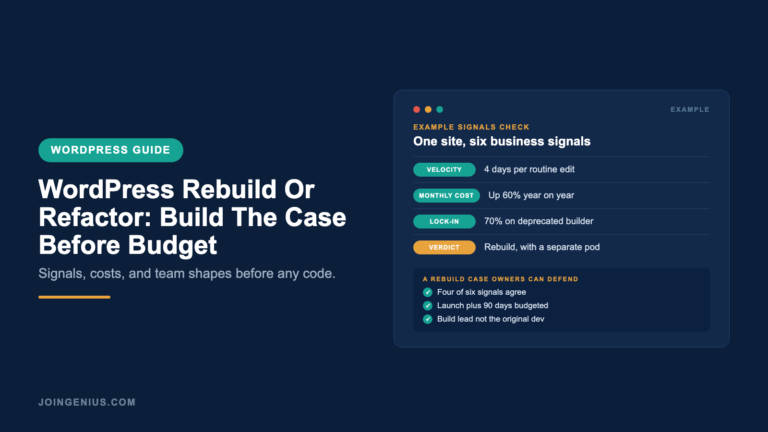
A WordPress site built three years ago is slow. Edits take longer, and the invoices from the developers who built it keep climbing. The owner wants to know whether to patch the current site or start over, and this WordPress rebuild or refactor question usually gets answered by the person who built the original site.
Below, we cover what to measure before you pick, and the costs that change the answer. Then we get into the team each path needs. We finish with who should sign off on the call, since a loop of plugin conflicts is not a decision anyone wants to inherit.
Why Most Owners Make The Rebuild Or Refactor Call Too Late
By the time the question reaches the owner’s desk, the team has been working around site problems for months. The cost of those patches is usually higher than the fix would have been.
The Decision Usually Comes From The Person Who Built The Site
The developer who built the current site has the most context, which is why owners ask them first. They also have the most reason to recommend a refactor. A rebuild says the thing they built needs to be replaced, and that is a hard call to make about your own work.
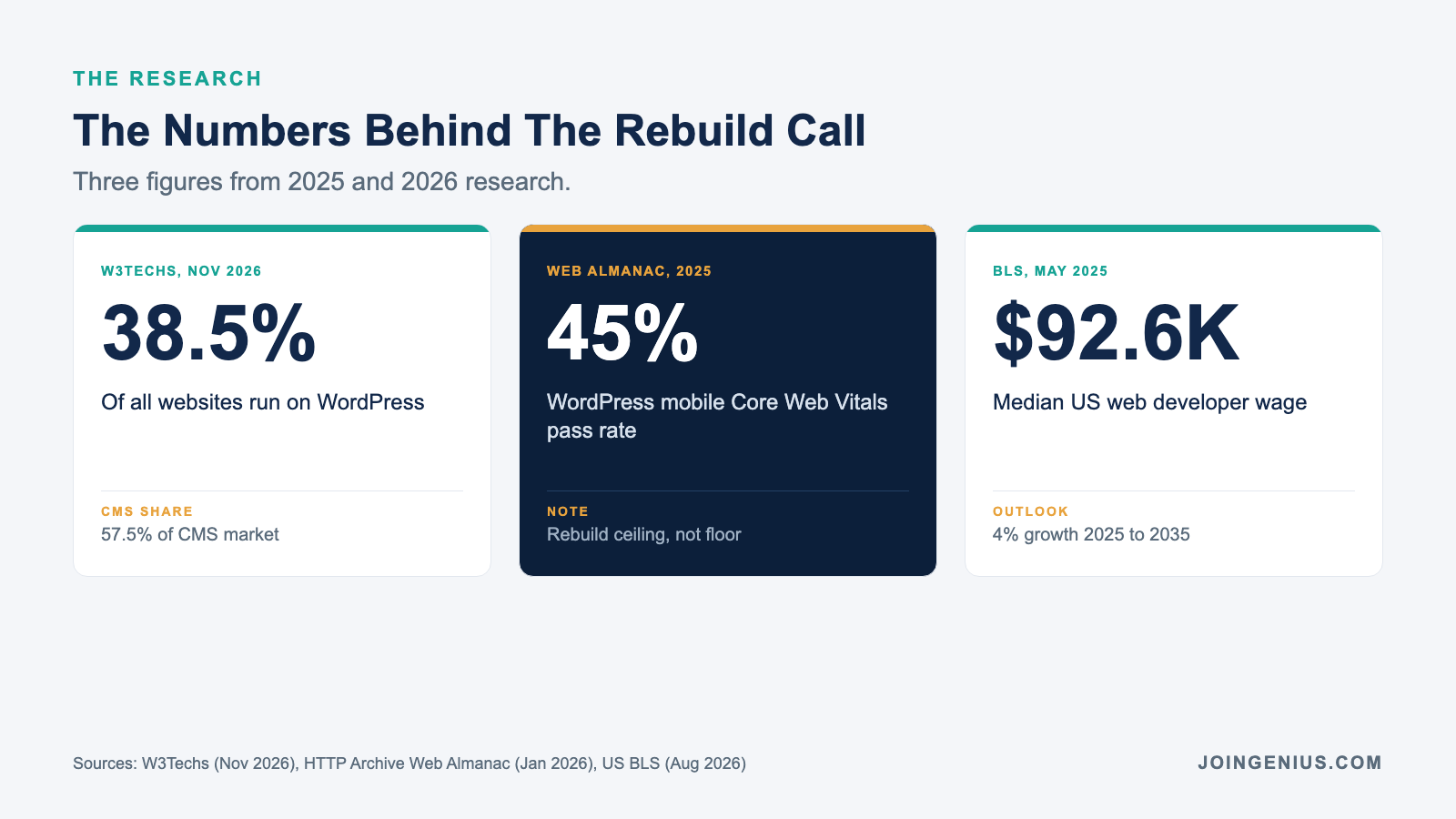
WordPress still runs more of the web than any other platform. W3Techs puts it at 38.5% of all websites as of November 2026, with a content management system market share of 57.5%. Most agencies default to another WordPress build when asked, so the recommendation often arrives before the business case does.
The Signal Owners Miss First Is Change Velocity
Site speed gets watched. The number of hours it takes to change a product page or publish a blog post does not. That number is the clearest early signal that a WordPress rebuild or refactor conversation is already overdue.
A site where a one-line copy change takes a developer two days is not a performance problem. It is a dependency problem, and no plugin swap will fix it. Track change velocity across 30 days before any audit.
What To Measure Before You Pick A Path
A WordPress rebuild or refactor decision gets easier when it starts from numbers. The six signals below are the ones most teams can pull in a week without any technical help.
Six Signals Owners Can Pull Without A Developer
These signals do not need any code to measure. A business analyst with access to invoices and the publishing calendar can fill them in during the first week.
| Signal | How To Measure It | Points To Refactor | Points To Rebuild |
|---|---|---|---|
| Change velocity | Hours to publish a routine edit | Under 2 hours | Over 2 days |
| Monthly maintenance cost | Dev invoices over the last 6 months | Flat or falling | Climbing each quarter |
| Plugin dependency | Share of features relying on one plugin | Spread across many | Concentrated in abandoned ones |
| Stakeholder trust | Confidence an edit will not break things | High | Low |
| Content lock-in | Pages locked inside a deprecated builder | Under 20% | Over half |
| Business roadmap | Features planned for the next 12 months | Fit existing templates | Need a different architecture |
How To Read Those Signals In A Budget Meeting
If four or more signals point the same way, the answer is already clear, and the remaining work is sizing the project. If the signals split evenly, the owner is usually looking at a refactor that needs a serious hiring plan to go with it.
The Hidden Costs That Change The Answer
Refactor and rebuild budgets rarely blow up on day one. They go wrong in month three, when the first assumptions collide with what the actual site turns out to need.
What A Refactor Costs After The Second Month
A refactor scope that read as four weeks in the proposal usually ends up between six and ten. The scope grows because every fix reveals a dependency the original quote did not see. Each new ticket also needs a round of regression testing, so the cost per fix doubles after the easy ones are done.
A refactor only works when the team has time for that drag. Teams that promise feature work on the same calendar end up delivering neither on schedule.
What A Rebuild Costs After Launch Day
Rebuild budgets cover the build, not the first 90 days after. The old site runs in parallel while traffic moves across, which doubles hosting bills for a quarter. Internal links need to be rewritten, and finance teams spend weeks reconciling the two analytics accounts.
The performance payoff is usually the headline number in the business case, but the ceiling is lower than most proposals assume. The 2025 Web Almanac found that WordPress sites pass Core Web Vitals on mobile 45% of the time, which means a new WordPress site still carries some of the same performance ceiling the old one did.
A rebuild budget that skips the launch-plus-90 line items is already over before anyone argues whether the redesign will actually drive sales.
Each Path Needs A Different Team Shape
A refactor and a rebuild do not compete for the same people. Treating them as the same hiring problem is a common reason WordPress rebuild or refactor projects stall in month two.
A Refactor Team Looks Like Three Specialists On Rotation
A refactor runs on continuous small changes against the live site. The best setup pairs a backend WordPress developer with a frontend engineer, plus a QA tester who reviews every merge. None of them needs to be full time, but each has to be dedicated to the refactor queue. Shared staffing is the main reason refactor scopes slip.
A Rebuild Team Looks Like A Separate Project Pod
A rebuild needs a team that can commit to the new site. Four to five people work full time on the build, with a change freeze on the old site. The pod reports to a build lead, not the product team. Any hybrid where the same engineers staff both burns out the people trying.
Where An External WordPress Partner Fits
External partners work well when the team shape above is temporary. For a refactor, a specialist can slot into the rotation for a quarter and leave when the queue is clean. For a rebuild, a pod can stand up outside the main team and hand the site back at launch.
WPExperts’ WordPress staff augmentation is built for that temporary shape, so a client avoids hiring full time for a scope that will end.
Who Should Sign Off On The Final Call
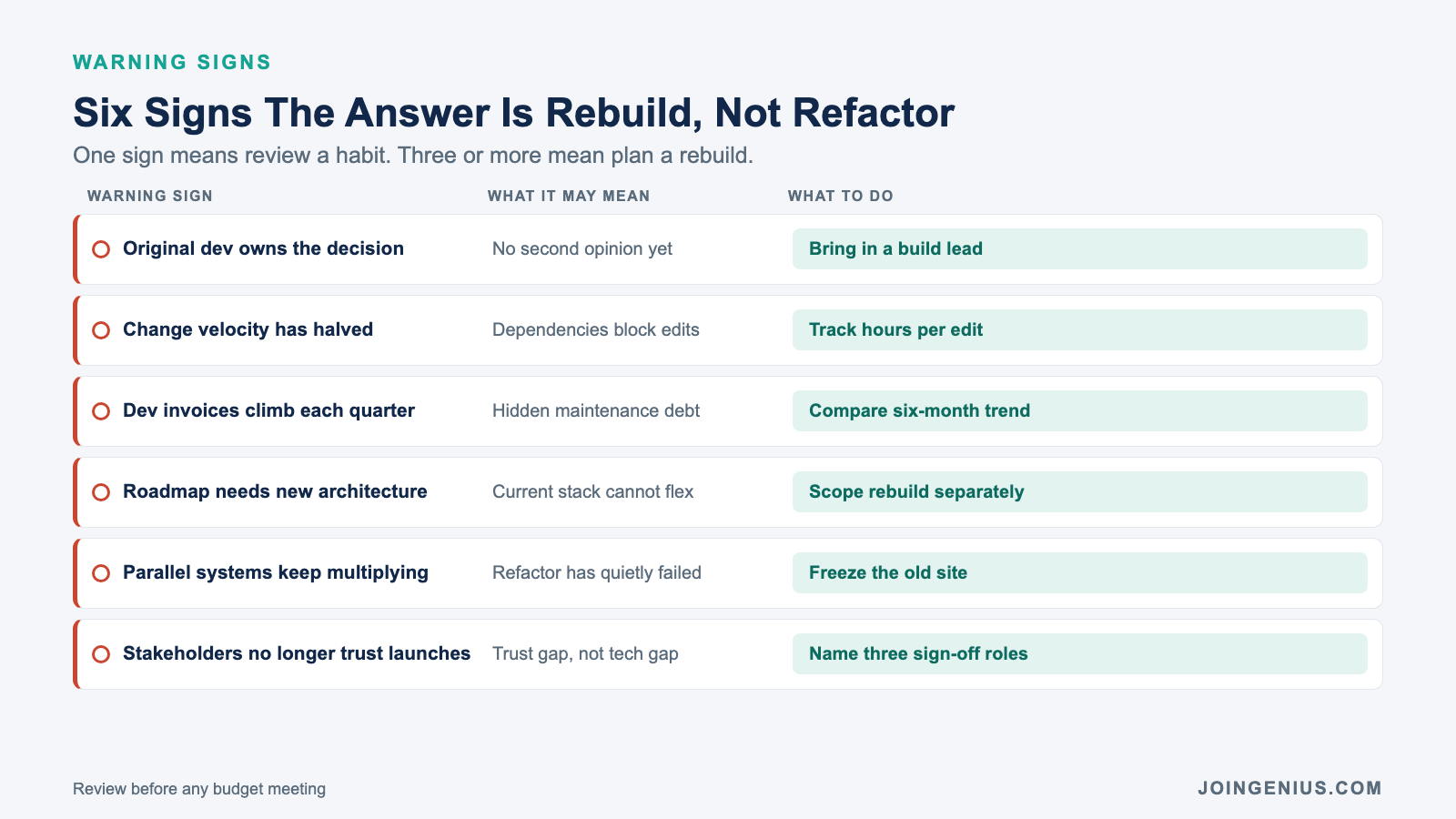
A WordPress rebuild or refactor decision that one person makes is a decision that one person will later unmake. The sign-off needs three roles in the room, and each one has a single question to answer.
The Three People Who Have To Agree
The owner sets the cost ceiling. The person who runs the site day to day decides what the new site has to do. The build lead is the only one who can say whether the plan is buildable in the time available.
None of these three can be the person who built the current site. They already answered the question when they picked the current platform three years ago.
What A Good Build Lead Looks Like
A build lead for either path has run a WordPress project where the rebuild question was already on the table. The best WordPress consultants recognize the shape of the role when they see it, and they have opinions about scope, not just about code.
- Reads a PageSpeed report and names the two fixes that matter most that week.
- Writes the change-velocity baseline before anyone argues over whether it is bad.
- Keeps a running list of decisions that can wait until after launch day.
- Says no to one new feature per fortnight without drama or escalation.
What That Hire Costs
The Bureau of Labor Statistics puts the median annual wage for web developers at $92,650 as of May 2025. It projects employment in the occupation to grow 4% from 2025 to 2035.
A senior build lead usually earns above that median, so plan for a fully loaded six-figure annual cost when the role is in the US. A fractional build lead through an external partner can cost a fraction of that number for a six-month engagement.
Conclusion
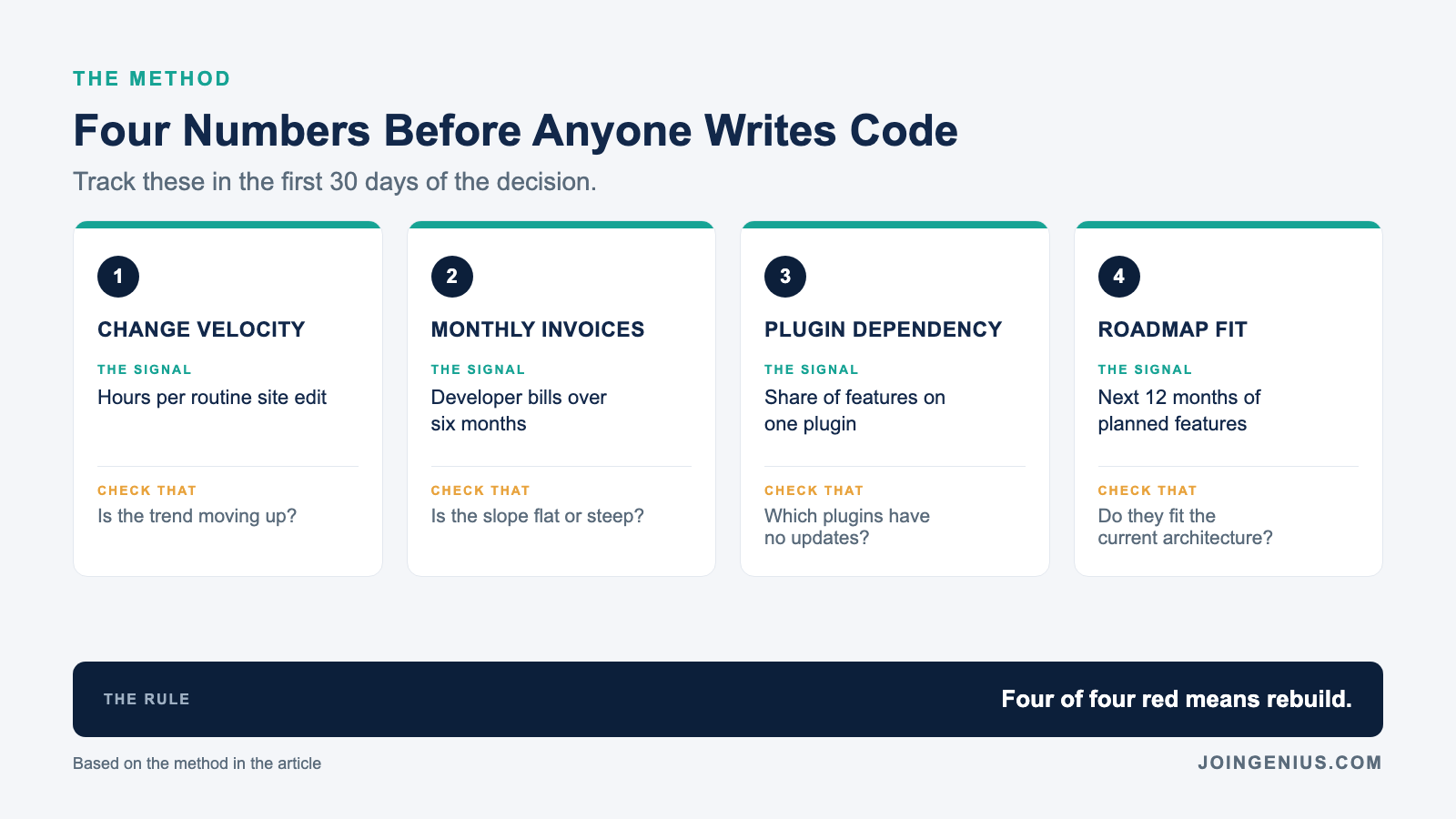
Before you commission a WordPress rebuild or refactor, spend two weeks tracking change velocity and listing which roadmap features the current site cannot support. If both numbers come back clean, keep what you have. If both are red, the answer is rebuild. Everything in between is a refactor, and the budget should match the smaller scope.
Genius can staff either path. We place top 1% WordPress developers and build leads from the Philippines and Latin America for 80% less than a comparable US hire. You pay no monthly fees, and every hire comes with a 6-month talent guarantee. If your project needs a team that can start next week, hire with Genius.