The developer who left your WordPress agency last quarter was not lazy. They were on call for seventeen client sites, three of which were running plugin combinations only they understood. A client’s checkout went down on a Friday night, they fixed it, and nobody told them it was ever broken again. Six months later they joined a product company and stopped answering recruiter messages.
That pattern is specific to WordPress agency work and it costs real retention. The product-shop engineer gets to own one codebase. The agency engineer owns every weird thing fifteen clients ever installed. Retention and attraction at a WordPress agency has to be designed around that reality. Below, we cover why WordPress agency work burns people out faster, where the hidden hours go, and what fixes it before the next resignation.
What Makes WordPress Agency Work Different
The WordPress agency job description looks like other dev jobs on paper. In practice, the shape of the work is nothing like a product team’s.
Clients Own the Site, Not You
A product engineer ships code into one environment they fully control. A WordPress agency engineer ships into fifteen client environments, each with its own hosting, its own plugin history and its own definition of “fine” at 2 am. Nothing about that is standardized by default.
The Surface Area Is Everything the Plugin Ecosystem Added
Every active plugin on every client site is a potential break. The agency didn’t write that plugin and often cannot read its code. Every WordPress core update is a roll of the dice across those plugins. The job becomes maintaining code written by other people under time pressure.
Every Incident Is Urgent Because Sites Are Revenue
A broken product feature is a bug in a sprint. A broken client checkout is a client calling. The pager treats both the same way, so the agency engineer gets paged on everything from a theme glitch to a real exploit. Over time the pager stops meaning anything and sleep stops happening.
What the 2025–2026 Numbers Say About Dev Burnout
The burnout data is clear and it is not evenly distributed. Agency environments show up over-represented, and the usual causes line up with WordPress work specifically.
Burnout Rates Among Developers Keep Climbing
Developer burnout is not a vibe. It is a measurable share of the workforce reporting exhaustion, lack of control and reduced ability to focus. The last two causes are precisely what WordPress agency work generates every week. Software development outsourcing sometimes gets blamed for burnout, but the shape of the work matters more than the geography.
Why Agency Devs Show Up Over-Represented
Agency devs context-switch between client codebases five or six times a day. They inherit code they never wrote, maintain plugins they do not love, and absorb the client’s panic as their own. Those three ingredients are a reliable burnout recipe anywhere, and WordPress agency work serves all three on repeat.
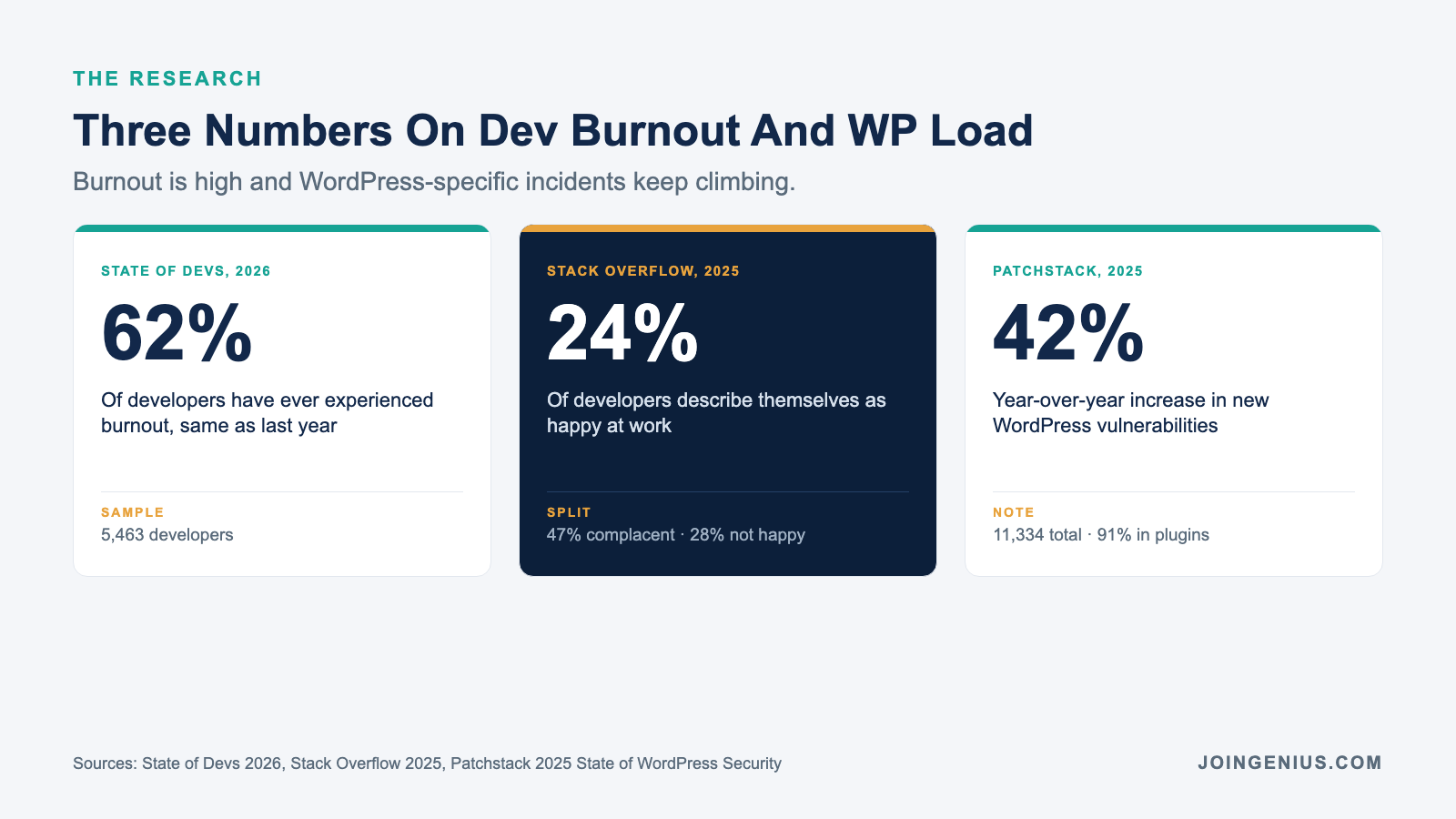
In the State of Devs 2026 survey of 5,463 developers, 62% reported having experienced burnout at some point in their career, the same share as the year before. The number is not getting better and the agency corner of the industry is where it tends to show up first.
Where the Hidden Hours Actually Go
The time that disappears from an agency week is rarely on the project plan. It goes to the kind of work nobody logs honestly.
Plugin Updates That Break Something Downstream
A plugin updates on a Tuesday, a checkout breaks on a Wednesday, and a client calls on a Thursday. The engineer loses half a day diagnosing which of forty plugins caused it. That half day was never scoped and never billed.
Security Incidents That Owning Your Hosting Would Prevent
A fraction of hosting setups cover brute-force attempts, malware scans and WAF rules at the edge. Most of the rest leave that work to the agency engineer at 2 am. Those incidents are expensive in sleep and expensive in trust with the client.
Patchstack’s 2025 State of WordPress Security report found 11,334 new vulnerabilities in the WordPress ecosystem, a 42% increase over 2024, with 91% of them in plugins. The agency inherits every one of those as a potential ticket.
After-Hours Tickets That Wait for Monday Morning
Weekend tickets accumulate quietly and arrive at the Monday standup as a wall of urgency. The engineer who checked their email on Saturday is already behind. The engineer who did not is suddenly the villain. Either way the work costs the week.
Take Repeat Firefighting Off the Team’s Plate
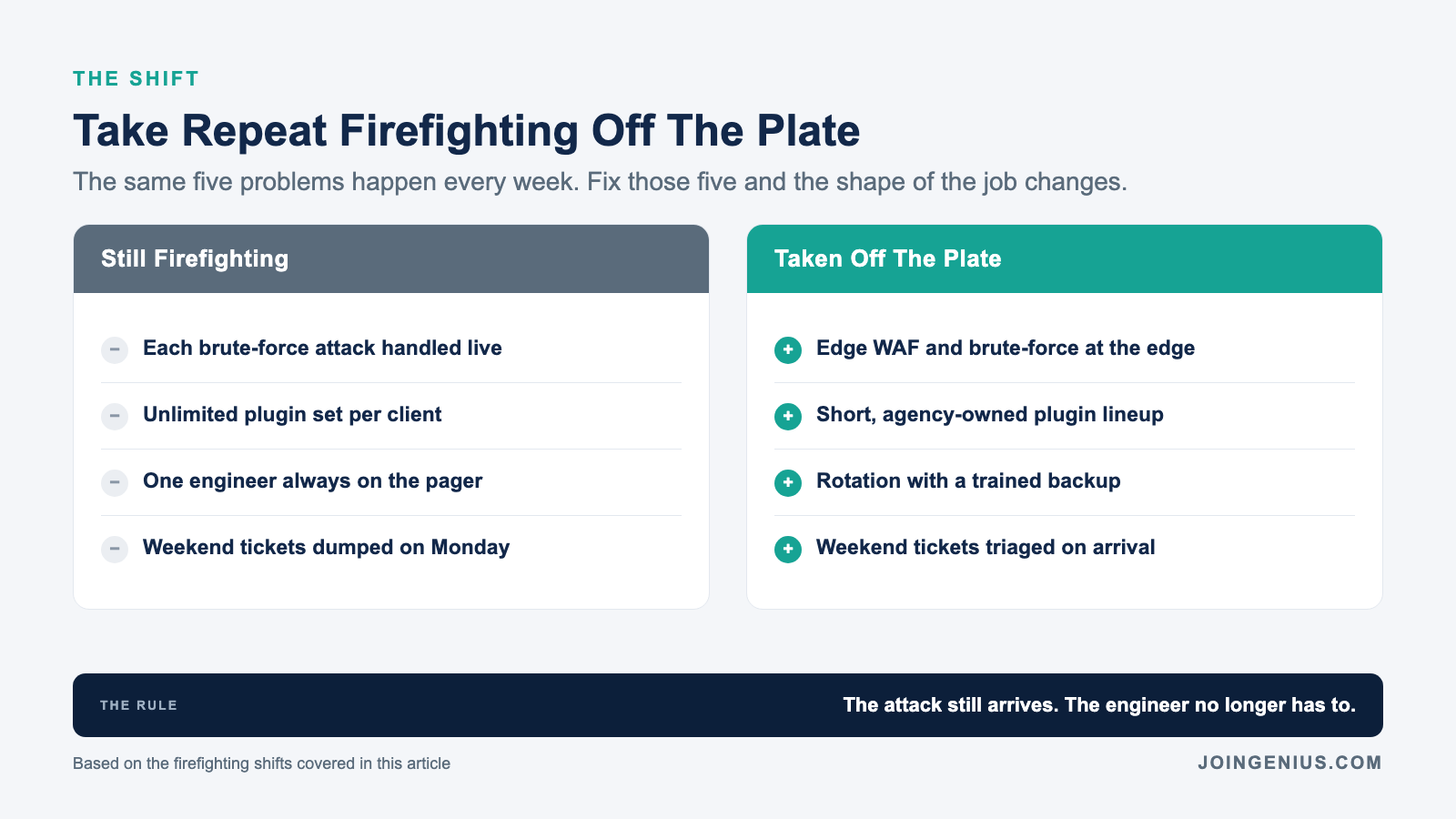
Most of what burns an agency team out is the same five problems happening again, every week. Fixing those five changes the whole shape of the job.
Move Brute-Force Protection and WAF to the Edge
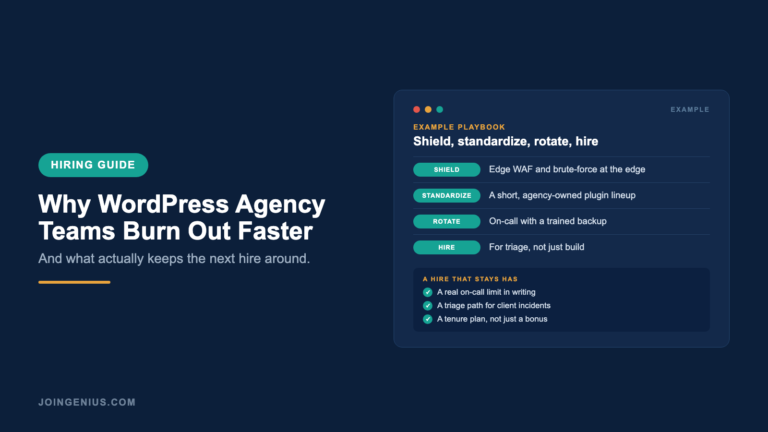
Automated login attacks are one of the most reliable sources of 2 am Slack messages for a WordPress agency, so moving brute-force protection to the edge takes a whole category of recurring tickets off the team’s queue. The attack still arrives. The engineer no longer has to.
Standardize the Plugin Lineup Across Clients
Pick a short list of plugins the agency will support and refuse to install anything outside it without a conversation. The second a client’s site runs forty plugins the agency has never seen, the week is already lost. A smaller, agency-owned plugin lineup collapses the surface area the team has to know.
Give the On-Call Rotation an Actual Escape Hatch
An on-call rotation that only one person can actually run is not a rotation. Pair every on-call engineer with a backup who has run that playbook before, and rotate who gets paged for what. The engineer who always answers the pager is the one who leaves.
A Short Signal Table
| What to Check | Still Firefighting | Taken Off the Plate |
|---|---|---|
| Brute-force logins | Agency handles each attack | Blocked at the edge |
| Plugin set per client | Unlimited and client-chosen | Short, agency-owned list |
| On-call rotation | One person always answers | Rotated with a trained backup |
| Weekend tickets | Pile into Monday standup | Triaged on arrival or scheduled |
How to Hire So You Don’t Burn Through the Team
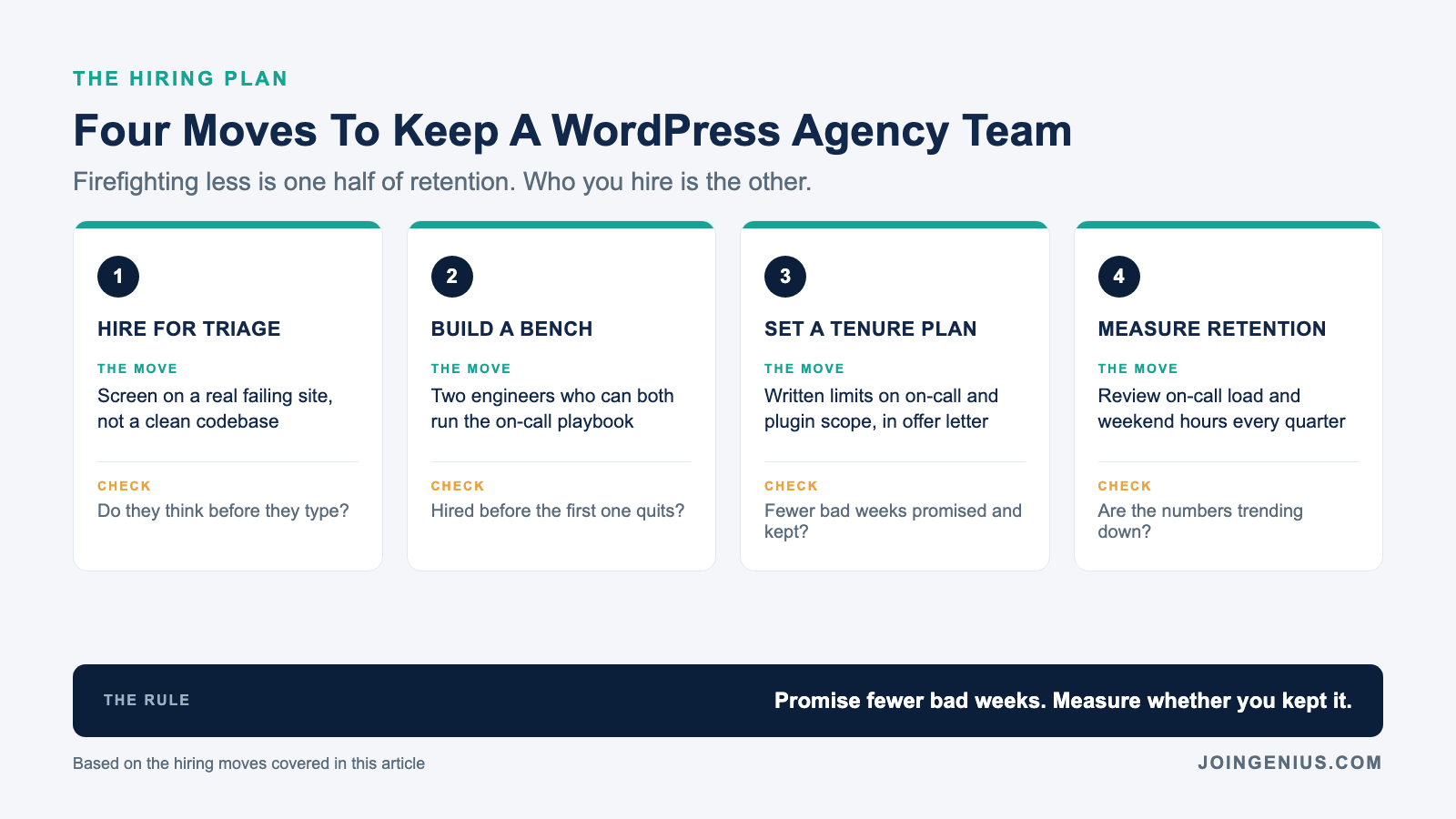
Firefighting less is one half of retention. The other half is who you hire and how long you set them up to stay.
Hire for Triage, Not Just Build
A WordPress agency engineer spends more time diagnosing other people’s work than writing new code. The hire that lasts is the one who likes diagnosis. Screen on a real failing site in the interview and watch how they think, not how fast they type.
Build a Bench So One Person Isn’t On Call Forever
Even two engineers who can both run the on-call playbook change retention outcomes. How to source founding engineers applies here — generalist, obsessive and able to work without a safety net. Hire the second one before the first one quits.
Set a Tenure Plan, Not Just a Comp Plan
A pay bump keeps nobody for long if the week keeps costing them weekends. Attract and retain the right people by promising fewer bad weeks, not just more pay. A written on-call limit, a written plugin policy and a written triage path matter more than a bonus.
Stack Overflow’s 2025 Developer Survey found that only 24% of developers describe themselves as happy at work. The other 76% split into 47% complacent and 28% not happy, and the agency corner of that middle 47% is where you lose people quietly.
Conclusion
WordPress agency burnout is not a motivation problem and it is not a WordPress problem. It is a shape-of-work problem. The engineer burns out because the work is unbounded, the surface area is unmanaged and the pager rings for everything the client cares about. Fix those three before you post the replacement job and the next hire actually stays.
We built Genius so WordPress agencies can hire that kind of engineer without the local-market tax. We place the top 1% of engineering and operations talent from the Philippines and Latin America, at around 80% less than comparable local hires. The relationship stays direct, with no monthly agency fees and a 6-month replacement guarantee on every placement. If the person who answers the 2 am ticket is the hire you keep losing, see how we source and place talent for WordPress agencies.