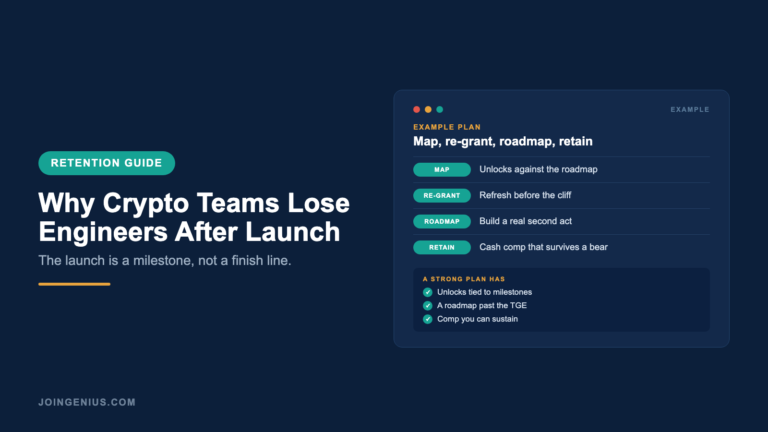
Most crypto projects have the same quiet problem. The token launches and the price does its thing. Within months, half the engineering team is gone. The people who built the protocol move on to the next launch, and the project meant to run for a decade is suddenly short-handed. Retaining engineers after the token launches is harder than shipping it.
This is not a loyalty problem or a bad-hire problem. The way crypto comp and launches are built practically schedules the exodus. Below, we cover why engineers leave the moment the token is live and what that churn costs, then how to keep them past the launch, which is really about retention design, not luck.
Why Engineers Walk the Moment the Token Launches
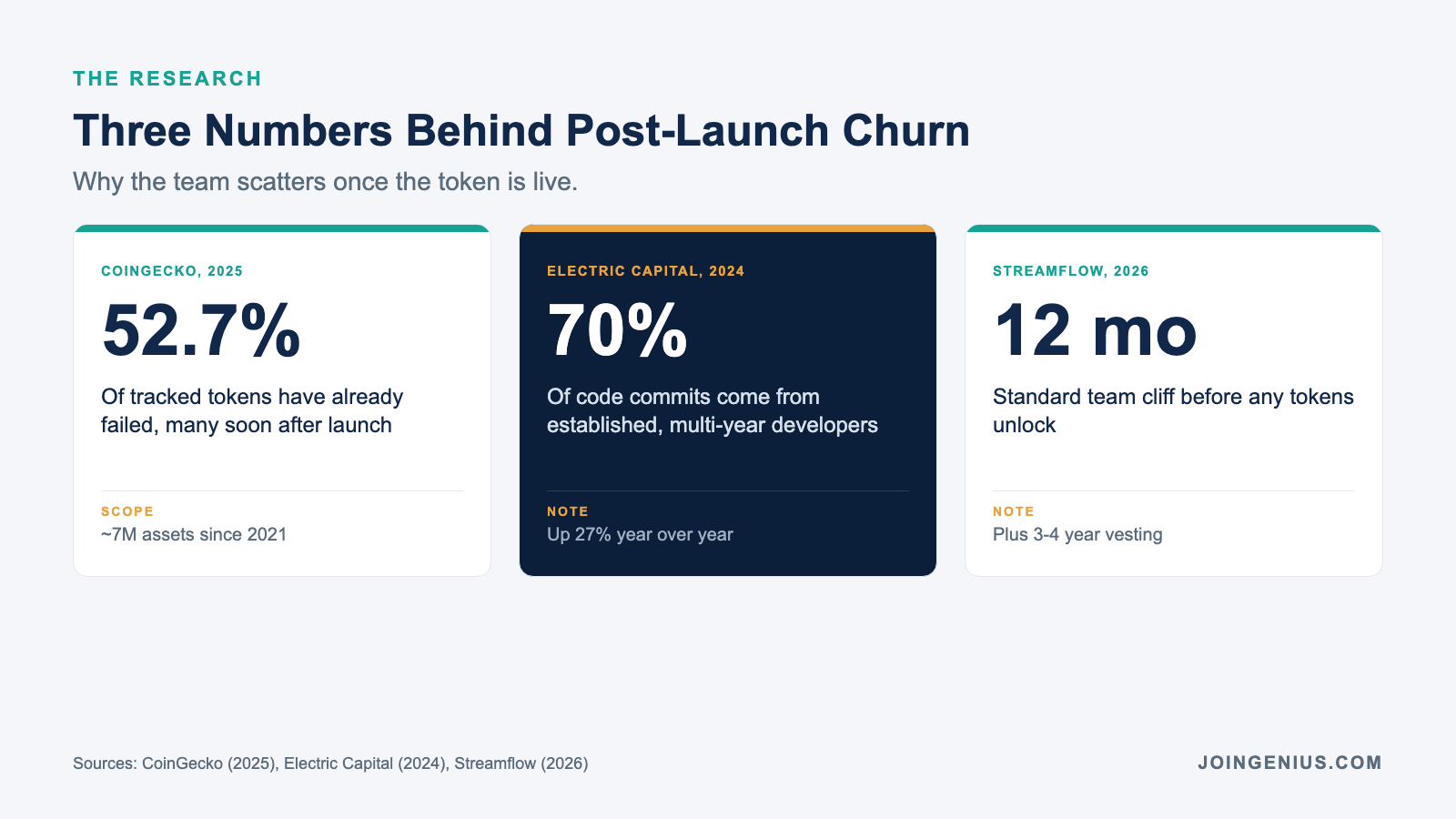
The timing is not a coincidence. A 2025 CoinGecko study found more than half of tracked tokens had already failed, and a team that scatters after launch is a big part of why.
The Vesting Cliff Was the Only Thing Holding Them
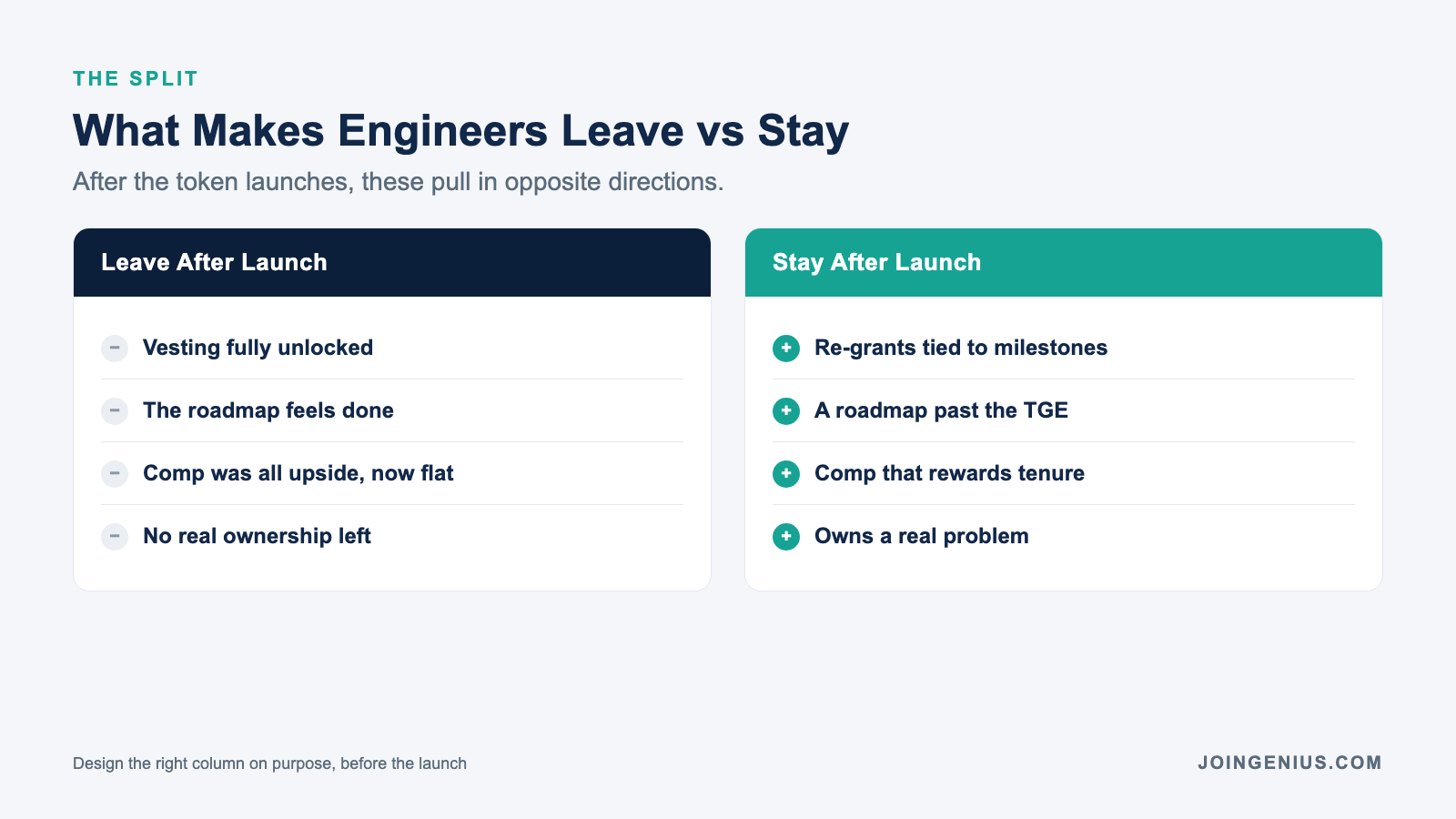
Most engineers join on a token grant with a one-year cliff. For twelve months, leaving means walking away from the whole allocation, so they stay.
The day that cliff passes, the handcuffs come off. Many departures are not about a better offer; they are just the first moment leaving became free. Watching it happen craters morale for the engineers left behind.
The Build-to-Launch Adrenaline Is Gone
Shipping a token is a sprint with a clear finish line. The all-nighters and the launch-day high are the fun part for a lot of builders. What comes after is maintenance and slow growth, which is a different job. Engineers who signed up for the launch often find they do not want the decade that follows it.
Token Comp Turned the Job Into a Lottery Ticket
When most of the pay is in the token, the job becomes a bet on price. If the launch pumps, an engineer may have made years of salary in a week and has little reason to grind on.
If it dumps, the upside they stayed for is gone, and so is the reason to stay. Either way, token-heavy comp weakens the hold right when you need it most.
What Post-Launch Churn Actually Costs a Crypto Project
Losing engineers after launch is not a clean headcount swap. In crypto the cost is sharper than in most industries.
The People Who Built It Hold the Context
Protocol code is dense and lightly documented, and the engineers who wrote it carry most of it in their heads. Experienced developers do the bulk of the work: in Electric Capital’s 2024 report, established developers made 70% of code commits, up 27% year over year.
Lose a few of them after launch and shipping anything safely gets slow and risky. The founding engineers are the hardest people to replace.
Shipping Slows Right When the Market Is Watching
Post-launch is exactly when you need to deliver. Holders want the roadmap, and the token needs a reason to hold its value. A thinned-out team slows that roadmap at the worst possible moment, and the gap between promises and shipped product shows up on-chain for everyone to see.
A Visible Exodus Spooks the Community
Crypto communities watch the team obsessively. When known engineers quietly remove the project from their profiles, holders notice and read it as a signal. A wave of departures can move the token as much as a bad product update. Talent leaving becomes a market event, which makes the next hire harder and the morale worse.
What Actually Keeps Engineers After Launch
Retention after a launch is not about ping-pong tables or bigger token grants. It is about giving good engineers a reason the money alone cannot.
A Roadmap That Is Exciting Past the TGE
The launch cannot be the whole story. Teams that keep engineers have a second act that is genuinely interesting, like a hard scaling problem or a new product line. If the roadmap after the token is just maintenance, your best builders will find their next hard problem somewhere else. Sell the decade, not the launch.
Comp That Rewards Staying, Not Just Launching
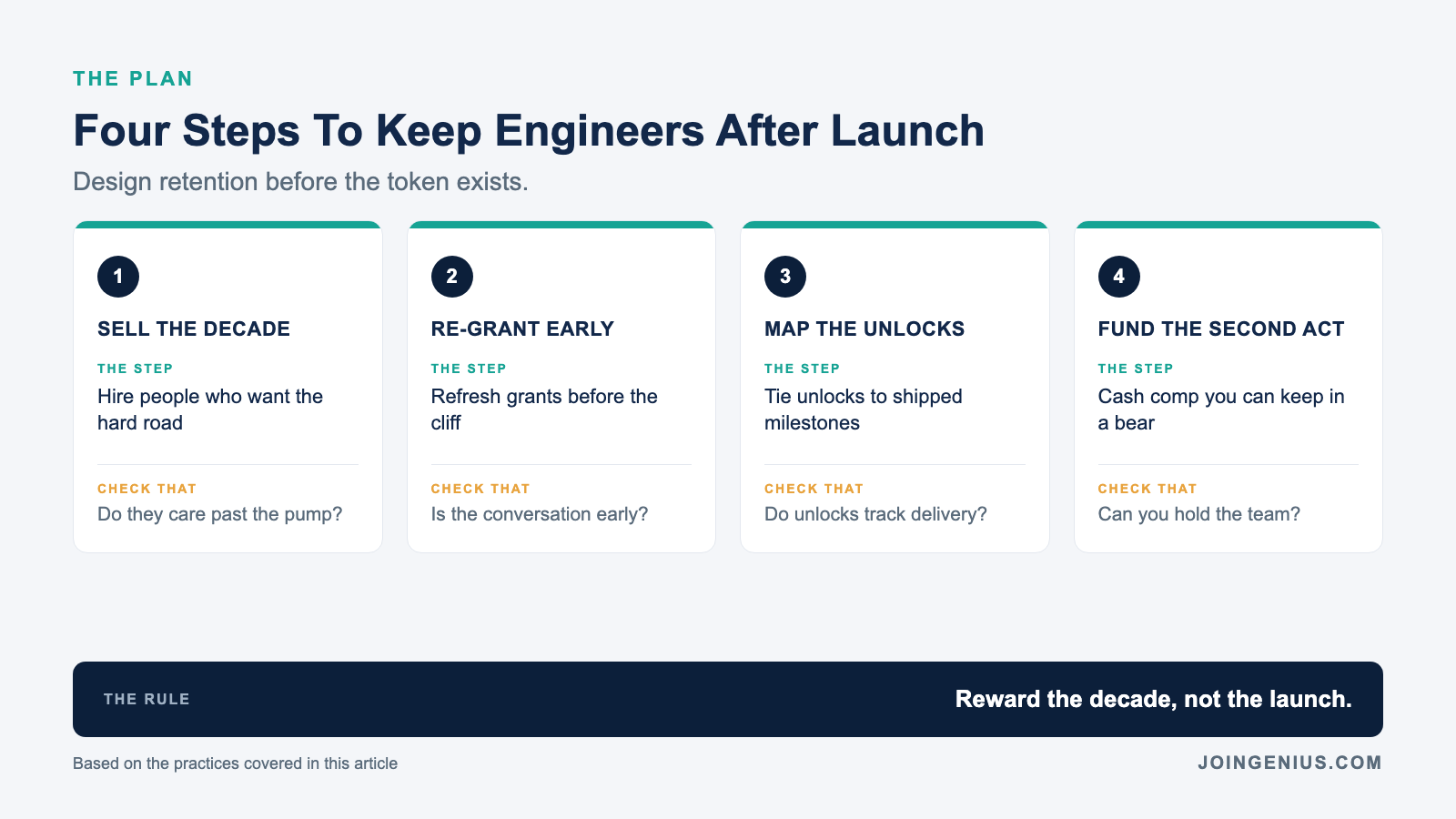
Front-loaded token grants pay people to reach the launch and then let go. Flip it. Use refresh grants and milestone-based unlocks so the most valuable tokens vest for work that happens after the TGE. The same logic sits behind every guide on how to attract and keep strong people: tie the reward to the future, not the past.
Ownership of a Real Problem, Not a Ticket Queue
Senior engineers stay where they own something that matters. After launch, that means handing over real surface area — a product or a protocol component — not a backlog of community-requested fixes. People who own outcomes stay to see them through. People who process tickets update their resumes.
Map Your Token Unlock Schedule Against Your Engineering Roadmap
Most teams set the unlock schedule during tokenomics design and never revisit it. That is a mistake, because the unlock calendar is also a retention plan. The standard core-team setup, a 12-month cliff with three-to-four-year vesting, only works if the roadmap gives people a reason to stay through it.
Line Up Unlocks With Milestones, Not the Calendar
A pure time-based unlock pays people for the passage of time. Tie a share of each engineer’s unlocks to shipped milestones instead, so the reward tracks contribution past the launch. It turns the vesting schedule from a countdown-to-exit into a reason to deliver the next thing.
Watch When Your Unlocks and Your Competitors’ Hit
You cannot plan around unlocks you are not tracking. A stacked unlock — team and investor tokens releasing in the same window — creates a supply shock and a wave of people suddenly free to leave.
Watching the schedule with a token unlock tracker lets you see those windows coming, for your own project and the competitors your engineers might jump to. Then you can plan retention conversations before the cliff, not after it.
Re-Grant and Extend Before the Cliff, Not After
The worst time to talk about a new grant is the week someone’s tokens fully vest. By then they are already looking. Have the retention conversation a quarter before the cliff, with a refresh grant that resets the horizon. A small, well-timed re-grant is far cheaper than backfilling a senior protocol engineer.
The difference between the two approaches is stark:
| Approach | Calendar-driven | Roadmap-driven |
|---|---|---|
| Unlock timing | Fixed dates | Tied to milestones |
| Engineer incentive | Drops at the cliff | Renews with each goal |
| Supply-shock risk | Stacked unlocks | Spread over delivery |
| Retention effect | Exodus at vest | A reason to stay |
Tie the tokens to delivery, and the schedule starts working for retention instead of against it.
How to Build a Team That Survives the Launch
Retention after launch starts at hiring, long before the token exists. Who you bring on, and how you pay them, decides who is still there in year two, the same way it does at any startup.
Hire People Who Want the Decade, Not the Pump
Screen for builders who care about the problem, not just the token. Ask what they want to be working on two years after launch, and listen for a real answer. The engineer who lights up about the hard technical road ahead is the one who stays. The one who only talks about the token is already halfway out.
Bring In Talent You Can Actually Afford to Keep
Retention is easier when comp is sustainable. A team built entirely on expensive senior engineers and fat token grants is hard to hold together when the market turns.
- Build a core of engineers whose cash comp you can sustain in a bear market.
- Use global talent to extend runway without gutting seniority or quality.
- Avoid a team that only makes sense while the token is pumping.
- Keep enough cash comp that staying never depends on the price.
Plan for the Post-Launch Phase Before You Launch
The time to design retention is before the token exists, not after people start leaving. Decide the second-act roadmap and the refresh-grant policy early, before people start eyeing the door. Teams that plan the post-launch phase keep their engineers. Teams that treat launch as the finish line watch them walk.
Conclusion
Crypto teams do not lose engineers after launch because builders are disloyal. They lose them because the whole system, from the vesting cliff to the comp design, points toward the exit the moment the token is live.
Change what the token rewards and give people a hard problem for the next phase, and the engineers who would have left will stay. The launch should be a milestone, not a finish line.
If part of the problem is that your whole team is built on expensive senior engineers you can only afford while the token is up, that is worth rethinking. At Genius, we help crypto and tech companies hire the top 1% of engineering talent from the Philippines and Latin America, at around 80% less than comparable local hires.
That lets you build a core team you can keep through a full market cycle, with no monthly agency fees and a 6-month replacement guarantee. If keeping engineers after launch is the problem you keep hitting, see how we source and place engineering talent.