Most ecommerce brands have a retention team on the org chart but a reporting function in practice. Someone pulls the loyalty dashboard every Monday. Redemptions ran flat again, and the week moves on. No offer ships because of the loyalty program.
A retention team that actually sells reads loyalty data the way a sales rep reads a pipeline. Points balance and tier flip trigger upgrade offers. Redemption lag and referral source trigger winback. Each signal becomes an input to this week’s offer calendar, not a monthly deck. Below is the team shape and weekly loop that ships booked customer lifetime value.
What A Selling Retention Team Actually Looks Like
The reporting-only version watches loyalty metrics. The selling version watches loyalty signals, and treats each one as the start of an offer brief.
Four Signals Worth Reading Weekly
The four signals a retention team should pull from loyalty every week sort into two pairs. Tier membership and points balance tell you who is about to earn a reward. Redemption lag and referral chain tell you who already has value stored in the program and is not spending it.
Each pair has a different offer shape. The earners get pre-redemption bumps, since a customer with 450 of a 500-point reward will cross the line for a 10 percent nudge. The parked-value group gets a reactivation push, because an unredeemed reward is money the business owes but can recover with a well-timed email.
Brands that run loyalty for three years without a selling retention function end up in the same spot. The program issues millions of points. Redemption stays low. No campaign in the current quarter happened because of a loyalty signal, which is the actual test of whether the team is selling or reporting.
The Line Between Report And Brief
A report answers what happened last week. A brief answers who gets what offer and how it ships. A selling retention team turns every Monday loyalty read into briefs the lifecycle marketer and the ad buyer can act on before Friday.
A one-page brief has six fields. Segment name and size. The offer and the send channel. The hypothesis and the success metric. The lifecycle marketer reads it and ships the email before Friday. Any brief longer than one page tells you the retention lead is still writing a report.
The Numbers That Make Loyalty Data A Sales Input, Not A Dashboard
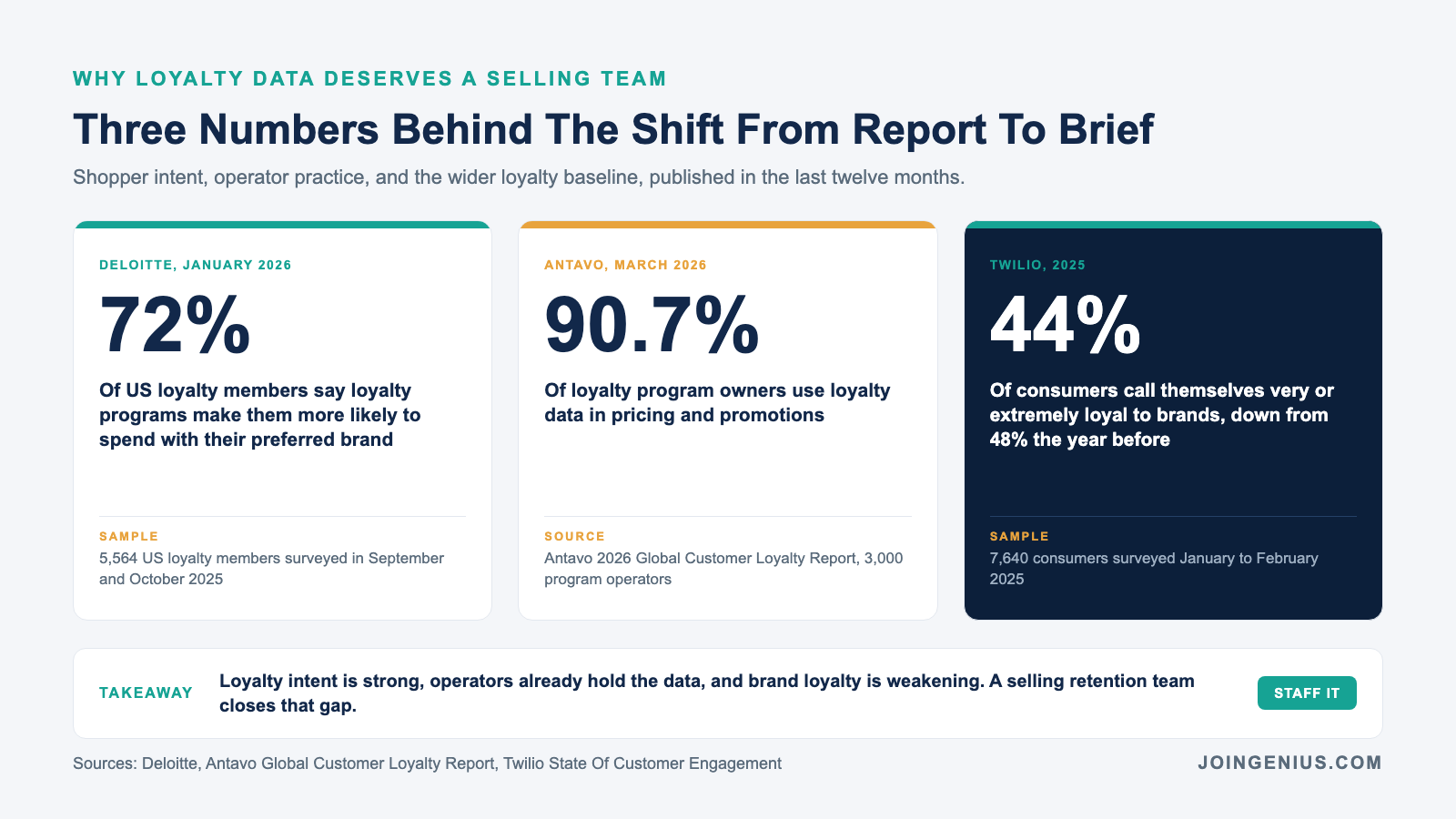
Three figures from the last twelve months separate the retention programs that produce revenue from the ones that produce decks. The first two cover shopper intent and operator practice. The third sets the wider loyalty baseline, which is where the staffing case begins.
A Deloitte January 2026 study of 5,564 US loyalty members found 72 percent say loyalty programs make them more likely to spend with their preferred brand. That is a share shift, not a pledge to spend more overall. The right offer at the right tier is how a selling team captures it.
The Antavo 2026 Global Customer Loyalty Report found 90.7 percent of loyalty program owners use loyalty data in pricing and promotions. The missing part is which owners use it well. Reading a dashboard and pricing from the dashboard are different disciplines, and the gap between them is where most retention programs lose revenue.
Twilio’s 2025 State of Customer Engagement surveyed 7,640 consumers between January and February 2025. Only 44 percent called themselves very or extremely loyal to brands, down from 48 percent. Brand loyalty is a weaker default than it was, which raises the return on a program that earns its name instead of counting swipes.
The Four-Role Shape Of A Retention Team That Ships Offers
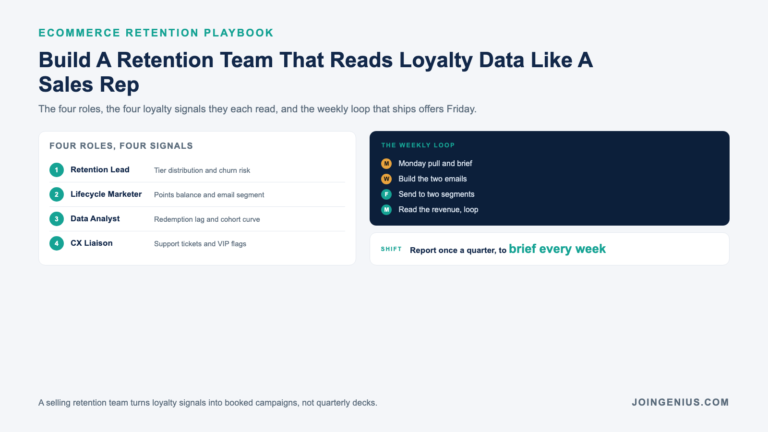
A retention team that ships offers weekly fits four people, not a department. Each role owns one slice of the loyalty-to-sales pipeline, with one loyalty-data KPI they hold the pen on.
Roles And Their Loyalty-Data Inputs
The four roles map one-to-one to the four signals in the data. One person owns the direction. One ships the sends. One checks whether the sends moved the number. One keeps the top tier happy enough to keep buying.
| Role | Loyalty Data Input | Weekly Output | KPI |
|---|---|---|---|
| Retention Lead | Tier distribution and churn risk | Offer calendar | Repeat-purchase rate |
| Lifecycle Marketer | Points balance and email segment | Triggered emails | Email revenue per recipient |
| Data Analyst | Redemption lag and cohort curve | Segment and A/B test | Program contribution margin |
| CX Liaison | Support tickets and VIP flags | VIP response playbook | Retention from top 10 percent |
Smaller brands collapse the analyst and the lifecycle marketer into one operator. Enterprise brands split the lifecycle role between email and SMS. The four-role shape is a template rather than a floor plan. The KPI that keeps the team honest is always average order value from loyalty-tagged orders.
Why Four, Not Six
The temptation to add a loyalty program manager and a retention PM is strong on paper. In practice that slows the weekly loop, because each new role adds a review step. A team that produces offers every week stays flat and runs on one meeting.
Where this team lands in the org depends on who else owns revenue. In DTC brands under $20M, it reports to the CMO or founder. Above $20M, a VP of Retention or Director of Lifecycle holds the P&L. The key is that the four people meet once a week with authority to ship.
The Data Stack That Lets The Team See Loyalty Alongside Sales
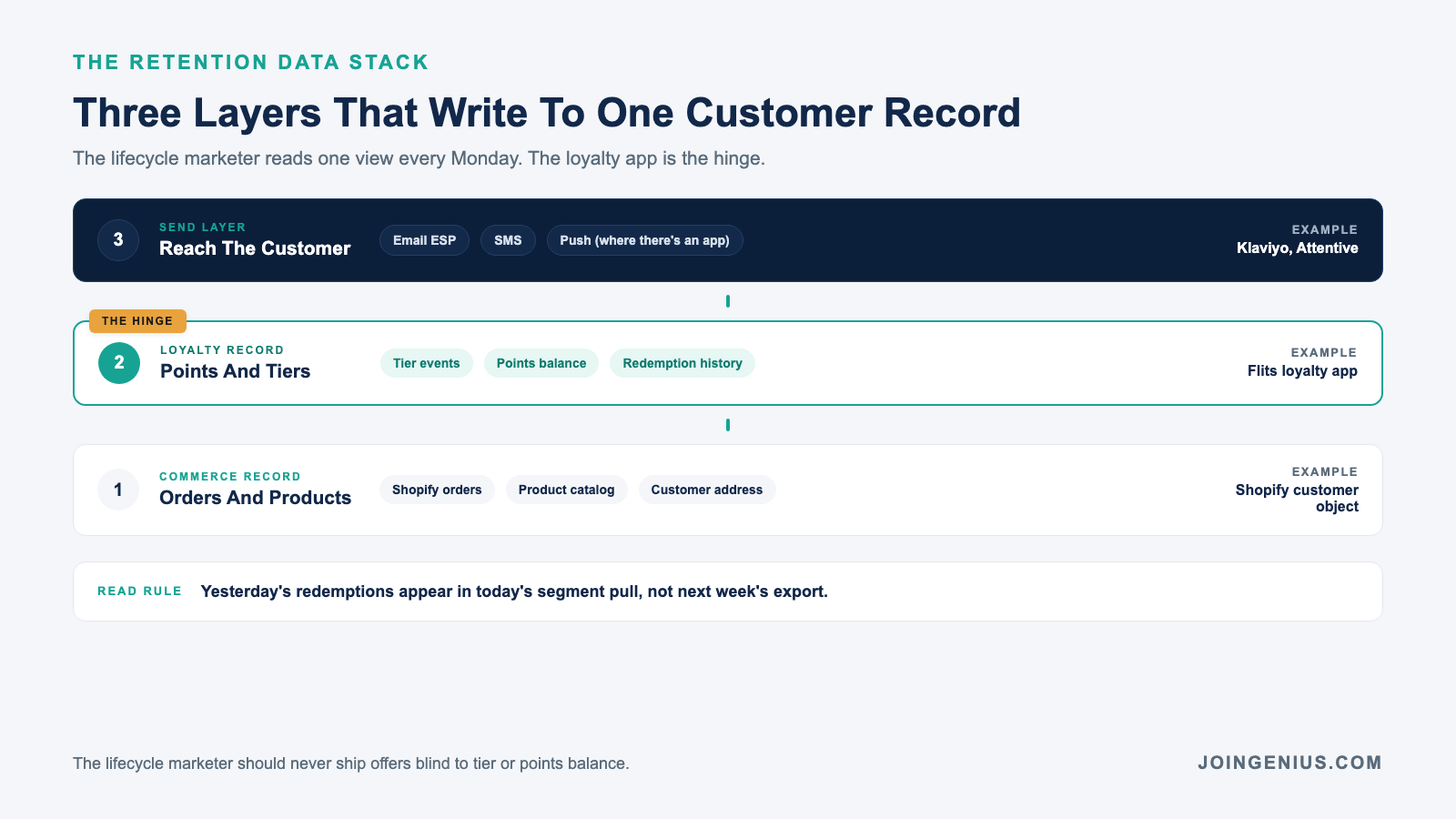
A retention team cannot sell from loyalty data if the data stays in a tab they open twice a quarter. The stack has to put tier and points data on the same customer record as order history, so the lifecycle marketer reads one view every Monday.
The Three Layers That Matter
Three layers belong in the retention stack. The commerce record carries Shopify order and product data. The loyalty record carries tiers and points data. The send layer carries email and SMS, with push added where the brand runs an app.
Any extra tool is optional until the three layers write to one view. BI dashboards and attribution tools belong on top of the stack once the base three are joined. Brands that invert this order end up with a dashboard nobody reads and a lifecycle marketer who still exports CSVs by hand.
Where The Loyalty Platform Fits
The loyalty app is the hinge. A platform like the Flits loyalty app writes tier events and points balance into the same Shopify customer record the ESP reads, which keeps Shopify stores from losing the data they already paid to collect.
Read logic matters too. The lifecycle marketer should see yesterday’s redemptions in today’s segment pull, not next week’s export. The gap between the two decides whether a customer gets the pre-redemption bump before the free-shipping window closes.
The Weekly Loop: From Loyalty Report To Published Campaign
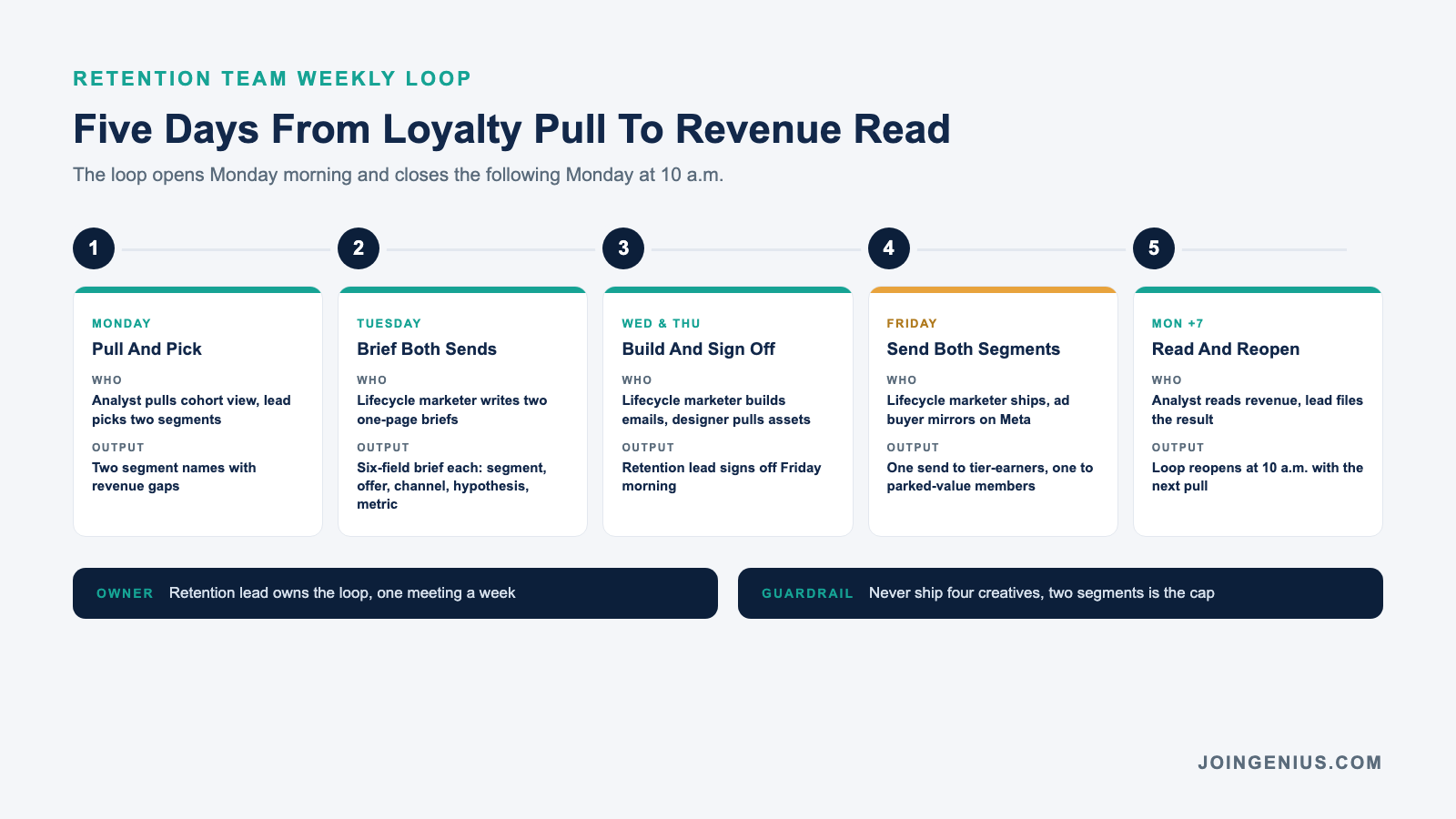
A selling retention function runs on a weekly loop, not a monthly one. The loop starts Monday with a loyalty pull and closes Monday morning with a revenue read. Five days in between carry the brief and the send.
Days 1 And 2: Pull And Brief
Monday morning the analyst pulls the loyalty cohort view. The pull shows points flow and tier shifts in one dashboard. Monday afternoon the retention lead picks two segments based on which one has the biggest revenue gap. Tuesday the lifecycle marketer writes briefs for both.
Days 3 And 4: Build And Send
Wednesday and Thursday the lifecycle marketer builds the two emails, with the designer pulling assets. The retention lead signs off by Friday morning. Friday the sends go out, one to tier-earners near a threshold, one to parked-value members. The ad buyer mirrors the second segment on Meta.
Where The Loop Breaks
Three failure modes kill the loop in the first quarter. The team skips Monday’s pull because a launch is behind. The analyst ships a report instead of a brief. The retention lead says yes to every segment suggestion, so Friday ships four creatives instead of two. Nobody can read the result against revenue the following Monday.
Day 5 And The Loop Close
Monday morning the analyst reads the revenue. Which emails pulled? Which segment moved? What changed about the tier mix? The retention lead files the result on the quarterly deck, and the loop opens again at 10 a.m. with the next pull.
Teams that keep this cadence treat loyalty the way a multichannel operator treats inventory. The data is a live signal, not a monthly artifact. The CFO starts to notice because the line item attached to loyalty moves every week instead of every quarter.
Hire The Retention Operator Who Reads Loyalty Data Like A Sales Rep
A retention team only ships offers if it can read loyalty signals Monday morning and write a brief by Monday afternoon. The hires that make this work are not the ones with the longest resumes. They are the ones who treat loyalty data as a sales input.
Genius vets lifecycle marketers and retention analysts in the top 1 percent of applicants from the Philippines and LATAM, and places them with US and EU DTC brands at roughly 80 percent less than a local hire. No monthly fees. Every match comes with a 6-month talent guarantee, and the interview rubric is built around the four loyalty signals above.