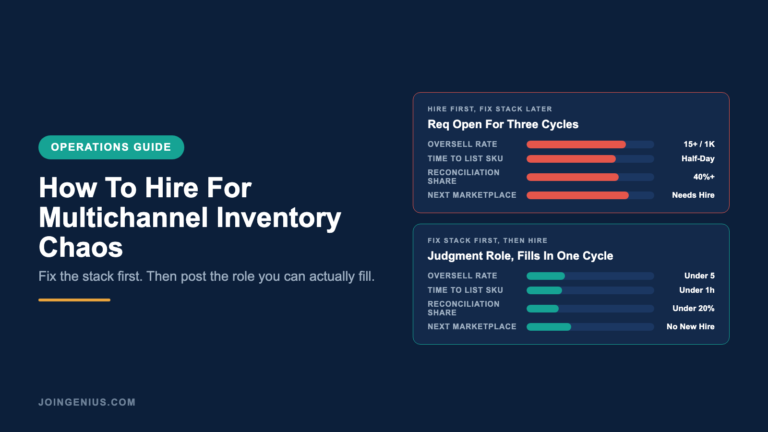
Six marketplace dashboards. Three warehouse feeds. One tired inventory manager who got hired to run Amazon and now owns everything else by accident, from TikTok Shop and Walmart to the EDI drops from the biggest retailer. The quarterly oversell rate is climbing, the ops lead is tired of the “we need another headcount” conversation, and the recruiter is sitting on a req that has been open for three cycles because every candidate who looks the part turns the role down inside the first week. This is not a hiring problem yet. It is a stack problem that is quietly dressed up as a hiring problem, and if you post the role before you fix the stack the next hire will burn out exactly the same way.
The right move almost never starts with another inventory manager. It starts with a single source of truth, so the role you post next is the role you can actually fill. Modern hiring workflows have cut time to hire for operations roles sharply, but speed does nothing if the role itself is scoped against a broken stack. Below we cover why “hire another inventory manager” is almost always the wrong first move and what a centralized listing stack changes about the role. We also cover how to fix the stack before you post, what to hire for once the stack is doing its job, and how to measure whether the headcount is still needed.
Why “Hire Another Inventory Manager” Is Almost Always The Wrong First Move
The default response to multichannel chaos is a new headcount. The default is also almost always wrong, and the reason the req stays open for three cycles is written into the first week on the job.
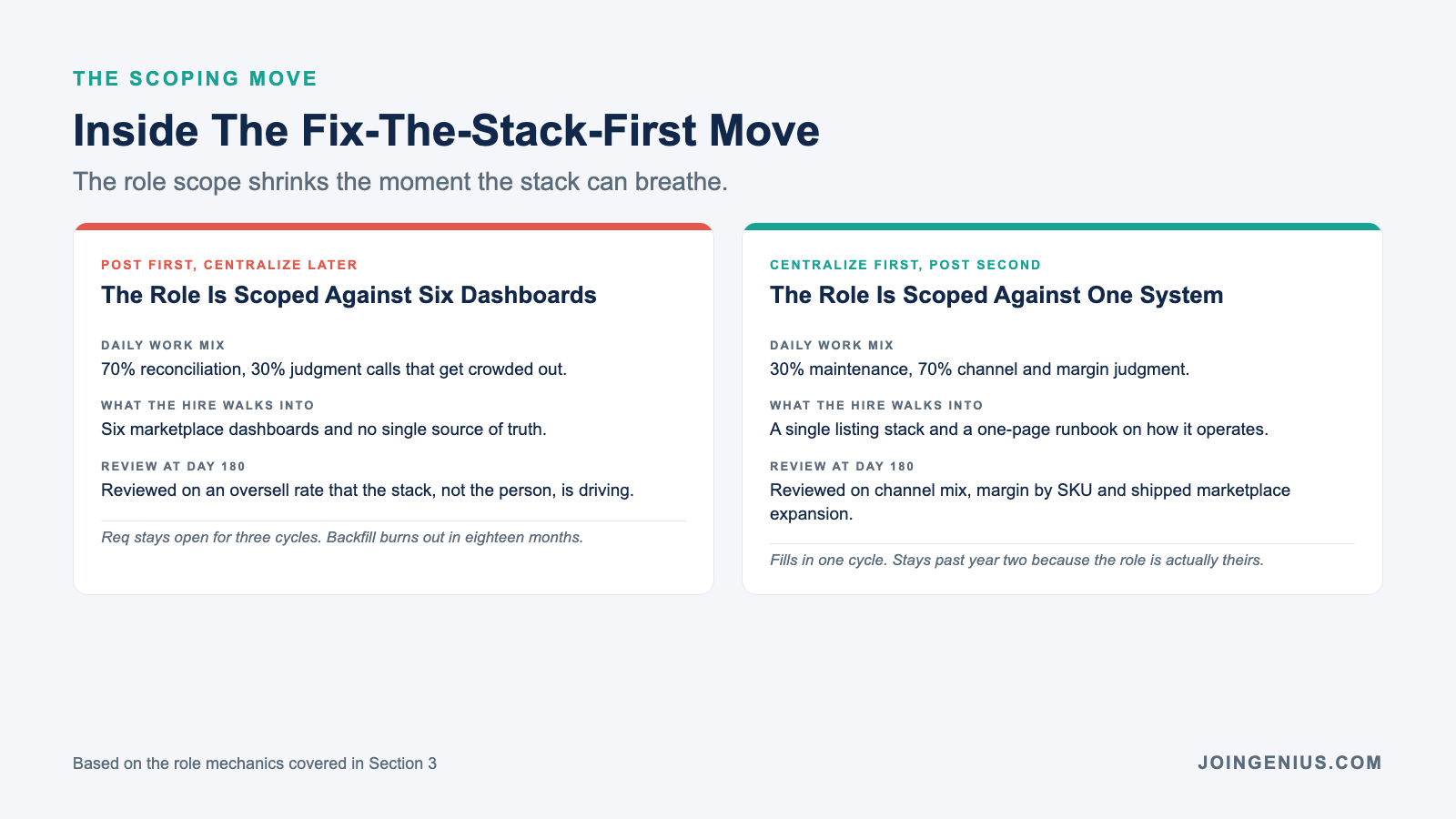
The Role Is Scoped Against Six Dashboards, Not One System
A req that reads “own inventory across five marketplaces, from Amazon and Walmart to TikTok Shop and Shopify” is a req that asks one person to be the integration layer the company never bought. The strongest candidates read that posting and know what the first ninety days will look like. They decline politely and the recruiter wonders why the pipeline keeps drying up.
The Last Hire Already Burned Out On The Same Problem
Most multichannel inventory reqs are backfills for someone who left inside eighteen months. The exit interview almost always points at the same thing: too many systems with no single truth, and a workload that scales with every new marketplace instead of with the actual revenue. Posting the backfill without fixing the system is a signal to the next hire that the pattern will repeat.
The Daily Work Is 70% Reconciliation, 30% Judgment
An inventory manager without a centralized stack spends most of their week reconciling counts between dashboards and resolving overselling events after the fact. That ratio is backwards. The role you actually need to hire is a 70/30 split toward judgment calls (which SKUs on which channels and how to price the long tail), and the stack decides which ratio the role will have.
The Cost Of Overselling Compounds Faster Than The Headcount Fix
Every oversell event cascades: the refund and the goodwill ask, then the marketplace-performance ding and the time to repair the listing. Adding a second manager absorbs some of the work but does not change the underlying failure rate. Fixing the stack changes the rate.
What A Centralized Listing Stack Changes About The Role
A single source of truth is not a nice-to-have for a multichannel operation that has outgrown spreadsheets. It is what makes the role fillable, and it is what keeps the person you hire for longer than eighteen months.
The Role Scope Shrinks To The Work That Needs A Human
Once listings are centralized and the inventory counts and orders underneath them follow, the operator stops being an integration layer and starts being a decision maker. That is a different job with a different candidate profile, and it posts and fills far faster.
The Review Conversation Changes
A manager reviewed on oversell rate inside a broken stack is reviewed on something they cannot control. A manager reviewed on margin by SKU and shipped marketplace expansion is reviewed on work that is actually theirs. The second conversation keeps good hires. The first one loses them.
The Expansion Decision Stops Costing A Headcount
Every new marketplace a company considers has a hidden question: does this require another inventory manager? With a centralized stack, the answer is almost always no. The decision moves from “can we staff this” to “can we price and position this,” which is the decision the business actually wants to be making.
The Vendor Is The Floor, The Hire Is The Ceiling
A centralized stack sets the floor on how badly things can go. The hire sets the ceiling on how well they can go. Both matter, and most ecommerce ops orgs invest in the ceiling before they have poured the floor.
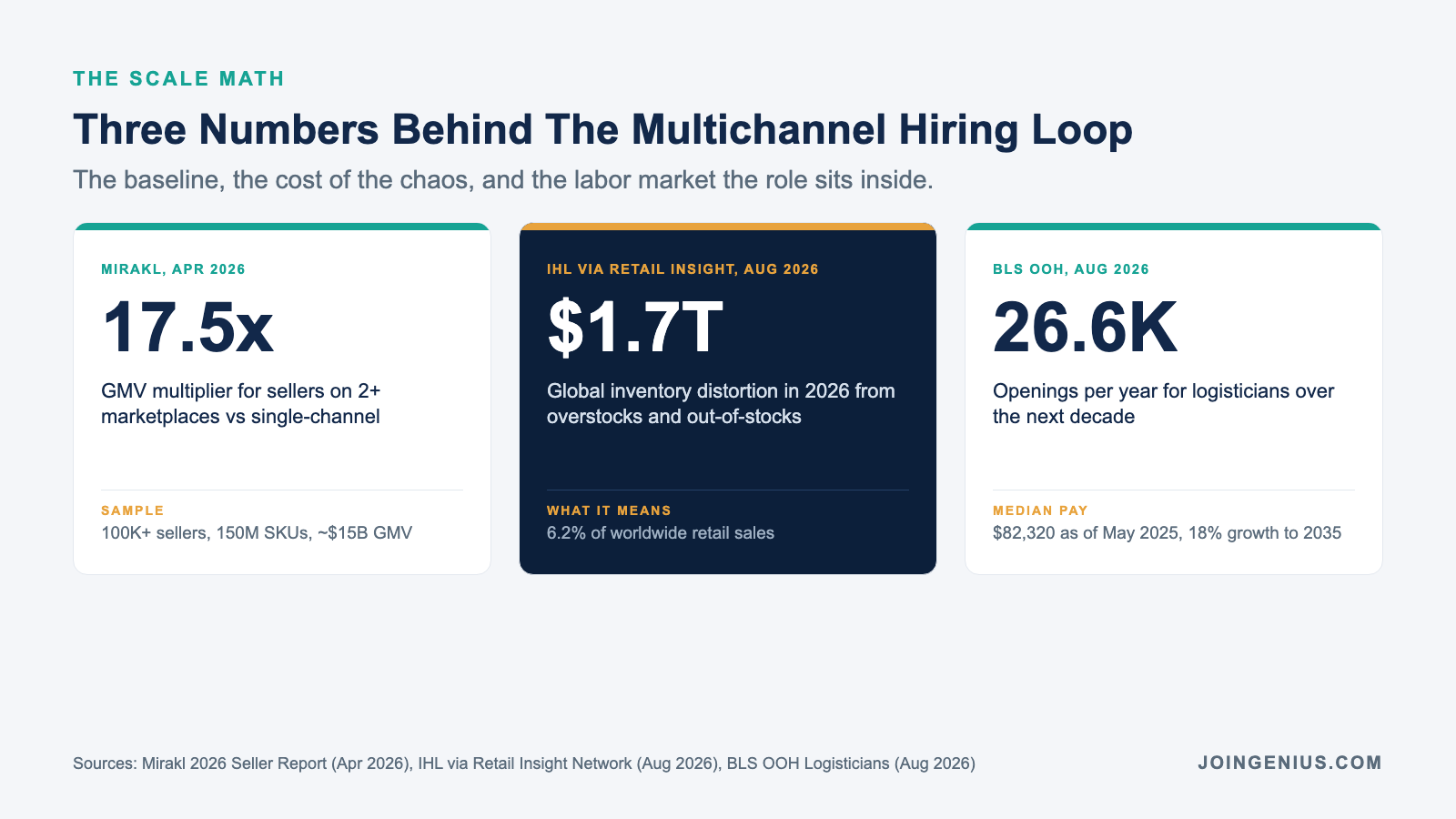
Mirakl’s 2026 Seller Report, published April 15, 2026 and based on performance data from over 100,000 global sellers on Mirakl’s marketplace and dropship platforms representing 150 million SKUs and nearly $15 billion in annual GMV, found that sellers operating on two or more marketplaces average $10,073,917 in GMV against $575,093 for single-marketplace sellers, which the report calls a 17.5x performance multiplier. Multichannel is the baseline, not an experiment, which is why “hire another inventory manager to catch up” is the wrong instinct. The headcount cannot scale with a market that grew 31% year over year in 2025.
Fix The Stack Before You Post The Role
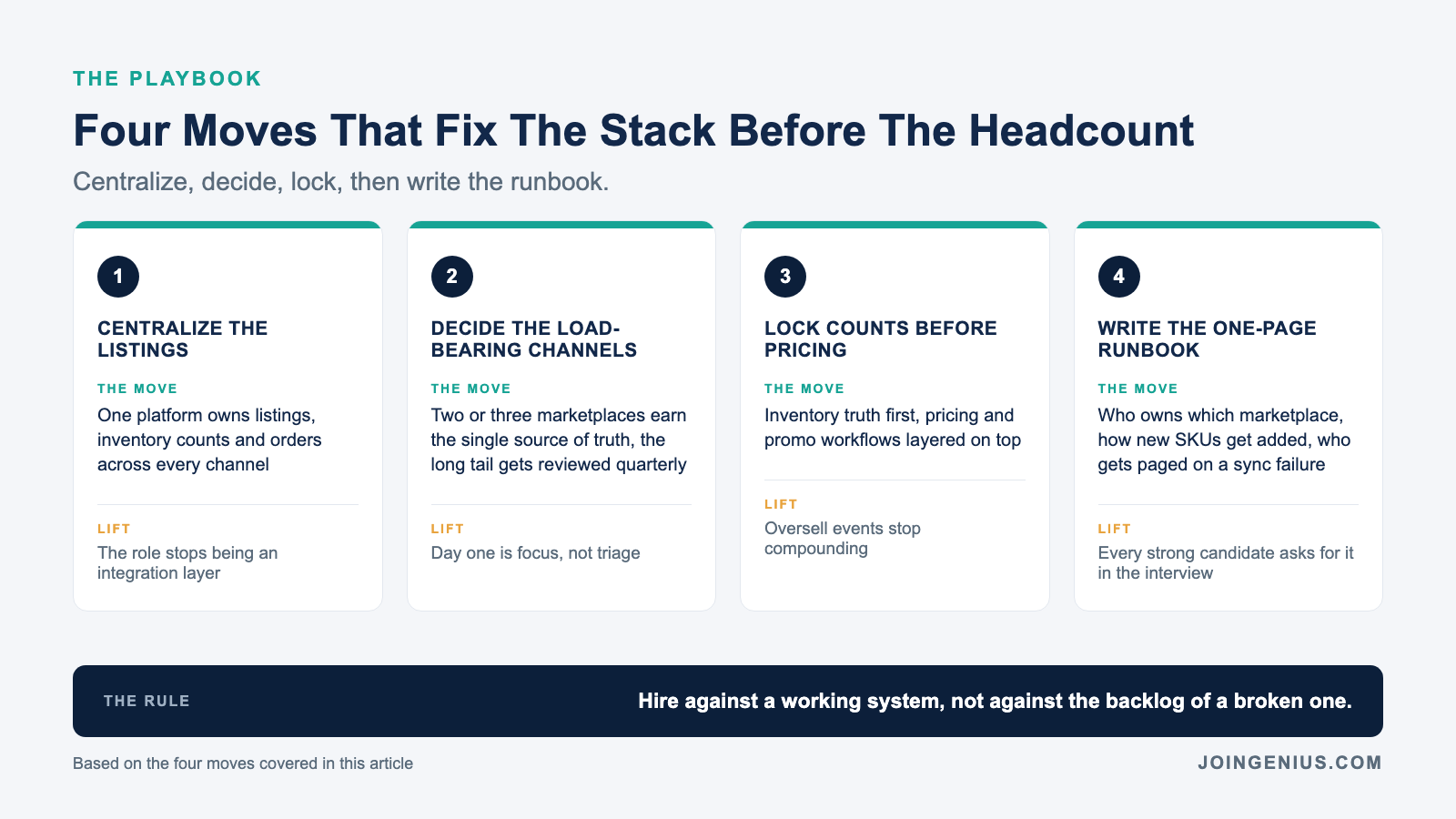
The strongest move an ops leader can make before opening a multichannel inventory req is to centralize listings and the inventory counts and orders that sit under them onto one platform. The hire you post against a single source of truth is a different hire, posted on different criteria, filled in a different timeline.
Centralize Listings Before You Centralize Headcount
Before hiring another inventory manager, consider using a multichannel listing platform like M2E Cloud to manage marketplace listings, sync inventory, and handle orders across multiple sales channels from one place. The role you can hire against that single source of truth is a very different and much more fillable role than the one you can hire against six disconnected marketplace dashboards.
Decide Which Marketplaces Are Load-Bearing
Not every channel earns a seat at the single source of truth. The two or three that drive the revenue earn it. The long tail should be reviewed quarterly and cut without ceremony when it stops contributing. The hire inherits a focused channel list on day one, not a sprawling one they have to triage first.
Lock Inventory Counts Before Pricing And Promotion
Centralized listings without centralized inventory still oversell. Centralized inventory without centralized pricing still leaves margin on the table. Order of operations matters. Lock the counts, then layer pricing and promotion workflows on top. The hire inherits a stack that is boring in the right places.
Write The Playbook Before The Job Post
Once the stack is centralized, write a one-page runbook on how it operates: who owns which marketplace and how new SKUs get added, plus who gets paged when a sync fails. That runbook is the artifact the new hire walks into. It is also the artifact every strong candidate asks for in the interview.
Retail Insight Network, in an August 6, 2026 feature citing IHL research, reports that inventory distortion measured through overstocks and out-of-stocks will cost the global retail industry around $1.7 trillion in 2026, equal to 6.2% of worldwide retail sales. That $1.7 trillion is exactly the thing a multichannel inventory manager is hired to prevent, which is why the sequencing matters. Stack first, hire second, and the person you post for inherits a role where the oversell rate is a signal they can actually move instead of a tax the system is quietly collecting.
What To Hire For Once The Stack Is Doing Its Job
The role you post against a centralized stack is not the role you were going to post against the chaos. The scorecard changes, and the candidate pool changes with it.
Hire For Channel Judgment, Not Dashboard Fluency
Dashboards are learned in a week. Channel judgment (which SKU belongs on which marketplace and when to kill a channel that is not pulling its weight) takes years and does not come from a tool training. Screen for the judgment. The dashboards will take care of themselves.
Hire For Marketplace-Specific Pattern Recognition
Each marketplace has its own quirks, from how Amazon’s BuyBox works to how TikTok Shop scores listing quality and recovers reviews after a refresh. The strongest hires have shipped on at least two platforms and can speak to the differences without a cheat sheet. Ask for a specific story, not a general philosophy. Why marketing ops hires don’t stay past their first 18 months is the sister retention story in an adjacent role, which is that specificity about the tooling is what keeps the hire past the honeymoon.
Hire For Margin Instinct, Not Volume Instinct
A multichannel inventory lead who optimizes for GMV without margin is the lead who grows the business into a loss. Screen for how they talk about contribution margin and the promotional math underneath it. Volume is cheap. Margin is the real signal.
Hire For The Expansion They Will Own In Year Two
The hire you post against the chaos is a cleanup hire. The hire you post against the centralized stack is a growth hire. Scope the role to the next marketplace or the next region, not to the backlog of broken listings. The best candidates are hired on the second scope, not the first.
What To Stop Doing (It’s Hiding The Real Fix)
Four moves consistently keep ops orgs stuck in the “hire another headcount” loop. Cut these first.
Posting The Role Before The Stack Is Centralized
The req that opens on top of six disconnected dashboards is the req that stays open for three cycles. Post it after the stack can breathe, not before. The pipeline will do a different thing almost immediately.
Treating Overselling As A Headcount Problem
The oversell event that gets a “we need another hire” response is the oversell event that keeps happening. Low morale at work often sits highest on ops teams whose managers are reviewed on failure rates that the stack, not the person, is driving.
Scoping The Role As “Own Multichannel”
Any role scope that fits in two words is a role scope that will stretch past four quarters. Name the five surfaces the hire owns and the three they do not, in writing, before you post. The hire fills faster and stays longer when the scope is specific.
Treating The Platform Spend As A Vendor Expense, Not A Hiring Expense
The spend that keeps the role fillable is not the recruiter retainer. It is the stack. Cutting the platform budget to afford a bigger salary is the trade that gets you a stronger hire burning out faster on the same broken stack.
How To Measure Whether The Headcount Is Still Needed
A centralized stack and a right-scoped hire show up in the data in four places. The last one is the one that decides whether the headcount is still needed at all.
Oversell Rate Per Thousand Orders By Channel
A healthy multichannel stack keeps this inside single digits per thousand per channel. Anything above that is the stack telling you the backfill will not help.
Time To List A New SKU Across All Channels
With a centralized stack this should be under an hour. Without one it is a half-day of coordination per SKU. The ratio tells you where the hire’s week is actually going. A structured hiring process is worth zero if the role it hires for is capped at this bottleneck.
Share Of The Operator’s Week On Reconciliation
Target below 20%. Above 40% means the stack is doing the operator’s job for them, and the person you are about to hire will be the one who finds out.
Expansion Decisions That Do Not Require A New Headcount
The strongest leading indicator of a healthy stack is whether the next marketplace launch requires a new hire. If the answer is no, the stack is pulling its weight. If the answer is yes, the stack is still the bottleneck.
A Short Multichannel Inventory Readiness Scorecard
| What To Measure | Weak Signal | Strong Signal |
|---|---|---|
| Oversell rate per 1,000 orders | 15+ per channel, climbing | Under 5, steady or falling |
| Time to list a new SKU | Half a day of coordination | Under one hour |
| Reconciliation share of the week | 40%+ | Under 20% |
| New-marketplace launch cost | Requires a new headcount | No new hire needed |
The US Bureau of Labor Statistics Occupational Outlook Handbook for Logisticians, last updated August 27, 2026, projects 18% employment growth from 2025 to 2035 for the SOC category multichannel inventory leads sit inside, with about 26,600 openings per year on average and a median annual wage of $82,320 as of May 2025. The market a stalled multichannel operator can step into stays persistently open, which is why the readiness scorecard above is also quietly a retention scorecard. The role you can hire against a working stack is the role that stays. The one you post against the chaos is the one the market will take back inside eighteen months.
Conclusion
Multichannel inventory chaos is a stack problem that most ops orgs misdiagnose as a hiring problem, and the misdiagnosis costs an open req for three cycles and a backfill who burns out in eighteen months. Centralize listings. Lock inventory counts. Write the runbook. Then post the role you actually need, which is a judgment hire against a working system, not a cleanup hire against a broken one.
We built Genius so ops leaders can staff the people who make that centralized stack pay off. We place the top 1% of operations and ecommerce talent from the Philippines and Latin America, at around 80% less than comparable local hires. The relationship stays direct, with no monthly agency fees and a 6-month replacement guarantee on every placement. If the next multichannel inventory hire is the one who finally stays past year two, see how we source and place the operations talent that compounds.