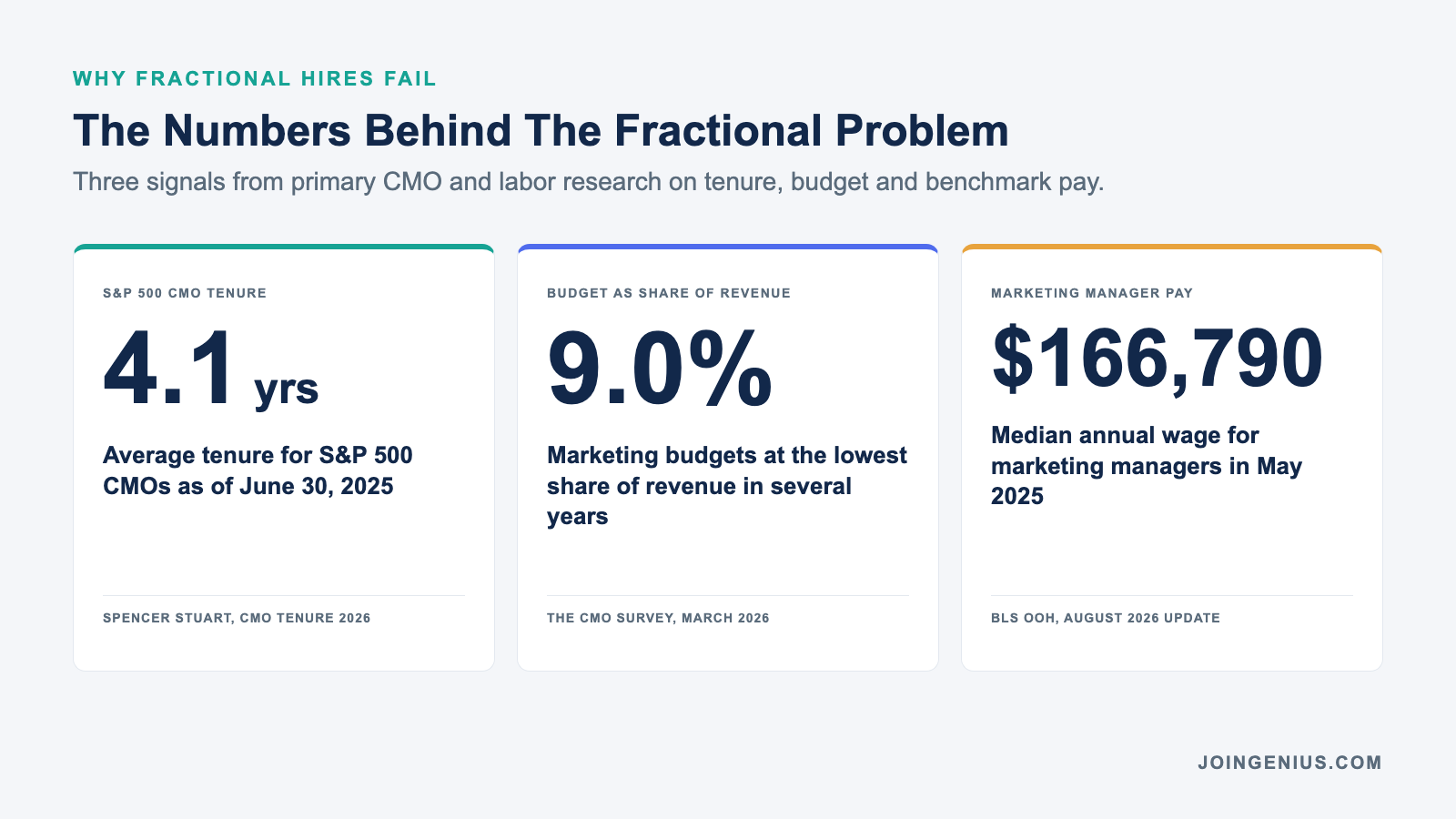
The fractional CMO market is crowded with people who call themselves one. Spencer Stuart’s January 2026 snapshot puts the average S&P 500 CMO tenure at 4.1 years, which is short for a C-suite role but a lifetime compared with the six-month revolving door most startup founders run on in-house marketing leaders.
So fractional looks cheaper and safer. The problem is that most fractional engagements deliver a fractional result, which is a deck and a slack channel and a quiet exit after the retainer ends. This guide borrows selection rules from the best marketing recruitment agencies so the hire leaves pipeline and a hiring plan behind.
Why Fractional CMO Hires Deliver Fractional Results Most Of The Time
The failure mode is cheap thinking. Founders see a fractional engagement as a discount on a full-time CMO salary, so they scope it like one, which means weekly office hours and a generic playbook delivered on Notion.
The engagement runs for three or four months, nothing compounds, and the next quarter starts from zero. Fractional is not a cheaper full-time CMO. Fractional is a different product, and scoping it like one is where founders bleed.
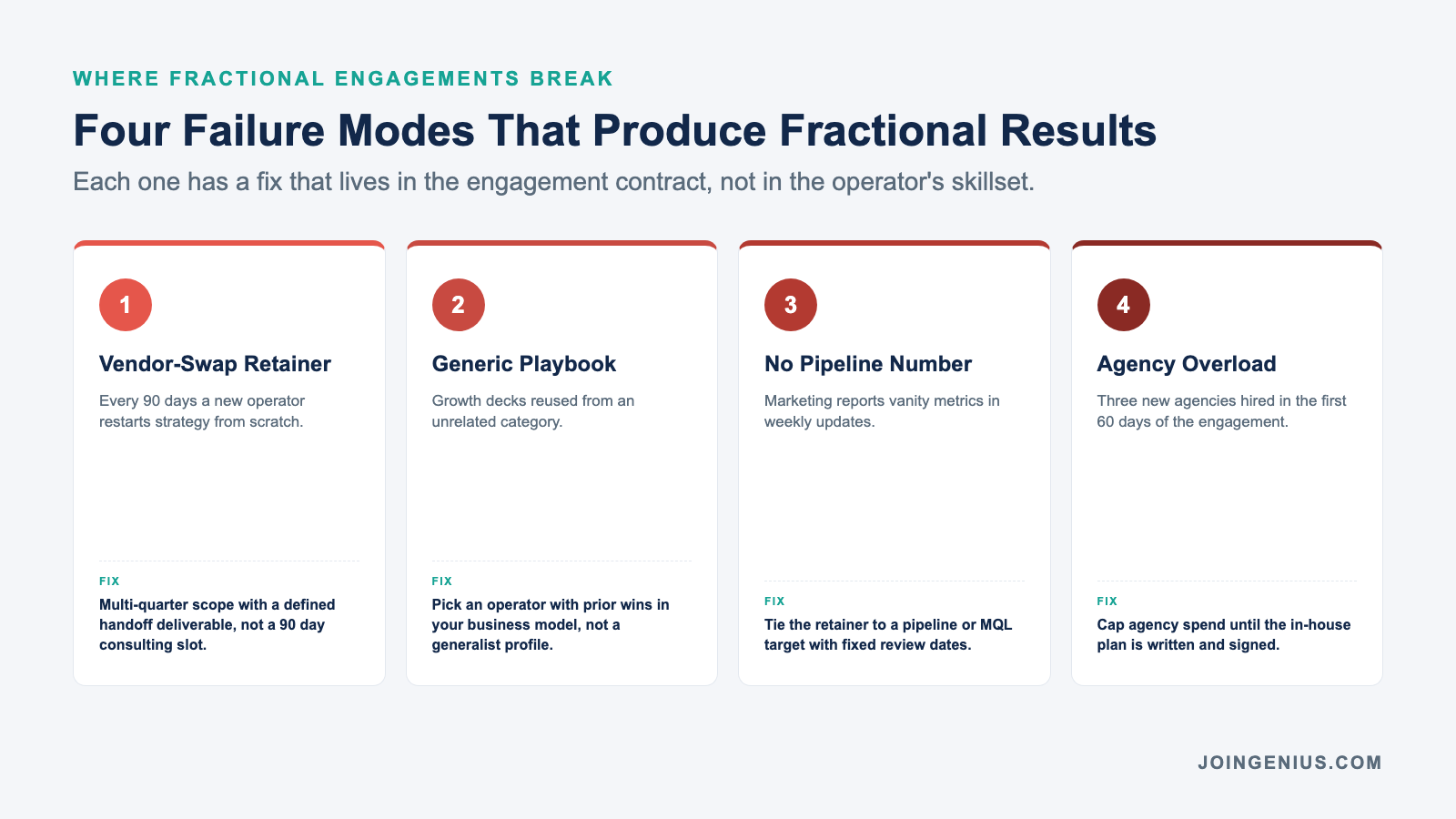
The failure pattern shows up in four places. Each has a symptom that is obvious by day 30 and a fix that lives in the engagement contract, not in the operator’s skillset.
| Failure Mode | Symptom By Day 30 | Why It Happens | Fix |
|---|---|---|---|
| Vendor-swap retainer | Every 90 days a new operator restarts strategy from scratch | The founder bought a monthly consulting slot, not an owner | Multi-quarter scope with a defined handoff deliverable |
| Generic playbook | Growth decks reused from an unrelated category | The operator has no category pattern match for your business | Pick an operator with prior wins in your business model |
| No pipeline number | Marketing reports vanity metrics in weekly updates | No revenue outcome in the engagement contract | Tie the retainer to a pipeline or MQL target with review dates |
| Agency overload | Three new agencies hired in the first 60 days | The fractional punted execution rather than owning it | Cap agency spend until the in-house plan is written |
The pattern connects. Each failure mode traces back to how the engagement was scoped before the operator ever touched the business, not to how good the operator was once hired. The next section sets the bar for what a real scope should deliver.
What A Real Fractional CMO Engagement Should Deliver
A real fractional engagement replaces the full-time CMO for the quarter it runs, which is a higher bar than it sounds. The operator owns the pipeline number. The operator also writes the hiring plan for the next role and leaves behind a quarterly plan the next person can run without a rewrite.
The budget frame matters here, because fractional operates inside a shrinking pot. The CMO Survey’s March 2026 report shows marketing budgets at 9.0 percent of company revenues, the lowest share in several years, with overall spending growing only 1.7 percent over the prior twelve months.
That is the context the fractional CMO walks into, so the engagement cannot be a shopping list of initiatives. It has to be a prioritization exercise where two or three bets get the budget and the rest get documented as not now, including choices like whether to outsource content operations rather than hire for them.
A useful mental model is that the fractional CMO is the interim CEO of marketing for 90 days. The deliverables are a pipeline number, a hiring plan, a budget reallocation, and a written handoff. Anything else is a bonus.
The flip side is what a real engagement should not deliver. A slide deck with no numbers attached is a consulting output. So is a persona workshop with no pipeline next to it. So is a tool stack audit where nobody owns which tool actually ships revenue.
Those are fine inside a longer retainer. They are a waste inside a 90 day fractional sprint, because the sprint ends before the output can be tested against the number.
The Senior-Only Bench Is The Only Shortlist Worth Reading
The single biggest predictor of whether a fractional engagement delivers is seniority. Not years on a LinkedIn profile, but pattern recognition from previous rounds and previous teardowns. A senior operator has already run the playbook you are about to run, which means they skip the first six weeks of discovery that a mid-career marketer has to do.
Benches that curate for this exist. GTM 8020 runs a senior-only fractional CMO bench of operators who have led growth campaigns at Reddit and Ramp and Shopify, placed on a flexible monthly retainer rather than a vendor-style hourly rate.
Most engagements run between 6,000 and 20,000 dollars per month, which is cheaper than a VP of marketing comp band but is not a discount product. The first 30-minute call ships a written 90 day GTM roadmap you keep whether or not you hire.
Two caveats before a founder signs. The bench is one of several service lines inside a broader GTM agency, so the operator you get needs a named track record in your category, not a generalist profile.
Start the scope narrow, which means one pipeline motion and one channel bet and one hiring decision. Extend only after the first 30 days have shipped against that scope.
The 90 Day Scope Document That Separates A Fractional CMO From A Fractional Consultant
The scope document is the single biggest lever a founder has. It decides what the engagement optimizes for before the first call. Write it before you shortlist, not after, and share it with every operator you interview so they can tell you what they would cut.
The operator who pushes back on the scope is usually the one worth hiring, because the operator who nods along will deliver what the brief said rather than what the business actually needs.
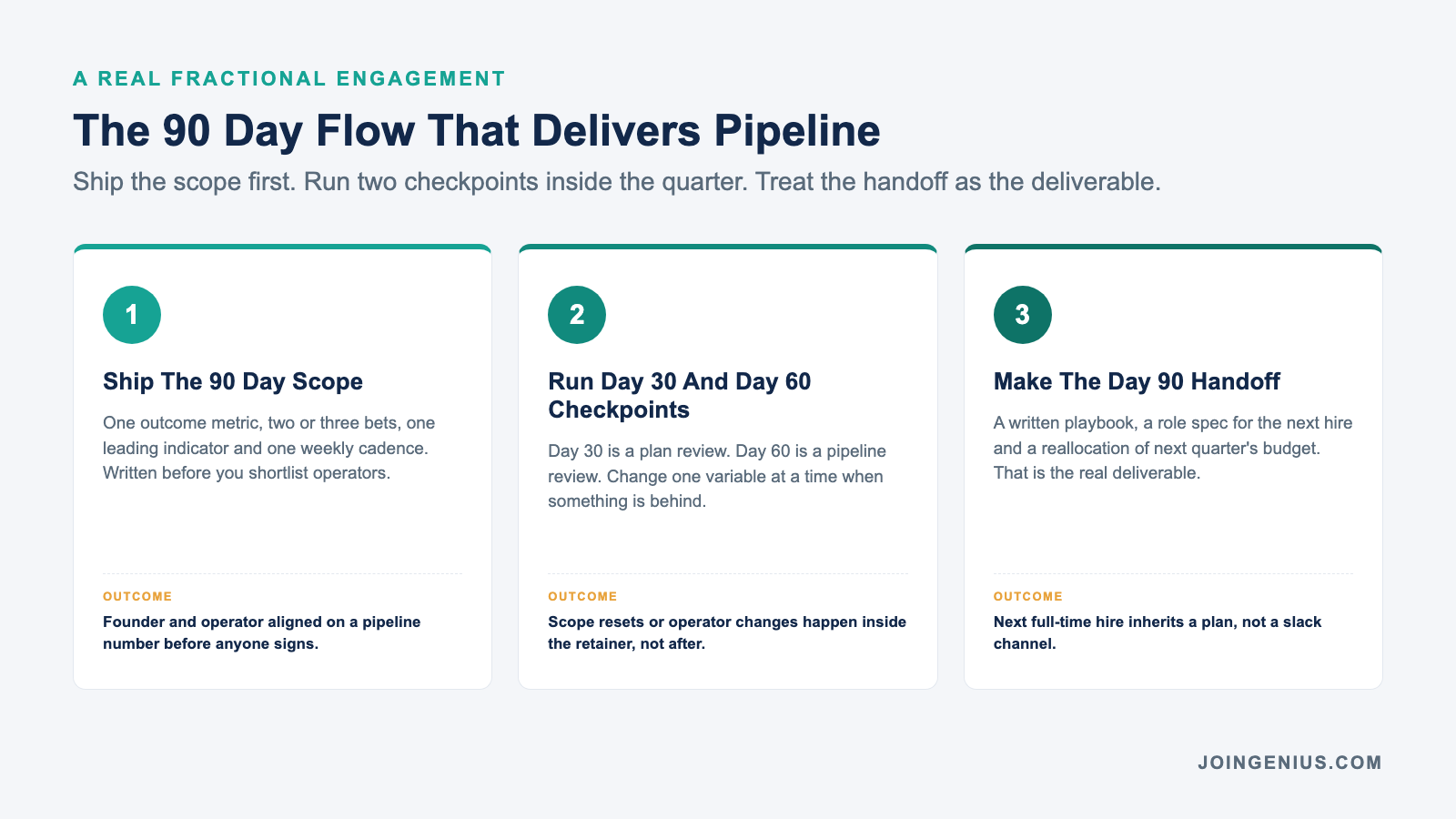
A working scope has five lines. The outcome is one metric with a number next to it, usually pipeline sourced or MQL volume. The 90 day plan names the two or three bets the operator will make, with the rest explicitly deferred.
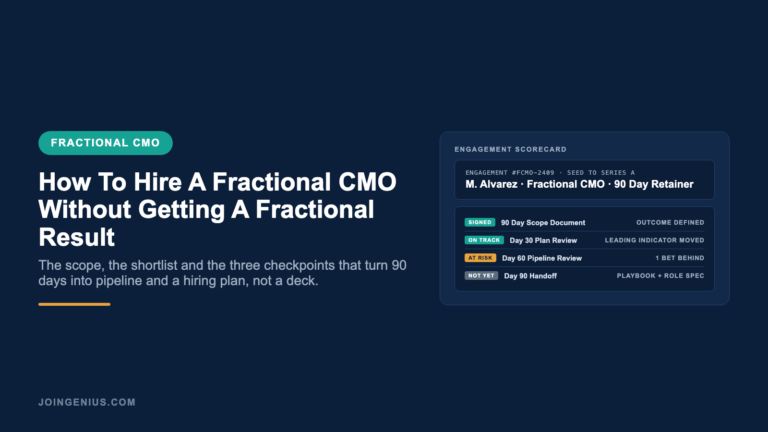
The 30 day leading indicator is one thing that must be true by week four, or the plan changes. The weekly cadence names who sees what, which is a one-page memo and a 30-minute call.
The handoff deliverable is what the operator leaves behind, which is a written playbook and a role spec for the next hire. This is the line that most founders skip and most engagements die on.
Scope discipline is what separates a fractional CMO from a fractional consultant. A consultant hands you a deck. A fractional CMO leaves the business in a place where the next full-time hire, or the best marketing managers you bring in from Latin America or the Philippines, can pick up where the plan stopped.
How To Evaluate The Result At Day 30 And Day 60 And Day 90
Three checkpoints. Nothing between them, because the 90 days is too short for a slow reveal, and nothing after them, because by day 90 the next quarter has to start with a plan already written.
Day 30 is a plan review, not a results review. The leading indicator either moved or it did not. If it did not, the founder and the operator decide together whether the scope was wrong or the operator was wrong, and change exactly one of those variables. Not both.
Day 60 is a pipeline review, which uses the outcome metric. The two or three bets either produced pipeline worth continuing or they did not. A 60-day review is the right moment to kill a bet that is not working, because by day 90 it is too late to pivot inside the engagement.
Day 90 is a handoff review. The operator shows the written playbook and the role spec and a reallocation of next quarter’s budget.
The founder decides whether to extend, which looks like a new 90 day scope, or to run the handoff and hire the next role full-time.
For context, BLS May 2025 data puts the median annual wage for marketing managers at 166,790 dollars, so a full-time VP-level hire will carry a loaded cost well above that figure. That is why the handoff decision matters, which is the only way the retainer actually ends on a founder’s own terms.
The handoff review is also where founders decide if the problem the fractional was hired to solve is actually a leadership problem, or if it is a channel problem (usually B2B SaaS traffic that is not converting on landing or a pricing page) that a strong director-level hire could solve instead.
Either answer is a win, because the 90 day engagement bought the founder a decision backed by data rather than a decision backed by a gut feeling about marketing headcount.
Conclusion: The Hire Earns A Full Brief
The fractional CMO works when the engagement is scoped like a quarter of CEO-grade attention on marketing, not a cheap discount on a full-time hire. The brief is the lever, and it is what a senior-only bench and a working scope document both demand before anyone signs a retainer.
Ship the scope in a day. Run three checkpoints. Treat the day 90 handoff as the real deliverable. That is how a fractional hire stops producing a fractional result and starts producing a quarter of compounding work. Genius can help with the full-time role when the handoff is ready.