Most staffing agencies track placement rates with daily rigor. Few track failure rates with the same discipline. A candidate accepts the offer, signs the paperwork, starts on Monday and then quietly leaves within 90 days. The retainer is already spent, the client is already annoyed and the account manager is already pulling a second search.
The failure pattern repeats across verticals, because the breakage happens between offer and day 30, not in the match itself. If you are running an agency or hiring a recruiter to clean up a leaky desk, the fix starts before the next requisition opens. This piece walks the four failure modes behind those early walks.
What Staffing Placement Failure Actually Means In 2026
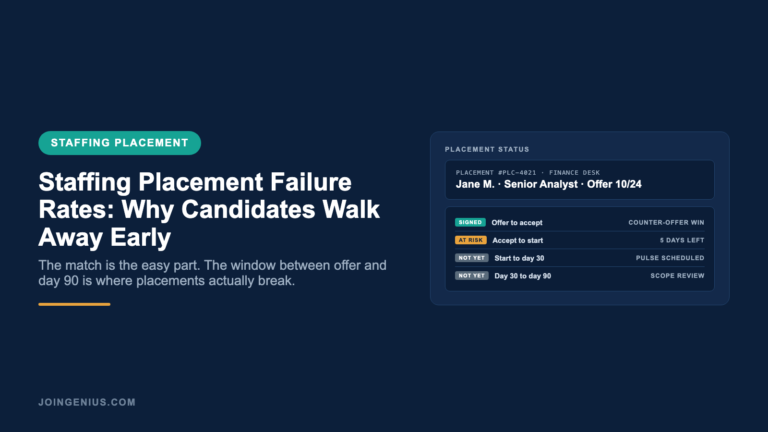
Placement failure is not a single number. Agencies that measure it well track at least four different rates: offer-to-accept, accept-to-start, start-to-day-30 and day-30-to-day-90. Each one has a different root cause and a different fix.
The Four Measurement Windows
Offer-to-accept covers the window where counter-offers decide the placement. Accept-to-start is where candidate ghosting happens, often because onboarding paperwork drifts or the hiring manager disappears after the offer email. Start-to-day-30 is where the first-week experience makes or breaks the match. Day-30-to-day-90 captures fit issues that only surface once the candidate has done real work.
Agencies that only track one of those windows miss three of the failure modes. Agencies that track all four learn which of their consultants or which of their verticals leaks hardest, then build the fix where it actually belongs.
What Changed Since 2022
Counter-offers used to be rare. Today they are the default on any candidate with more than two years of experience. Candidate ghosting used to be a story. Today it is a measurable rate on every ATS dashboard.
Onboarding used to end when the ink dried on the contract. Today it covers everything from eligibility checks to day-30 pulse surveys, and the agency owns a larger slice of it than ever.
The Data Behind Why Placements Fail
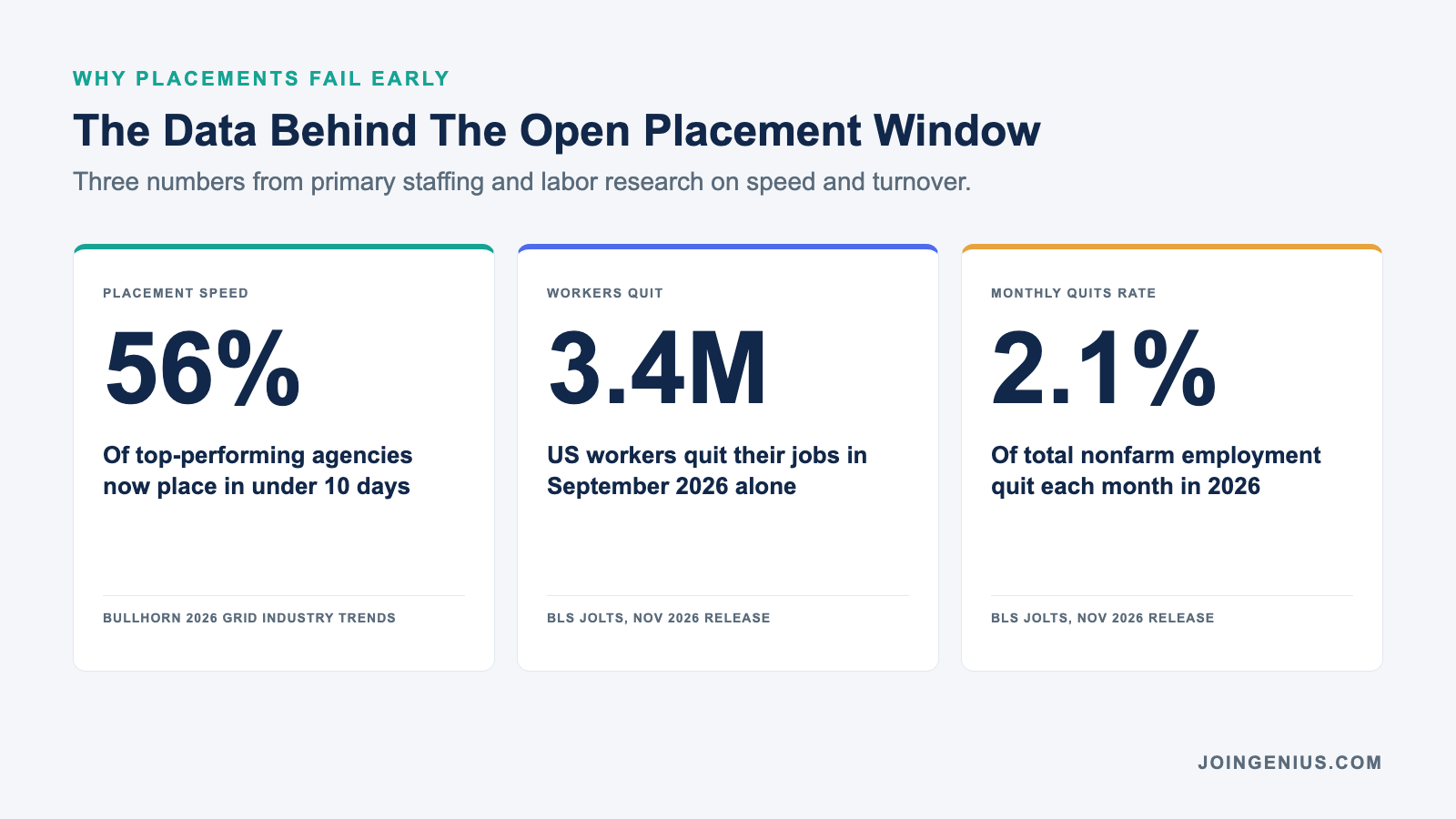
Bullhorn’s 2026 GRID Industry Trends report, based on more than 2,300 recruitment professionals, finds 56 percent of top-performing agencies now report placement times under 10 days. The implication for everyone outside that top slice is that the window for a counter-offer or ghosting event stays open longer.
The macro backdrop is the Bureau of Labor Statistics JOLTS release for September 2026. It shows 3.4 million workers quit their jobs in a single month, at a 2.1 percent monthly quit rate across total nonfarm employment. Every placement sits inside that tide, and every slow week in the pipeline gives the tide more time to pull the candidate out.
Agencies that scale off a predictable placement cycle plan around those two realities. Speed matters because it shortens the window where a candidate can change their mind. Pulse checks matter because the quit rate does not pause once the candidate signs the paperwork.
The three numbers in the image below are the shape of the problem. Any failure mode that stretches the timeline or leaves the candidate without a check-in makes the shape worse.
The failure modes that actually drive those early walks cluster around four specific operational gaps in the agency workflow, not around the match itself.
Four Failure Modes That Kill Placements
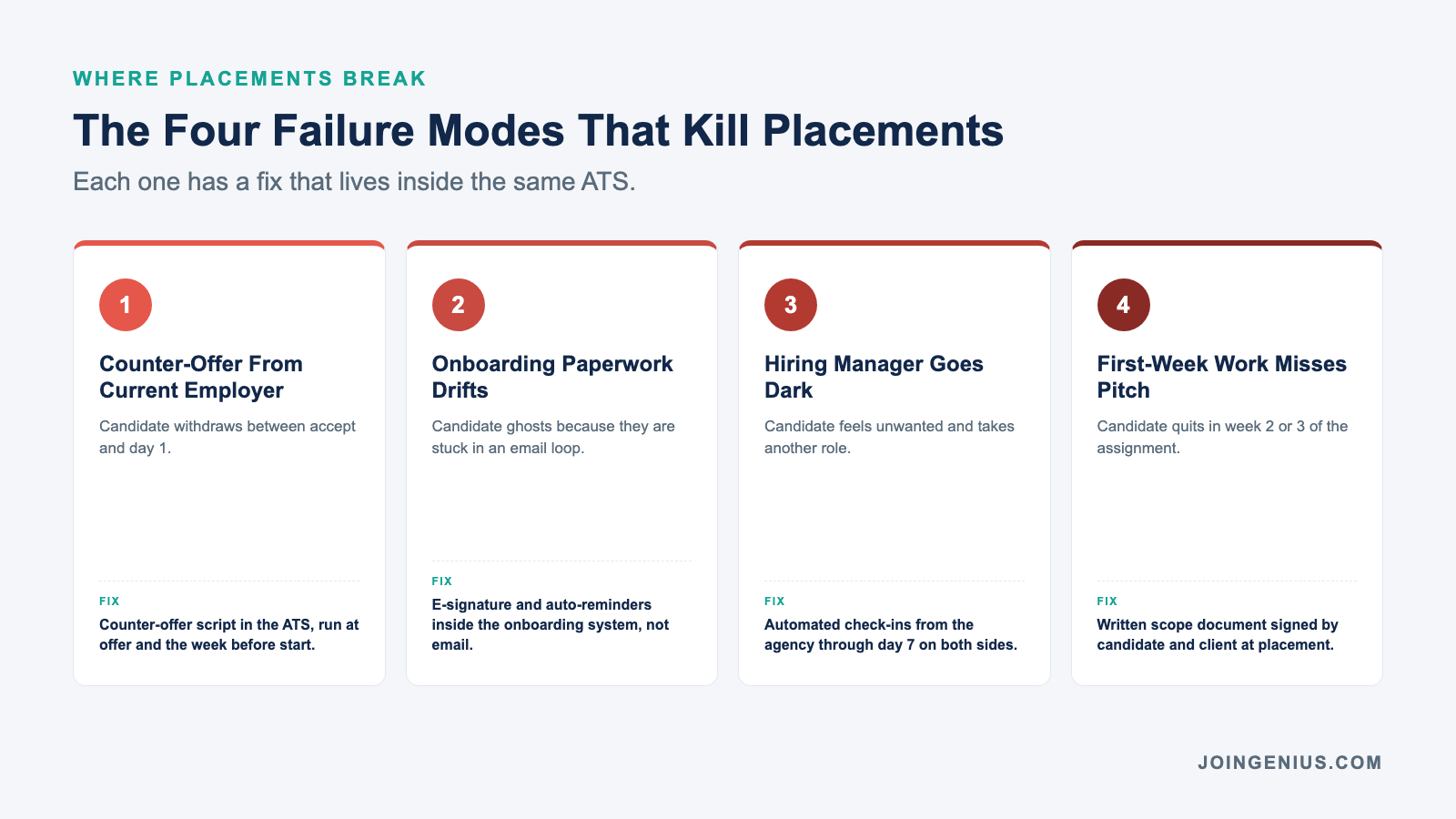
Each mode below is the one that quietly stalls a placement between offer and day 30. The agency celebrates the signed contract, the hiring manager moves on and nobody looks at the candidate inbox until the resignation email arrives. The table maps each mode to what it breaks and the fix that keeps the placement alive inside the same ATS.
| Failure Mode | What Breaks | Fix |
|---|---|---|
| Counter-offer from current employer | Candidate withdraws between accept and day 1 | Counter-offer script in the ATS, run at offer and again the week before start |
| Onboarding paperwork drifts | Candidate ghosts because they are stuck in an email loop | E-signature and auto-reminders inside the onboarding system, not email chains |
| Hiring manager goes dark after offer | Candidate feels unwanted and takes another role | Automated check-ins from the agency through day 7 on both sides |
| First-week work does not match the pitch | Candidate quits in week 2 or 3 of the assignment | Written scope document signed by candidate and client at placement |
These are not exotic bugs. They are the result of an ATS being used as a billing record rather than a candidate experience system. The right order is counter-offer defense first, then the paperwork gap, then the day-7 check-ins. Agencies that try all four at once usually finish none, because each one needs a different owner and a different cadence.
Fix the paperwork gap once and ghosting drops inside a quarter. Fix the sourcing pipeline first and every new placement becomes a new ticket for the delivery team.
The practical path through all four is to pick the mode that burns the most placements this quarter and design the agency workflow around it, then expand only after the first fix is holding. That focus is the difference between a retention program that lifts numbers and one that lives in a quarterly deck.
How To Build The Handoff That Keeps Placements
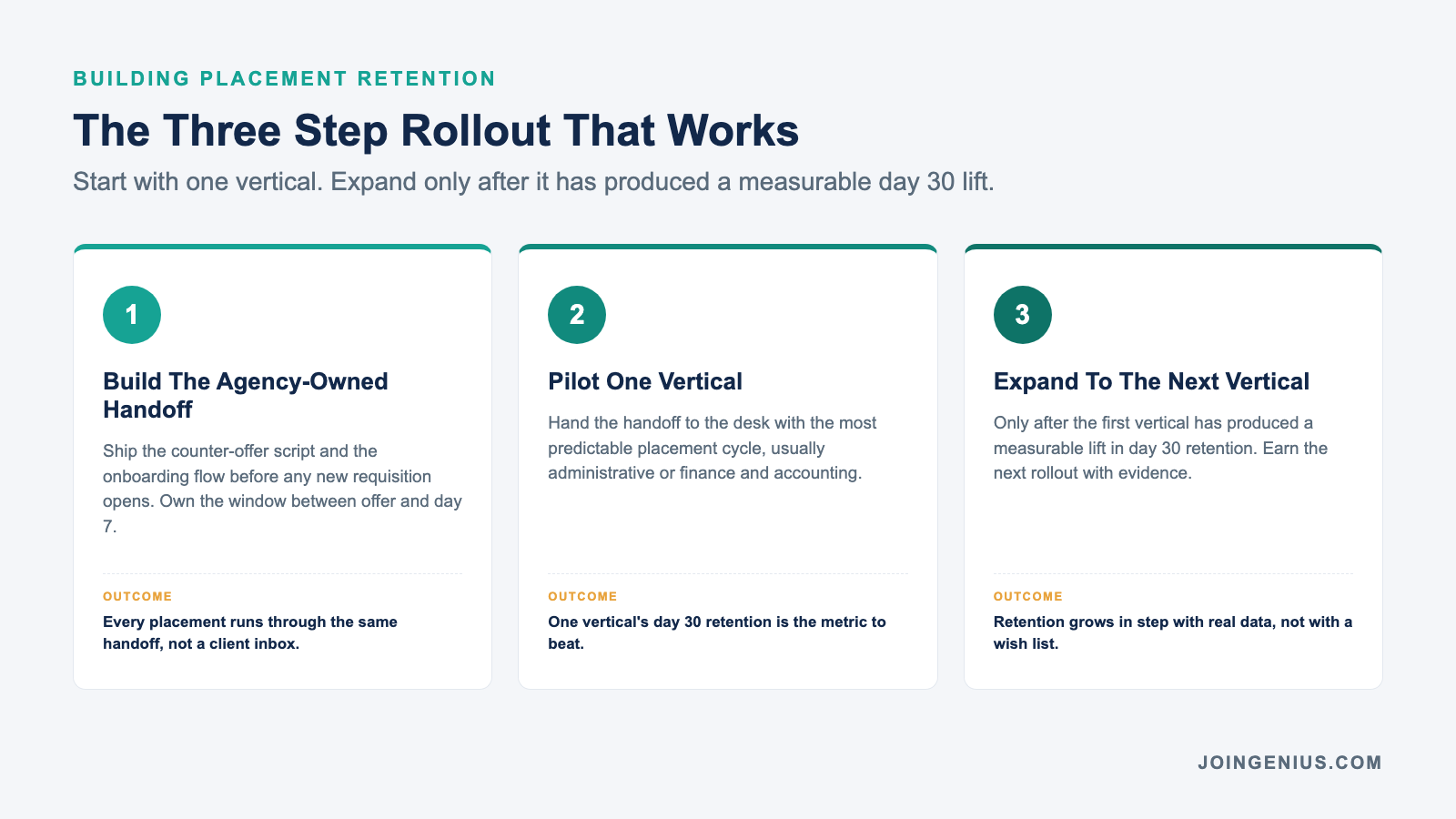
A placement retention plan that works has four moving parts. A counter-offer script the recruiter runs at both offer and pre-start. An onboarding flow that signs itself without an email chain. A day-7 check-in with the candidate and the hiring manager. A written scope document the account manager can escalate against when the assignment drifts.
The common factor across all four is that the agency owns the handoff rather than handing it to the client. A client that runs its own onboarding does it well half the time and badly the other half. An agency onboarding flow runs the same way for every placement, which is the only way day-30 retention improves over time.
A dedicated onboarding software layer such as TrackerRMS handles that handoff out of the box. The flow starts running the moment a placement is made. The candidate completes forms and e-signatures before day one, and the client sees progress on a live dashboard rather than through weekly status emails that nobody reads.
TrackerRMS’s Core plan starts at 99 dollars per user per month on a six-month minimum term, with Professional and Enterprise on custom pricing. Like any agency platform it only pulls its weight when the recruiter workflow runs inside it, so start the pilot with the vertical with the most predictable placement cycle, usually administrative or finance rather than executive search.
If the dashboards and integrations are the piece that always slips, this is a good spot to look at how to outsource software development for the webhook and reporting work. Keep the counter-offer script and the day-7 cadence in-house with the recruiters who already own the relationship, and let an external team own the plumbing.
Who Should Own Placement Retention Inside A Growing Agency
The owner question is the one that sinks most retention programs. The Bureau of Labor Statistics counted 939,700 human resources specialists in the United States in 2025, with a median annual wage of 75,940 dollars and projected employment growth of 6 percent through 2035.
The employment-services subset of that pool, which covers staffing agencies, pays a median of 60,550 dollars. Recruiter pay sits below the broader HR benchmark, so agencies compete on tooling and lead flow more than on salary.
In practice the retention work gets split across three functions. The recruiter owns the counter-offer script and the candidate relationship through day 7. The delivery team owns the day-30 pulse survey and any scope drift that follows. Operations owns the onboarding system itself, including e-signature, eligibility checks and the dashboards the client actually sees.
Smaller agencies fold these roles into one senior recruiter with a shared Slack channel for issues. The seat looks more like an account executive who runs both candidate and client conversations than a sourcer who hands off at offer. That ordering decides whether the retention rate improves month over month or stays flat quarter after quarter.
If you are hiring for that senior recruiter seat, an engineering recruitment agency with a placement-retention practice can shorten the search. Agencies scaling an IT desk often pair that senior hire with the option to hire LATAM developers who can build the custom reporting the senior recruiter needs to prove retention gains to clients.
Make The Handoff Earn The Placement
Staffing placement retention only improves when the agency owns the window between offer and day 90, rather than treating that window as the client’s problem. The match is the easy part. The counter-offer script, the onboarding flow and the day-7 check-ins are where most retention stalls, so those three are the ones that deserve the first sprints of implementation work.
If the retention program is going to move numbers this quarter, it needs a senior recruiter who has run a counter-offer script before and an operations lead who can ship an onboarding flow that actually runs itself. Genius helps staffing agencies fill those seats without the usual three-month search.