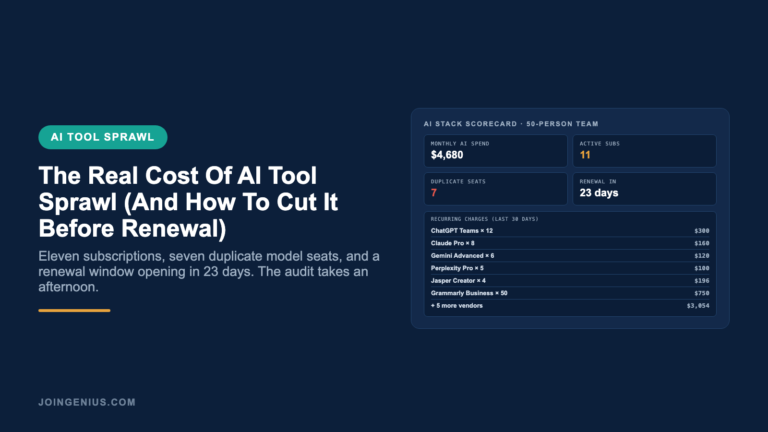
Somewhere between the marketing team’s ChatGPT Plus accounts and the sales team’s Claude Pro seats and the research team’s Perplexity Enterprise and the designer’s Midjourney and the writer’s Jasper, a company stops being able to say out loud what it pays for AI each month. The bills come in on a dozen separate cards. The seat counts creep. The renewal dates land on random Tuesdays. This post walks through where AI tool sprawl actually hides on the P and L, how to run a real audit before the next renewal cycle, and how to consolidate without costing the marketing managers who actually use these tools their favorite workflow.
Why AI Tool Sprawl Snuck Onto The Team Credit Card
Every AI subscription on the bill got there the same way. A single employee tried the product and loved it and expensed $20 a month without a single meeting. The procurement team never saw a contract. The IT team never provisioned a seat. The finance team saw one $20 line item and categorized it as “software, misc.”
Multiply that path by seven tools and twenty-five employees and the number stops being small. This is the same dynamic that already broke the broader SaaS stack. The AI wave is just the newest layer sitting on top of it. The signal that engineering tool fragmentation has become AI tool fragmentation is the credit card reconciliation itself.
That reconciliation is now a full Friday for the ops person who has to match 14 line items to 14 people, and the line items themselves are opaque: “OpenAI 20.00” says nothing about which plan or which seat or which project.
Vendor-side aliases do not help either. Payment processor charges hide behind generic strings, so even the merchant name on the statement needs translation before the audit can start.
The sprawl is not a discipline problem. It is a default path problem. Self-serve pricing and consumer-grade sign-up flows beat procurement cycles by a factor of 50, so the tool arrives before anyone has written a policy for it.
The Three Costs Teams Miss At Renewal
Most teams track one number: the line item total on the credit card. That is the cost they would catch at any point in the year. The other three costs only surface when someone looks at the full picture, and most teams only look at renewal.
| Hidden Cost | Where It Hides | What To Audit |
|---|---|---|
| Duplicate Model Seats | GPT Plus + Claude Pro + Gemini Advanced on separate cards | Credit card statements, SSO user list |
| Admin And Audit Time | Hours chasing owners and matching invoices and pulling usage | Timesheet the ops person who runs renewals |
| Context Switching | Writers alt-tab between four chat tools and lose 20 minutes a day | Shadow a user for one morning |
| Overlap And Orphan Seats | Seats on former employees, unused trials, duplicate roles | SSO last-login plus per-vendor usage reports |
The scale of the underlying stack is already huge. The BetterCloud 2025 State of SaaS report (based on roughly 600 IT professionals) found that companies run an average of 106 SaaS apps and that 95 percent have already made AI investments.
AI tools land on top of a stack that was already past the point of coherent oversight. Worse, they ride a seat-creep curve that SaaS never had: a $20 Pro plan turns into a $25 Team plan at renewal, then a $30 Enterprise quote a year later, then another $20 for the model that was not on the plan.
The Audit That Takes An Afternoon, Not A Quarter
A full AI tool audit does not need a vendor platform or a two-month project. It needs one ops person and three data sources and a shared spreadsheet open for four hours.
Pull the credit card statements for the last 90 days and grep for every recurring charge under $50. Most AI tool subscriptions sit in that band, which is why finance treats them as noise and why they do not trigger any approval workflow.
Pull the SSO user list and filter for every AI-shaped app (OpenAI and Anthropic and Perplexity and Jasper and Writer and Descript and ElevenLabs and Midjourney and the twenty more that will be on the list). Then pull the Slack channel where purchases get announced and search for “subscribed” over the past year.
Cross-reference the three lists and you have the real inventory. The operations managers who run this exercise usually find two things: tools nobody remembers buying, and tools everybody uses that are not on any invoice because they live on a personal card getting expensed.
Then add a fourth data source: per-user token or usage counts from each vendor’s admin panel. Three seats doing 80 percent of the work is the pattern to look for. If the top three users account for the vast majority of real queries, the other licensed seats are decorative.
The spend scale explains why this matters. The Menlo Ventures 2025 State of Generative AI in the Enterprise (based on 495 US enterprise AI decision-makers) put total enterprise generative AI spend at $37 billion in 2025, up from $11.5 billion the prior year, which is a 3.2x annual increase. That growth lands on budgets that were not sized for it.
Give The Team One Workspace Instead Of Five Logins
The teams that recover the most hours move from five vendor logins to one AI workspace, where everyone picks between ChatGPT, Claude, Gemini and Perplexity inside a single thread.
Magai is one of the vendors in that aggregator slice. One subscription covers the top frontier models plus image generation plus a project workspace. One invoice replaces five. Thread history stays intact when a user swaps from one model to another mid-conversation to compare outputs.
Honest caveats on fit. Magai bills on its own monthly plan rather than BYOK, so a team with existing enterprise contracts at OpenAI or Anthropic will not get to stack those credits inside Magai. Pricing starts at $20 per month per seat on Standard, and above ten seats moves to enterprise quoting.
The shared chat features (view-only links and workspace roles and shared project folders) are the piece worth testing first. Those are what deflect the Slack-DM-the-prompt workflow that eats parallel tokens on five different accounts for the same question.
The waste is not theoretical. The Torii SaaS Benchmark Annual Report 2026 flagged that 61 percent of apps enter companies as Shadow IT discovered through usage or browser activity or direct signup (not procurement), and that 26 of the top 50 shadow IT apps are now pure-play AI tools. The sprawl is not slowing down on its own.
The Renewal Playbook That Actually Cuts Spend
Ninety days before the biggest renewal, open the inventory spreadsheet and sort by monthly spend. The top three line items are the negotiation targets. The rest are either consolidation candidates or outright cuts, and most teams find that half the spend sits in tools three people are opening per week.
The first negotiation move is to downgrade on paper before the call. Switch to monthly billing for 30 days, then schedule the renewal conversation. The vendor sales rep now has visible churn risk on the account and a measurable date, and the conversation shifts from “would you like to renew?” to “what does it take to keep you?”
The second move is to bundle. If the same team is paying three vendors for overlapping workflows, pick one and tell the other two the workflow is being consolidated. Half the time the losing vendor comes back with a bundled discount. The other half the time the consolidation was the right call anyway.
The third move is to tie spend to actual usage. A tool that 12 licensed seats open twice a month is not a $240 per month tool. It is a 3-seat tool with 9 overpaid seats attached. The B2B SaaS traffic playbook has the same lesson: the second-biggest line item usually needs the hardest look.
The fourth move is timing. If the fiscal year ends in December and the renewal hits in February, pull the conversation forward into November. Vendor sales teams close harder in Q4 to hit quota, and the discount a rep can approve in December is often double what the same rep can approve in February.
Conclusion: Renewal Is The Only Leverage Moment You Get
Outside the renewal window, the vendor has every structural advantage. The team is dependent on the tool and the admin has not pulled the usage report and nobody is tracking the monthly spend in context. Inside the renewal window, that inverts for exactly 30 days.
The move is to walk into that window with the inventory already built and the consolidation candidates already picked. The AI stack that survives the next renewal cycle is the one where every seat has a name attached and every tool has a usage count.
If the team running this work also needs to hire for the roles that keep the stack honest (the ops people who run the audits and the finance people who track the spend), start with Genius.