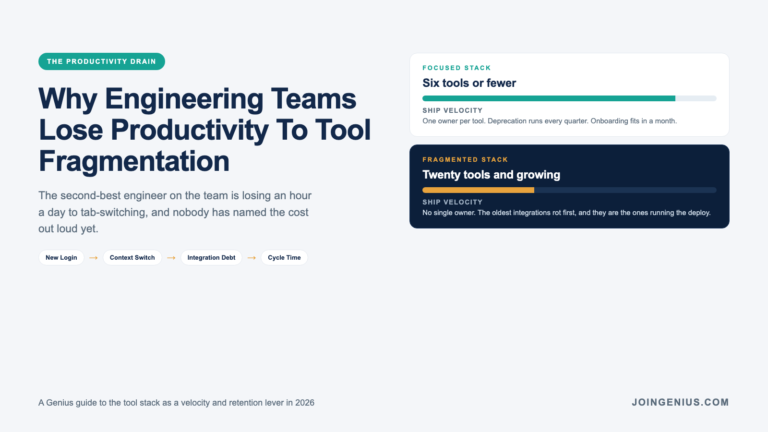
Every engineering org that scaled past twenty people has a tool graveyard. It started with one new SaaS login for monitoring. Then an observability platform promised to replace that. Then a feature-flag tool. Then an API gateway. Each tool solved a real problem the quarter it was bought, and each one quietly became a new tab the senior engineer never fully closes. By the time anyone measures, half the team has thirty tabs open and nobody is sure which dashboard owns which alert.
Tool fragmentation is the retention problem engineering leaders talk about last, usually after they have already explored comp bands and headcount. Modern hiring workflows have made it faster than ever to bring on a new senior engineer, and faster still to lose them, because the first thing a strong hire notices is which part of their day is spent switching tools instead of shipping. Below we cover why tool fragmentation compounds faster in engineering teams and where the hidden productivity costs land. We also cover when a single-purpose tool beats another platform, and the playbook for cutting the sprawl without blowing up the workflows that already ship.
Why Tool Fragmentation Compounds Faster In Engineering Teams
Engineering tooling fragments faster than ops or marketing tooling for a specific reason: every engineer has budget authority on a $20 utility. Nobody has to ask permission to add a new login, and so nobody does. By the time the finance team notices the SaaS line, there are already two dozen tools and no clear owner for most of them.
Each Tool Has Its Own Mental Model
A production incident at 2am is not just a context switch between tools. It is a context switch between mental models, where the dashboards do not share units and the severity grades do not translate. The engineer who gets paged carries that cost even on quiet nights because they rehearse the switching in their head.
Integration Debt Is Invisible
Every time a new tool shows up, the webhooks between the old tools stop lining up. Nobody tracks that debt because no single engineer owns it. The oldest integrations rot first, which is a problem because the oldest integrations are often the ones running the deploy pipeline.
The Default Choice Is “Add One”
When any team hits a new problem, the easiest fix is to add a tool. Removing one is political work. That asymmetry quietly compounds, and after four years the stack is wider than any one engineer can keep in their head.
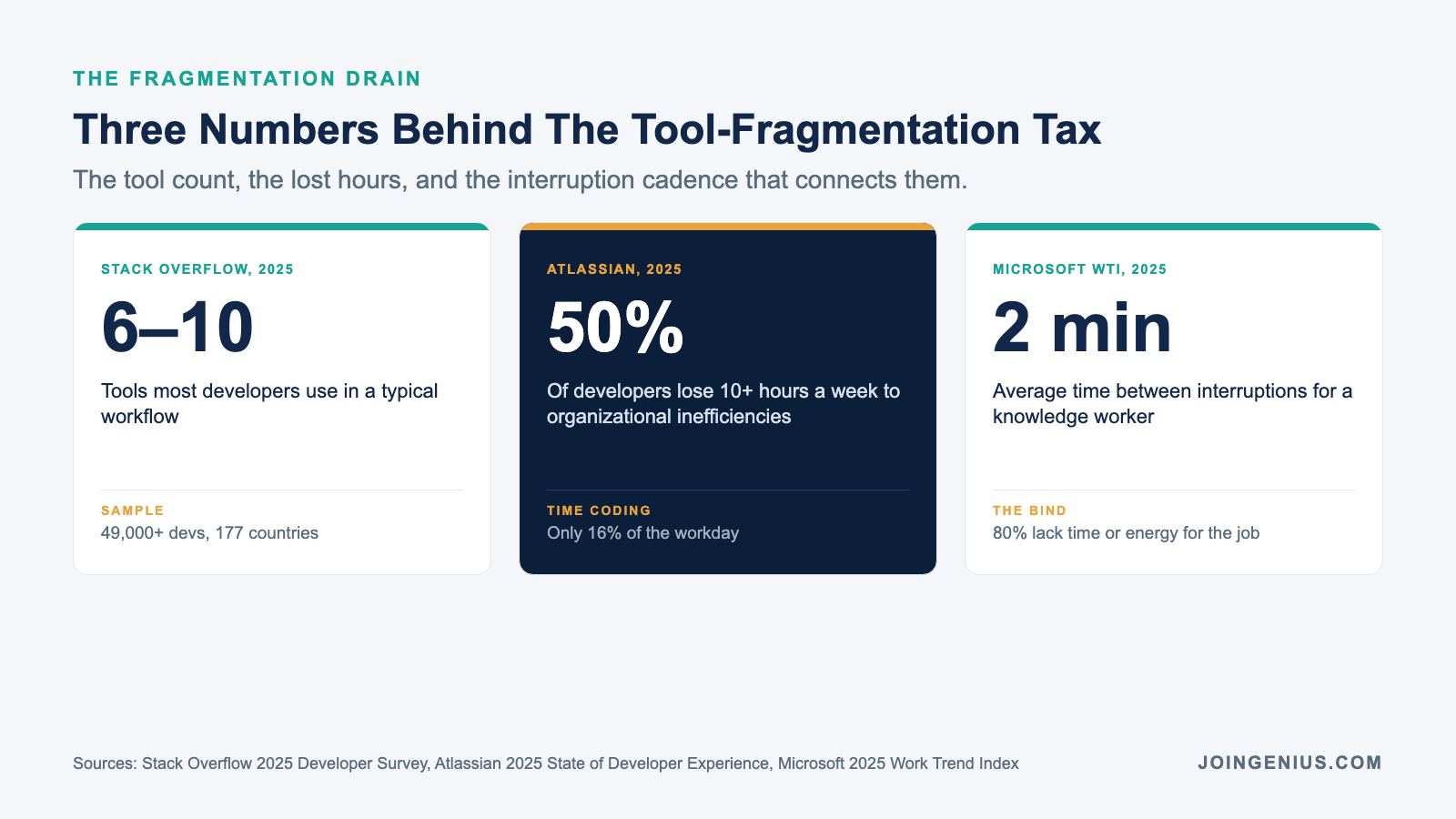
Stack Overflow’s 2025 Developer Survey leader summary, published October 23, 2025 from a sample of over 49,000 developers across 177 countries, found that most developers use 6 to 10 tools in a typical workflow. That is the headline count behind every leadership complaint about “tab-switching.” The gap between a six-tool team and a ten-tool team is where the fragmentation tax starts to compound in real cycle-time numbers.
The Hidden Costs Of A Fragmented Dev Stack
The costs engineers pay for a fragmented stack rarely show up on a dashboard. They show up in the gap between the time a feature was promised and the time it actually shipped.
Context Switching Is The Largest Line Item
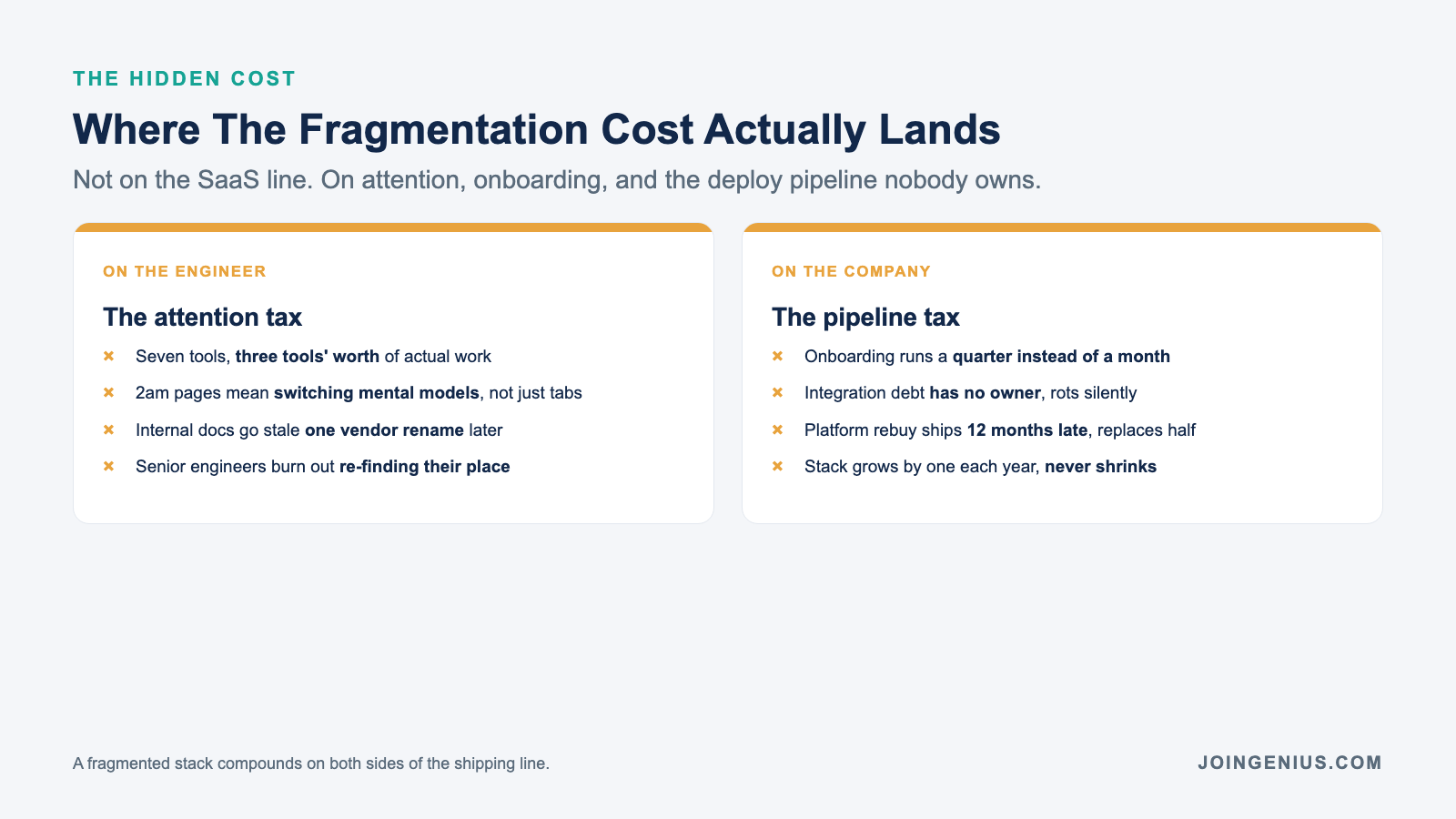
Every tool switch costs attention, and attention is the only truly scarce resource on an engineering team. The senior engineer who juggles seven tools in a day does not get seven tools’ worth of work done. They get three tools’ worth of work done, then burn the other half of the day re-finding their place.
Documentation Rots Faster Than The Stack
A new tool’s docs are written for the vendor’s imagined customer, not for your stack. The internal “how we use X” doc gets written once and then goes stale the quarter the vendor renames half their menu items. Nobody updates it because nobody owns it.
Onboarding Takes Longer Than Anyone Admits
A new engineer joining a six-tool team gets productive in a month. A new engineer joining a twenty-tool team gets productive in a quarter, and by then two more tools have shown up. Why marketing ops hires don’t stay past their first 18 months teaches the same lesson a department over, which is that tool sprawl is a tenure problem long before anyone names it as one.
The Platform Rebuy Lands Every Three Years
Every three years an executive asks “why do we have twenty tools when a platform could replace eight of them?” The platform migration is a six-month project that ships twelve months in. It replaces four tools instead of eight and leaves the other sixteen in place. The stack is now twenty-one tools wide.
Atlassian’s 2025 State of Developer Experience Report, published July 9, 2025 from a 3,500-person survey of developers and managers across six countries, found that half of developers lose 10 or more hours per week to organizational inefficiencies, and that only 16% of a developer’s time is actually spent writing code. The report names context switching between tools and finding information inside those tools as the two largest contributors to the lost hours. That is where the fragmentation shows up on a line everyone on the team already feels but nobody has written on the whiteboard.
When A Single-Purpose Tool Beats Another Platform
The teams that cut tool fragmentation well do not do it by buying a bigger platform. They do it by picking which single-purpose utilities earn their place in the stack, and letting the rest fall out.
The Platform Fallacy
The pitch for every all-in-one platform is that it replaces N tools. The reality is that it replaces three or four of them well and two of them badly. The rest it does not touch. The team ends up running the platform plus the old tools, which is the same stack plus one more login.
A Small Utility Can Earn Its Keep Forever
The irony of tool sprawl is that the fix often isn’t another all-in-one platform, it’s trusting one small utility to do one job well, the way frontend teams reach for Tinify to shrink product images in seconds instead of booting up a full asset pipeline just to compress a hero shot. The utility is cheap and the output is correct, so the engineer never has to context-switch into a bigger tool to get the job done.
The Test For Keeping A Tool
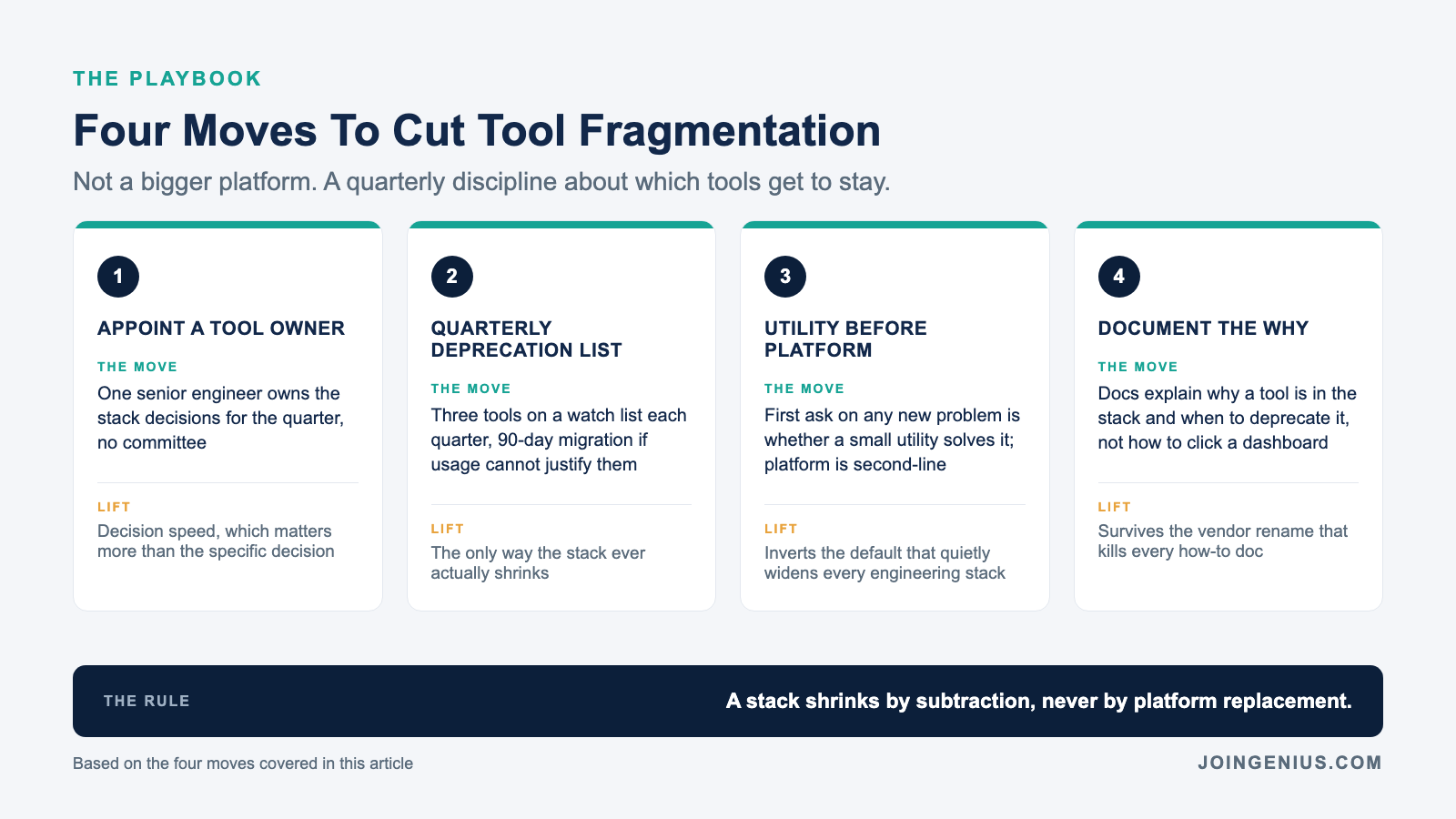
A tool earns its slot in the stack when it does one job you cannot cleanly do inside another tool you already have. Any tool that fails that test gets a 90-day deprecation window and a migration doc. The team shrinks by subtraction, not by platform replacement.
Automation Beats Consolidation
A webhook between two single-purpose tools often does more real work than a consolidated platform. The webhook is one file somebody can read. The platform is a bet on the vendor’s product roadmap.
The Playbook For Cutting Tool Fragmentation
Four moves consistently cut the fragmentation tax without blowing up the workflows that already ship.
Appoint A Tool Owner, Not A Tool Council
One senior engineer owns the stack decisions for a quarter. Not a committee of five, one owner who can say no to a new tool and yes to killing an old one. The decision speed matters more than the specific decision.
Run A Quarterly Deprecation List
Every quarter, three tools go on a watch list. If the usage data at the end of the quarter cannot justify them, they get a 90-day migration plan. The deprecation list is the only way the stack ever shrinks.
Prefer Utility Over Platform For New Problems
When a new problem shows up, the first ask is whether a small utility can solve it. The platform ask is the second-line move. That order inverts the default most engineering orgs run on, which is why most engineering stacks are too wide.
Document The Why, Not The How
The documentation that survives contact with a vendor rename is the one that explains why a tool is in the stack and when to deprecate it. The step-by-step “how to use the dashboard” doc goes stale in a quarter and gets ignored for a year.
What To Stop Doing (It’s Making The Stack Worse)
Four moves consistently inflate the tool stack. Cut these first.
Adding A Tool To Fix A People Problem
A communication problem is not a tool problem, even when the loudest person on the team insists it is. Adding a tool to route around a weak manager builds a stack whose purpose is to compensate for a management gap. The stack grows and the gap remains. Low morale at work often sits highest on teams whose tool count tells the real story about trust.
Letting Vendors Replace Each Other In Place
When a new tool arrives and the old tool stays “just in case”, the old tool is now permanent. The migration never ends because no deadline was ever named.
Running A Platform RFP Every Two Years
The platform RFP is the longest meeting on the engineering calendar. It consumes two senior engineers for a quarter and ships a decision that is wrong half the time. Run it when the stack is actually broken, not on a schedule.
Confusing Tool Count With Capability
A team with thirty tools is not more capable than a team with ten. It is more fragmented. Capability shows up in cycle time and in incident recovery time, and both of those get worse as the stack gets wider.
How To Measure Tool Fragmentation Over Time
A healthy engineering stack shows up in the data in four places.
Active Tools Per Engineer
The count of tools a single engineer actually touches in a normal week. If it is above eight, the fragmentation is already costing cycle time.
Deprecation Velocity
The number of tools removed from the stack per quarter. If this number is zero for two quarters in a row, no one owns the stack.
Time To First Deploy For A New Hire
The number of business days between an engineer’s start date and their first merged PR to production. If this is longer than two weeks on a team with experienced hires, the onboarding tool count is probably the drag. How to measure recruiting ROI without spreadsheet chaos covers the same measurement discipline from the hiring side.
A Short Tool-Fragmentation Scorecard
| What To Measure | Weak Signal | Strong Signal |
|---|---|---|
| Active tools per engineer | 10+ per week, no clear owner | 6 or fewer, one owner per tool |
| Deprecation velocity | Zero removals per quarter | 2 to 3 removals per quarter |
| New-hire time to first deploy | 3+ weeks, tool-training heavy | Under 10 business days |
| Platform rebuy cadence | Every two years, scheduled | Only when the stack is actually broken |
The Microsoft 2025 Work Trend Index, published April 23, 2025, found that knowledge workers get interrupted by a meeting or a message every two minutes, and that 80% of the global workforce reports lacking the time or energy to do the job. That cadence is the engineer’s day on a fragmented stack, which is why the deprecation list is not a cost-cutting exercise. It is a condition for anyone on the team to think for an hour at a stretch.
Conclusion
Tool fragmentation is a management problem that disguises itself as a tooling problem. The fix is not another platform. It is a quarterly discipline about which tools get to stay, and an owner who can say no in both directions. The engineering teams that run this discipline ship faster and retain better than the teams running the latest consolidation RFP.
We built Genius so engineering teams can staff the people who actually run that discipline. We place the top 1% of software engineering and operations talent from the Philippines and Latin America, at around 80% less than comparable local hires. The relationship stays direct, with no monthly agency fees and a 6-month replacement guarantee on every placement. If the next hire is the one who finally shrinks the stack without breaking the deploy pipeline, see how we source and place the engineering talent that stays through the cleanup.