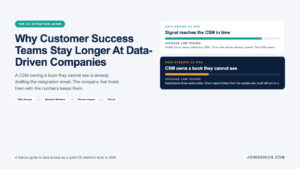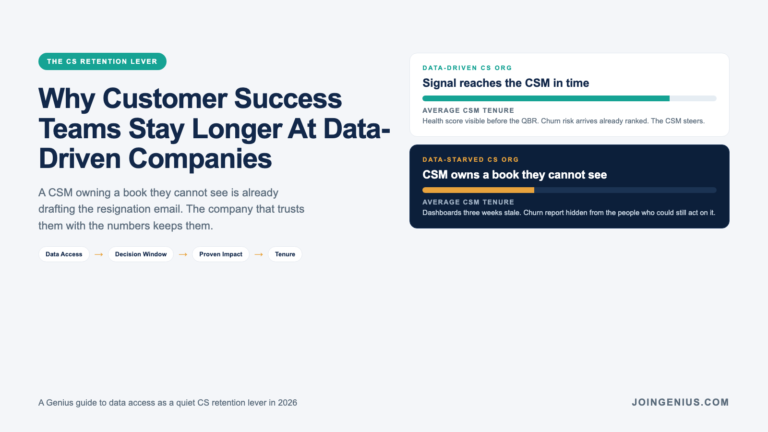
The CSM you promoted last year is already updating their LinkedIn. They are not leaving over comp. They are leaving because they cannot answer “how is my book doing?” without opening five tabs and asking two engineers. Every CSM in a non-data-driven org has that same two-week period, and the strongest CSMs are the ones who have it first. By the time the exit interview says “I did not feel set up to win,” the data stack had been the reason for a year.
A data-driven culture is a quiet retention lever for customer success teams, and it is almost never framed that way inside the ops review. Modern hiring workflows have made it faster to find a strong CSM and faster still to lose one, because the first thing a strong CSM measures on day thirty is whether the data reaches them in time to act. Below we cover why customer success churn is a data problem before it is a people problem and what a data-driven culture actually changes for a CSM. We also cover the tool layer that keeps CSMs in the role, and the hiring playbook for a CS team that stays.
Why Customer Success Churn Is A Data Problem
The leaving pattern on CS teams is not random. It tracks the gap between what the CSM is accountable for and what the CSM can see without asking somebody else. The wider that gap, the shorter the tenure.
A CSM Is A Decision-Maker Without The Numbers
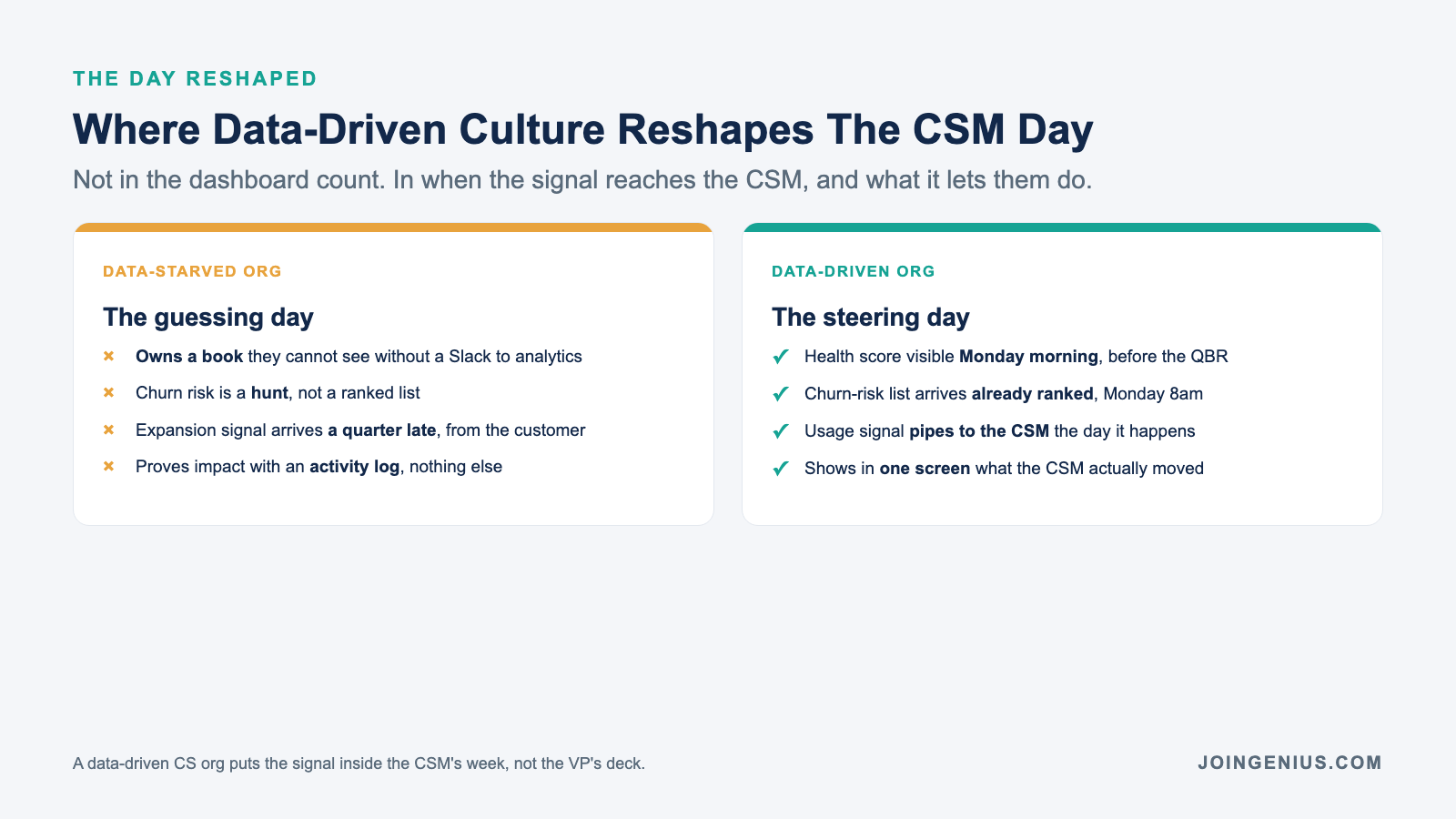
The job description promises the CSM will “own” a book of business and “drive” renewal. The reality on a data-starved team is that they cannot see product usage without a Slack message to analytics, and they cannot pull a churn-risk list without filing a ticket. Owning a book you cannot see is the fastest way to burn out a strong operator.
Guesswork Compounds Faster Than It Looks
A CSM making five calls a week on gut feel is making 250 calls a year on gut feel. By year two, half of those calls were pointed at the wrong accounts. The pattern is invisible until the renewal numbers show up a year later and the CSM is already gone.
The Signal The CSM Trusts Is Not The Dashboard
In a non-data-driven org the dashboard is twelve clicks away and three weeks stale. The signal the CSM trusts is the last email the customer sent them. That is not instinct. It is the absence of a better signal, and a leading indicator of their next job search.
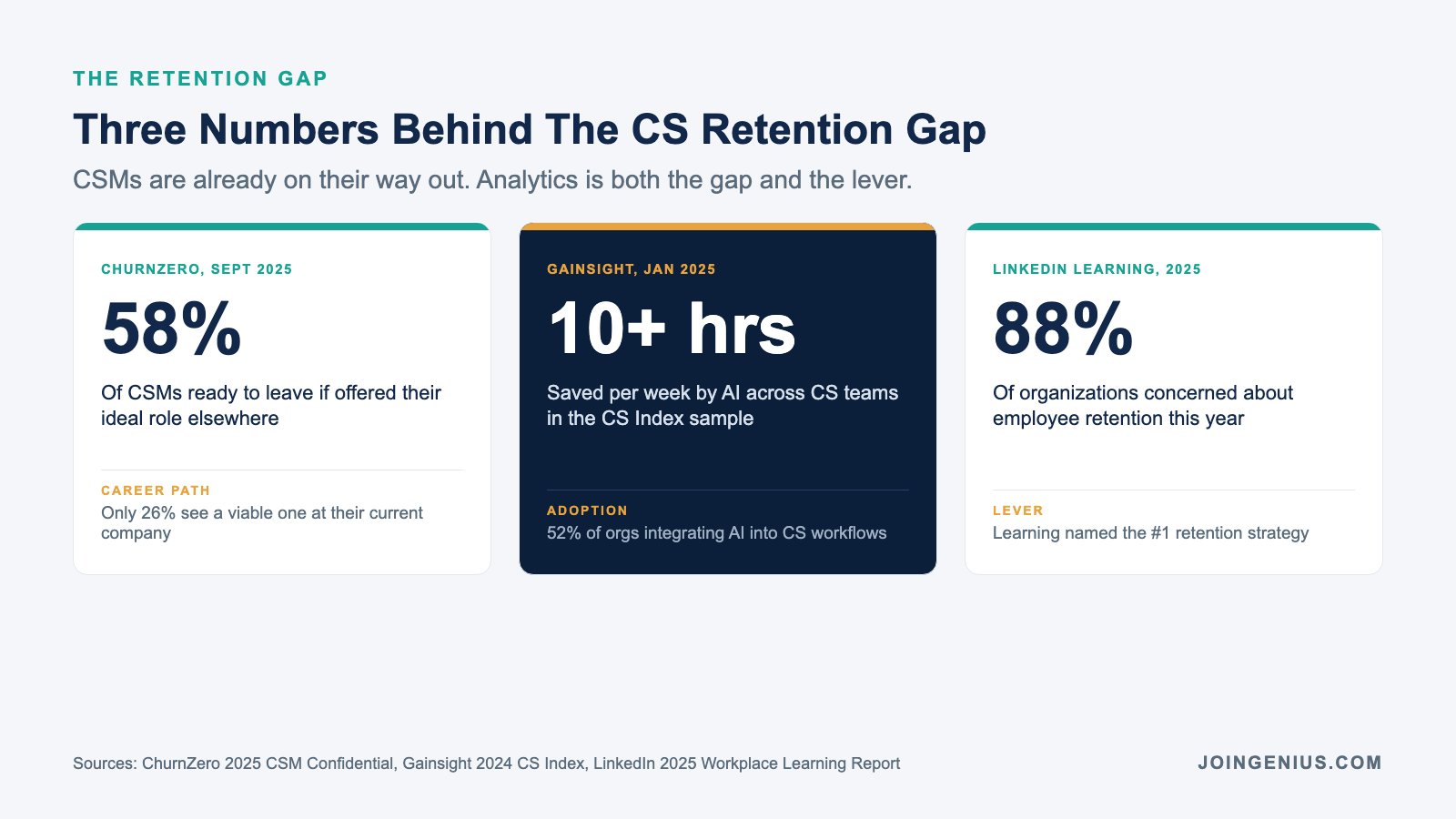
ChurnZero’s 2025 CSM Confidential research, published September 3, 2025, found that 58% of CSMs are ready to leave if offered their ideal role elsewhere, while only 26% see a viable career path at their current company. The same survey named analytical skills as the single biggest skills gap CSMs cite, flagged by 32% of respondents. The CSMs who are drafting the resignation email in their head are the same ones who want a data stack they can actually drive.
What A Data-Driven Culture Changes For A CSM
A data-driven culture is not about dashboards everywhere. It is about the CSM having the specific numbers they need, within the time window the decision is still live.
The Account Health Score Is Visible Before The QBR
A CSM at a data-driven company opens Monday morning and already knows which accounts moved. They are not waiting on an analyst’s queue. The decision window compounds across the quarter because the decisions were made on time.
Churn Risk Is A Pre-Filtered List, Not A Hunt
The weekly churn-risk list arrives in the CSM’s inbox already ranked. Their job is to act on it, not to assemble it. The difference between “assemble the list” and “work the list” is roughly a day a week, which is six weeks a year. Why marketing ops hires don’t stay past their first 18 months teaches the same lesson a department over, which is that the people who assemble the data get bored faster than the people who act on it.
The Expansion Signal Is Automatic
Usage data tells a CSM when a customer is ready for the upsell conversation. The data-driven org pipes that signal to the CSM the day it happens. The non-data-driven org pipes it to the CSM when the customer tells them, which is a quarter too late.
The CSM Can Prove Their Impact
Impact is the single most durable retention signal for a CSM. In a data-driven org, the CSM can show in one screen what they moved. In a non-data-driven org, the CSM can show the activity log and nothing else, and the activity log never wins the comp conversation.
Gainsight’s 2024 Customer Success Index, recapped January 10, 2025 from a 400-plus company sample run with Benchmarkit, found that AI is already saving CS teams more than 10 hours per week by automating data entry and churn detection, and that 52% of surveyed companies are integrating AI into their CS workflows. One case study in the report (Launch Potato) banked 25% of its CSMs’ time back the quarter the automation shipped. That reclaimed time is where the renewal work and the growth conversation actually live, and it is also where CSMs stop feeling like a data-entry function.
The Tool Layer That Keeps CSMs In The Role
The retention tax most CS teams underpay sits inside the CRM. A CRM that forces manual updates is a tax on the CSM’s week, and the strongest CSMs resent it first.
The Record That Updates Itself
The retention lever most CS orgs under-invest in sits inside the CRM, not inside the comp band. When the record updates itself from the conversations the CSM is already having, the day gets its hours back and the dashboard stops being the enemy of the relationship. An AI-native CRM like Lightfield is built around exactly that premise, which is why tenured CS teams keep showing up in orgs that run on this kind of stack.
Reporting Should Be A Byproduct Of The Work
The report the CSM shares on Friday should be a byproduct of what they already did Monday to Thursday, not a separate Friday project. Any CS org whose Friday is a report-building day is paying the retention tax twice: once in the Friday, once in the quit two quarters later.
Context Lives Where The Work Happens
A CSM should not have to leave the account page to find the last email thread or the open support ticket, and definitely not to look up the executive sponsor’s job change. Customer support metrics that matter covers the same unification pattern in the adjacent function. Scattered context is scattered attention, and scattered attention is a resignation on a six-month lag.
Automation Replaces The Thankless Work
Every CS team has a stack of tasks nobody wants: logging a call, updating a renewal date, re-attributing an opportunity. Automate those jobs and the CSM gets a cleaner day. The strongest CSMs stay longer in orgs whose automation covers the thankless parts of the role.
The Hiring Playbook For A CS Team That Stays
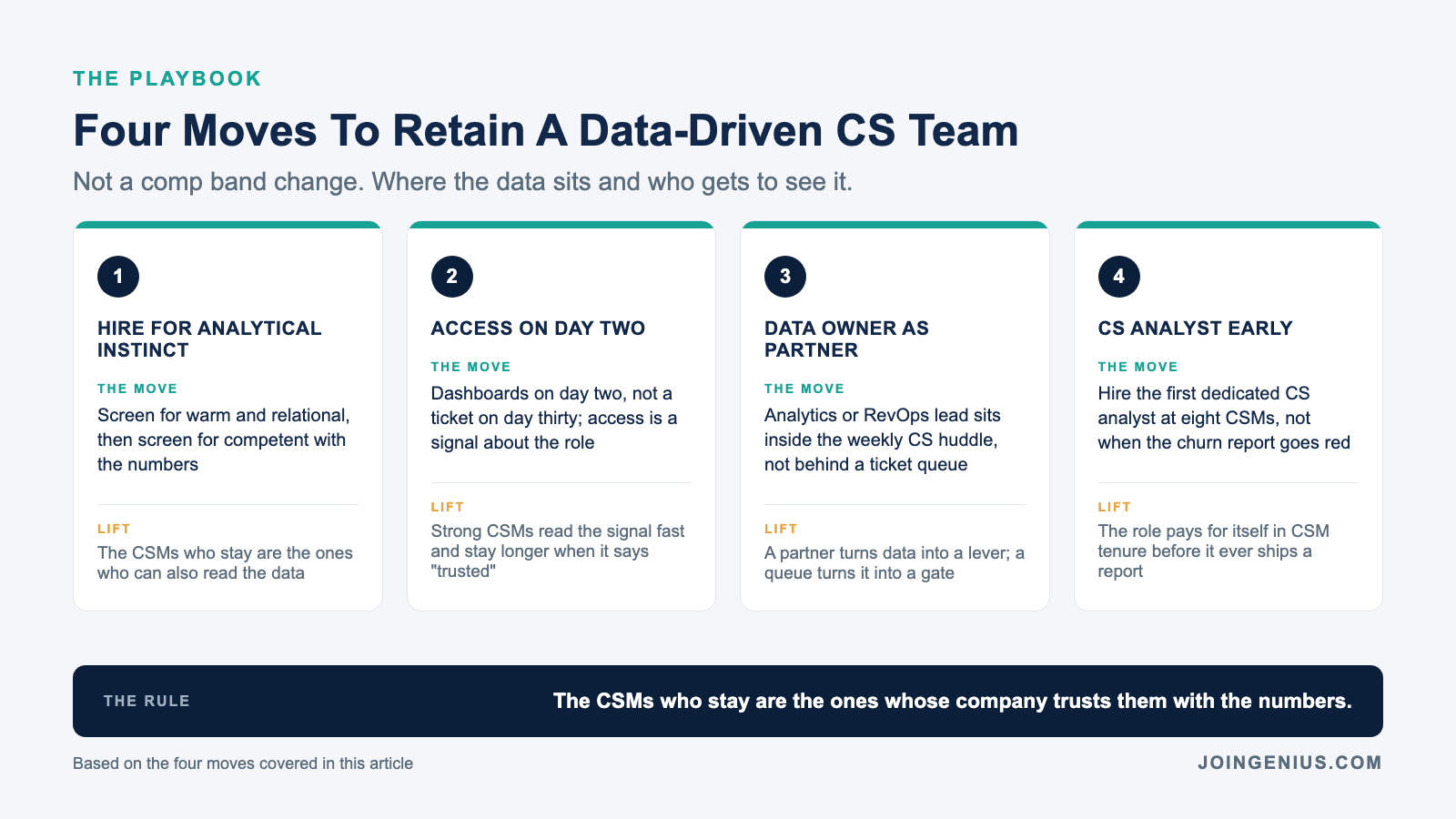
Four moves consistently increase CS tenure in a data-driven org. None of them require a comp band change.
Hire For Analytical Instinct, Not Just Empathy
The CSM archetype most teams hire for is “warm and relational.” The CSM who stays is the one who is also a competent data user. Screen for both, in that order.
Give The CSM Access On Day Two
The CSM who gets dashboards access on day two is a different hire from the one who waits for a ticket on day thirty. Access is a signal about where the role sits in the company, and strong CSMs read that signal fast.
Make The Data Owner A Partner, Not A Queue
The analytics or RevOps lead who serves CS should sit in the weekly CS huddle. If the CS team has to file a ticket for every pull, data is a gate. If they have a partner, data is a lever. The retention delta is a quarter of CSM tenure.
Build A CS Analyst Role Before You Think You Need One
The first dedicated CS analyst usually joins twelve months after the signal said to hire them. Hire them in the quarter the CS team crosses eight CSMs, not the quarter the churn report shows up red. The role pays for itself in CSM tenure alone.
What To Stop Doing (It’s Pushing CSMs Out)
Four moves consistently inflate CS attrition. Cut these first.
Measuring CSMs On Activity, Not Outcomes
Call counts and ticket counts are the easiest numbers to collect, which is why they end up in the CSM review. They are also the numbers that reward the wrong behavior and burn out the right CSM. Low morale at work often sits highest on teams whose metrics track activity instead of impact.
Running A Monthly QBR On Data You Had On Day Twelve
A CSM reviewing month-old data in a month-end QBR is doing the autopsy, not the surgery. If the QBR cadence does not match the data refresh cadence, the review is for show.
Hiding The Churn Report From The CSMs
Some orgs run a monthly churn report that only the VP sees. The CSMs find out their accounts churned at the next pipeline review. That order of information flow is a retention problem disguised as a reporting cadence.
Confusing “Customer Love” With Customer Signal
A CSM who is friendly with the champion is not the same as a CSM who sees the usage drop in week two. The first metric is nice. The second one keeps renewals in the funnel and keeps the CSM in the role.
How To Measure Data Access As A Retention Signal
A healthy CS org shows up in the data in four places.
Time To First Pull For A New CSM
The number of business days between the CSM’s start date and their first self-service pull of their book. If this is longer than two weeks, the data stack is the first retention problem the role has.
Share Of Decisions Made On Data
The portion of CSM moves in a quarter that cite a specific metric, not a feel. If this is under 60%, the role is operating on instinct and the strongest CSMs will leave for a role that is not.
Data Request Backlog Per CSM
The number of open data asks per CSM at any given time. If this number is above three, the analyst-to-CSM ratio is the bottleneck. How to measure recruiting ROI without spreadsheet chaos covers the same measurement discipline on the hiring side.
A Short CS Data-Access Scorecard
| What To Measure | Weak Signal | Strong Signal |
|---|---|---|
| Time to first pull | 3+ weeks, ticket queue | 2 days or fewer, self-serve |
| Decisions made on data | Under 60% of CSM moves | 80%+, with named metrics in notes |
| Data backlog per CSM | 3+ open asks on average | 1 or fewer, same-week turnaround |
| CRM data entry burden | Weekly manual logging | Record updates itself from the work |
LinkedIn Learning’s 2025 Workplace Learning Report, published February 2025 from a survey of 1,564 learning and talent-development professionals across 23 countries, found that 88% of organizations are concerned about employee retention and that providing learning and growth opportunities is the single most-named retention strategy of the year. A data-driven CS team stacks exactly that career artifact onto the role, which is why the retention lever doubles as a talent-development one.
Conclusion
The CS retention problem that looks like comp or culture is almost always a data problem. The CSMs who stay are the ones whose company trusts them with the numbers, early enough to act on them. The CSMs who leave are the ones who spent a year running a book they could not actually see. Fix the data layer and the hiring problem gets smaller on its own, because the CSMs already on the team stop writing the resignation email in their head.
We built Genius so CS leaders can staff the operators who make a data-driven CS team possible. We place the top 1% of customer success and operations talent from the Philippines and Latin America, at around 80% less than comparable local hires. The relationship stays direct, with no monthly agency fees and a 6-month replacement guarantee on every placement. If the next CS hire is the one who finally pairs the human instinct with the data, see how we source and place the customer success talent that stays through the renewal cycle.