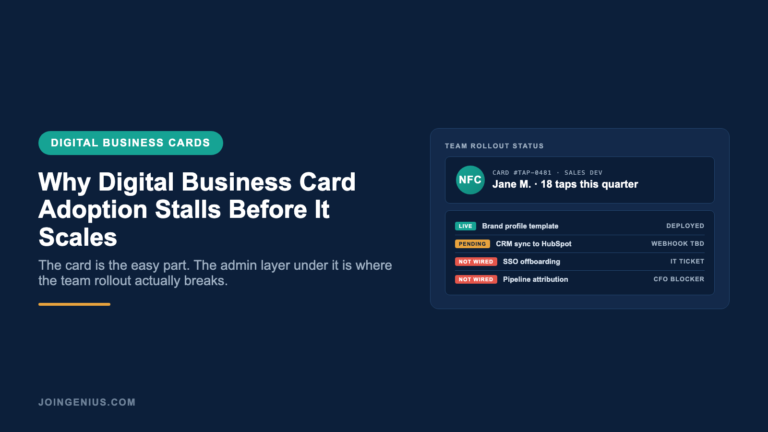
Most teams adopt digital business cards for one or two reps and then stall at the team rollout. The individual version is easy. You buy an NFC card, tap it against your phone and your contact details load without any app install. The team version is where every project gets stuck.
The barriers live in the operational layer under the card, not in the hardware. Brand control breaks first at team scale, and CRM sync breaks second. If you are hiring sales reps who will carry the card to events, the fix starts before the cards ship. This piece walks the four barriers and the order that gets past them.
What Digital Business Cards Actually Are In 2026
A digital business card in 2026 is not a QR code on a static PDF. It is an NFC chip inside a physical card paired with a hosted profile that updates in real time. Every new contact pushes into the CRM through a webhook, not a scanned image the rep forgets to upload after the event.
The Card And The Hosted Profile
The hardware is a PVC card with an NFC chip, or the same chip inside a bamboo or metal body for premium tiers. The reader is any smartphone on iOS or Android, with no app install required. The receiver taps the card against their phone and a landing page opens with the sender’s contact info already there.
Volume discounts kick in once a team buys more than a handful of cards. A single card typically costs between 20 and 50 dollars one time. The digital profile either comes bundled or sits behind a modest per-seat subscription that scales with the team.
What Changed Since 2022
Three shifts made this an enterprise-ready tool rather than a conference novelty. SSO landed on the major platforms, so IT can provision cards from Okta or Entra. AI-powered scanning of paper cards came in, so reps who still receive paper can push those contacts into the same CRM pipeline the digital cards feed.
Offboarding controls caught up next, so a rep leaving the company does not leave an ex-employee contact page live on the internet forever. That control is what separates the team-grade cards from the consumer versions you see at networking meetups.
Why Adoption Stalls At The Team Level And Not The Individual
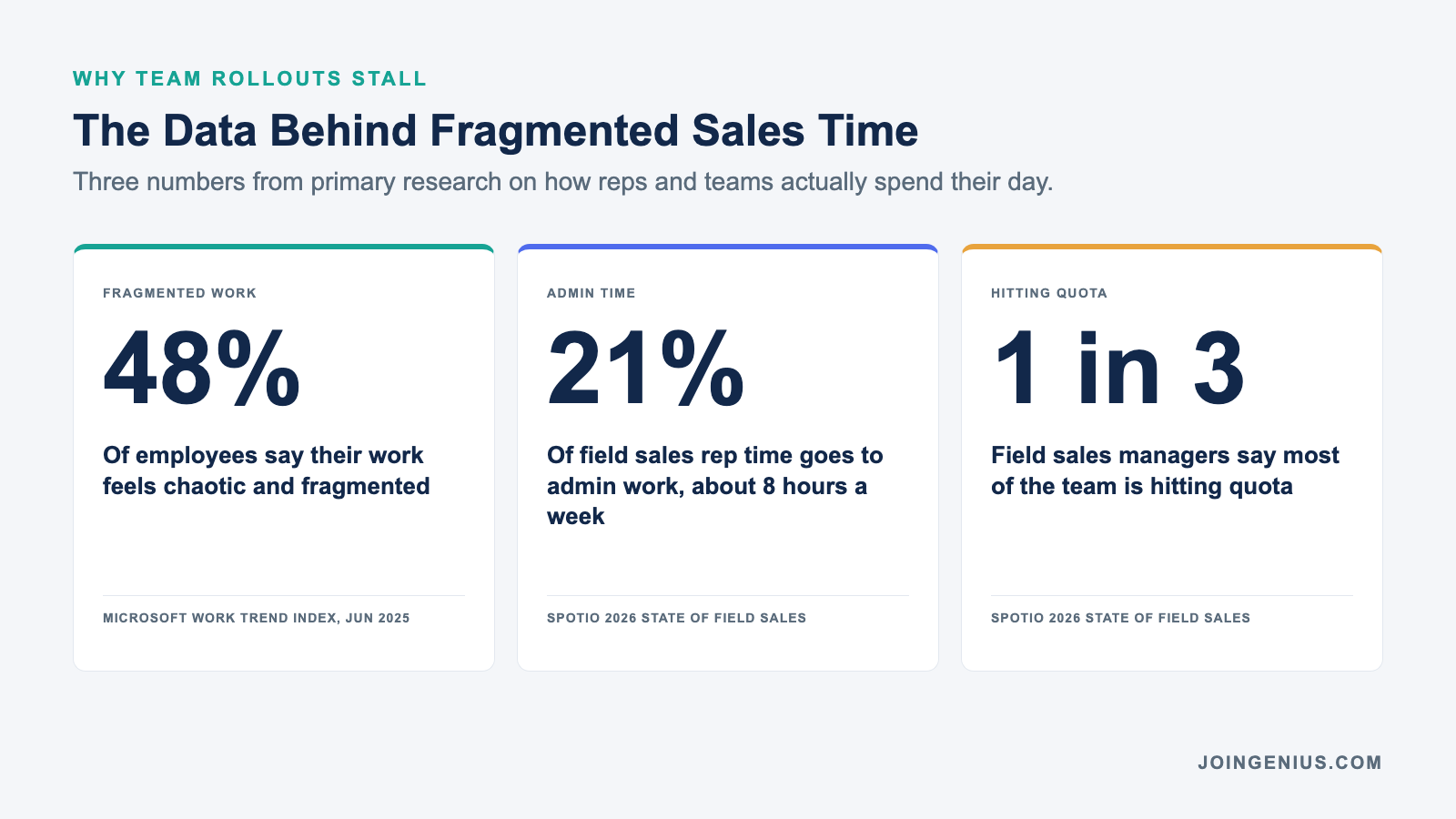
Microsoft’s June 2025 Work Trend Index surveyed 31,000 knowledge workers in 31 markets and found 48 percent of employees say their work feels chaotic and fragmented, with 52 percent of leaders saying the same. A new tool that fits that workflow is one that does not add another step for the rep or another dashboard for the manager.
SPOTIO’s 2026 State of Field Sales survey of 388 field respondents reports that 21 percent of field rep time is spent on administrative work, roughly 8 hours a week per rep not in front of a customer. This is vendor research, so treat the direction as the headline. Lead capture after events is a visible slice of that admin time.
The same survey found just one in three field sales managers reports more than 70 percent of their team hitting quota. A digital business card is not going to fix quota attainment on its own. Every minute shaved off lead entry is one more minute the rep can spend in front of a buyer.
The three numbers in the image below are the shape of the problem. Any adoption barrier that adds minutes to the rep’s day rather than saving them makes the shape worse, which is why team rollouts fail where single-user pilots succeed.
The barriers that matter for a team rollout cluster around four specific operational gaps that sit under the card, not around the card itself.
Four Barriers That Kill Team Rollout
Each barrier below is the one that quietly stalls a pilot after the first batch of cards arrives. The team buys 25 cards, hands them out at an event and then nothing moves into the CRM. The table maps each barrier to the system it breaks and the fix that keeps the rollout alive inside the same admin console.
| Barrier | What Breaks | Fix |
|---|---|---|
| CRM sync is manual | Leads sit on the rep’s phone instead of the pipeline | Pick a card that pushes contacts into HubSpot or Salesforce directly |
| Brand control slips | Each rep designs a different landing page and headshot | Enforce a branded profile template at the admin dashboard |
| Offboarding leaves the card live | An ex-rep’s profile keeps pointing at your logo and inbox | Tie provisioning to SSO so revoking the account revokes the profile |
| ROI is invisible to the CFO | The cards look like swag rather than revenue tooling | Instrument the webhook so every tap shows up in pipeline attribution |
These are not exotic bugs. They are the result of a team installing hardware on top of a process the admin never finished setting up. Brand control and CRM sync go first. Cards go in reps’ hands only once the admin dashboard is wired up to SSO and the pipeline attribution dashboard shows the first taps from a pilot.
Fix the admin layer once and the cards start paying for themselves inside a quarter. Hand out cards first and every new hire becomes a new support ticket for ops.
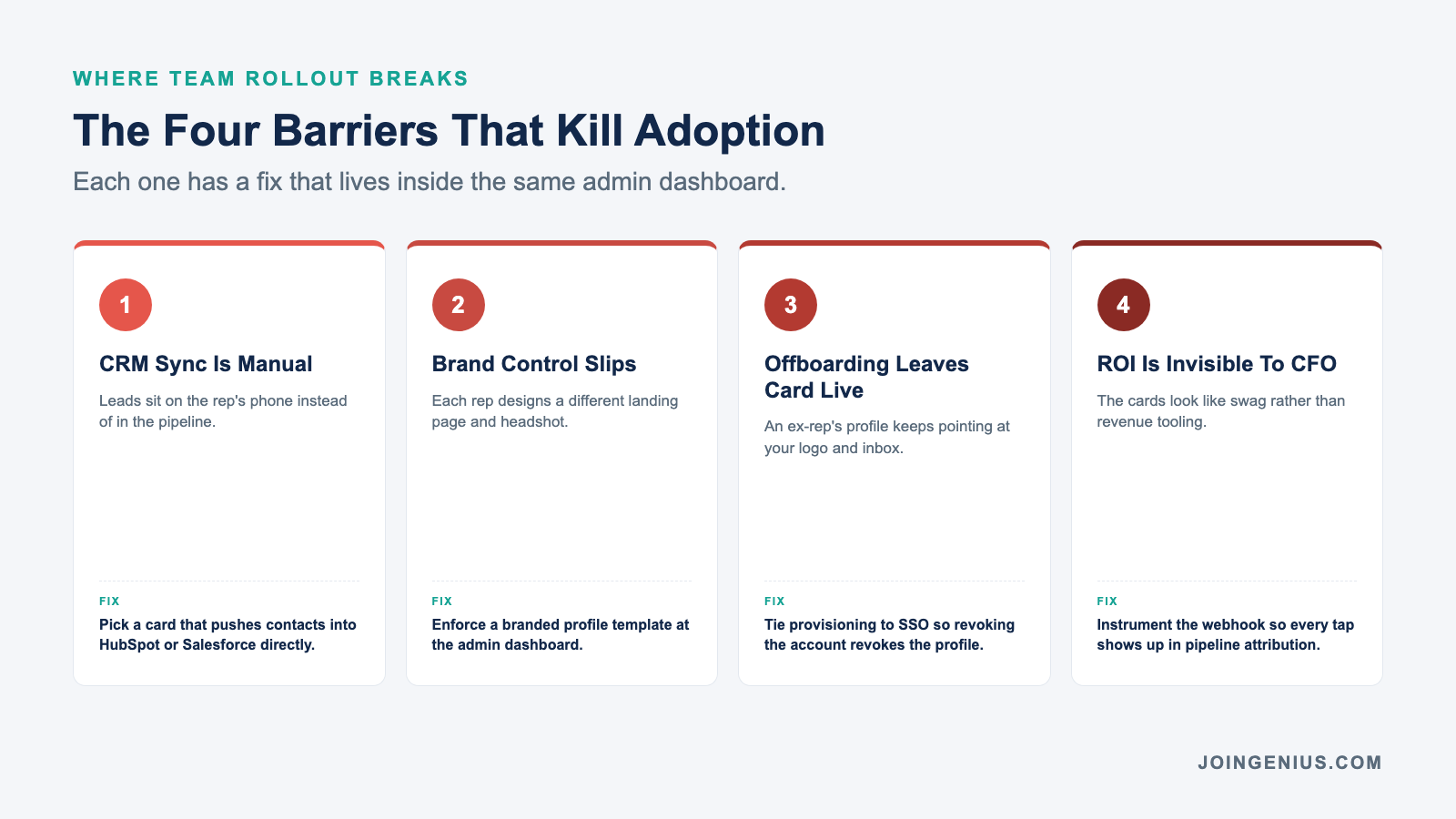
The practical path through all four is to pick the single barrier the team hits hardest in the pilot and design the admin flow around it. Only expand to the next barrier once the first one has stopped generating tickets.
How To Roll Digital Business Cards Out Without The Usual Friction
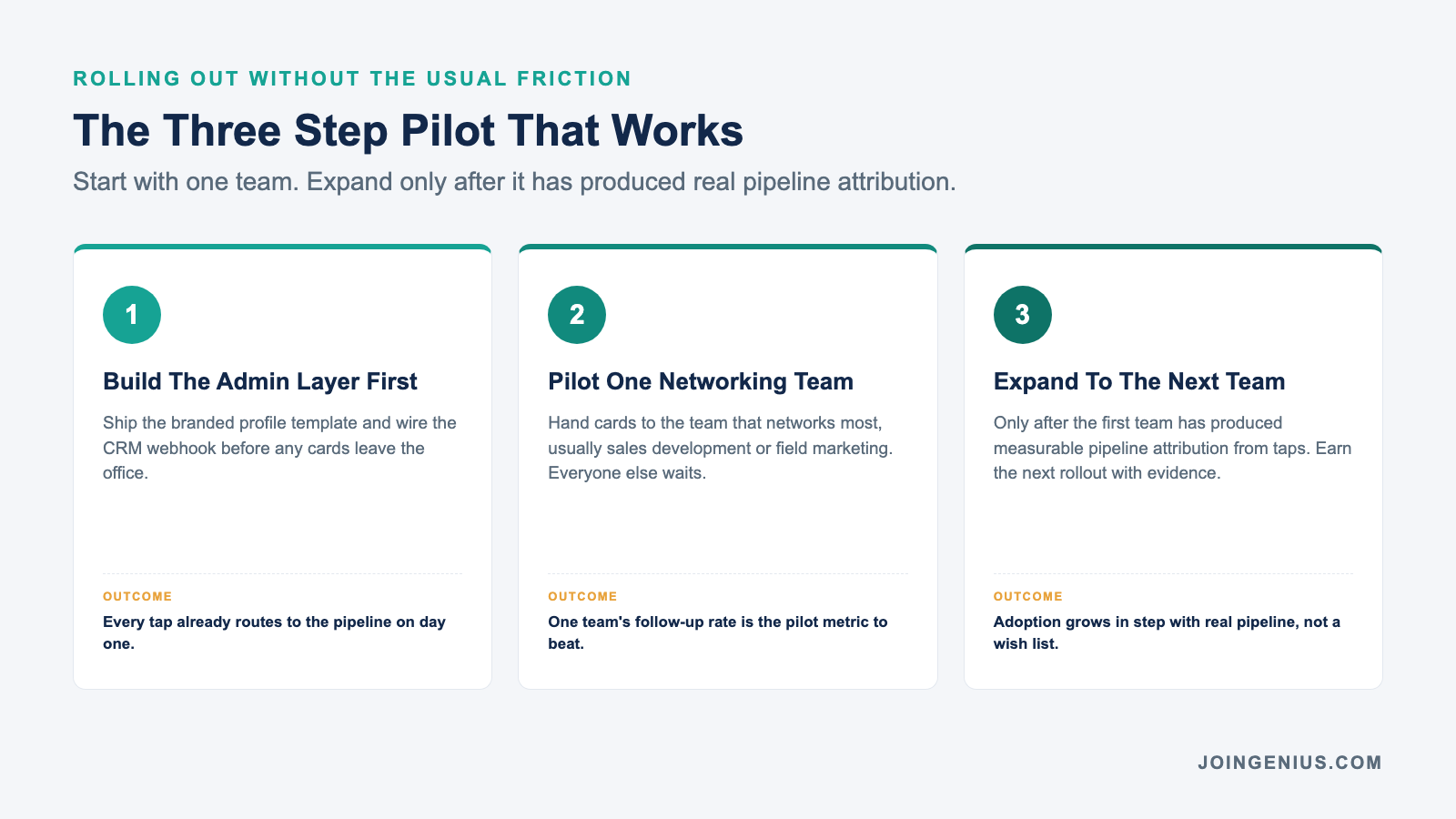
A team adoption plan that works has four moving parts. A branded profile template every rep clones at signup. A CRM webhook that fires on every tap. A provisioning flow tied to SSO so the admin does not manage cards by hand.
The fourth part is a short events kit so the rep knows how to use the card at a conference. This is usually a one-page runbook that covers when to tap, how to follow up and how to log the interaction when the person they met did not have an NFC-capable phone.
A dedicated team business cards platform such as Tapni handles all four parts out of the box. It ships branded NFC cards plus a shared admin dashboard, with CRM sync into HubSpot and Salesforce. An AI card scanner lets reps push received paper cards back through the same pipeline, since plenty of attendees still carry paper at events.
Tapni Business plans start at 59.90 dollars per user per year for small teams and drop to 29.90 dollars per user per year at the 31 to 50 user tier, with custom pricing above that. Like any team tool it only pulls its weight if the reps actually use it, so start the pilot with the team that networks most.
If the CRM integration is the piece that always slips, this is a good spot to look at how to outsource software development for the webhook work. Keep the brand template and the events kit in-house with marketing, and let an external team own the plumbing that routes every tap into the CRM.
Who Should Own The Rollout Inside A Growing Team
The owner question is the one that sinks most pilots. The Bureau of Labor Statistics counted 1,571,400 wholesale and manufacturing sales representatives in the United States in 2025, with a median annual wage of 76,460 dollars and zero percent projected employment growth through 2035. A flat headcount means productivity has to come from tooling, not from a bigger team.
In practice the rollout gets split across three functions. Marketing owns the branded profile template and the events kit. Sales ops owns the CRM webhook and the pipeline attribution math. IT owns the SSO provisioning and the offboarding controls that matter the day a rep leaves.
Smaller teams fold these roles into one revenue operations hire with a shared Slack channel for issues. The seat looks more like a sales engineer who speaks marketing than a designer who dabbles in CRM fields. That ordering decides whether the rollout survives month three or quietly dies when the first rep cannot find their cards.
If you are hiring for that revenue operations seat, a digital marketing specialist with CRM experience can shorten the search. Teams scaling faster often fill the whole sales and marketing stack through one vendor so that the card program slots in alongside the lifecycle tooling the team already uses.
Make The Card Earn Its Place
Digital business cards work when the admin layer under them is honest about where every tap ends up and who still has an active profile. The hardware is the easy part. CRM sync is where most rollouts stall, and offboarding is the second place they stall, so those two deserve the first sprints of implementation work.
If the pilot is going to land this quarter, it needs a revenue ops hire who has shipped a CRM webhook before and a marketer who can build a branded profile template reps actually want to use. Genius helps growth and ops teams fill those seats without the usual three-month search.