Most CDP segments never move a revenue metric. A team spends a quarter setting up Segment or Rudderstack. They build a dozen audiences and push them to the ad platforms. The first campaign still runs a week late, because the cohort looks wrong to the paid team the moment they see it.
The problem is almost never the segment rules. It is the data layer feeding them. If you are planning a CDP project or hiring developers to clean up what you have, the fix starts before anyone writes a filter. This piece walks the data mistakes that quietly kill segmentation and the fixes that work in production.
What CDP Segmentation Actually Means In 2026
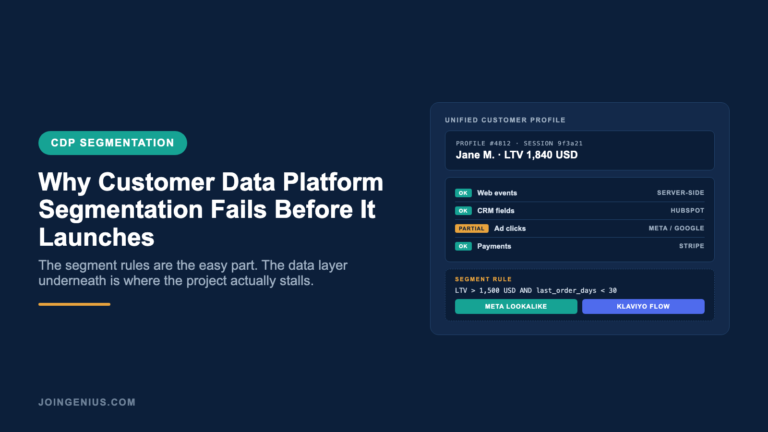
CDP segmentation is the layer between a unified customer profile and the tools that act on it. A profile pulls together web events with CRM fields under one identity. Ad clicks and payment data attach to the same profile.
The segment is a rule or model that runs on top of that profile. It sends a cohort to an ad audience or an email flow. Downstream tools like ad platforms or email service providers do the work of actually reaching the user. The CDP’s job is to give them a trustworthy list.
What Changed In 2026
Profiles now span server-side events and model-scored traits, not just cookies. A segment like “likely to churn in 30 days” used to be a wish. Today it is a predicted probability that a reverse ETL job writes back into Salesforce or HubSpot every morning.
This also means a segment is only as good as the pipes under it. If one pipe drops a field or renames an event, the segment silently decays. No alert fires, and the campaign that depends on it runs on last month’s definition. By the time someone notices, the ad spend is gone.
Behavioural Versus Modelled Segments
The practical distinction worth keeping in mind in 2026 is between behavioural segments and modelled segments. Behavioural segments run on observed events, so they fail loudly when the event stops firing. Modelled segments run on predicted scores, so they fail quietly when the training data drifts. Each failure mode needs its own monitoring.
Why Most Segments Fail To Lift Revenue
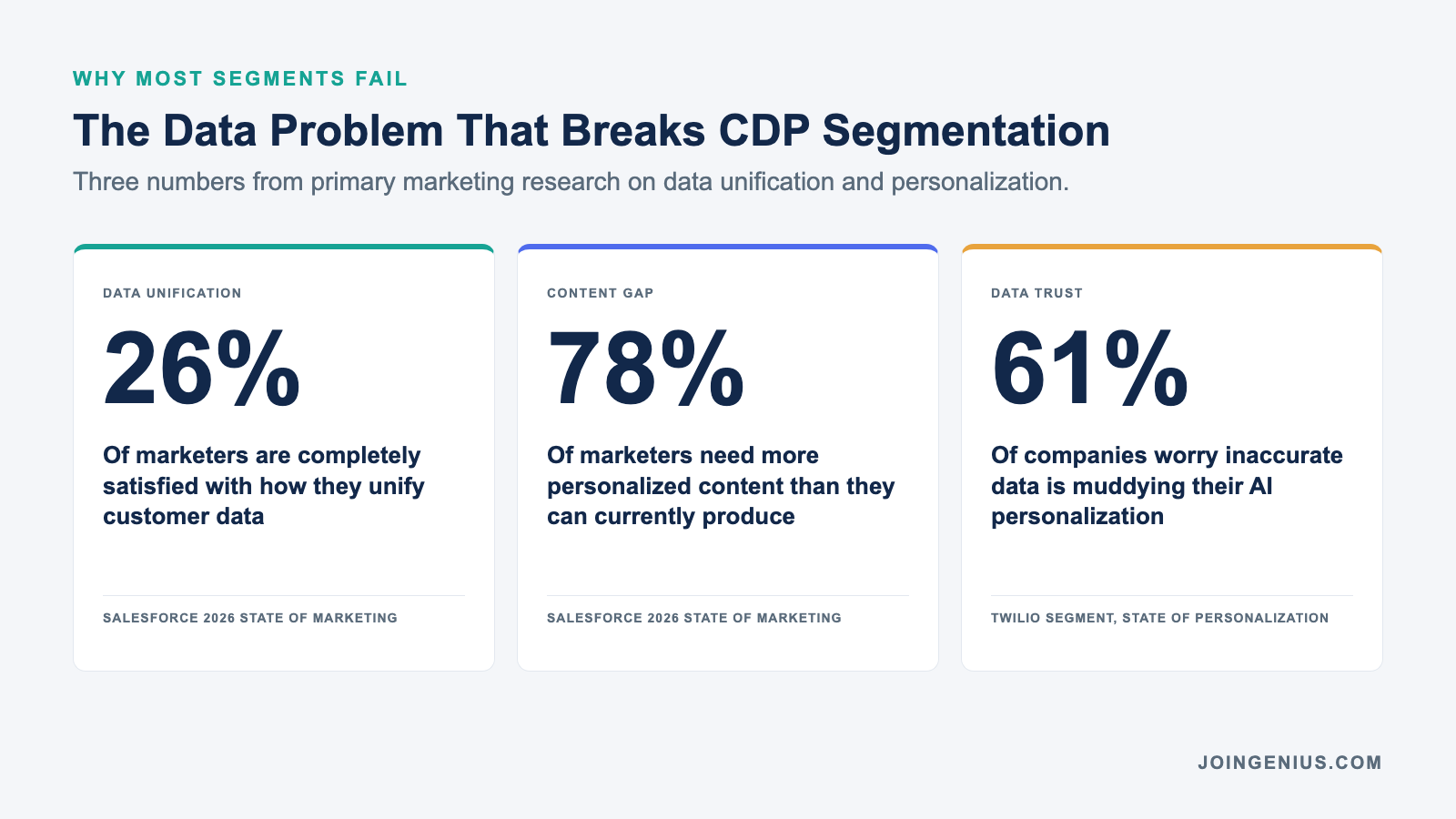
Salesforce’s 2026 State of Marketing report surveyed 4,450 marketing professionals and found only 26 percent are completely satisfied with how they unify customer data. Three in four marketing teams know their foundation is wobbly before they build a single audience.
Twilio Segment’s State of Personalization report reaches the same floor from the other direction. 61 percent of companies say they worry about inaccurate data compromising their AI-driven personalization work. When the inputs are suspect, every downstream segment inherits the doubt, and no model score can repair it.
The business pressure shows up in content, not in dashboards. Seventy-eight percent of marketers in the same Salesforce survey say they need more personalized content than they are currently able to produce. A segment the team does not trust produces a creative brief no one is willing to write for.
Part of the reason is the sheer number of inputs. The same survey finds the average marketing organisation uses at least seven data sources. Each connection has its own schema and its own failure mode. The CDP is only ever as current as its slowest integration.
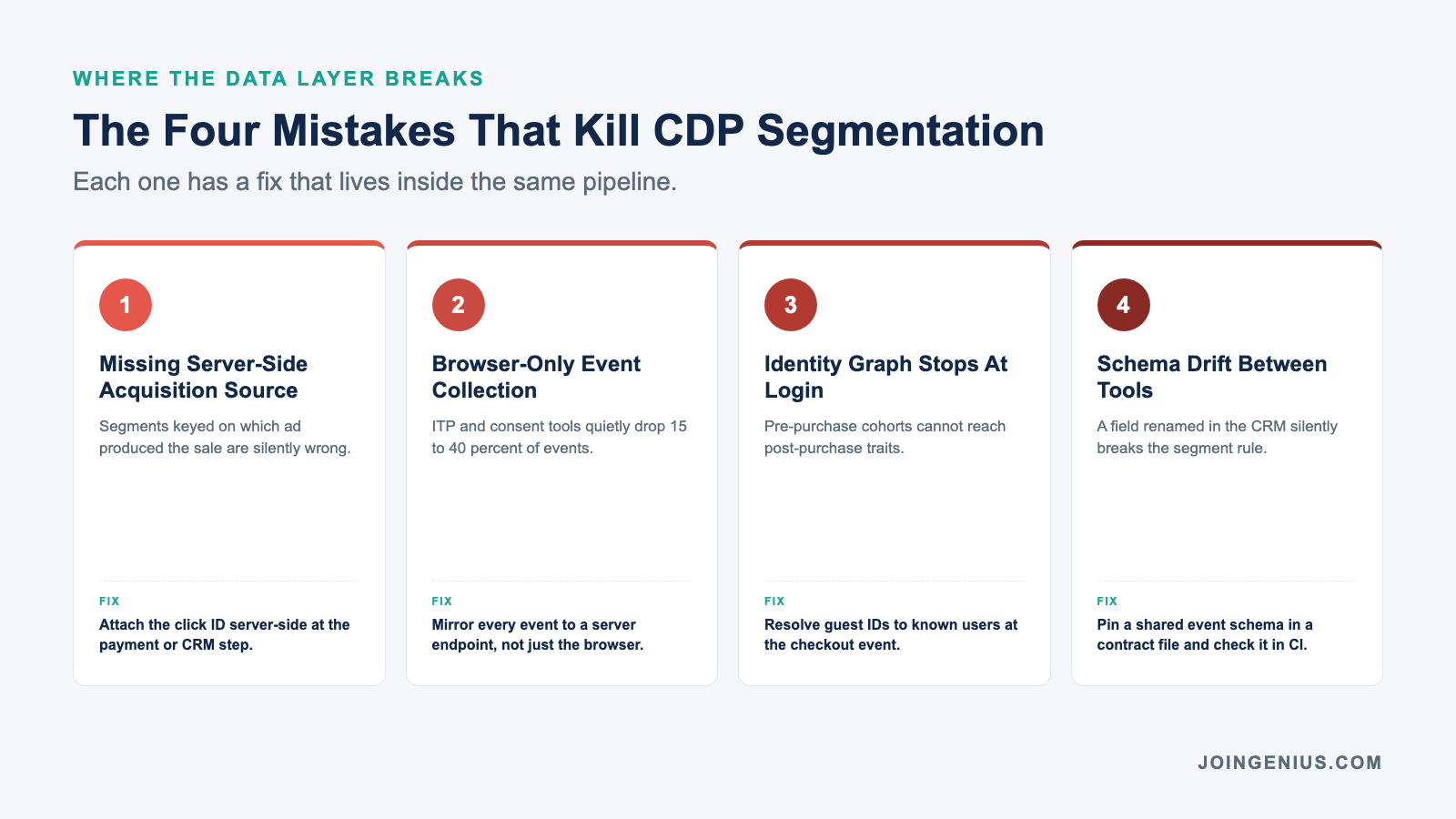
The gap between what a CDP can do on paper and what a team actually ships traces back to four mistakes in the data that feeds the segment, repeated across teams.
Four Data Layer Mistakes That Break Segmentation Before It Starts
The failure modes repeat across teams because the plumbing is the same. Mock events pass unit tests. The production stack handles real customers. The table below maps each mistake to what it breaks downstream and how to fix it inside the same pipeline, without a rebuild.
| Mistake | What It Breaks | Fix |
|---|---|---|
| Missing server-side acquisition source | Any segment keyed on which ad produced the sale is wrong | Attach the click ID server-side at the payment or CRM step |
| Browser-only event collection | ITP and consent tools quietly drop 15 to 40 percent of events | Mirror the same events to a server endpoint |
| Identity graph stops at the login wall | Pre-purchase cohorts cannot reach post-purchase traits | Resolve guest IDs to known users at the checkout event |
| Schema drift between tools | A field renamed in the CRM silently breaks the segment rule | Pin a shared event schema in a contract file and check it in CI |
These are not exotic bugs. They are the result of a CDP installed on top of a tracking layer the team never finished. The right order is tracking first. Identity resolution and segmentation come after that. Teams that try the three at once usually finish none.
Fix the tracking once and the rest gets easier. Fix the segmentation first and every new source becomes a new bug report from the paid team.
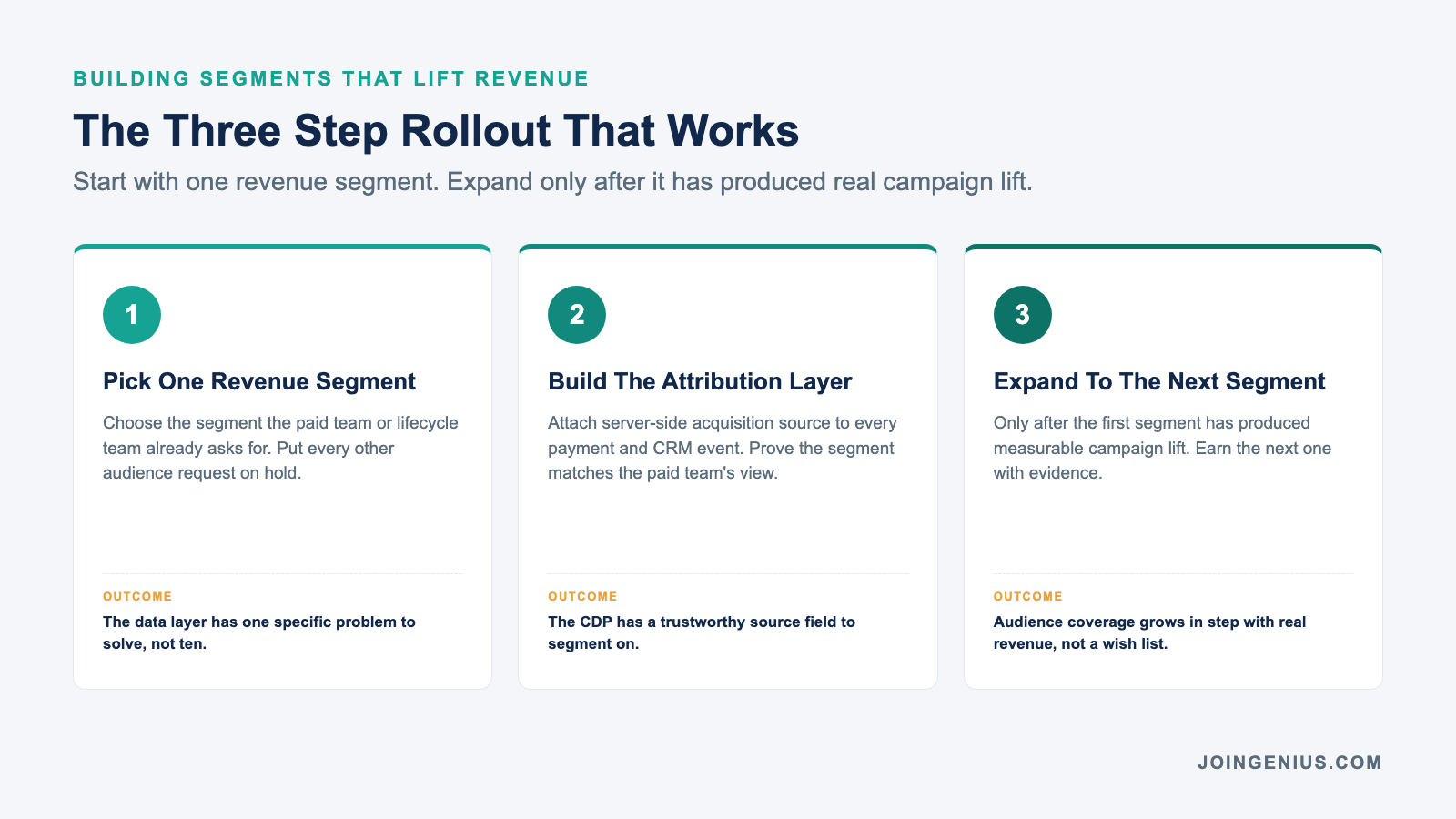
The practical path through all four is to pick the segment the team cares about most and build the data layer that it needs. Expand to the next segment only after the first one has proven it can produce real campaign lift.
How To Build Segments Your Team Can Actually Act On
A segment only earns its place when someone on the team can act on it the same week. That filter kills most dashboard segments. What survives is tied to money. A purchase event or a churn risk score crossing a threshold turns into a creative brief inside a day.
To build that kind of segment you need two things on the data side. First, every revenue event must carry the acquisition source that produced it, including offline and recurring charges. Second, every anonymous event on the website must be joined to a known user as soon as that user identifies themselves.
The first requirement is where most tracking stacks fall over. A browser-only setup loses the ad click after a cookie expires or a consent tool fires. The segment feed is then permanently incomplete. Server-side attribution is the fix, and it lives at the payment or CRM boundary, not in the browser.
A server-side marketing attribution tool such as Able CDP is one option here. Able ties Stripe and CRM revenue back to the ad click and landing page that produced it, including offline and recurring sales. That gives the CDP a clean source field to segment on, regardless of how the user arrived.
Able’s plans start at 49 dollars per month for analytics-only and 145 dollars per month once ad-platform server-side tracking is enabled, with volume plans above that. The scope is attribution and journey tracking, not identity resolution or reverse ETL, so pair it with a downstream activation layer when your segments need to run inside a tool like Hightouch or Braze.
If your team is already stretched, this is a good spot to look at how to outsource software development for the pipeline work. Keep the segment rules in-house with the marketers who actually use them, and let an external team own the tracking build.
Who Should Own CDP Segmentation Inside A Growing Team
Segmentation sits between marketing and engineering, which is why it so often sits with no one. The Bureau of Labor Statistics counts 952,700 market research analysts in the United States in 2025, with a median annual wage of 78,760 dollars and projected employment growth of 7 percent through 2035.
In practice the role is often split across three seats. A growth marketer owns the segment definitions and the creative they drive. An analytics engineer owns the identity graph and the reverse ETL jobs. A data platform engineer owns the server-side tracking that feeds both. The boundaries between those seats are where segmentation projects actually stall.
Smaller teams combine these roles into one data generalist, usually sitting on the growth team with a dotted line to engineering. The hire looks more like a senior analytics engineer who can read a creative brief than a marketer who can read SQL. That ordering matters at interview time.
If you are hiring for that generalist seat, an engineering recruitment agency with a data practice can shorten the search. A path to hire LATAM developers is often the cheapest option that still gets the right skill set, since the role lives in data engineering more than in marketing.
Make The Data Earn Its Segment
CDP segmentation only works when the data underneath it is honest about where every customer came from and what every customer did. The segment rules are the easy part. Server-side tracking is where most teams stall, and ownership of the whole stack is the second place they stall.
If the segmentation project is going to land this year, it needs a data engineer who has built a server-side tracking layer before and a growth marketer who knows what to do with it. Genius helps growth and data teams fill those seats without the usual three-month search.