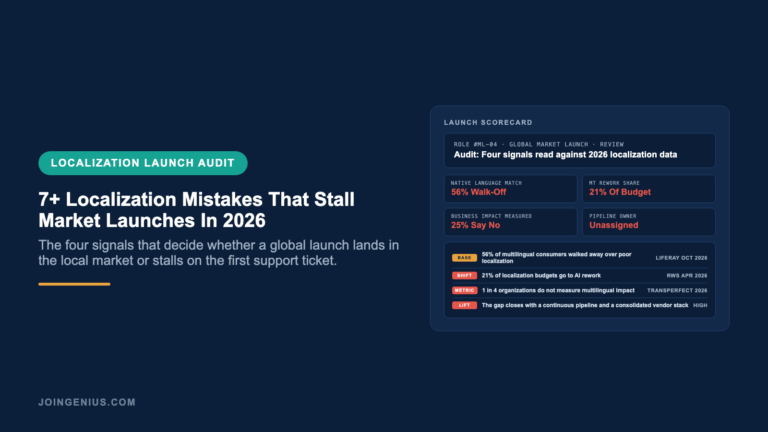
The pitch of a global launch is simple. The product gets translated into the target language. The market opens up and revenue follows the way the business case said it would. Two quarters later the telemetry tells a different story. The signups came in at launch. The dropoff showed up a month later. The post-mortem points at localization mistakes nobody caught because nobody owned them. This guide walks a launch lead or operations manager running a market launch in 2026 through the seven mistakes that stall the release, plus the eighth one that is really the root cause and the one to fix first.
Localizing The Marketing Site And Leaving The Product Surface In English
The marketing site gets translated first because marketing owns the deadline. The product surface sits downstream, and because engineering owns it the translation shows up later. The gap sits where the buyer actually spends the hours after signup. Button labels stay in English. The onboarding email arrives in the source language a week after the welcome screen.
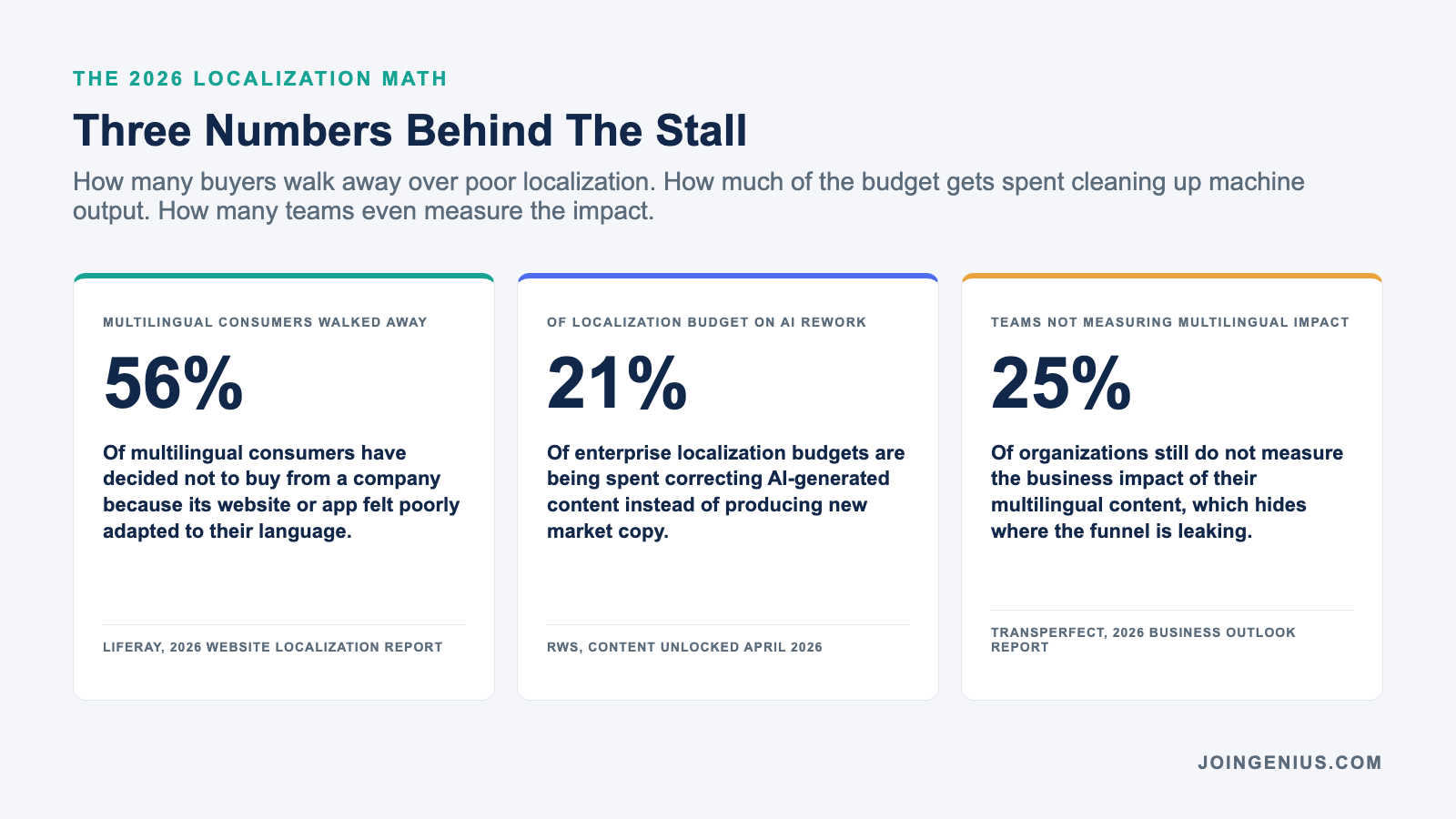
Liferay’s 2026 Website Localization Report, published October 2026 after a Pollfish survey of 800 US adults who had used a non-English website or app in the past year, puts a number on the retreat. Fifty-six percent of multilingual consumers have decided not to buy from a company because its website or app felt poorly adapted to their language.
A digital marketing manager can ship the translated marketing site on time and still see conversion collapse inside the product. The marketing site brings the buyer in. The product surface is where trust forms, and when it does not form the business case numbers do not either.
Shipping Machine Translation Output Without An Editing Pass
Neural machine translation got good enough in 2026 that teams treat the first pass as the final pass. The output reads fluently in isolation and fails inside the product because fluency is not accuracy. The terminology the model picks is the one its training corpus picked, not the one the brand uses.
RWS’s 2026 Content Unlocked report, built on a survey of 200 senior content leaders across the US, UK and Asia-Pacific published April 2026, puts the cost of that shortcut at a specific number. Twenty-one percent of localization budgets are being spent correcting AI-generated content. The rework eats the savings the machine was supposed to deliver.
The fix is a human editing pass on anything that reaches a customer. A content writer who knows both the source brand voice and the target market catches the terminology drift before it reaches production. The machine does the first pass. The editor decides what ships.
Treating Right-To-Left Languages As A Styling Afterthought
Arabic and Hebrew need the UI to mirror. The icons flip. The navigation flips. The form layout flips. Teams that discover RTL requirements at the end of the localization sprint find that half the CSS was written with assumptions that break at mirror time.
The usual move is to translate the strings and deploy to the Arabic market. The team then discovers that the modal closes on the wrong side of the screen. The progress bar moves from right to left, but the next button still points right. The product reads foreign to the user even when the words are correct.
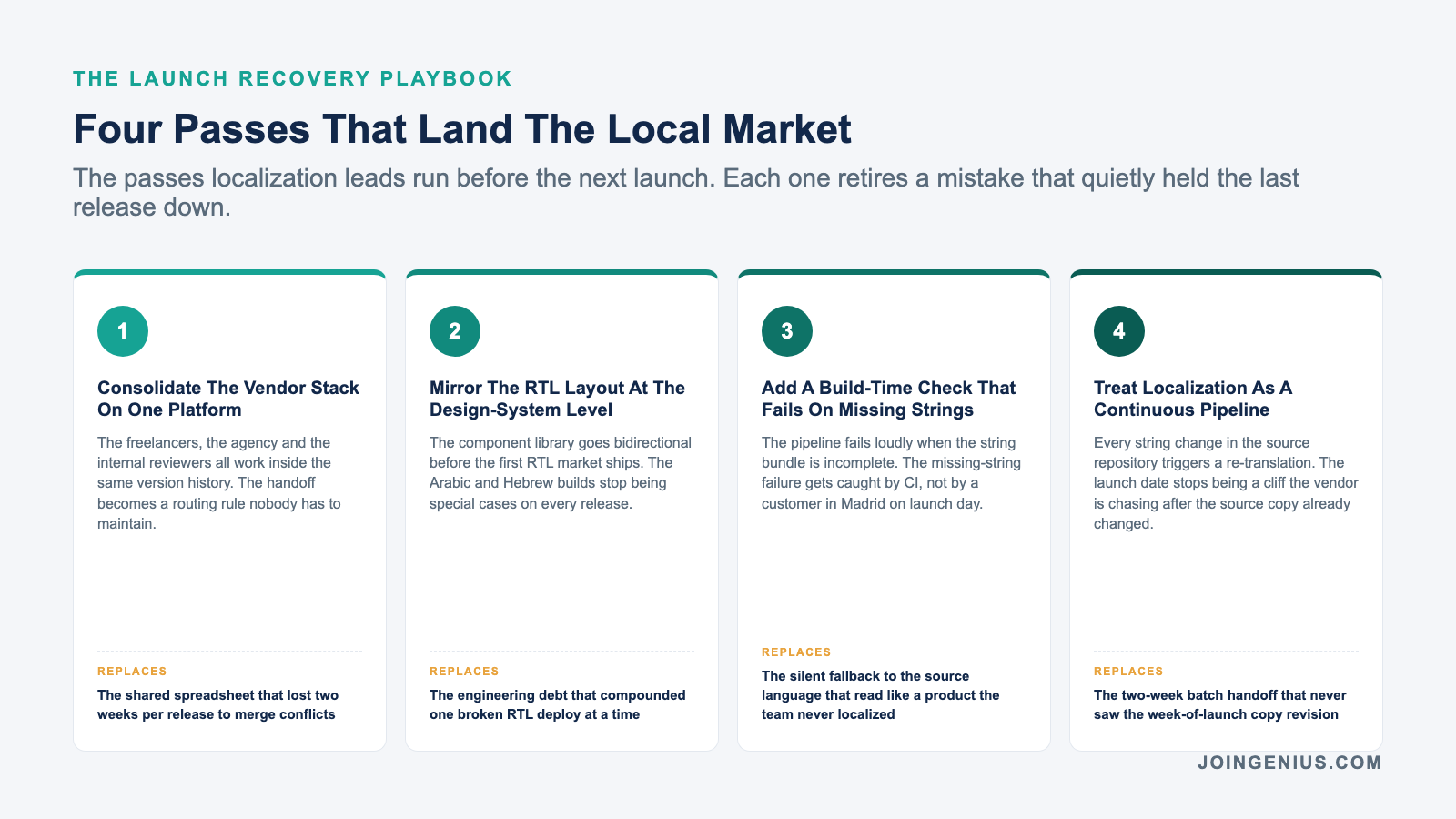
A web developer with RTL experience bakes the bidirectional layout into the component library at the design-system level. The components mirror automatically for RTL locales, and the engineering team stops shipping each market as a special case.
Translation Vendor Soup That Nobody Owns
Localization at scale sits across more parties than anyone consolidated. Freelance translators handle some languages. An agency handles the rest. An internal reviewer signs off on compliance copy. A project lead keeps the version history straight in a shared spreadsheet that gets copy-pasted every release. The risk compounds because nobody owns the pipeline end to end.
TransPerfect’s 2026 Business Outlook Report, based on a survey of 96 enterprise leaders in operations and localization roles released May 2026, flags the deeper problem. One in four organizations still do not measure the business impact of their multilingual content, which means nobody can tell which part of the handoff chain is costing them revenue.
The fix is consolidation. One system of record replaces the shared spreadsheet, and every vendor and reviewer works inside the same version history.
Where Crowdin Enterprise Fits
Teams juggling freelance translators, agency vendors, and internal reviewers lose two weeks per release to spreadsheet merges, which is why localization leads now build their localization system around existing workflows on a single platform like Crowdin Enterprise, with 700+ apps and integrations.
Pulling the vendor stack onto one platform does two things at once. The version history becomes the pipeline instead of a spreadsheet, and the handoff work that used to eat two weeks per release becomes a routing rule nobody has to maintain by hand.
The String File That The Build Pipeline Cannot Find
Translated strings live in a resource file. The resource file lives in a bucket or a shared drive. The build pipeline needs to pick up the right version of the file at the right moment in the deploy, or the product ships to the new market in the source language because the new strings never got bundled.
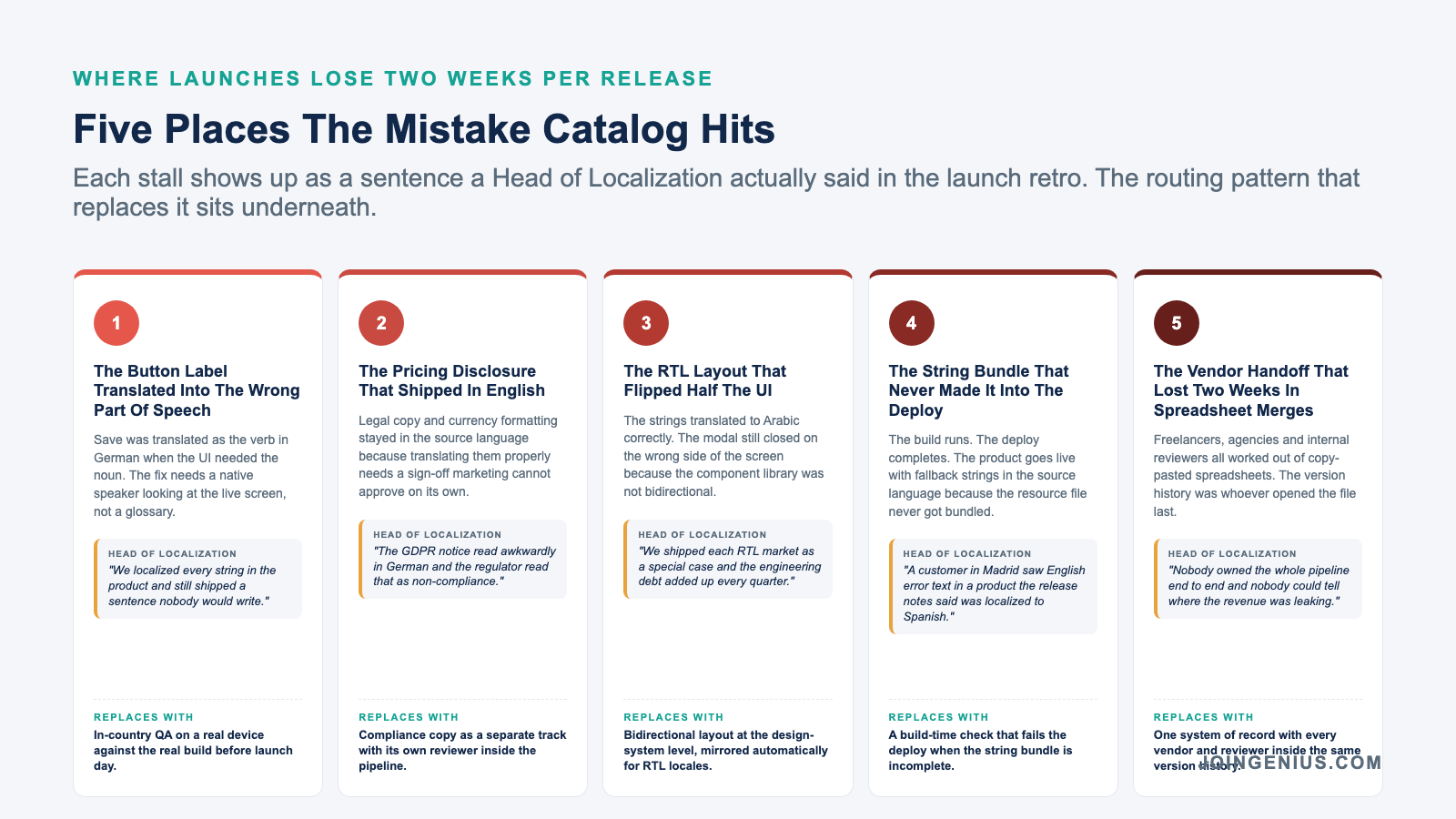
The failure mode is that the pipeline technically succeeds. The build runs. The deploy completes. The product goes live in the target locale with fallback strings nobody noticed. A customer in Madrid sees English error text inside a product the release notes claimed was localized to Spanish.
A software engineer owning the localization pipeline writes a build-time check that fails the deploy when the string bundle is incomplete. The check runs before the code reaches staging, and the missing-string failure gets caught by CI instead of by a customer the first week after launch.
Pricing And Compliance Copy Left In The Source Language
The parts of the product that carry legal weight are the ones most often left untranslated. Terms of service copy ships in English. Pricing disclosure language ships in English. The local-currency formatting ships with a dollar sign and a decimal point for a market that reads the comma as the decimal separator and the euro symbol as the currency.
The downstream risk is regulatory. A GDPR notice that reads correctly in English and awkwardly in German is a notice the EU regulator reads as non-compliance. The product ships. The audit comes next. The ten-day remediation window starts the week the growth marketing campaign was supposed to go live.
Pricing copy and compliance copy enter the pipeline as a separate track with its own reviewer. The legal sign-off is part of the translation workflow, not a separate ticket a product lead chases down the Friday before launch.
The In-Country QA Pass That Never Happened On The Live Build
The strings translate in isolation and still read wrong in context. A button labeled Save might translate as the verb in German when the UI needs the noun. A date format can be grammatically correct and culturally wrong for the market. The error is only visible once the build is live and a native speaker looks at it.
Teams that skip the in-country QA pass before launch ship the product and read the support tickets. They find out from the Spanish-speaking customer base that the error message on step three of the checkout flow is a sentence nobody would write.
The fix is a native speaker on a real device against the real build, before launch day. Thirty minutes of in-market QA catches the errors the 95 percent machine-translation accuracy rate still leaves in.
Treating Localization As A Final-Mile Task Instead Of A Continuous Pipeline
The last mistake is the one that causes most of the others. Teams scope localization as a step that happens near the end of the release, a batch of strings sent to vendors with a two-week turnaround and a return date on the launch calendar. The problem is that the product keeps changing after the batch goes out.
A string finalized when the batch shipped gets rewritten the week before launch. The translation vendor never sees the revision. The product goes live in the target locale with the old version of the copy, which reads fluently and says the wrong thing.
Treating localization as a pipeline instead of a batch keeps the translation layer connected to the source repository. Every string change triggers a re-translation. The pipeline sits where the source of truth sits, and the launch date stops being a cliff the vendor is chasing.
Conclusion
The seven mistakes are specific. The eighth one is structural, and it produces most of the others. The pattern across launches that land in 2026 is the same. A continuous pipeline replaces the batch handoff. A consolidated vendor stack replaces the spreadsheet.
Genius helps operations and localization leads staff that pipeline with the vendors and roles that make the next launch land in the local market the way the business case said it would.