The pitch of the modern video interview platform is clean. A standardized format and a structured scoring layer pull the right candidate out of the pipeline, because the tools can see what a resume cannot. Two years into AI-scored video interviews at scale, the signals the platforms were supposed to surface are the ones candidates are learning to game, and the signals that actually tell you who is in front of the camera are the ones the format flattens. This guide walks a hiring manager staffing a customer service representative role through where the authenticity gap opens and what both sides can do about it.

The Authenticity Claim Video Interview Platforms Can No Longer Keep
The claim that an asynchronous video interview captures a real version of a candidate was always a stretch. By 2026 the stretch has broken. The format trades the small signals a live conversation carries for a standardized clip the hiring team can rewatch, but the trade only works if the clip is itself the real candidate.
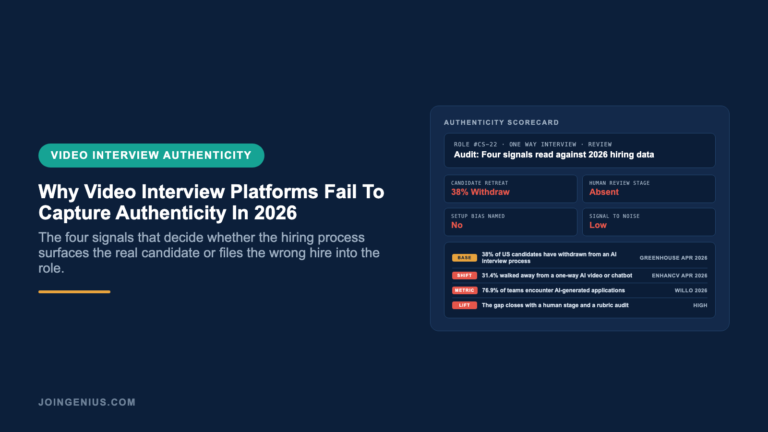
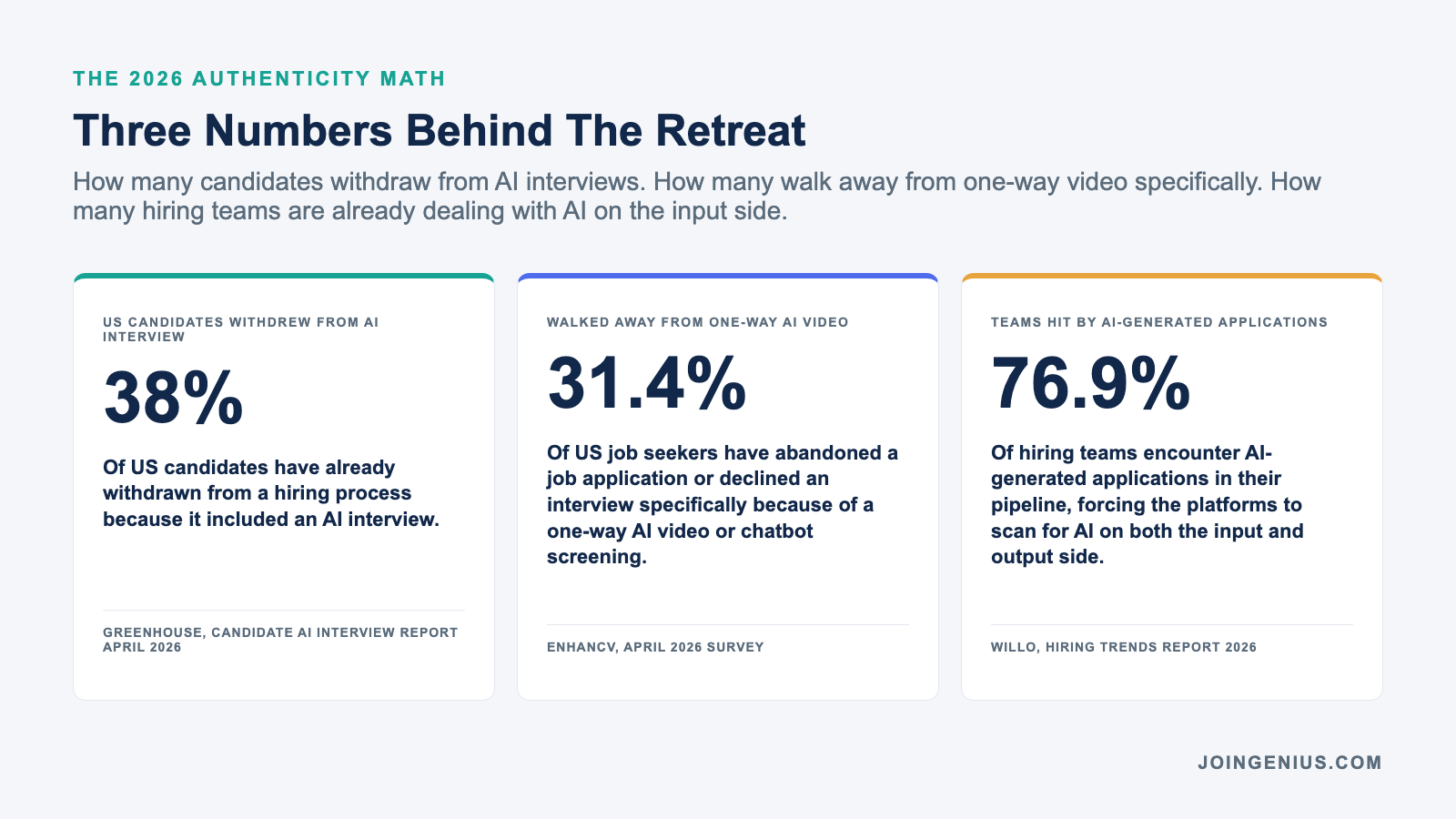
Greenhouse’s 2026 Candidate AI Interview Report, published April 2026 after a survey of 2,950 job seekers across the US and four other markets, puts a number on the break. Thirty-eight percent of US candidates have already withdrawn from a hiring process because it included an AI interview.
The read is not that the technology is useless. It is that the layer sitting between the hiring team and the candidate is filtering out the exact signal it was meant to capture. The best people are walking away from the format before the platform ever meets them.
The One-Way Format That Flattens Every Candidate To The Same Shape
The one-way asynchronous video interview is the format most platforms default to, because it scales. A candidate records answers alone while the hiring team watches later, which frees up everyone’s schedule. The cost is that the most human part of an interview, which is reading how the interviewer reacts and adjusting what you say next, is gone.
What the candidate records instead is a monologue delivered to a dot on the screen. Enhancv’s April 2026 survey of 1,066 US job seekers, conducted via Prolific, found that 31.4 percent have abandoned a job application or declined an interview specifically because of a one-way AI video or chatbot screening.
The format is also where the best virtual assistant candidates are lost first. The strongest VAs are the ones with the most context on asynchronous communication, and they are the quickest to notice when a hiring process has chosen the format that denies them their best signal.
The Timer That Turns A Thoughtful Pause Into A Red Flag
Response time limits are the second layer of the authenticity flatten. A candidate gets ninety seconds to answer a question and the clock is visible on the screen. The thoughtful pause that would have been a signal of care in a live interview becomes a visible count-up that reads as hesitation on video.
The candidate who thinks before speaking is penalized by the format. The candidate who starts talking the second the question appears is rewarded. The latter is not the better hire. They are the one more comfortable on camera, which is a different signal.
The result is that the format prices in a trait that has little to do with the job. On-camera smoothness correlates weakly with job performance in roles where thinking out loud and asking clarifying questions is the actual skill.
The Camera Angle That Is Doing Half The Hiring Decision
The camera itself is doing more of the decision than most platforms admit. A candidate with a professional headshot angle and clean studio-style lighting reads as more hireable than the identical candidate on a laptop camera lit by a window. The lens and the environment are the first scoring layer, and the platform never sees them.
This is where the authenticity gap starts compounding. A candidate who invests in a lighting kit and a decent microphone is signalling resources, not fit for the role. A candidate who did not reads as scattered, when they are only showing up with what they own.
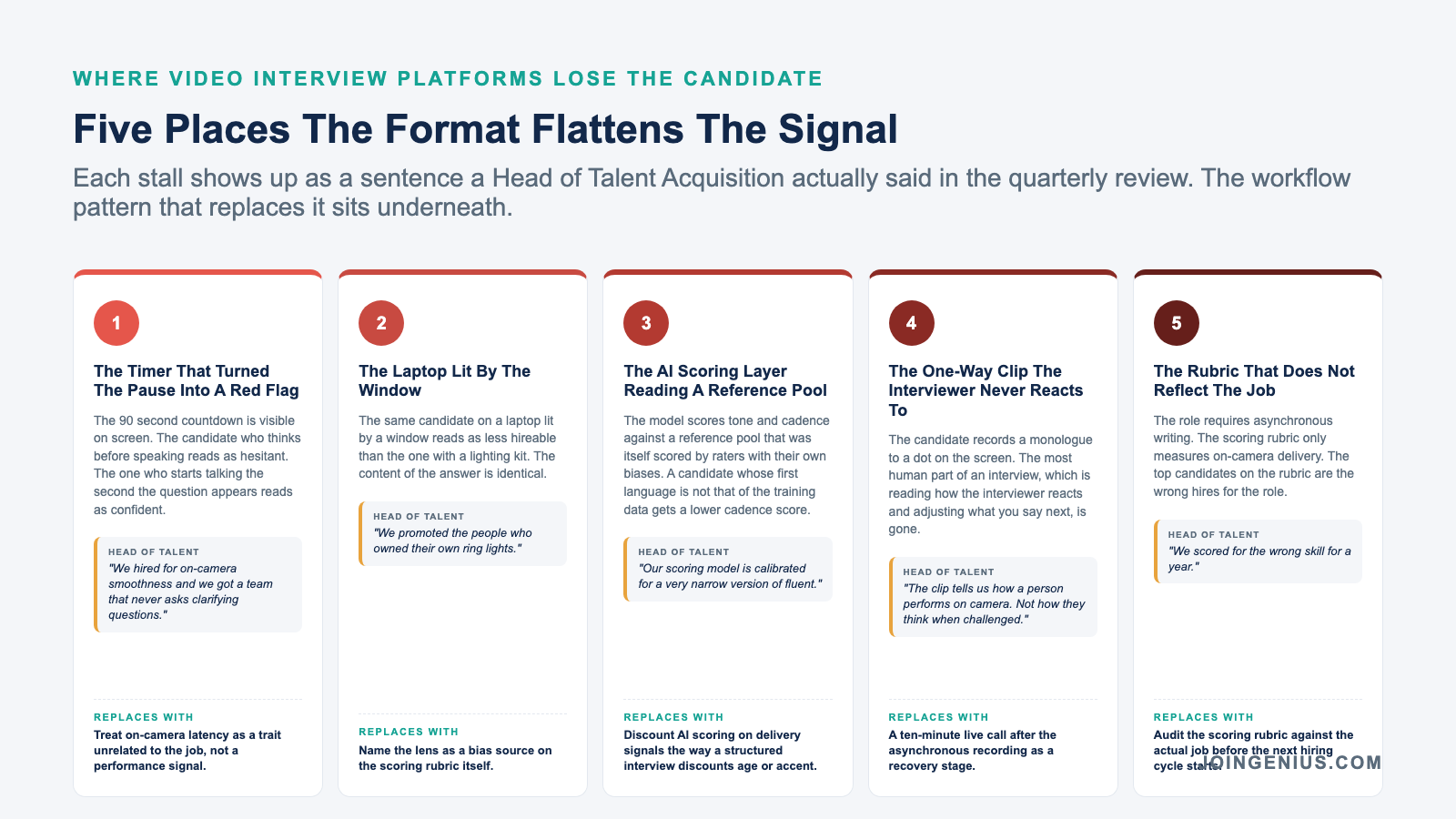
The fix is neither a longer rubric nor a better scoring model. The fix is naming the lens as a bias source on the scoring rubric itself, and discounting it the way a structured interview discounts age or accent.
The AI Scoring Layer That Reads A Script, Not A Person
The AI scoring layer on top of the video is where the authenticity claim collapses. The model scores tone and cadence against a reference pool scored by raters who had their own biases. The result is not a measure of the candidate. It is a measure of how closely the candidate matches the reference pool.
Willo’s Hiring Trends Report 2026, fielded with hiring professionals in late 2025 and published in 2026, reports that 76.9 percent of teams encounter AI-generated applications in their pipeline. The platforms now have to scan for AI on the input side while their own scoring layer is being gamed by candidates on the output side.
The scoring breaks hardest for candidates whose natural delivery sits outside the reference pool. A data entry specialist whose first language is not the one of the training data gets a lower score on cadence, even when their actual output is exactly what the role needs.
What Candidates Can Do About The Authenticity Gap
The authenticity gap is not only a platform problem. Candidates who treat the video interview as a live conversation they can wing often leave the interviewer with less signal than a prepared one does, because the platform is already filtering out nuance and dropping the body-language cues that soften an off-the-cuff moment.
The counter-move is preparation that does not harden into a memorized monologue. The goal is ready without being rehearsed, and the fastest route to that state is organizing talking points before the camera starts, so the candidate shows up focused instead of improvising under a visible timer.
Where Teleprompter.com Fits
Teleprompter.com helps candidates prepare for video interviews by organizing their talking points and letting them read a script while recording, so they stay focused, keep their flow, and communicate ideas clearly and confidently without memorizing every word. Used as a preparation aid, it supports authentic delivery on camera.
The staffing effect is not that the candidate becomes a different person on camera. It is that the real person shows up ready, which is the version of them a hiring team would want to meet in a live interview anyway.
What Hiring Teams Can Do On Their Side
The fastest fix on the hiring side is adding a human stage back to the funnel. The AI-scored clip can still be a screening layer, but it cannot be the layer that decides. A ten-minute live call after the asynchronous recording recovers most of what the format filtered out.
The second fix is naming the lens as a bias in the scoring rubric. The camera and the background shape the first impression. Lighting does the rest. Scoring them explicitly, even by asking the hiring team to score “setup quality” as a separate axis, forces the rater to disentangle setup from substance.
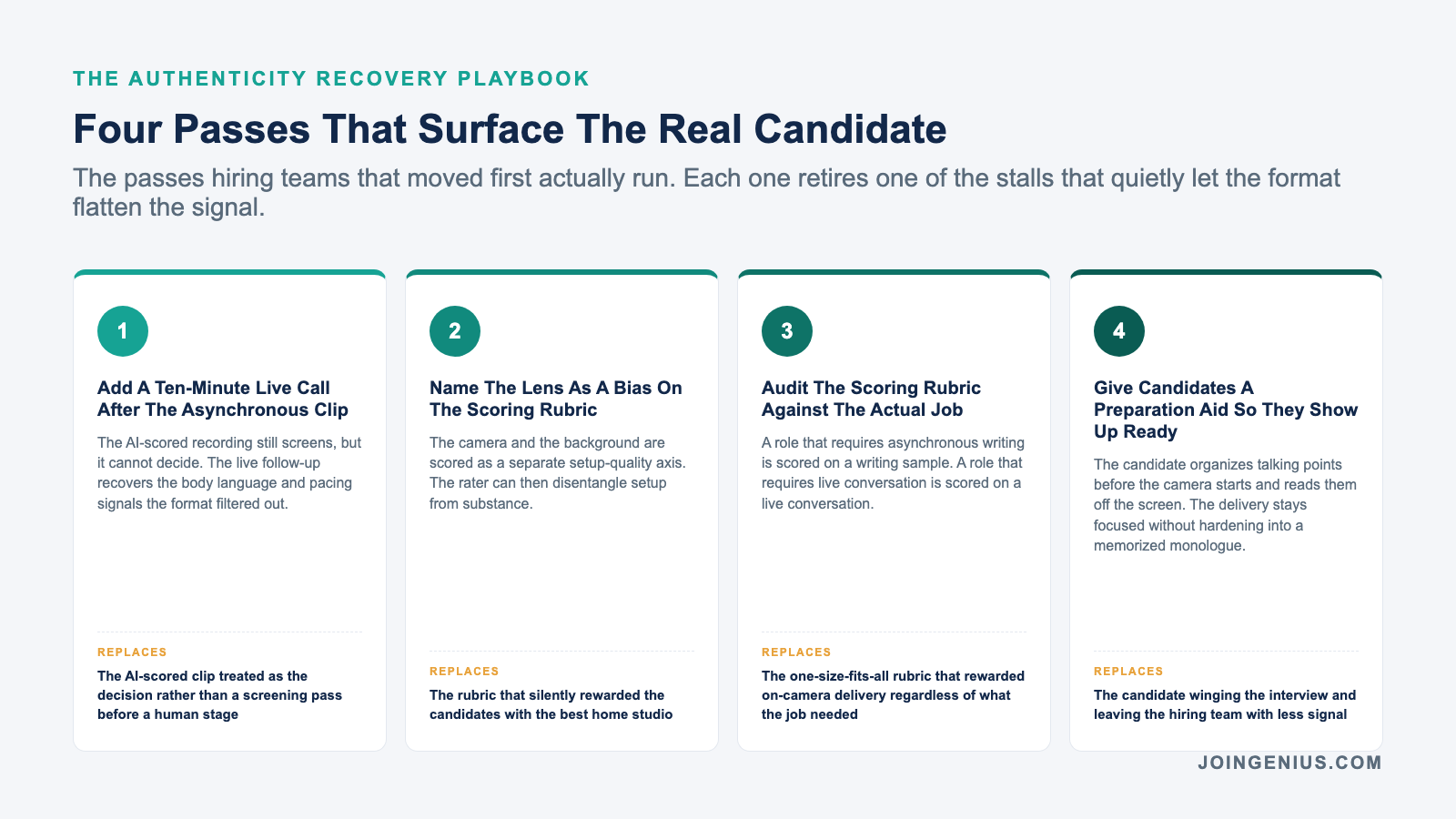
The third fix is making sure the scoring rubric reflects the job. A role that requires asynchronous written communication should be scored on a writing sample, not a recorded monologue. A role that requires live conversation should be scored on a live conversation.
A steady operations manager can own the audit of the scoring rubric against the actual job before the next hiring cycle starts.
The Interview Formats That Still Surface The Real Candidate
Some formats still surface the person. They are the ones the video interview platforms were supposed to replace. The live call with a prepared interviewer and a structured rubric remains the most reliable signal, because the interviewer can adapt to what the candidate is actually saying.
The paid work sample is the second underused format. A candidate who completes a scoped task in their own time and voice reveals more about how they think than any recorded monologue does. For roles where the output is the job, the work sample should probably come before the video interview.
The portfolio review is the third. A fifteen-minute live walkthrough of past work, with the candidate narrating decisions and the interviewer asking follow-ups, surfaces what the AI scoring layer flattens. It takes less time to run than a one-way video and returns more signal.
A thoughtful content writer on the hiring side can convert that playbook into the one-page interview guide every manager uses, which is the piece most hiring processes assume exists and often does not.
Conclusion
The authenticity gap is not going to be closed by a better scoring algorithm. It will be closed by hiring processes that use the video interview as one input instead of the decision, and by candidates who bring the preparation the format quietly demands.
A visit to Genius is the staffing side of the same move. The right hiring support on the account is the one who runs the live follow-up and builds the one-page guide the manager uses, which is what gets the real candidate through.