
Poor localization costs businesses 20% of potential revenue, and 36% of companies have already delayed or pulled back from a market because of it. Most of that damage starts before launch, when a team translates the website and then signs contracts, including agreements with local hires, that were written for another country’s courts. This post gives you the localization strategy for both tracks: what to adapt on the site, the 5 contract clauses that change by market, a 30-day plan, and the 5 metrics that show it’s working.
What a Localization Strategy Covers Before You Enter a New Market
A localization strategy is the plan for adapting your language, formats, legal terms, and cultural cues so every asset works in the market you’re entering. It runs on 2 tracks: the customer-facing assets buyers see and the legal-facing documents lawyers read.
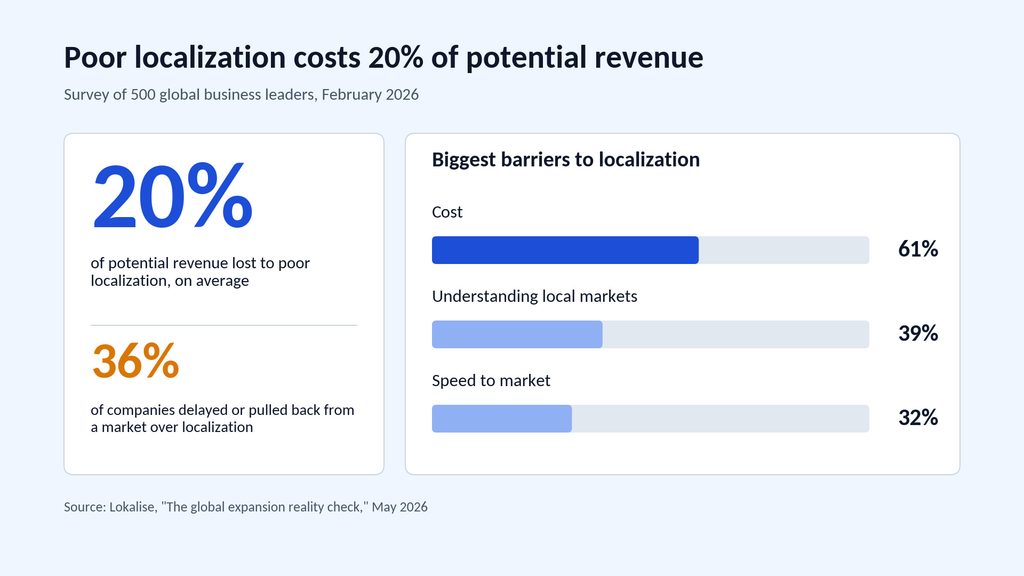
A localization strategy runs on 2 tracks, and both need sign-off before launch day.
The customer-facing track covers site copy, checkout, support and system emails, and how prices and dates display. The legal-facing track covers customer contracts, terms, the privacy policy, employment agreements, and NDAs. Most teams fund the first track and forget the second.
That gap gets expensive as international expansion speeds up. Companies entered an average of 1.1 new markets in 2025 and plan to enter 1.5 in 2026, and 42% plan to enter 2 or more. Every extra market needs both tracks done again, in a new language and under new law.
📊 By the Numbers
85% of leaders say localization matters, yet only 28% describe their own efforts as very strong.
Cost stops most teams, with 61% of leaders naming it their biggest barrier. It’s a fair worry. But skipping the contract track tends to cost more later, in redlines and renegotiation.
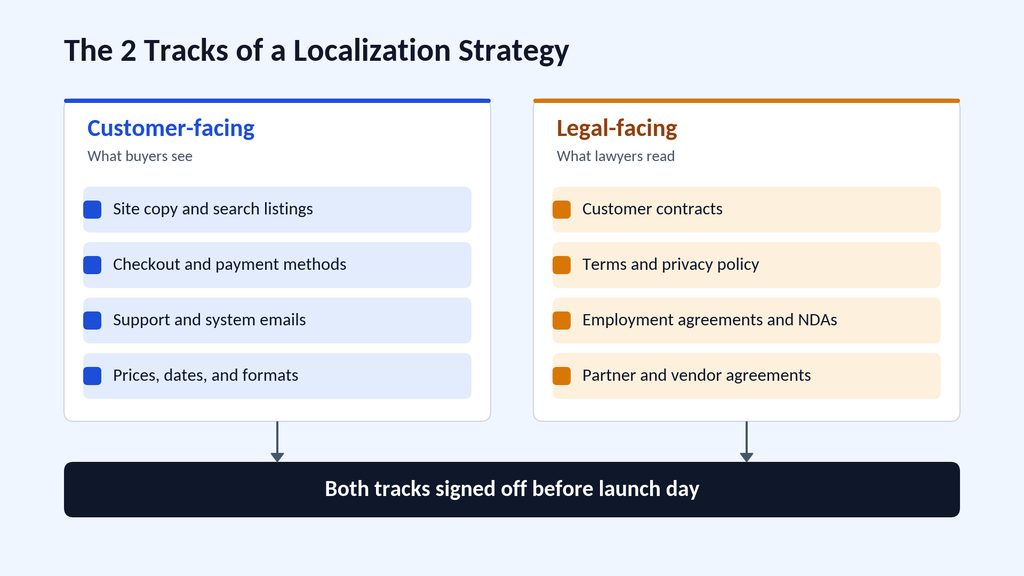
Poor localization costs businesses 20% of potential revenue on average, and cost is the top barrier at 61%. Source: Lokalise, May 2026.
Start with the customer-facing track, because that’s where translation and localization get confused most.
Localization Goes Further Than a Word-for-Word Translation
Translation moves your words into another language, and localization rebuilds the buying experience around the local market. A shopper in Germany expects 1.299,00 € instead of $1,299.00, dates written day first, and a checkout that offers SEPA and Klarna.
Date order alone causes trouble. 03/04/2026 reads as March 4 in the United States and 3 April in Germany, so a misread delivery or renewal date turns into a support ticket.
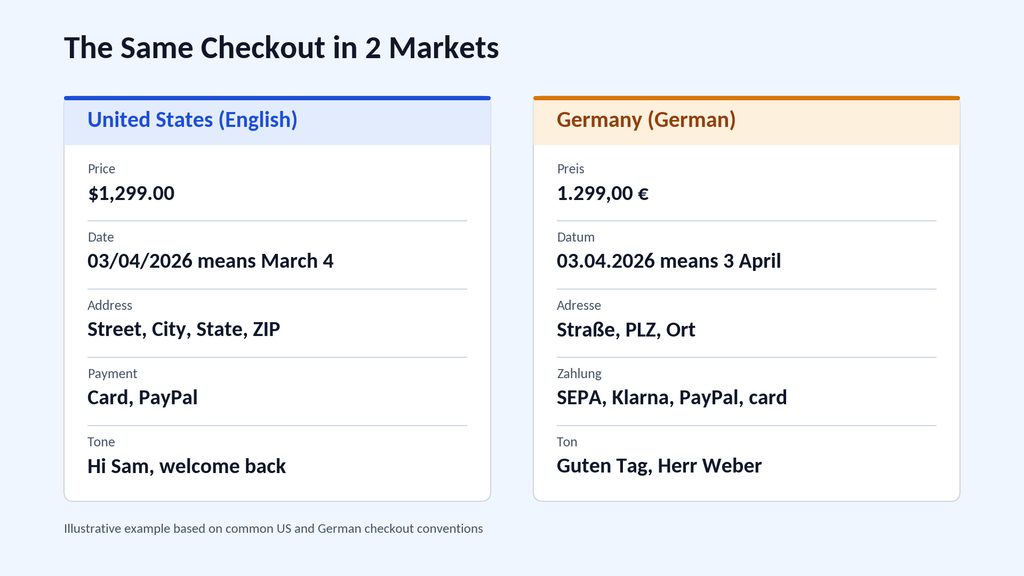
The same checkout in 2 markets differs on price format, date order, address fields, payment options, and tone. Illustrative example.
Here’s what to adapt at minimum:
- Currency, number formats, and units of measure
- Date formats, plus phone and address fields that match local habits. A required “State” box means nothing in Germany, where buyers enter a postcode (PLZ) and a city
- The payment methods buyers already trust in that market
- Register: German copy picks between Sie and du, and the wrong choice reads as tone-deaf
- Images, icons, and colors, since these carry different meaning by market
Search needs the same treatment, since a translated keyword list misses the phrases buyers in Munich type into Google. Providers of website localization services, eTranslation Services among them, cover this across 200+ languages: keyword optimization for each market, layout adjustments for translated text, and QA testing for text overflow and misalignment before launch.
Layout breaks in quieter ways too. Translated copy often runs longer than the English original, and a button label that fit before can spill over its edge or wrap into a broken line.
Here’s the test I use on any localization strategy: could a buyer finish checkout without reading a word of English? If the answer is no, the market isn’t ready.
This table shows where the 2 approaches part ways.
| Factor | Translation | Localization |
| Scope | Words on the page | Words, formats, layout, payments, and legal terms |
| Search | Translated keywords | Keywords researched in the local market |
| Reviewer | Translator | Native reviewer for the full buying path |
| Typical failure | Awkward phrasing | Broken checkout, wrong date, unusable form |
| Fixing it after launch | Edit the copy | Rebuild pages, forms, and templates |
⚠️ Common Mistake
Teams machine-translate the page copy and leave English baked into images, error messages, and confirmation emails. Buyers hit that English at the exact moment they decide to pay. Add every image, error state, and system email to your inventory in week 1.
Contracts follow the same logic, and the stakes are higher.
5 Contract Clauses Your Localization Strategy Needs Before You Sign in a New Market
Contract localization starts from 1 fact: a contract translated word for word can still fail in the new market’s courts. Local judges often work from the local-language text under local law, and meaning shifts in the move. These 5 clauses are where it shifts most.
1. State the Governing Law and the Court Separately So Neither Gets Left to Chance
Write both into the contract explicitly. Governing law tells you which country’s rules apply, and jurisdiction tells you which country’s courts hear the case.
Leaving either one open to interpretation is a risk. Ask local counsel which combination holds up where you’d need to enforce the agreement.
2. Name a Prevailing Language Before One Word Decides the Case
Name which language version controls if the versions ever disagree. Without a prevailing language clause, each version becomes evidence for a different reading, and in Vietnam, courts will usually apply the Vietnamese version unless the contract says otherwise.
One dispute shows how much a single word can carry. In Marine Pro Dock Systems v. Polietilen Mamulleri, a Florida company and a Turkish company argued over the word “execution” in the English version of a forum clause sending disputes “in the execution of this Agreement” to the courts of Izmir.
The Florida company said execution meant signing. The Turkish original used uygulamasinda, closer to “in practice,” and a prevailing language clause gave the Turkish text priority.
3. Define Terms That Have No Local Equivalent Before They Reach a Judge
Certain English legal terms have no exact Vietnamese equivalent, and misused technical terms can lead to disputes. Liability and consequential damages are the usual suspects.
Build a 1-page glossary of your 10 to 15 defined terms, then have a legal translator and local counsel agree on the local term for each one.
💡 Pro Tip
Send counsel the glossary before the contract, not with it. Agreeing on 12 terms takes 1 review, and reopening a signed clause means renegotiating with the other side.
4. Add the Clauses Local Law Requires and Your Template Skips
Templates built for your home market leave out clauses that another country requires by law. Consumer rights, data protection language, and notice periods top that list.
Laws change over time, so build a regular review into your process. Ask counsel for a gap list: every mandatory clause your template lacks.
5. Localize Employment Agreements and NDAs Before the First Local Hire Starts
Labor law differs by country, and a home-market template can conflict with it. Teams that don’t want to set up a local entity often use an employer of record, which employs the worker under local law and handles the local employment contract.
Use this table as the checklist you hand to local counsel.
| Clause | Reviewed by | Done when |
| Governing law and jurisdiction | Local counsel | Both are stated in writing |
| Prevailing language | Legal translator and local counsel | 1 version is named as controlling |
| Defined terms | Legal translator and local counsel | A 1-page glossary is approved |
| Mandatory local clauses | Local counsel | The gap list is closed |
| Employment agreements and NDAs | Local counsel or an employer of record | A local template is signed off |
This is general information, not legal advice, so have local counsel review anything you sign. With the clause list settled, the rest is sequencing.
Your 30-Day Localization Strategy for Launching in a New Market
4 weeks covers both tracks of a localization strategy if you limit the scope to your 10 highest-traffic pages and your core contract set. Each week below has an action, a benchmark for done, and the trap that most often derails it.
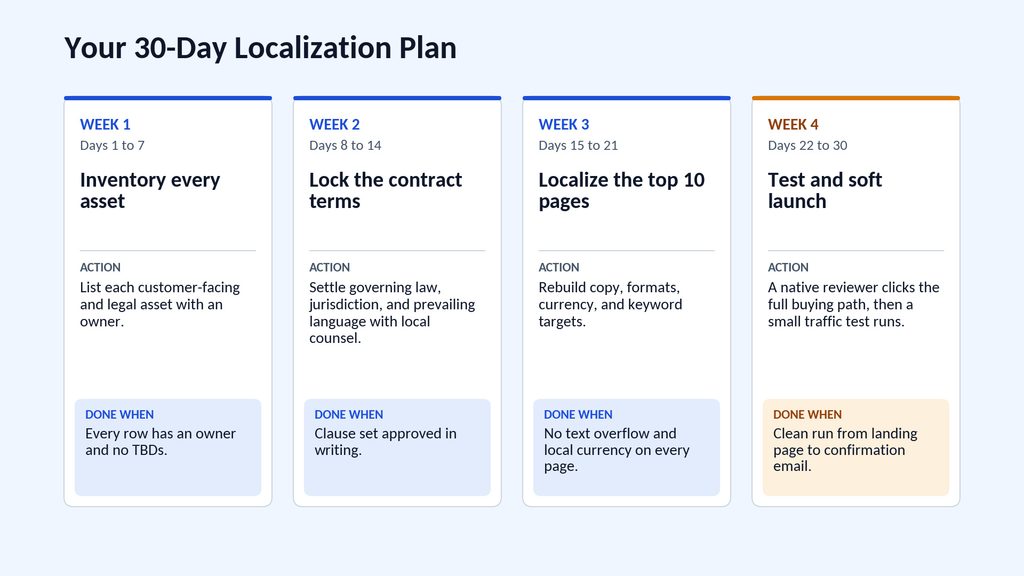
A 30-day localization plan gives each week 1 action and 1 benchmark for done.
Week 1: Inventory Every Asset and Give Each One an Owner
List every customer-facing and legal asset in 1 sheet with an owner beside each row: site pages, images, checkout steps, error messages, system emails, contract templates, and the privacy policy.
Benchmark for week 1: every row has an owner and no TBDs.
Common trap: skipping error messages and system emails, which buyers read at the worst moment.
Week 2: Lock the Contract Terms Before You Touch the Website
Send your templates to local counsel and settle governing law, jurisdiction, and prevailing language first. Then agree on the glossary of defined terms.
Benchmark for week 2: the clause set is approved in writing.
Common trap: sending contracts through machine translation and calling it done. A legal translator drafts, and local counsel reviews.
Week 3: Localize the 10 Pages That Carry the Revenue
Rebuild copy, currency, date formats, and address fields for your 10 highest-traffic pages. Run keyword research in the target market instead of translating your English list, then adjust layouts wherever translated copy overflows.
Benchmark for week 3: local currency and formats on every page, with no text overflow.
Common trap: leaving URLs, title tags, and meta descriptions in English.
📌 Key Takeaway
Contracts go ahead of pages in this plan on purpose. You can patch a page on a Tuesday afternoon, but you can’t patch a signed clause.
Week 4: Test With a Native Reviewer and Soft Launch to a Small Audience
Have a native reviewer click through the full buying path, from landing page to confirmation email. Then send 5 to 10% of traffic to the localized version for the first week.
Benchmark for week 4: a clean run from landing page to confirmation email, plus a signed-off checklist.
Common trap: sending full traffic before the reviewer finishes. Any fix after that point happens in front of paying customers.
Once the site is live, the numbers tell you what to fix next.
5 Metrics That Show Your Localization Strategy Is Working
Track these 5 metrics per market and compare each one against your home-market baseline. Together they cover the site, search, support, and contracts.
1. Conversion Rate by Market Shows Whether Buyers Trust the Page
Compare each market’s conversion rate to your English baseline every week. A localized page that converts at half the baseline points to a checkout, payment, or trust problem.
2. Bounce Rate on Localized Pages Flags Broken Layouts Early
A spike on 1 page usually means overflow, a wrong format, or copy that misses local phrasing. Check that page on a phone first.
3. Rankings for Local Keywords Prove the Search Work Paid Off
Track impressions and positions for the keywords you researched in week 3. Search moves slower than conversion, so review monthly.
4. Support Tickets About Language or Format Show What Testing Missed
Tag every ticket about a date, price, address, or confusing phrase. A falling tag count after launch says the fixes landed.
5. Contract Cycle Time and Redlines Show Whether Your Templates Fit
Track the days from first draft to signature and the redlines per agreement in the new market. Both should fall by the 2nd or 3rd deal as the local template settles.
Why a Localization Strategy Built Before Launch Beats Fixing It After
A localization strategy that covers both the site and the contracts protects the revenue that poor localization takes. Set the clause list with local counsel first, then localize the pages buyers see. The same groundwork applies when you staff offshore teams, where contracts, NDAs, and cultural setup carry the same weight.