Creators shipping video today sit on a privacy problem most teams still treat as a checkbox. Video consent is not a signed PDF filed in a folder. It is a running record of what you captured and from whom, and regulators are now asking for the receipts across both marketing and hiring workflows.
This guide is for marketing ops teams and hiring teams, plus solo creators actually clicking record. We cover what consent must prove in 2026 and the minimum capture flow that holds up under audit. We also cover where the risk hides in your current platform choice and the retention rules protecting you after the clip is published.
Why Video Consent Is Harder Than Written Consent In 2026
Video consent operates in different legal territory from a written form because the clip itself carries identifying features. Regulators treat it differently, and enforcement data over the last 18 months confirms that view.
Biometric Data Keeps Pulling Video Into Stricter Rules
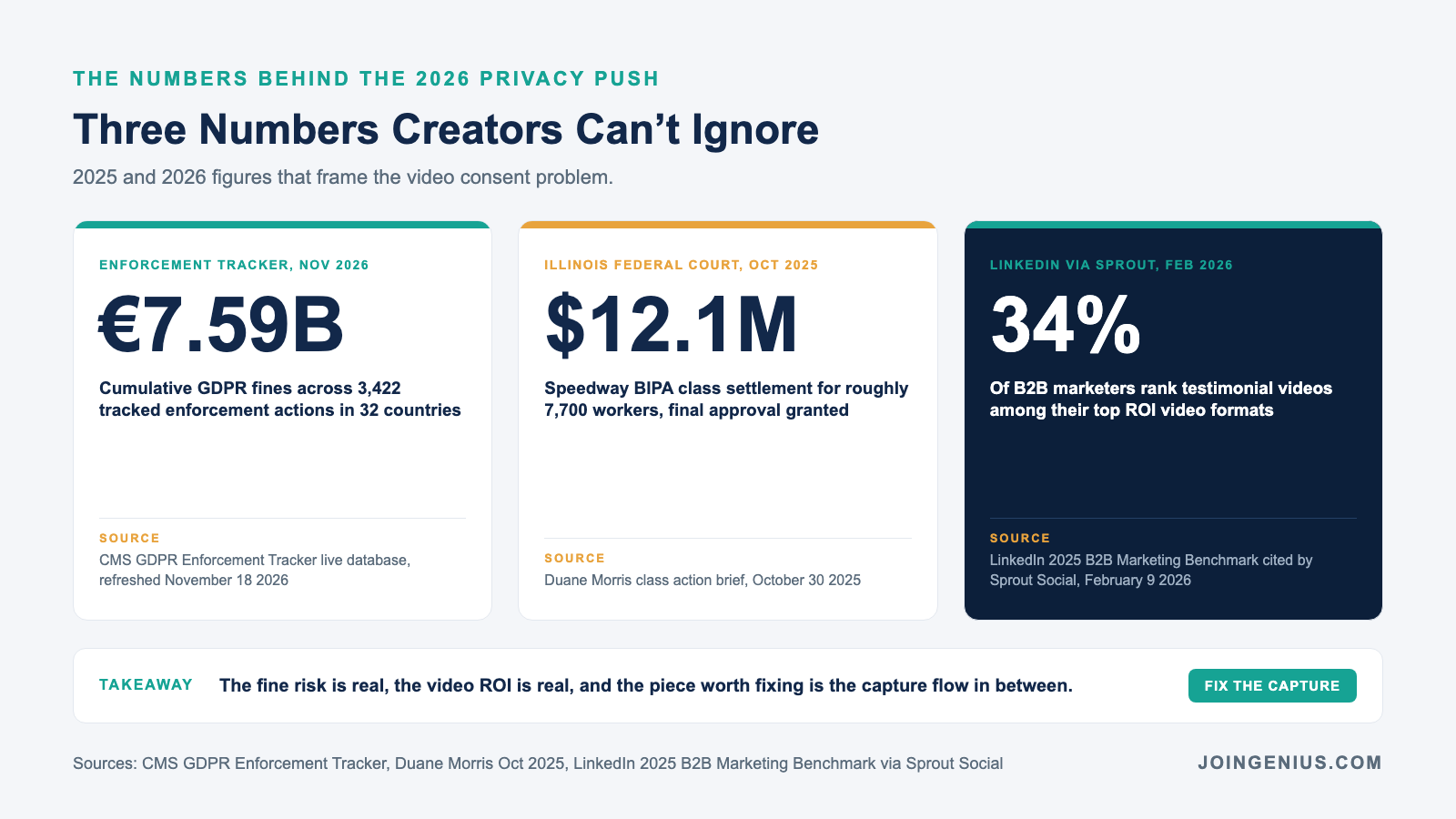
Face and voice patterns in a clip are treated as biometric data under GDPR and most US state privacy laws, which raises the consent bar above a general marketing release. The CMS GDPR Enforcement Tracker listed €7.59 billion in cumulative fines across 3,422 actions as of November 2026.
Illinois BIPA cases show the US side of the same risk. A $12.1 million Speedway settlement cleared a federal court in October 2025 over fingerprint scans tied to 7,700 workers, and video with identifiable faces falls under the same statute.
Video consent carries this risk by default because any usable clip shows a face. There is no low-risk version of marketing video that avoids the biometric classification.
The GDPR And US State Patchwork Overlap Problem
A single video asset can trigger GDPR when an EU subject appears in scope. The same clip can also trigger CCPA or CPRA for California residents and Illinois BIPA for biometric identifiers. Each regime wants its own disclosure wording, so a one-line release form built for 2020 marketing videos is almost always under-spec for 2026.
The practical result is that most 2026 release forms carry a short core plus modular paragraphs that toggle on by subject location. Teams that still work from a single template without conditional sections are the ones most likely to find a surprise in audit.
The Minimum Consent Flow Every Creator Needs
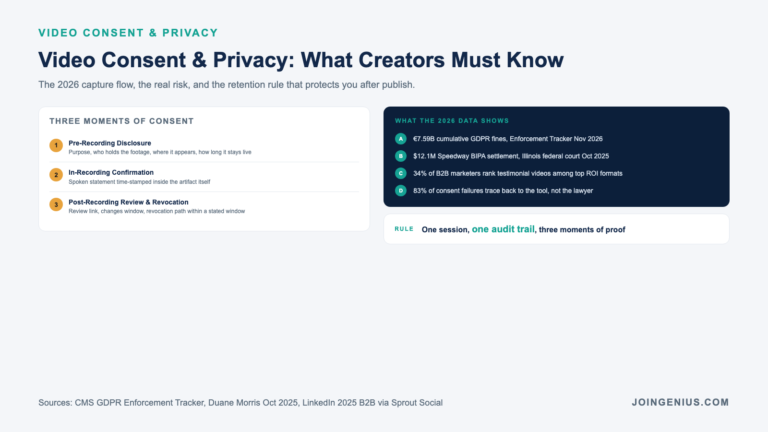
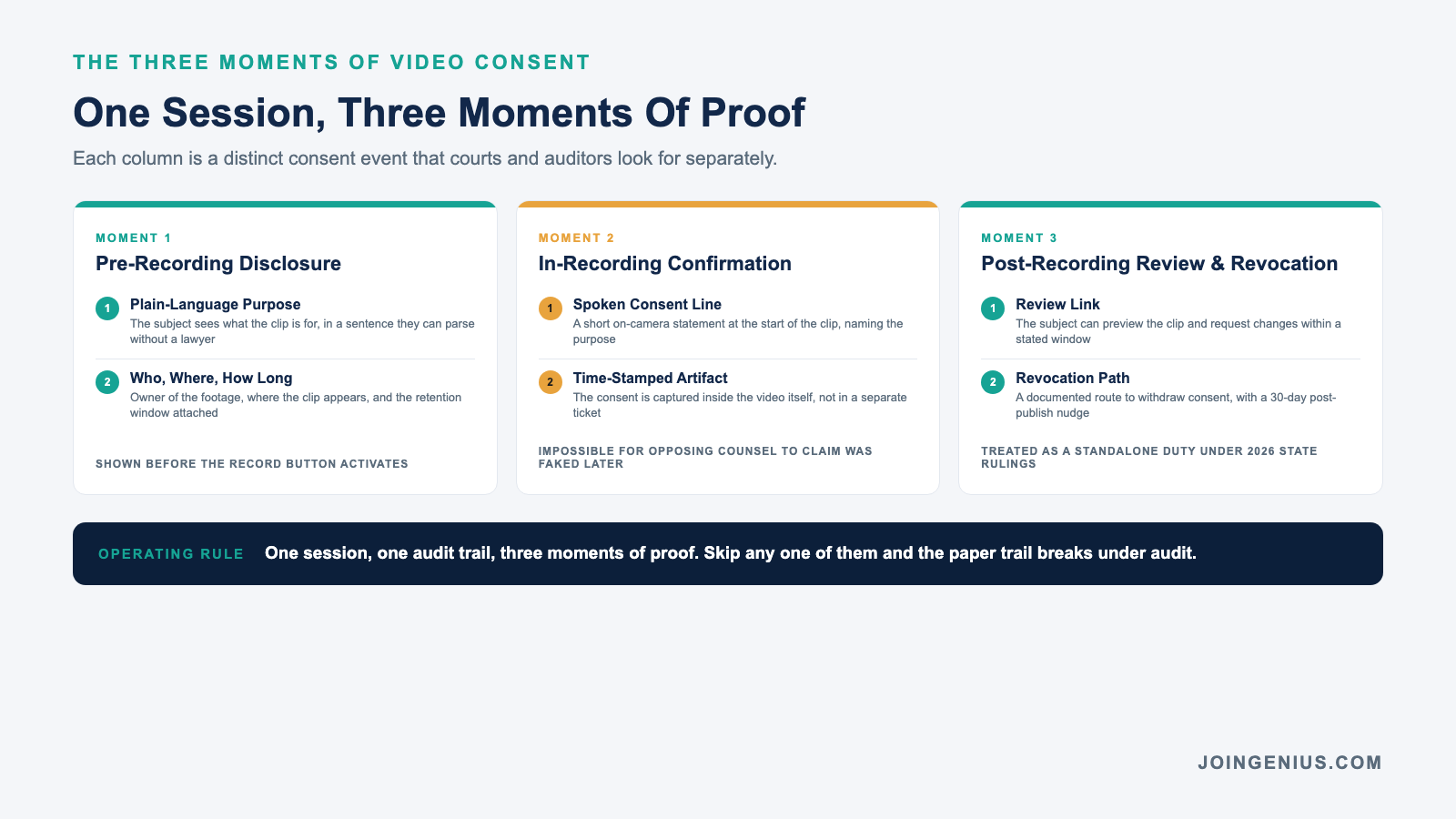
A defensible video consent flow has three distinct moments, not one. Each moment collects a different proof element, and skipping any one of them is where most litigated cases trace back to.
Pre-Recording Disclosure
Before the camera starts, the subject needs to see what will be captured and what you will do with it. That means plain-language purpose and who holds the footage.
The subject also needs to see where the clip appears and how long it stays live. A short on-screen summary before the record button outperforms a legal modal most people dismiss.
In-Recording Confirmation
The recording itself should carry the consent proof, not a separate ticket. A spoken statement at the start of the clip (“I agree to the capture and use of this video for [purpose]”) time-stamps the consent inside the artifact, which is the one piece an opposing counsel cannot claim was fabricated later.
Post-Recording Review And Revocation
Give the subject a link to review the clip and request changes, plus a path to revoke within a stated window. Revocation is where state privacy laws pull ahead of GDPR in 2026, since several California and Illinois rulings now treat a missing revocation path as a standalone violation separate from the original collection.
Automated reminders tie this together. Most teams in 2026 run a 30-day post-publish nudge that lets the subject confirm the clip still matches their expectations, since agreeing at capture does not count as agreeing forever under GDPR Article 7.
Platform Risk: Where Marketers Still Trip Up
Most consent failures start with the tool you shipped video from, not the lawyer you asked afterward. The 2026 risk profile splits by whether you own the capture layer or the upload layer.
Direct Uploads To Social Platforms
A subject who sends you a clip through Instagram DM or TikTok has not given you video consent in a legally durable form. The platform owns the transmission record, not you, and either side can lose the proof when an account is deleted or restricted.
This hits hiring teams hard. Candidates emailing video answers to a recruiter through consumer tools leave the hiring team holding biometric data with no audit trail, which is why structured AI in hiring tools now record consent events separately from the video itself.
The cheapest fix is to standardize on a single capture path that logs consent events server-side. Email attachments and DM screen recordings each make the team re-litigate consent provenance in a 2026 complaint, since neither channel keeps a durable audit trail.
Hosted Video Players And Embed Code
A hosted player that drops a third-party cookie before playback runs into the same ePrivacy consent rules as any ad pixel. Vimeo and YouTube embeds both ship third-party trackers by default in 2026, so creators serving EU traffic need either the “nocookie” variant or a consent manager that holds playback until the viewer accepts.
Self-hosted players or privacy-first alternatives like Cloudflare Stream remove the embed-cookie problem, though they add a configuration step. The Sprout Social report citing LinkedIn’s 2025 B2B benchmark found that 34% of B2B marketers rank testimonial videos among their top ROI formats, which is why the hosting decision now affects budget plans that most legal teams underestimate.
Building A Compliance-Minded Video Capture Workflow
The capture layer is where consent evidence is either built in or lost. Two decisions matter most: where the recorder runs, and how retention is enforced after the clip is published.
Capture Consent At The Record Button
The cleanest video consent pattern is to record the consent prompt and the subject’s confirmation alongside the video in a single session on the same server. Builders typically wire this up through a video recording platform that writes consent markers and video chunks to the same storage, so the audit trail stays attached when the asset is exported.
The alternative pattern, running separate capture and separate consent forms with their own storage, works but demands that your audit log reconciler never desync. Most teams underestimate the operational cost of keeping three systems aligned under rolling retention rules, which is why 2026 Data Processing Impact Assessments increasingly reward the single-session design.
Retention Windows That Protect You
Short retention is a privacy best practice and a business one. The GDPR’s storage limitation principle plus the aggressive scope of Illinois BIPA mean any video kept past its stated purpose becomes evidence against you in a complaint.
A rolling 90-day window for raw captures and a 24-month cap for published clips is the pattern most 2026 processor contracts expect.
The 24-month ceiling matches what most Data Processing Agreements now require, and the consent proof itself should persist at least that long since claims can be filed after the published clip has been taken down.
Here is how the three most-cited regimes compare on the specific points that matter for a defensible consent flow.
| Rule | GDPR (EU) | CCPA or CPRA (California) | BIPA (Illinois) |
|---|---|---|---|
| Written consent required | Yes, before capture | Notice at or before capture | Yes, written release |
| Covers biometric features | Yes, under Article 9 | Yes, under CPRA | Yes, named statute |
| Revocation path mandatory | Yes, any time | Yes, any time | Case law trending yes |
| Max statutory exposure | 4% of global revenue | $7,500 per intentional violation | $1,000 to $5,000 per scan |
The Creator Checklist For 2026
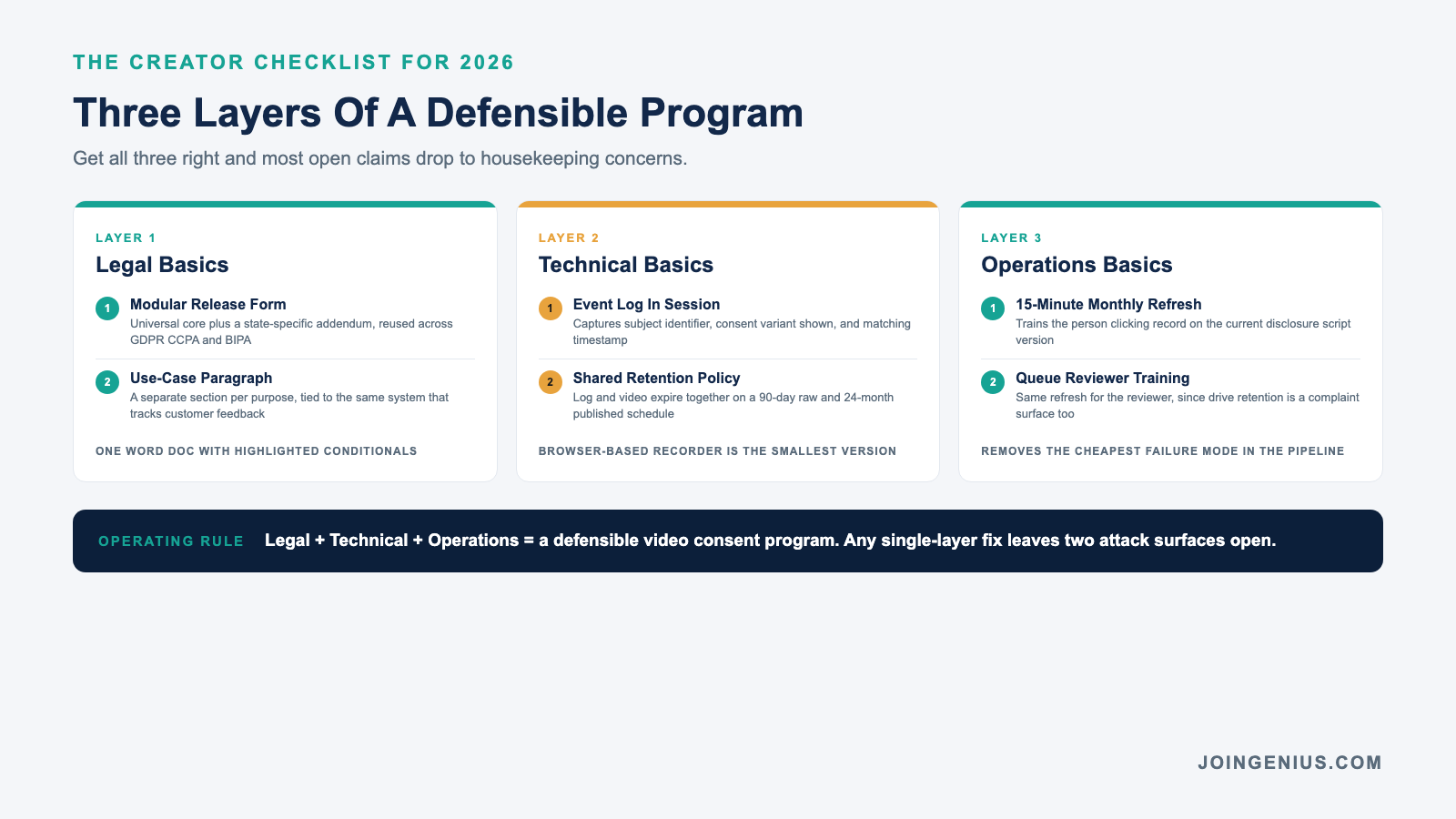
Pulling the full picture together, the 2026 checklist has three layers. Get all three right and most of the open claims against video creators drop to housekeeping concerns.
Here is the shortlist in order:
- Legal: a modular, state-aware release form
- Technical: event logging in the same session as the recorder
- Operations: trained reviewers and a 15-minute monthly refresh
Legal Basics
Write a video-specific release that names the capture and the stated use, plus the retention window attached to it. For customer testimonials, tie this release into the same system that tracks customer sentiment tracking so the consent and the feedback appear together in one audited record.
A modular form has a universal core and a state-specific addendum. A use-case paragraph slots in at the end as a third section. Writing this as one Word doc with highlighted conditional blocks is cheaper than running three separate PDFs, and it survives a quarterly legal review better.
Technical Basics
The record flow should write an event log that captures the subject identifier and the consent variant shown. The same log should write the timestamp as a third field. A browser-based recorder that captures video and consent events in the same session is the smallest version of this that holds up in a 2026 DPIA.
Keep the log and the video in the same retention policy. Separating them is the mistake that lets a complaint point to a surviving log row for a deleted video (or vice versa), and that mismatch is the easiest signal for an auditor to find.
Operations Basics
Train the person clicking record. Most 2026 class-action complaints trace back to a staffer or a hired virtual assistant who skipped the disclosure script and captured the clip anyway. A 15-minute monthly refresh with the current script version removes the cheapest failure mode in the whole pipeline.
The person reviewing the queue needs the same training, not just the one clicking record. A recorded clip that stays in the publishing team’s drive for three months without revocation handling creates the same statutory exposure as a missed disclosure at capture.
Where Video Consent Programs Go From Here
Video consent in 2026 is an engineering problem dressed up as a legal one. Written releases still matter, but what holds up under audit is a capture flow that produces time-stamped events inside the video. Treat the record button as a consent checkpoint and the retention window as a product requirement.
At Genius, we place top 1% Philippines and LATAM talent for the video ops layer behind this. Our placements run the review queue and the consent audit log at roughly 80% less than a local hire, with no monthly subscription and a 6-month talent guarantee if the fit is wrong. Start at joingenius.com.