
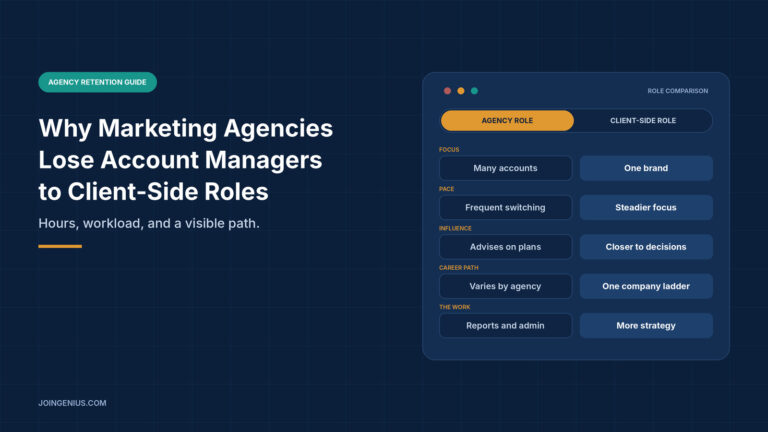
Every agency leader knows the moment. A strong account manager asks for a quiet word, and a few minutes later you learn they are joining a client, or a company much like one. The relationship you built together goes with them, and so does the context nobody wrote down.
This guide covers why account managers make that move, where their hours actually go, and what an agency can change. Most of the advice costs time and attention rather than money, and none of it depends on a single fix. Agencies that keep their account managers usually do a few ordinary things well: they spread the load fairly, they protect client time, and they make the next step on the ladder visible. For the first of those, the principles in these employee retention strategies apply to an agency team as much as to any other.
Why Account Managers Move Client-Side
The pull toward a client-side role is rarely about one thing. It is a set of small contrasts that add up over a few years of agency life.
An account manager at an agency may serve many brands in a single week, so a Monday can mean three different industries, three sets of platforms and three sets of expectations. On the client side, the same person goes deep on one brand. They learn the product, the customers and the internal politics, and they get to see a plan through to its result instead of handing it on.
Influence is part of it too. Inside a client company, the marketing lead sits closer to budgets and decisions. Career paths tend to be easier to see, because there is one ladder in one company. Pay sometimes plays a part, but it is rarely the only reason, and it is the one agencies most often assume is the whole story.
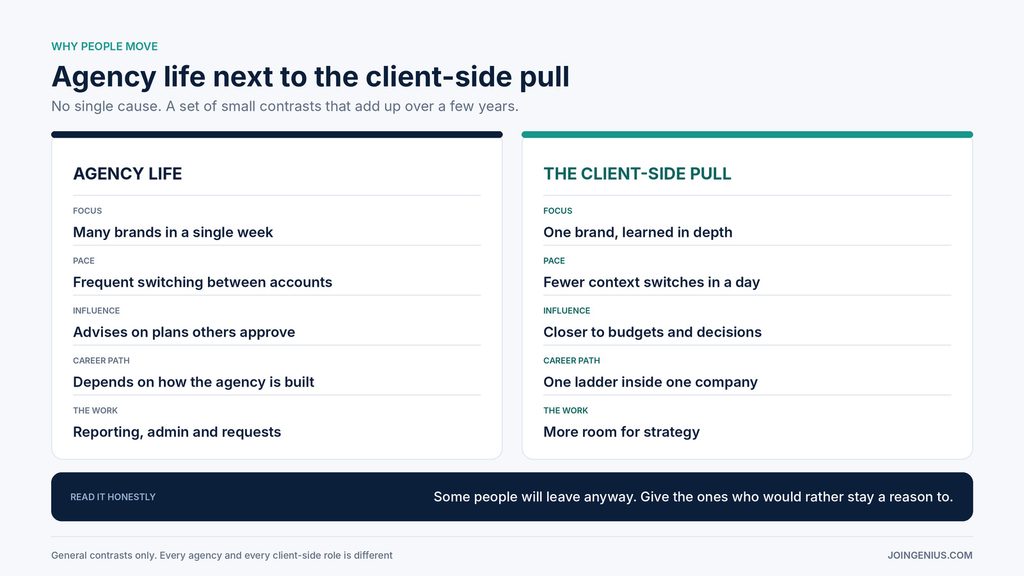
None of this means every account manager who leaves was lost through neglect. Some will want a different kind of job, and that is fine. The aim is to make sure the ones who would rather stay have good reasons to.
Where the Hours Actually Go
Before changing anything, find out how your account managers spend their week. Most leaders guess, and the guess is usually kinder than the truth.
Ask one or two account managers to log their time for a single week in half-hour blocks. Keep the buckets simple:
- Client communication: calls, emails and messages with the client.
- Strategy: planning, analysis and ideas for the account.
- Reporting: pulling data, building and sending reports.
- Admin: invoices, tickets, timesheets and status updates.
- Internal meetings: standups, reviews and anything that is not client-facing.
Then compare the log with what the person says they want to do more of. Most account managers want more client communication and more strategy. If reporting and admin take the larger share of the week, you have found the first thing to fix, and you have a baseline to measure the fix against.

Do this audit with the person, not to them. It works best when the account manager sees it as a way to get rid of dull work, not as a check on their output.
Manual Reporting Eats the Hours Account Managers Want to Spend on Clients
Reporting is one of the quietest time sinks in an account manager’s week. Pulling numbers from several platforms, pasting them into a template, checking the formatting and sending the file can take hours, and the work tends to land at month-end, when clients also want attention. Those are hours that could have gone to a client call, a strategy session or a conversation about next quarter.
Automated marketing reports are one way to give some of that time back. Two Minute Reports describes reusable reports with your own logo and layout, delivery as Excel or PDF, emailed updates from Google Sheets, scheduled sends from hourly to monthly, delivery of dozens of client reports in one click, and alerts when a scheduled automation fails. Those are the vendor’s descriptions, so test them on two or three of your own accounts before you roll anything out.
Automation has limits, and it helps to decide them up front. The mechanical steps are good candidates: data pulls, formatting and branding, scheduling, delivery and failure alerts. The human steps are not: the story behind the numbers, the recommendation, the explanation of an odd result and the client call itself. A report that arrives on time with no explanation is not better service. Clients value the person who tells them what the numbers mean and what to do next, and that part should stay with your account manager.

Treat the rollout with the same discipline you would use for any AI process automation. Pick one early target, such as the monthly report for a single client. Record how long it takes by hand first, so you have something to compare against. Review the result after 90 days. If the saved hours do not show up in your time audit, adjust the setup before adding more tools.
Give the Reclaimed Hours Back to Clients
Saved time disappears quickly if nobody protects it. Without a plan, the hours freed by automation get absorbed by more admin, more meetings or one more account. Decide in advance where they go.
Three changes help most:
- Protect weekly client time. Put a recurring block on each account manager’s calendar for proactive client work, and treat it like a client meeting. If it is the first thing to be moved, it will not survive.
- Move from reactive to proactive. Reactive work answers the client’s last message. Proactive work brings the client something they did not ask for: an idea, a test to run, a risk spotted early. Ask each account manager to bring one new idea to each client every month.
- Cap accounts per person. There is no right number for every agency, because it depends on account size and complexity. Pick one, say it out loud and review it when the team changes.
Clients notice the shift quickly. A client who hears from their account manager before something goes wrong is far less likely to start asking about alternatives.
Build a Visible Career Path
Many account managers leave because they cannot see what comes next. A client-side job offers a title, a scope and a clear next step. An agency can offer the same, but only if it writes it down.
Start by defining the next level for the role. Describe what an account manager does today, what a senior or lead does differently and what evidence would show someone is ready. Add a second route for people who would rather go deeper than manage: a strategy track or a specialist track. Share the criteria with the whole team, so nobody has to ask.
Then ask the people involved. A short stay conversation, held while the person is happy, tells you more than an exit interview ever will. These stay interview questions are a good starting point. Three that work well for account managers:
- What do you look forward to most in your week, and what do you dread?
- What would make you consider a client-side role?
- If you could remove one task from your week, what would it be?
If the answer to the last question is “the monthly reports,” you already know where to begin.
Warning Signs You Are About to Lose an Account Manager, and What to Do About Each
Most departures show signs well before the resignation. One sign is a prompt to fix one thing. Several at once mean it is time to act this month.

Take the Next Step
You do not need a full retention program to start. Run the one-week time audit with your most stretched account manager. Look at where the hours go, and pick the single biggest drain on client time. If it is reporting, test one automated report on one account and compare it with your baseline after 90 days.
Then write down the next level for the role, and hold one stay conversation this month. Account managers who can see their hours going to clients, and a path ahead of them, have far fewer reasons to look at the other side of the table.