The portfolio is usually the first filter in any 3D hiring process. A candidate sends a link, someone scrolls through a handful of renders, and a yes or no follows within a minute. It feels efficient. It also screens out a lot of people who could do the job well.
Strong artists often cannot show their best work because it sits under a studio NDA. Newer artists have not had time to build a gallery. And a polished render says little about whether the files behind it will work in your engine, hit your polygon budget or hold up under animation.
This guide covers where portfolio screening goes wrong, how to define what you actually need, how to read an artist’s track record, and how to replace the portfolio gate with a small paid test.
Where Portfolio Screening Goes Wrong
A portfolio is a curated highlight reel, and that creates four problems for anyone hiring from it.
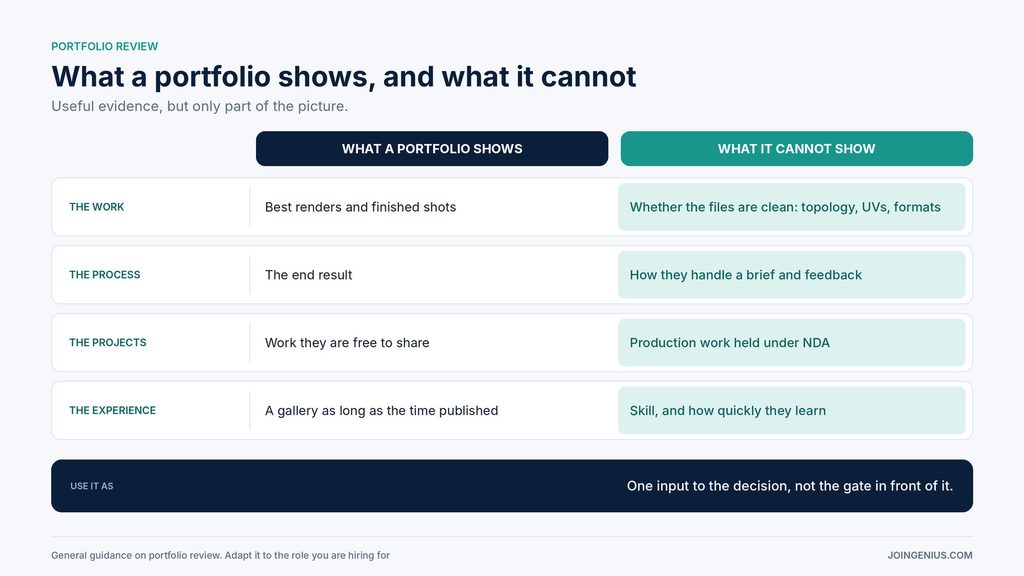
- The image is not the asset. A render can hide messy topology, poor UV layouts or heavy post-processing. What you receive and pay for is the model, not the picture.
- The best work is often hidden. Artists at studios and agencies are commonly bound by NDAs, so their strongest production work cannot be shown. What they can show may be older, smaller or unrepresentative.
- New artists look weak next to veterans. A short gallery tells you how long someone has been publishing. It says nothing about skill or how fast they learn.
- Reviewers see what they expect. A quick scroll rewards familiar styles and familiar names. Our guide to interviewer bias shows how first impressions skew screening, and a portfolio skim is a first impression.
The cost of a narrow gate adds up. You draw from a smaller pool, your shortlist looks the same every time, and the roles take longer to fill because good candidates never reach the interview stage. Teams that rely only on portfolios also tend to hire for style first and delivery second, then wonder why the files need rework.
None of this means portfolios are useless. It means a portfolio should be one input to the decision and not the gate in front of it.
Define the Production Skills Before You Look
Most portfolio gatekeeping happens because nobody wrote down what “good” means for the role. Before you review anyone, put together a short brief that covers:
- The software and engine you use, and the file formats you need, such as FBX or GLB
- The asset type: hard-surface props, characters, environments or scans
- Technical limits: polygon budget, texture resolution and any rigging requirements
- Delivery needs: naming conventions, levels of detail and handoff format
- Timeline, and how many assets you need per month
Split the list into must-haves and nice-to-haves. Clean topology and the right file formats are usually must-haves. A particular art style or a second software package often is not. When everything is a must-have, the portfolio becomes the only way to choose, because no candidate matches every line.
A brief like this turns “do I like the style?” into “can this person deliver what we need?” It also gives you a fair basis for a test later. If you are hiring across several creative roles, our guide to hiring a motion graphics designer covers a related creative role.
Read an Artist’s Track Record, Not Just Portfolio Polish
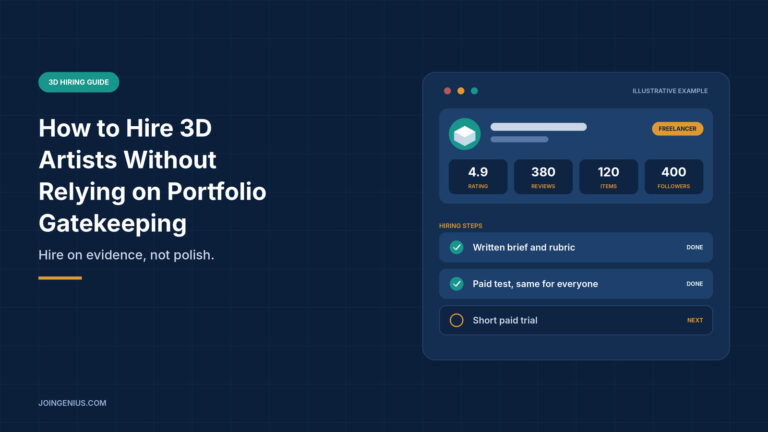
Marketplaces that sell 3D assets show something a portfolio cannot: how an artist’s work has been received by many real buyers over time. RenderHub’s list of top 3D model vendors is one example. The site says these vendors stand out for “exceptional product quality, high sales, and glowing customer reviews.” Next to each vendor it shows a vendor rating, a review count, a follower count and the number of items, and for some vendors a Freelancer label and a gallery link.
Here is how to read those signals sensibly:
- Rating and review count together. A 4.9 across hundreds of reviews says more than a 5.0 across six. Always check both.
- The reviews, not just the stars. Look for comments about file quality, whether models matched their previews and how the artist handled questions.
- Number of items. A long catalogue lets you judge consistency. One standout piece does not.
- Followers. A sign that other people keep an eye on the artist’s work. It is not a measure of skill on its own.
- Vendor type. A Freelancer label is a useful starting hint, but confirm availability and terms yourself.

Know the limits as well. RenderHub does not publish how its list is ranked, and it cites high sales without showing sales figures. The page also does not say whether artists take commissions, so treat the list as a way to find and assess artists, then approach them directly and ask. Marketplace history shows how someone makes assets for sale, which can differ from custom client work. And newer artists will have thin histories, so a short record is not a red flag by itself.
A marketplace is also only one place to look. You can apply the same thinking to other evidence: client references that speak to deadlines and communication, a short call where the artist walks through how a past asset was built, or a trial task. Each one tells you something the portfolio image does not, and together they give a fuller picture than any single gallery.
Replace the Gate With a Small Paid Test
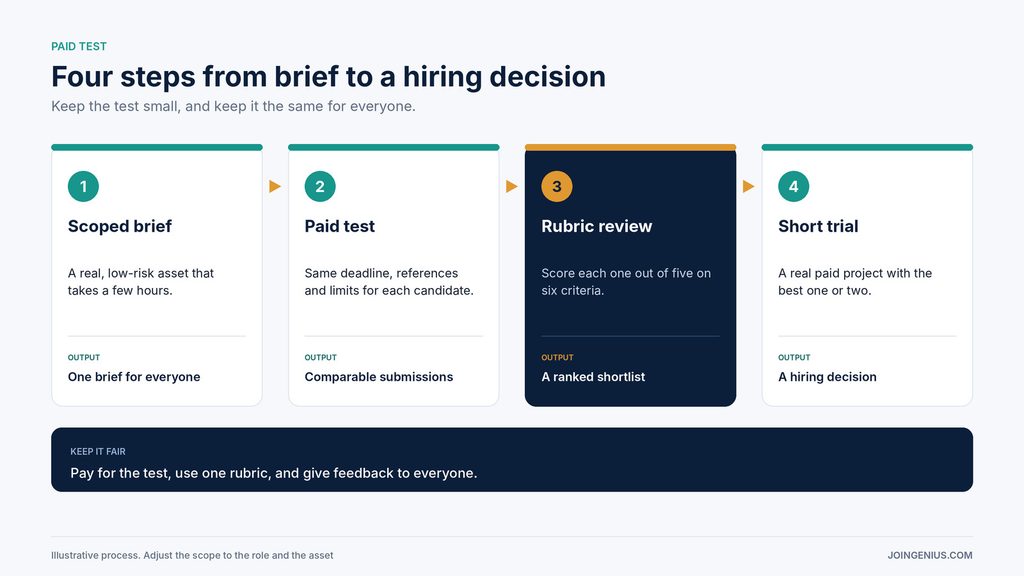
A paid test shows what a portfolio cannot: how someone works to your brief. Keep it small and fair.
- Choose a real but low-risk asset. Pick something that takes a few hours, not days.
- Give every candidate the same brief. Use the same deadline, reference images and technical limits.
- Pay a fair rate, whether or not you hire. Unpaid tests tend to filter out experienced freelancers who have other options.
- Score with a written rubric. Decide the criteria before the first submission arrives.
- Run a short paid trial with the best one or two. A real project shows fit better than any test. Give feedback after each stage, even to people you do not hire. It costs little, it keeps your reputation strong in a small industry, and it helps you check that your rubric is clear.
A simple rubric scores each submission out of five on these points:
- Matches the brief and the reference
- Clean topology and sensible UV layout
- Textures at the requested resolution
- Correct file formats and naming
- Communication during the task
- Delivered on time
Build the test into your hiring pipeline as a defined stage, with the same steps for every candidate. That consistency is what turns the process from gatekeeping into a fair comparison.
Warning Signs Your 3D Artist Hiring Is Too Gated, and What to Do About Each
A gated process rarely announces itself. These signs show where it is happening, and each one has a specific next move. One sign is a prompt to fix one thing. Several together mean you should rebuild the screening before the next role opens.

A Practical First Step
Pick your next 3D role and rewrite the screening in three parts. First, write the brief and the rubric. Second, check each candidate’s track record, whether on a marketplace or through past client work, alongside the portfolio. Third, send a short paid test to the people who pass.
Then compare who gets through against how you screened before. If strong candidates appear who the old method would have dropped, the portfolio gate was costing you talent. If the shortlist looks the same, you have lost little and gained a clearer reason for your choices. Either way, you will be hiring on evidence of what the artist can deliver and not on how well a gallery was curated. That is a better basis for a decision, and it is one you can explain to the artist, to your team and to yourself.