Hiring managers who weigh open source contributions over years on a resume keep shipping better hires than the ones running the same credential-first talent acquisition process they ran in 2018. The signals from a working GitHub profile cover intent and taste plus follow-through in a way no bullet point can match.
This guide is a practical read on what hiring managers should scan for, which contributions actually predict shippable engineers, and the red flags that still fool experienced panels. It also walks through building an open-source-first pipeline that works for a startup or an enterprise team without adding more rounds.
Why Open Source Signals Have Replaced Years-Of-Experience
Hiring managers used to lean on years in a role as a proxy for taste and judgment. Open source now gives a cleaner read that updates every week instead of every two years.
The Talent Pool Is Already Public
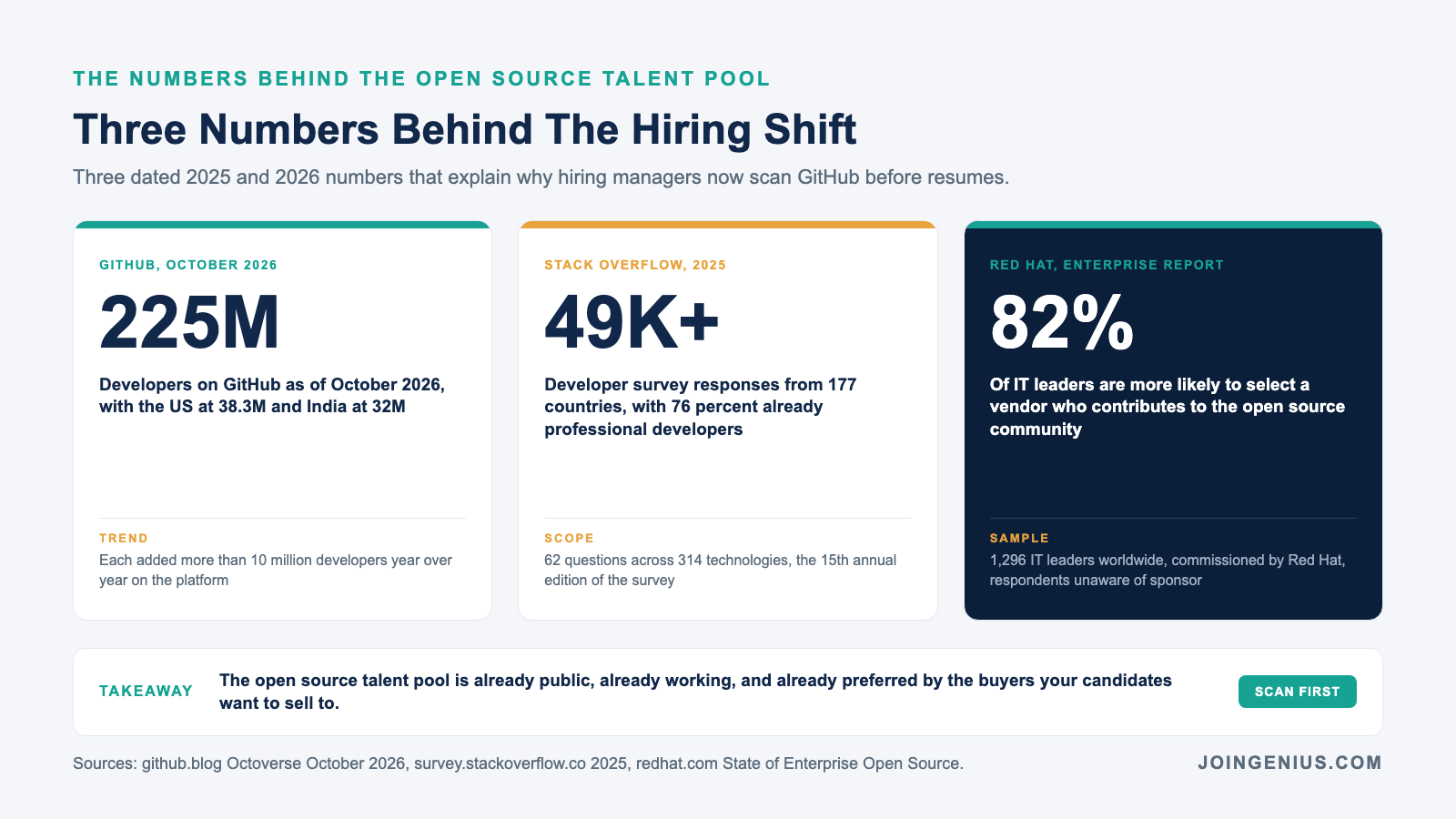
GitHub reports more than 225 million developers on the platform as of October 2026, with the US at 38.3 million and India at 32 million. For hiring managers this means the shortlist no longer starts from applications.
It starts from the public record a candidate already keeps every workday. The old move was to post the role and wait for resumes to come in. The new move is to read the public record first and shortlist from it, then invite applications from the top tier.
Every other step in AI-assisted talent acquisition rides on this one change. Panels that still start from applications now spend their senior hours grading resumes instead of reading code, and the best candidates almost never apply cold in the first place.
Years Of Experience Lost Its Signal Power
Ten years in a role used to mean ten years of shipped features. For many senior roles today it means two years of real growth and eight years of the same tickets. Open source contributions carry a date and a diff attached to every commit, so the panel reads actual recent work rather than inferring it from tenure.
This matters more for backend and infrastructure roles than it does for pure product UI work. The gap between a senior engineer and a staff engineer often shows up in the public record as open source maintenance, not as additional job titles.
How To Read A GitHub Profile In 90 Seconds
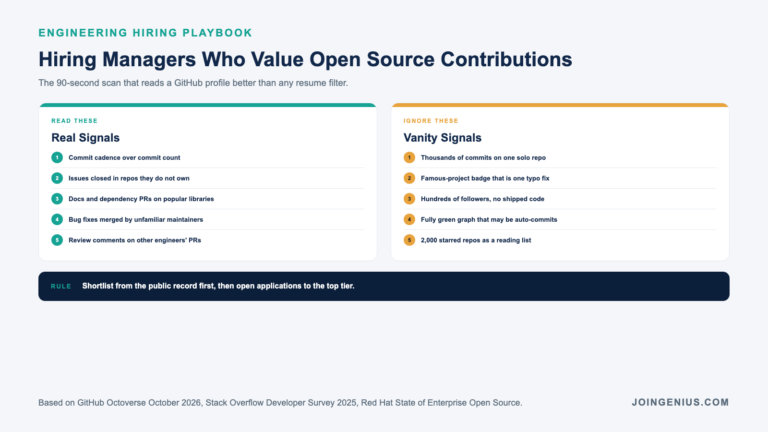
The 90-second scan is a repeatable method. The goal is not to read the code, it is to read the shape of the work and the way the engineer interacts with other maintainers.
Managers who shortlist from open source look at commit cadence over commit count and skim the issues an engineer closed rather than opened, which is why pairing that read with a Linux Professional Institute cert settles the “does this person actually ship” question fast.
Commit Cadence Over Commit Count
A profile with 2,000 commits over four weekends before a job search tells you less than a profile with 300 commits spread across 18 months. Cadence shows habit, and habit is what survives a hard release week in production.
Scan the contribution graph for gaps that match life events versus gaps that match “I only code when interviewing.” The second pattern usually appears when every green square falls inside a 60-day window right before the search started.
Issues Closed Rather Than Opened
Anyone can open an issue. Engineers who close issues wrote the fix and wrote the test, then convinced a maintainer and carried the follow-up through review.
Scan the “closed by” tab on a repo the candidate frequents, and count the ratio of closed to opened across the last six months of activity. A healthy ratio stays well above 1-to-1 for mid and senior engineers.
Which Contributions Actually Signal Shippable Engineers
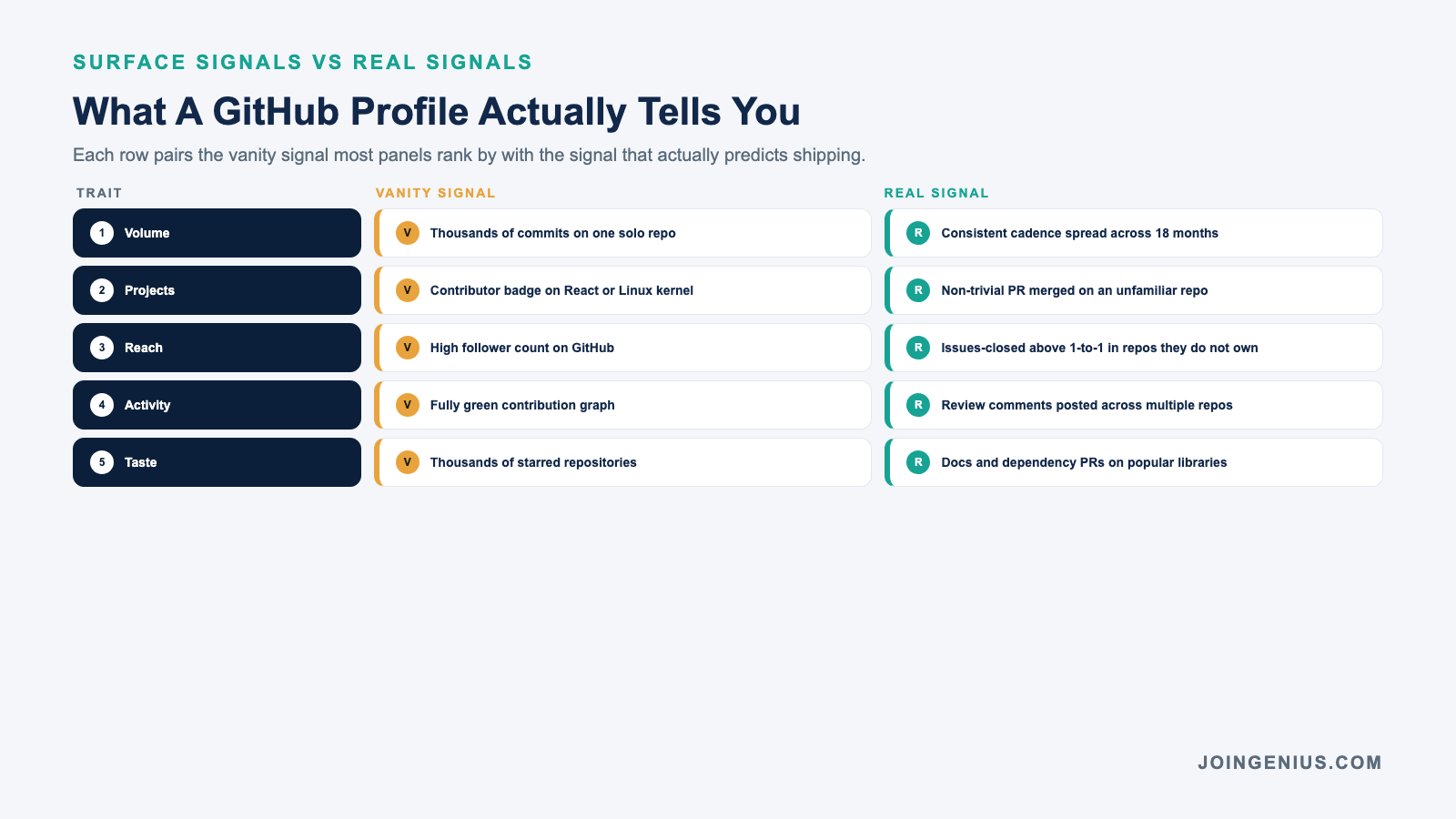
Not every open source contribution carries the same weight. Hiring managers who read profiles well can tell the difference in about a minute.
Documentation And Dependency Updates Count More Than You Think
A README fix on a popular library is often a stronger signal than a new feature on a solo repo. It means the engineer reads code carefully enough to spot a gap, cares about the next developer who will hit it, and can get a change merged inside a project they do not own.
Stack Overflow’s 2025 Developer Survey drew 49,000+ responses from 177 countries and found that 76% of respondents are already professional developers. The open source tier is not a learner pool. It is the working pool, which is why documentation and dependency work there carries production weight.
Bug Fixes In Repos The Candidate Does Not Own
Bug fixes in another maintainer’s repo show three things at once. The engineer could reproduce the bug and trace it through a codebase they did not write, then get a fix merged over an unfamiliar reviewer’s bar. That is roughly the same skill set a first ticket at your company will test.
Red Flags That Fool Even Senior Hiring Managers
Senior panels miss the same signals the junior ones do, just more confidently. The common trap is reading a repo at face value instead of reading the metadata around it.
The “100 Repos” Profile With No Collaborators
A profile with 100 personal repositories and zero merged pull requests to other projects is usually a tutorial profile. The engineer has worked through courses, shipped nothing with another engineer, and has not held a code review conversation on the public record.
The Famous Project With One Vanity Commit
A commit to React or Linux kernel looks prestigious on a resume, but click through and the commit is often a typo fix. That does not prove anything about shipping, it proves the candidate can use “git clone.”
Red Hat’s State of Enterprise Open Source Report found that 82% of IT leaders are more likely to select a vendor who contributes to the open source community, so expect candidates to game this signal as it becomes more valuable to hiring panels.
| Signal | What It Looks Like | What It Actually Means |
|---|---|---|
| High commit count | Thousands of commits on one repo | Could be squash-free solo work, not team shipping |
| Popular-repo contributor badge | “Contributor to React” | Often a one-line README fix, read the actual diff |
| Hundreds of followers | Big GitHub following | Shows audience, not shipping ability |
| Full green contribution graph | Every day shaded green | May be auto-commits or scripted; verify with review activity |
| Starred repo count | “Starred 2,000 repos” | Reading list, not production record |
| Closed issues in owned repos | “Closed 400 issues” | Could be self-cleanup; look for closures in repos they do not own |
Building An Open-Source-First Hiring Pipeline
An open-source-first pipeline does not mean hiring only maintainers. It means shifting the shortlist filter earlier, so the panel spends time on the right candidates instead of grading all of them equally.
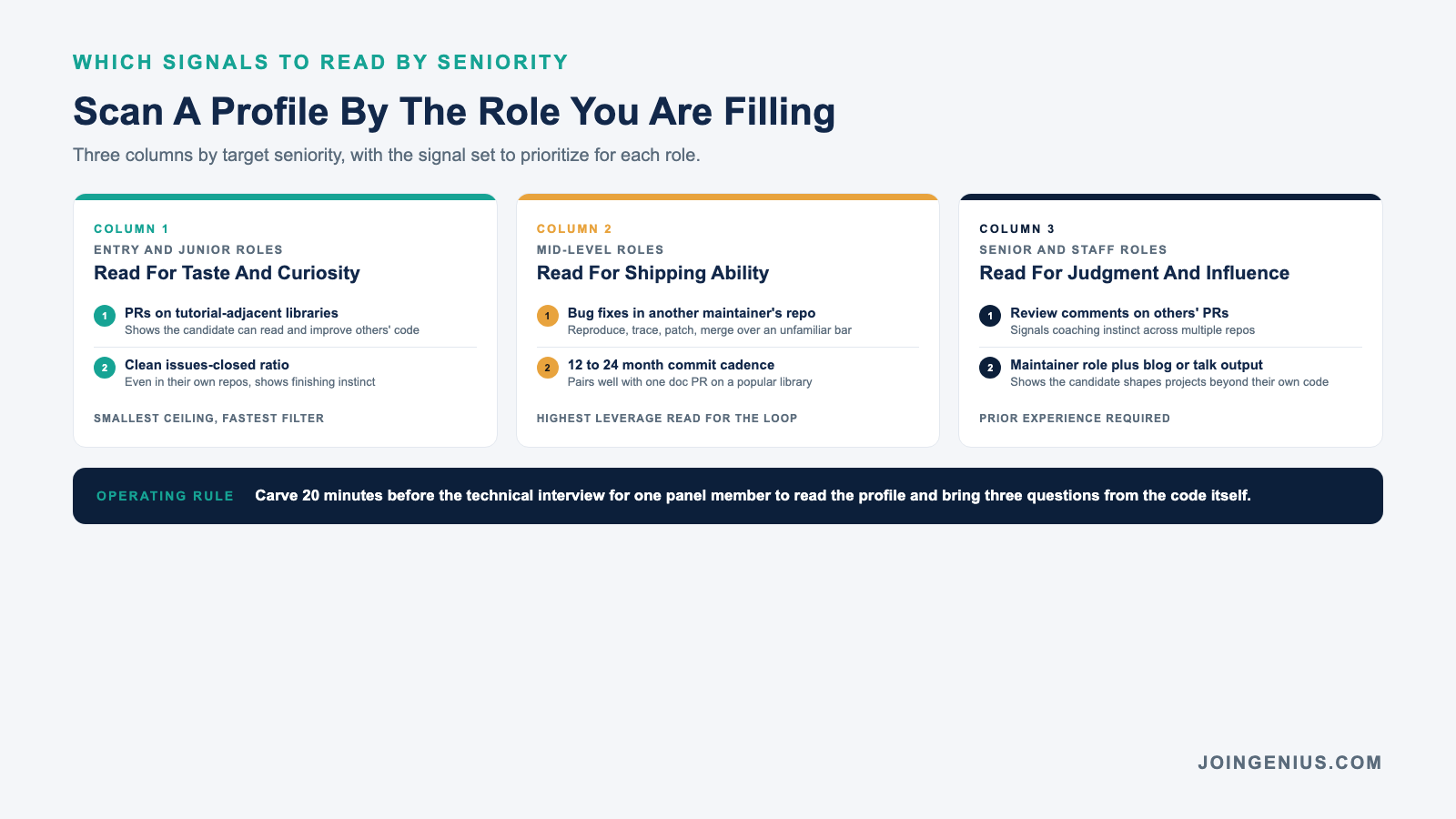
Rewrite The Job Description Around Public Evidence
Replace “5 years of Python experience” with “public evidence of shipping Python code reviewed by at least one maintainer you did not know before the PR.” The wording filters out the resume-matcher noise and attracts candidates who can send a profile link instead of a cover letter.
Pair it with a short note on what the role will ship in the first 90 days. Engineers who can read a public record for taste will read your job post the same way.
Add A 20-Minute GitHub Review To The Loop
Carve 20 minutes before the technical interview for one panel member to read the candidate’s public profile. Note three questions that come from the code itself, and ask those in the first half of the interview.
This approach beats the standard take-home round for mid-level roles and scales well for sourcing founding engineers who do not have time for a 4-hour project. It also gives the panel a better read than any coding puzzle for anyone above the three-year mark. See the hiring for startups playbook for how to sequence this before a full-loop day.
The Bottom Line For Hiring Managers In 2026
Open source contributions are the closest thing to a continuous performance review that candidates publish for free. Hiring managers who build the 90-second scan into their shortlist and reserve a 20-minute profile read inside the loop will out-hire the panels still ranking resumes by years and prestige logos.
Pair that with a credential that validates fundamentals and the method pays for itself inside the first two senior hires. Panels that keep the same loop for three quarters usually see the time-to-fill curve bend before the sixth hire, because the 90-second scan filters out the bottom tier before the technical round even starts.
Running this kind of hiring process at scale takes dedicated recruiting ops, and that is where Genius fits. We place top 1% engineering talent from the Philippines and LATAM at roughly 80% less than a local hire. There is no monthly retainer attached to the model and we back every placement with a 6-month talent guarantee.
If you are hiring developers who already contribute to open source in 2026, our team can source and screen them before you open the role to applications. Visit joingenius.com to start a pipeline and we will build the first shortlist from public evidence inside the first week.