
You’ve probably Googled it at some point—how to hire the best developers offshore—then closed the tab 5 minutes later because it felt like opening a can of worms. Too many options, too many unknowns, and way too many horror stories.
But don’t worry, we have prepared this guide to lay everything out clearly.. We will walk through how to avoid the headaches, find legit talent, and turn offshore hiring into one of your smartest decisions yet.
How To Hire The Best Developers Offshore: Everything You Need To Know In Under A Minute
| Step | What to Do |
|---|---|
| 1. Define the role based on impact | Focus on outcomes like “launch MVP in 6 weeks” |
| 2. Choose the right country | Match tech needs with regional specialties (e.g., AI in Ukraine, UI in Brazil) |
| 3. Pick a hiring channel | Choose vetted platforms, agencies, or direct outreach based on speed and budget |
| 4. Write a filter-first job post | Emphasize outcomes, expectations, and time zone availability |
| 5. Screen for skills & remote fit | Use technical tests + async communication checks |
| 6. Ask for impact-based samples | Request project results like performance boosts or shipped features |
| 7. Run a paid test project | Assign a 4–8 hour task from your backlog |
| 8. Evaluate communication style | Assess clarity, tone, and responsiveness across channels |
| 9. Check remote references | Talk to past clients or managers who worked with them remotely |
| 10. Send a clear, written offer | Include expectations, time zones, payment, scope, and legal terms |
Your Next Must-Read Blogs
🌟 How To Hire A+ Big Data Offshore Software Developer
🔥 How To Hire A+ Offshore Artificial Intelligence Developers
💯 Offshore Embedded Firmware Development: Full Guide
What Is An Offshore Developer?
An offshore developer is a software developer who works remotely from a different country, usually in a region with lower labor costs than yours. These developers can work as freelancers, through outsourcing agencies, or as part of dedicated offshore teams. Businesses hire offshore developers to build websites, apps, or digital products without needing to hire in-house or local talent.
Why More Founders Are Hiring Offshore Developers: 5 Surprising Benefits

Here are the main advantages of hiring an offshore developer:
1. Access Niche Tech Expertise Not Available Locally
Hiring offshore gives you access to a global talent pool of 27.7 million software developers worldwide, expanding your options beyond your local market.
If you’re struggling to find specialists in emerging technologies like AI, blockchain, or cybersecurity, chances are they already exist in countries where demand isn’t as high and competition isn’t as cutthroat.
Offshore hiring lets you tap into this niche expertise quickly, so you can move faster without lowering your standards or overpaying for scarce local talent.
2. Build Around-the-Clock Development Cycles Across Time Zones
Hiring offshore developers lets your team work while you sleep. With time zone differences, your offshore team can pick up tasks after your local team signs off, which creates a near 24-hour development cycle.
This means faster iteration, quicker bug fixes, and shorter time to market. Instead of waiting another day to see progress, you wake up to completed work.
3. De-Risk Scaling by Testing with Smaller Offshore Teams First
Offshore hiring lets you start small to test fit, workflow, and results before scaling up. This phased approach lowers financial risk and gives you time to evaluate quality, communication, and cultural alignment.
If the pilot works well, you can confidently grow your team without the upfront cost or commitment of hiring a full in-house department.
4. Tap Into Faster Hiring Pipelines in High-Supply Regions
In the US, it can take 4 to 8 weeks (or longer) to hire a qualified software developer, especially for in-demand roles. Between posting the job, sourcing candidates, interviewing, and negotiating offers, the process drags.
In contrast, offshore hiring through vetted agencies or platforms in countries like India or the Philippines can take as little as 3 to 7 days. These regions have large developer pools and pre-vetted candidates ready to start quickly, helping you speed up hiring without sacrificing quality.
5. Leverage Mature Offshore Agencies With Proven Workflows
Established offshore agencies come with built-in processes, experienced project managers, and tech teams that have worked together on dozens of similar projects. This means less trial and error for you.
You get access to structured onboarding, agile workflows, quality control, and support systems that help reduce ramp-up time and keep delivery smooth. Instead of building everything from scratch, you plug into a system that already works.
🤔 Did You Know?
Offshore software development teams achieve 25% faster time-to-market.
How To Hire The Best Developers Offshore: 10 Steps To Get It Right The First Time
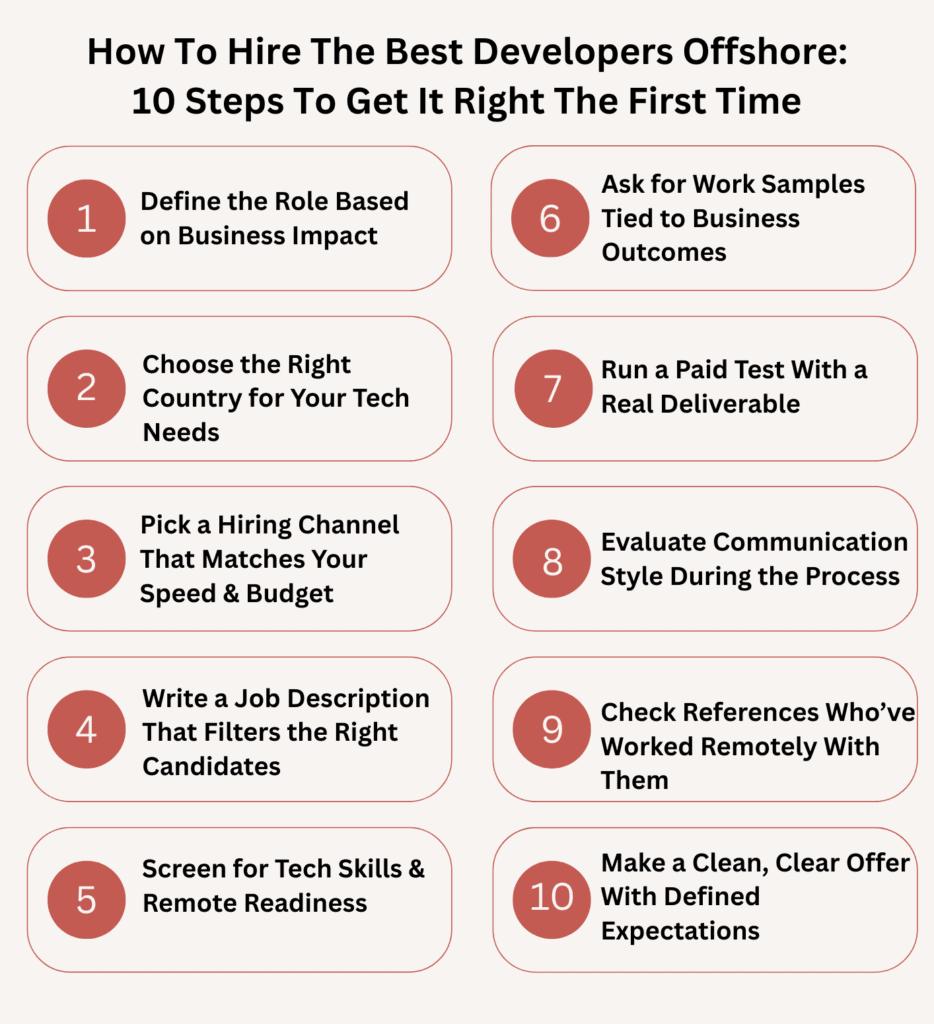
Follow these steps to hire top offshore developers without wasting time, money, or momentum:
1. Define The Role Based On Business Impact
Before you write a job post or start searching, get crystal clear on why you’re hiring. Ask: What problem will this developer solve? What outcome do I expect 30, 60, or 90 days in?
Instead of vague goals like “build our app,” focus on measurable impact like “reduce page load time by 50%” or “launch a working MVP in 6 weeks.” This helps you identify the exact skills, experience level, and tech stack you need.
Here’s how to do it:
- List your top 3 priorities for the role (fix bugs, speed up development, build new features).
- Define what a successful outcome looks like in numbers or time. For example, 2 bug-free releases per month.
- Match outcomes with skill sets like fast load times = React optimization + backend API tuning.
- Turn this into a short mission statement to guide the job description and interviews.
2. Choose The Right Country For Your Tech Needs
Different countries develop strengths in specific technologies based on their industry focus and training. Hiring based solely on low rates causes mismatched skills, poor code quality, or communication issues. Instead, match your tech needs with countries known for delivering strong developer talent in those areas.
Here’s where to find developers who specialize in them:
| Country | Known For |
|---|---|
| India | Web and mobile development, backend systems, cloud platforms, enterprise software |
| Ukraine | AI/ML, blockchain, cybersecurity, and custom software development |
| Philippines | Frontend development, WordPress, customer-facing apps, and strong English communication |
| Poland | Embedded systems, DevOps, fintech, and high-performance computing |
| Brazil | UI/UX design, full-stack development, and scalable web platforms |
| Vietnam | E-commerce, mobile apps, and cost-effective full-cycle development |
| Argentina | Data science, product design, and agile development teams with overlapping US hours |
| Egypt | Cross-platform development, game development, and .NET expertise |
3. Pick A Hiring Channel That Matches Your Speed & Budget
Hiring channels offer different trade-offs in speed, cost, and support. If you’re in a rush, vetted agencies or dedicated platforms might save time. If you have more bandwidth, direct sourcing gives you control but takes longer.
To help you decide, here’s a table of common hiring channels:
| Hiring Channel | What It Is | Best For |
|---|---|---|
| Freelance Platforms | Marketplaces like Upwork or Freelancer where you post jobs and screen applicants | Short-term projects, flexible budgets, small teams |
| Vetted Talent Platforms | Curated services like Genius, Toptal, or Arc that pre-screen developers | High-quality hires, fast onboarding, less time spent vetting |
| Offshore Dev Agencies | Firms that provide ready-made teams or individuals with management support | Businesses needing end-to-end delivery, team scalability, or minimal setup |
| Developer Marketplaces | Job boards like We Work Remotely, RemoteOK, or AngelList | Companies with internal hiring support that want more control and visibility |
| Direct Outreach | Sourcing candidates yourself via LinkedIn, GitHub, or referrals | Custom roles, tight team fit, more control (but slower) |
4. Write A Job Description That Filters The Right Candidates
A well-written job description attracts people who are aligned with your goals, which saves you hours of screening later. Your job description should filter out the wrong ones.
Instead of listing only skills and tools, describe the outcomes, challenges, and daily responsibilities the developer will actually face. This helps serious candidates self-select and weeds out those who aren’t a fit.
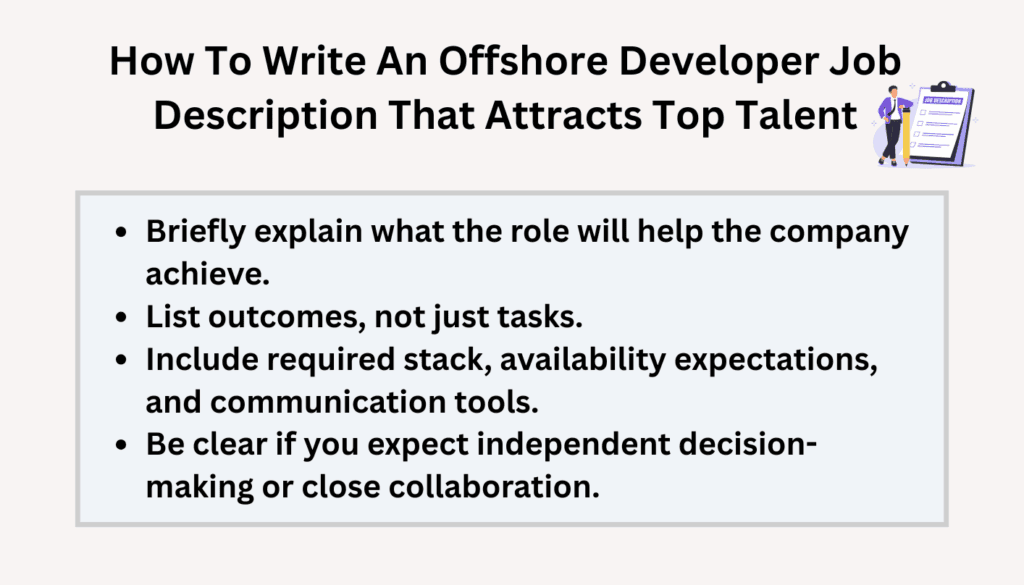
Here’s how to do it:
- Start with the mission. Briefly explain what the role will help the company achieve.
- List outcomes, not just tasks. Say “launch MVP in 8 weeks” instead of “build web app.”
- Mention tools and time zones. Include required stack, availability expectations, and communication tools.
- Set the tone. Be clear if you expect independent decision-making or close collaboration.
You can use this customizable offshore developer job description:
| Job Title: Offshore [Frontend / Backend / Full-Stack / Mobile] Developer Location: Remote (Preferred timezone overlap: [e.g., 2–4 hours with EST]) Engagement Type: [Full-time / Part-time / Contract / Project-based] Start Date: [Immediate / Within 2 weeks / Flexible] About Us We’re [Company Name], a [brief description—e.g., fast-growing SaaS startup / product-led company / digital agency] focused on [your mission or product area]. We’re looking to expand our team with a reliable offshore developer who can help us [mention project or outcome, e.g., ship new features, improve backend performance, or launch an MVP]. What You’ll Do – Collaborate with our in-house team to deliver high-quality, tested code – Own and execute tasks such as [customize: building responsive UIs, developing APIs, optimizing queries, etc.] – Communicate progress regularly via [Slack / Jira / Notion / other tools] – Attend [weekly standups / bi-weekly check-ins / async updates] to stay aligned – Work independently while meeting project deadlines and business goals What Success Looks Like – [Example] Complete 3 production-ready features in the first 30 days – [Example] Improve page speed by 30% within the first sprint – [Example] Help launch the mobile app beta within 8 weeks What We’re Looking For – [X]+ years of experience with [e.g., React, Node.js, Python, AWS, etc.] – Strong problem-solving skills and ability to write clean, maintainable code – Solid understanding of [customize: REST APIs, CI/CD, cloud infrastructure, etc.] – Experience working with distributed or remote teams – Able to work at least [X] hours overlapping with [your time zone] – Fluent in written and verbal English Nice to Have – Familiarity with [optional: Agile/Scrum, Figma, Docker, etc.] – Past experience working for [startups / SaaS / agency environments] – Portfolio or GitHub showing relevant project work What We Offer – Competitive offshore compensation based on experience – Flexible working hours – Long-term collaboration opportunity – Direct access to a small, supportive team – Fast decision-making and minimal red tape How to Apply Send us: – A short note on why you’re a good fit – A link to your portfolio, GitHub, or recent work – Your availability and expected rate |
5. Screen for Tech Skills & Remote Readiness
Screen for both skills and remote readiness to find developers who can deliver quality work and fit into your workflow without hand-holding.
Here’s how to do it:
- Use platforms like HackerRank, Codility, or a short take-home test based on your real tasks. Focus on code clarity, logic, and problem-solving.
- Ask candidates about tools they’ve used (GitHub, Slack, Jira) and how they manage tasks or blockers on their own.
- During screening, send some questions via email or chat and evaluate how clearly and thoroughly they respond.
- Pay attention to how they write, whether they ask thoughtful questions, and how well they explain their work.
“Offshore hiring works best when you treat it like building your core team—with precision, purpose, and long-term thinking.”
Burkhard Berger, Founder & CEO
6. Ask For Work Samples Tied To Business Outcomes
Instead of just reviewing code snippets or GitHub links, ask for real-world examples where the developer’s work made a measurable impact. This shows problem-solving, ownership, and the ability to drive results.
Here’s how to do it:
- Ask candidates to share 2–3 project examples, including:
- What the project was
- Their specific role and contributions
- The outcome, like “reduced load time by 40%” or “helped launch MVP in 6 weeks”
- Request before-and-after metrics or improvements if available
- Look for signs of business awareness, like improving user experience, boosting conversion, or reducing bugs
- If possible, ask for a walkthrough via Loom or screen share to explain how they approached the project
7. Run A Paid Test With A Real Deliverable
A short, paid test project is one of the best ways to see how a developer performs in your actual workflow. It lets you evaluate their coding quality, communication, and how they handle real requirements, before committing to a full hire.
This step filters out candidates who look good on paper but struggle in execution, and gives top talent a chance to shine in context.
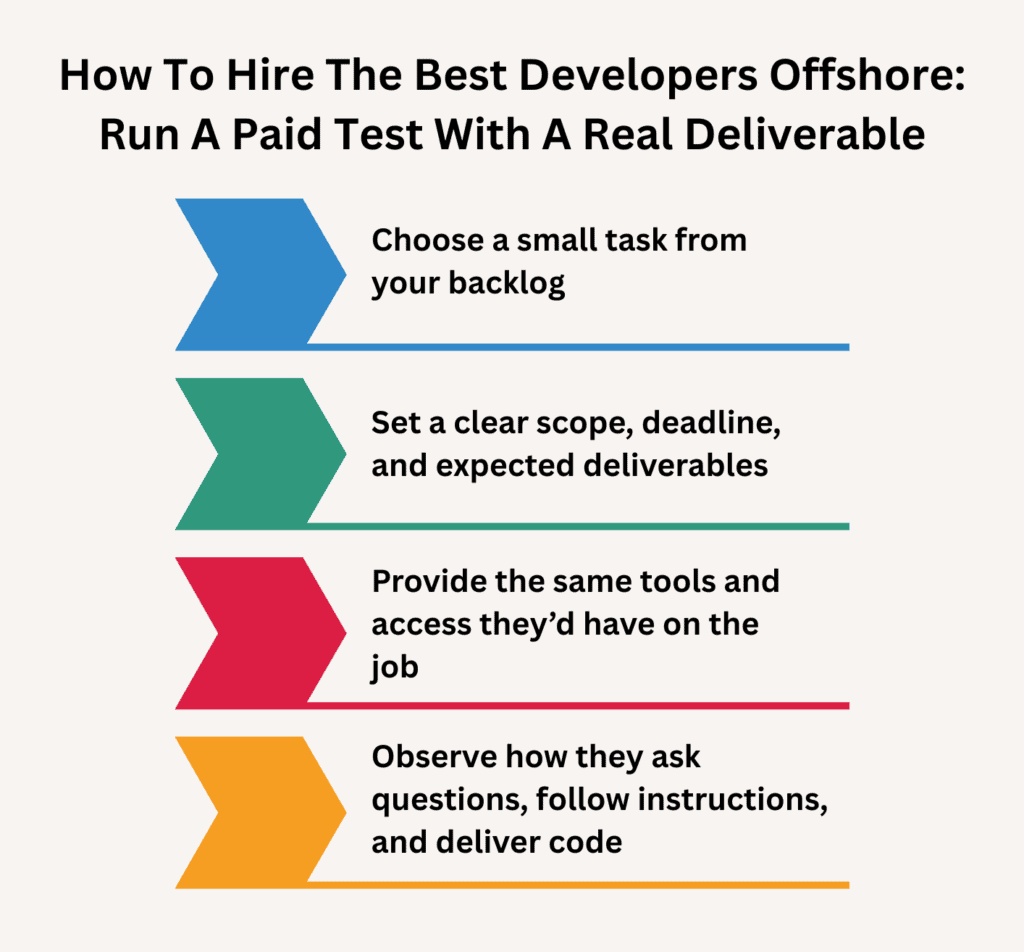
Here’s how to do it:
- Choose a small task from your backlog—something meaningful but not mission-critical (e.g., build a simple feature, fix a specific bug, or create a small API).
- Set a clear scope, deadline, and expected deliverables. Keep the test between 4–8 hours of work.
- Provide the same tools and access they’d have on the job (access to GitHub, test data, communication tools).
- Observe how they ask questions, follow instructions, and deliver code. Review for quality, structure, and clarity, not just whether it works.
8. Evaluate Communication Style During The Process
Since most of your collaboration will be remote, evaluating how they write, respond, and clarify things is just as important as their code. Consistent, clear communication reduces back-and-forth, speeds up delivery, and builds trust, especially across time zones.
Here’s how to do it:
- Watch their tone and clarity in emails or messages—are they direct, respectful, and easy to understand?
- Track how quickly they respond to questions or follow-ups during the interview and test task.
- Ask scenario-based questions like “How would you update the team if a task is delayed?” or “What’s your process when unclear on a requirement?”
- Note if they ask thoughtful questions about the role, product, or task—that shows engagement and responsibility.
9. Check References Who’ve Worked Remotely With Them
Talking to someone who’s worked with the developer in a remote setting gives you insight into how they communicate, handle deadlines, and solve problems when no one’s looking over their shoulder. Strong references confirm you’re hiring a dependable remote teammate.
Here’s how to do it:
- Ask the candidate for 1–2 references from past clients or managers they’ve worked with remotely (not just in-office roles).
- Prepare a few focused questions like:
- “How did they handle communication across time zones?”
- “Were they proactive when problems came up?”
- “Would you hire them again for a remote role?”
- Pay attention to tone and hesitation (a lukewarm review is a red flag).
- If a reference doesn’t respond or gives vague answers, consider that a sign to dig deeper.
10. Make a Clean, Clear Offer With Defined Expectations
Once you’ve chosen your offshore developer, don’t leave the offer open to interpretation. A clear, written offer avoids confusion and sets the foundation for a productive working relationship from day one.
Here’s how to do it:
- Write a simple offer letter or contract that outlines:
- Start date and working hours (include time zone expectations)
- Compensation (hourly rate, fixed price, or salary + payment schedule)
- Scope of work (key responsibilities, deliverables, and tools they’ll use)
- Communication expectations (e.g., response time, weekly check-ins, tools used)
- Legal basics (IP ownership, NDAs, termination terms)
- Send it as a PDF or Doc with a friendly note, and ask for confirmation in writing.
- Review it together on a call if needed to clarify anything upfront.
😱 This Might Surprise You
66% of US businesses use offshore software development.
The 5 Biggest Offshore Developer Hiring Mistakes & How to Avoid Them

Before you commit to a hire, make sure you’re not falling into one of these offshore hiring traps:
1. Not Testing For Independent Decision-Making
Many offshore developers are used to being task-takers, not problem-solvers. If you don’t screen for decision-making ability, you risk hiring someone who waits for instructions instead of pushing things forward.
How to avoid it: Ask scenario questions like, “What would you do if specs are unclear but a deadline is near?” Look for initiative and logical judgment.
2. Hiring Without Checking Their Long-Term Availability
Some developers take on multiple short-term gigs or have shifting commitments. Hiring someone who’s unavailable after a few weeks can break your roadmap.
How to avoid it: Ask about other current contracts, preferred engagement length, and future availability during the interview.
3. Underestimating The Cost Of Context Switching
Hiring multiple part-time offshore developers may seem cost-effective, but it causes scattered focus, slower delivery, and more onboarding effort per person.
How to avoid it: Consolidate work with fewer developers at higher capacity, and hire full-time or near-full-time when possible.
4. Using A One-Size-Fits-All Hiring Process
Treating offshore hiring like local hiring (same assessments, same expectations) fails because of cultural or workflow differences.
How to avoid it: Tailor your process. For example, test async communication or give deadlines that match their timezone. Make your process reflect how you’ll actually work together.
5. Overlooking Soft Skills That Directly Impact Delivery
You might hire someone who passes technical tests but struggles with collaboration, patience, or receiving feedback. This hurts morale and momentum.
How to avoid it: During interviews, assess how they respond to constructive feedback, describe past teamwork experiences, or handle conflict in remote settings.
“Great offshore hires start with clarity—when you define the outcome, you attract the right developer.”
Christian Cabaluna, Senior Recruiter
10 Critical Skills Every Great Offshore Developer Should Bring To Your Team

Make sure your offshore developer has these skills to work well with your team and deliver real results:
- Asynchronous communication mastery: Clearly shares updates and blockers without needing real-time meetings
- Outcome-oriented thinking: Focuses on solving business problems, not just completing tasks
- Version control discipline: Writes clean commits with clear messages and regular Git updates
- Experience working across time zones: Manages work independently and handles handoffs smoothly
- Proactive clarification: Asks the right questions early to avoid confusion or rework
- Strong written technical communication: Explains decisions clearly in pull requests, docs, or messages
- Familiarity with Agile or Lean delivery models: Adapts to sprint cycles, changing scope, and team workflows
- Ability to work from minimal specs: Turns rough ideas into working code without constant input
- Self-testing mindset: Tests their own code thoroughly before it reaches QA
- Long-term collaboration mindset: Invests in team success and cares about product quality over time
How Much Do Offshore Developers Cost?

Offshore developers cost between $15-$60 per hour, depending on location, skill level, and project complexity.
Key factors that affect offshore developer costs:
- Country and region: Asia and Africa are more affordable than Eastern Europe or Latin America.
- Experience level: Junior, mid-level, and senior developers have very different rates.
- Specialization: Rates increase for skills in AI, blockchain, DevOps, or cybersecurity.
- Engagement type: Costs differ for freelance, contract, dedicated teams, or agency-based hires.
- Project scope and timeline: Short, urgent projects may carry premium rates compared to long-term contracts.
- Communication and time zone overlap: Developers fluent in English or available during your work hours may charge more.
Here’s an hourly rate breakdown by country and skill level:
| Region | Junior | Mid-Level | Senior / Specialist |
|---|---|---|---|
| India | $15 – $25/hr | $25 – $35/hr | $35 – $50/hr |
| Philippines | $15 – $20/hr | $20 – $30/hr | $30 – $45/hr |
| Ukraine | $25 – $35/hr | $35 – $45/hr | $45 – $60/hr |
| Poland | $30 – $40/hr | $40 – $50/hr | $50 – $65/hr |
| Brazil | $25 – $35/hr | $35 – $45/hr | $45 – $60/hr |
| Vietnam | $15 – $25/hr | $25 – $35/hr | $35 – $45/hr |
| Egypt | $15 – $20/hr | $20 – $30/hr | $30 – $40/hr |
Also consider these hidden costs:
- Project management overhead (10-20% of development costs)
- Communication tools and infrastructure
- Legal and compliance requirements
- Time zone coordination challenges
- Quality assurance and code review time
Factor these additional costs when calculating total project budgets. Here’s a sample computation:
You’re hiring a mid-level offshore developer from India at $30/hour for a 3-month project, working 40 hours/week.
Base development cost: $30/hour × 40 hours/week × 12 weeks = $14,400
Add hidden costs:
| Hidden Cost | Calculation | Estimated Cost |
|---|---|---|
| Project Management (15%) | $14,400 × 0.15 | $2,160 |
| Communication Tools/Infra | Flat monthly fee ($30 × 3 months) | $90 |
| Legal & Compliance | Contract templates, NDAs, etc. | $150 (one-time) |
| Time Zone Coordination | Extra hours for meetings/check-ins | $300 |
| Quality Assurance & Code Review | QA contractor: $20/hour × 20 hours | $400 |
Total estimated project cost: $14,400 (base) + $3,100 (overhead) = $17,500
🔎 This Is Interesting
80% of companies plan to use low-code/no-code platforms in offshore software development.
Conclusion
If you’re still wondering how to hire the best developers offshore, here’s the deal: don’t rush it, and don’t settle. Get clear on what you actually need, go deeper than resumes, and treat your hiring process like a filter. The best offshore developers aren’t just great at writing code—they’re proactive, curious, and know how to deliver results without hand-holding.
Genius helps you hire US-quality talent for up to 80% less, sourcing directly from top-tier candidates in the Philippines and Latin America. We focus on the top 1% of global talent, not just what’s available. With on-the-ground sourcing, no monthly fees, and a 6-month talent guarantee, you get a hiring experience that’s fast, cost-effective, and risk-free.
Let Genius show you how offshore hiring should work.
FAQs
What’s the best way to interview offshore developers?
Use a mix of video interviews, live coding tests, and real-world project scenarios. This helps you assess both technical skills and how well they communicate, solve problems, and fit into your team’s workflow.
Is it safe to share my code or IP with offshore teams?
Yes, if you take proper precautions. Use NDAs, secure platforms like GitHub, and work with trusted developers or agencies that understand IP protection and follow clear contract terms.
Do offshore developers work full-time or part-time?
Turnover can happen with any hire, but it’s lower when developers feel valued. Choose reliable partners, offer stable contracts, and maintain good communication to keep offshore talent engaged.
Should I hire individuals or a dedicated offshore team?
Hire individuals if you need flexibility or one-off support. Go with a dedicated team for complex, ongoing projects that require multiple roles working together under unified management.