
Managing accounting in-house often feels like you are always behind. Between late reports, growing payroll costs, and the constant scramble to stay compliant, it is easy to get stuck in the weeds. And if you are running a growing business, every wasted hour and dollar stings a little more. That is why more companies (big and small) are using offshore accounting in the Philippines.
It is not just about cutting costs (though yes, the savings are real). It is about building a leaner, more focused operation with expert support behind the scenes. In this article, we will break down the top 10 reasons why outsourcing your accounting to the Philippines might be the smart business decision you make this year.
Top Reasons To Choose Offshore Accounting Philippines
| Key Advantage | Impact | |
|---|---|---|
| Cost Savings | 70% reduction in operational costs | Annual savings of $50,000+ per offshore accountant |
| Talent Access | 10,000 – 12,000 new accounting graduates yearly | Unlimited talent pool vs. local shortages |
| English Proficiency | Ranked #22 globally (EF EPI Index) | Seamless communication with Western clients |
| Time Zone Benefits | Overlap with Australia, US, and Europe | 24/7 operational coverage |
| Scalability | Rapid team scaling up or down | Flexible capacity management |
| Technology | Advanced infrastructure and software expertise | Future-ready operations |
| Cultural Fit | Strong work ethic and Western business alignment | Higher retention and productivity |
| Government Support | BPO-friendly policies and incentives | Stable, secure operating environment |
| Service Range | Full spectrum accounting and specialized services | One-stop solution for all needs |
| Risk Mitigation | Geographic diversification and business continuity | Reduced operational vulnerabilities |
Your Next Must-Read Blogs
🌟 Offshore Big Data Development: Your Complete Starter Guide
🔥 14 Benefits Of Offshore Bookkeepers & How To Avoid Risks
💯 10 Benefits Of Offshore Accounting vs Risks For Startups
Why Offshore Accounting In The Philippines Is A Smart Move?
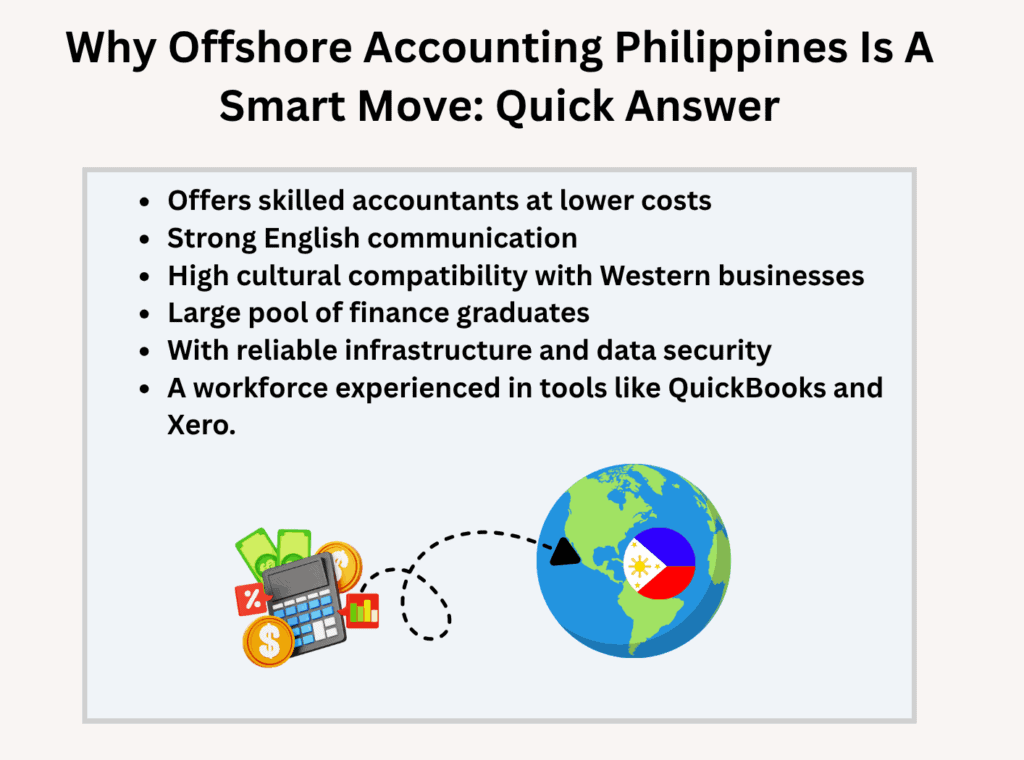
Offshoring accounting to the Philippines offers skilled accountants at lower costs, strong English communication, and high cultural compatibility with Western businesses. The country has a large pool of finance graduates, many trained in global standards like US GAAP and IFRS. It’s also a top BPO destination with reliable infrastructure, data security, and a workforce experienced in tools like QuickBooks and Xero.
🤔 Did You Know?
23% of employees would take a 10% pay cut to work from home permanently.
Top 10 Reasons To Offshore Accounting To The Philippines
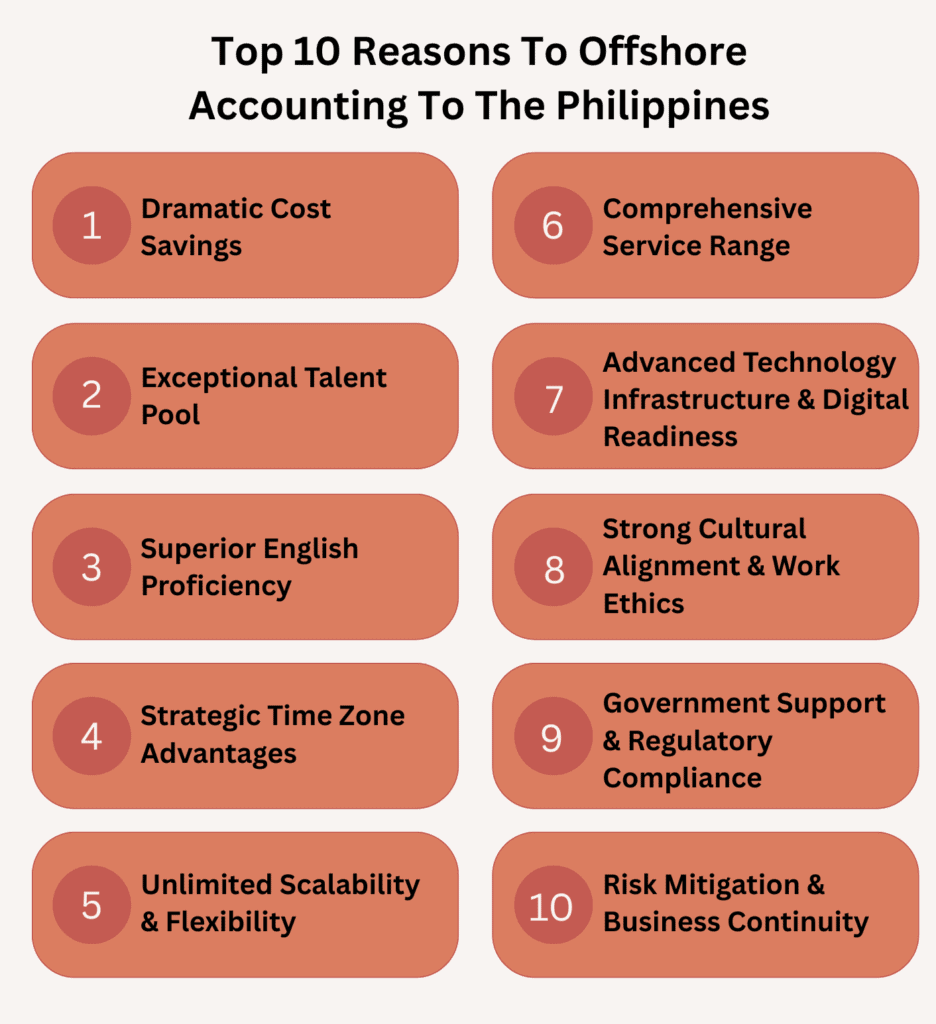
Let’s break down the biggest reasons businesses offshore accounting to the Philippines:
1. Dramatic Cost Savings
Offshoring accounting to the Philippines can cut labor and operational costs by up to 70%. Filipino accountants offer high-quality work at a fraction of the cost of hiring locally in the US, UK, or Australia. You save on salaries, benefits, office space, equipment, and overhead without sacrificing reliability or skill. These savings can be reinvested into growth areas like marketing, product development, or hiring strategic roles.
2. Exceptional Talent Pool
The Philippines produces 10,000-12,000 accounting and finance graduates every year, many of whom are CPA-certified and trained in global standards like U.S. GAAP and IFRS. Filipino professionals are known for their strong attention to detail, work ethic, and fluency in English, making collaboration smooth and reliable. You get access to highly capable talent without the time and cost of lengthy recruitment cycles.
3. Superior English Proficiency
The Philippines ranks among the top countries in Asia for English proficiency, making communication smooth and professional. English is one of the country’s official languages and the primary language of business, education, and government. In fact, the Philippines ranked 2nd in Asia and 20th globally in the EF English Proficiency Index.
This strong command of English allows Filipino accountants to understand complex financial instructions, prepare detailed reports, and communicate clearly with international clients.
4. Strategic Time Zone Advantages
The Philippines operates in a time zone (GMT+8), which is flexible for work coverage across the US, Europe, and Australia. This creates a “follow-the-sun” workflow, where tasks completed by your offshore team overnight are ready by the time your local team starts their day.
Many Filipino accounting firms also offer night-shift support or overlapping hours tailored to your business hours. This means faster turnaround on urgent requests, fewer delays in approvals, and near 24/7 operational support.
5. Unlimited Scalability & Flexibility
Outsourcing to the Philippines gives your business the ability to scale your accounting team up or down quickly without long hiring cycles or fixed overhead costs. You can start small with core tasks like bookkeeping, then scale into full-service accounting without having to rebuild infrastructure or retrain staff.
“Companies choose the Philippines for accounting support because it lets them scale faster, stay lean, and maintain full financial visibility.”
— Burkhard Berger, Founder & CEO
6. Comprehensive Service Range
Philippine accounting firms offer a wide range of services beyond just basic bookkeeping. You can outsource everything from accounts payable and receivable to payroll processing, tax preparation, compliance reporting, financial analysis, and even audit support.
This one-stop-shop approach means you won’t need to juggle multiple vendors or hire different specialists in-house. As your business grows, you can easily expand the scope of work all under one reliable offshore team.
7. Advanced Technology Infrastructure & Digital Readiness
The Philippines has heavily invested in IT infrastructure to support its booming BPO and accounting outsourcing industries. Many firms operate in tech-enabled environments with high-speed internet, cloud-based platforms, encrypted file-sharing systems, and enterprise-grade cybersecurity protocols.
Filipino accounting teams are also well-versed in modern accounting software like QuickBooks, Xero, NetSuite, and Sage. They’re trained to use automation tools, AI-enabled reporting dashboards, and workflow platforms that streamline tasks and reduce manual errors. This digital readiness makes integration with your internal systems smooth and keeps your data safe, accurate, and accessible in real-time.
8. Strong Cultural Alignment & Work Ethics
Filipino professionals are known for being respectful, reliable, and highly committed to their work. Their strong sense of responsibility and willingness to go the extra mile align well with the expectations of Western businesses.
Culturally, the Philippines shares many values with the US, UK, and Australia, like professionalism, clear communication, and customer service focus. This alignment reduces friction, strengthens collaboration, and creates a more seamless working relationship. Many international companies find that Filipino accountants exceed expectations with consistent performance and a positive attitude.
9. Government Support & Regulatory Compliance
The Philippine government actively supports the outsourcing industry through tax incentives, infrastructure investment, and workforce development programs. Agencies like the Board of Investments (BOI) and the Philippine Economic Zone Authority (PEZA) offer benefits to BPO firms, helping them maintain global standards and stable operations.
On the compliance side, many offshore accounting firms follow international data protection protocols and are familiar with regulations like US GAAP, IFRS, and even local tax laws in the client’s country. This ensures your financial processes meet regulatory requirements while giving you peace of mind that your data is secure and your reporting stays audit-ready.
10. Risk Mitigation & Business Continuity
Offshoring your accounting to the Philippines helps reduce operational risk by diversifying your workforce and building redundancy into your financial operations. Instead of relying solely on a local in-house team, you gain a dedicated offshore partner that can continue working even if local disruptions occur (e.g., natural disasters, economic shifts, or staffing shortages).
Top Philippine accounting firms have disaster recovery plans, secure cloud systems, and backup communication channels in place. This ensures your financial data stays protected and your business remains functional even during unexpected events.
😱 This Might Surprise You
Outsourcing has strengthened the economies of some countries.
Common Accounting Services Offshored To The Philippines

These are the go-to accounting services many companies trust Filipino professionals to manage remotely:
- Bookkeeping: Day-to-day tracking of financial transactions, including sales, expenses, and bank reconciliations.
- Accounts Payable (AP) and Accounts Receivable (AR): Managing outgoing payments and incoming invoices.
- Payroll Processing: Calculating employee wages, tax deductions, and issuing payslips—ensures everyone is paid accurately and on time.
- Tax Preparation and Filing: Preparing and filing business taxes based on local or international tax rules—reduces errors and helps you stay compliant.
- Financial Reporting and Analysis: Creating profit and loss statements, balance sheets, and cash flow reports.
- Budgeting and Forecasting: Building short- and long-term financial plans.
- Audit Support: Organizing documents and assisting with audit requests.
- General Ledger Management: Overseeing all entries in your accounting system.
How Much Does It Cost To Offshore Accounting To The Philippines?
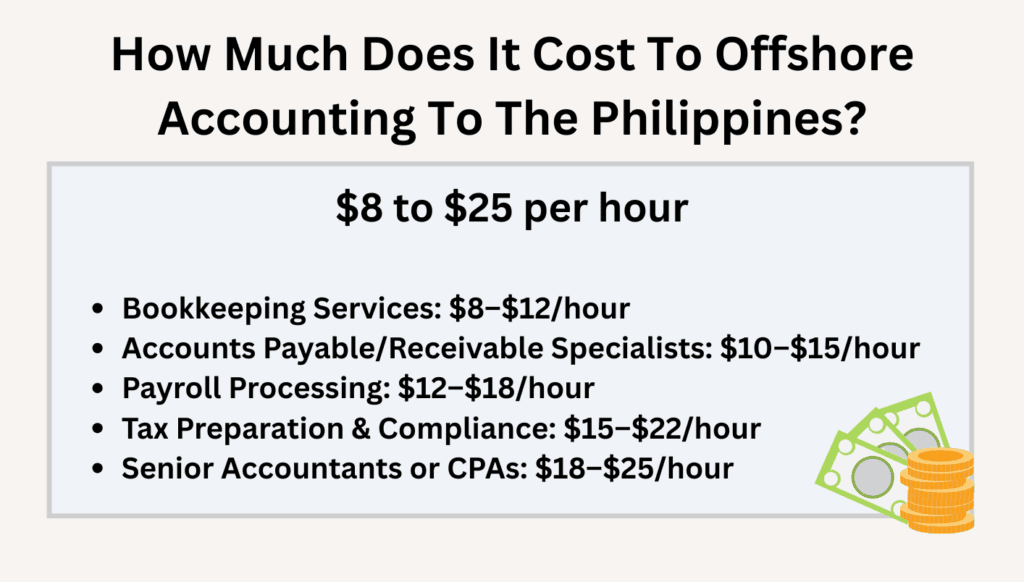
Offshore accounting services in the Philippines cost between $8 to $25 per hour, depending on the role, experience level, and scope of work:
- Bookkeeping Services: $8–$12/hour
- Accounts Payable/Receivable Specialists: $10–$15/hour
- Payroll Processing: $12–$18/hour
- Tax Preparation & Compliance: $15–$22/hour
- Senior Accountants or CPAs: $18–$25/hour
How To Choose The Right Offshore Accounting Partner In The Philippines
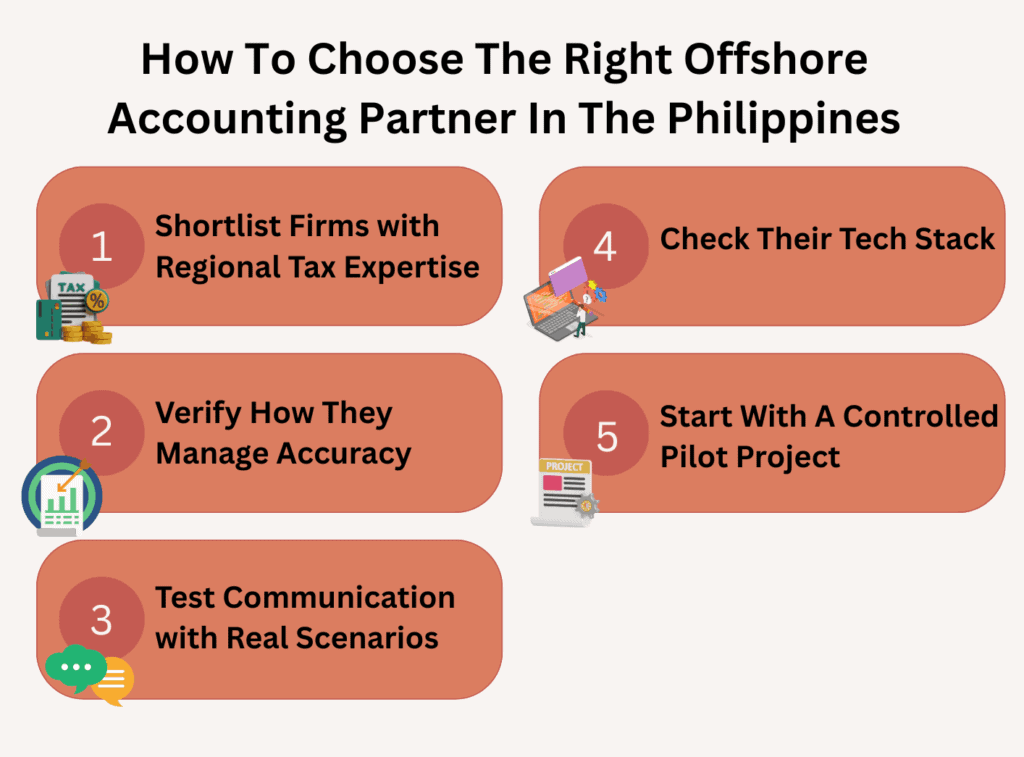
Follow these steps to work with the best offshore accounting partner from the Philippines:
1. Shortlist Firms With Regional Tax Expertise
- Ask for client references specifically from your country or region.
- Request sample reports (US GAAP financials, UK VAT returns, AU BAS statements).
- Confirm if their team includes CPAs or accountants trained in your country’s standards.
- Check if they offer region-specific services like IRS filings, VAT reconciliation, or local payroll compliance.
- Look for published case studies or testimonials involving businesses similar to yours in both size and location.
2. Verify How They Manage Accuracy
- Ask about their internal review process (Do they double-check entries before delivery?).
- Request their average error rate and how they track and report mistakes.
- Find out if they use a multi-level review system (junior prepares, senior approves).
- Ask how they handle corrections and how quickly they respond to accuracy issues.
- Review a sample financial report and ask them to walk you through their validation steps.
3. Test Communication With Real Scenarios
- Send a sample scenario (revenue recognition for a service business) and assess their response clarity.
- Ask how they’d handle a common issue like late payments or misclassified expenses.
- Pay attention to whether they ask follow-up questions that show real understanding (not just yes/no answers).
- Evaluate their written explanation skills (Are they concise, accurate, and easy to follow?).
- Hold a short video call to discuss the scenario and see how well they explain their approach live.
4. Check Their Tech Stack
- Ask which accounting platforms they specialize in (QuickBooks, Xero, NetSuite, Sage).
- Request a walkthrough of how they use your preferred tools for daily workflows.
- Check if they’re familiar with complementary tools like payroll software, expense trackers, or inventory systems.
- Ask how they handle file sharing, data backups, and version control (Google Drive, Dropbox, cloud storage).
- Confirm if they can recommend automations or integrations to improve your existing processes.
5. Start With A Controlled Pilot Project
- Define a limited scope (only accounts payable or monthly reconciliations) for the first 30–60 days.
- Set specific deliverables and deadlines upfront to measure consistency.
- Schedule weekly check-ins to review output, address issues, and give real-time feedback.
- Track key metrics like turnaround time, accuracy rate, and responsiveness during the pilot.
- Use the pilot results to decide whether to scale up, renegotiate terms, or move on.
“Offshore accounting in the Philippines gives companies faster access to skilled talent without slowing down hiring cycles.”
— Christian Cabaluna, Senior Recruiter
5 Potential Challenges Of Offshore Accounting In The Philippines & How To Overcome Them
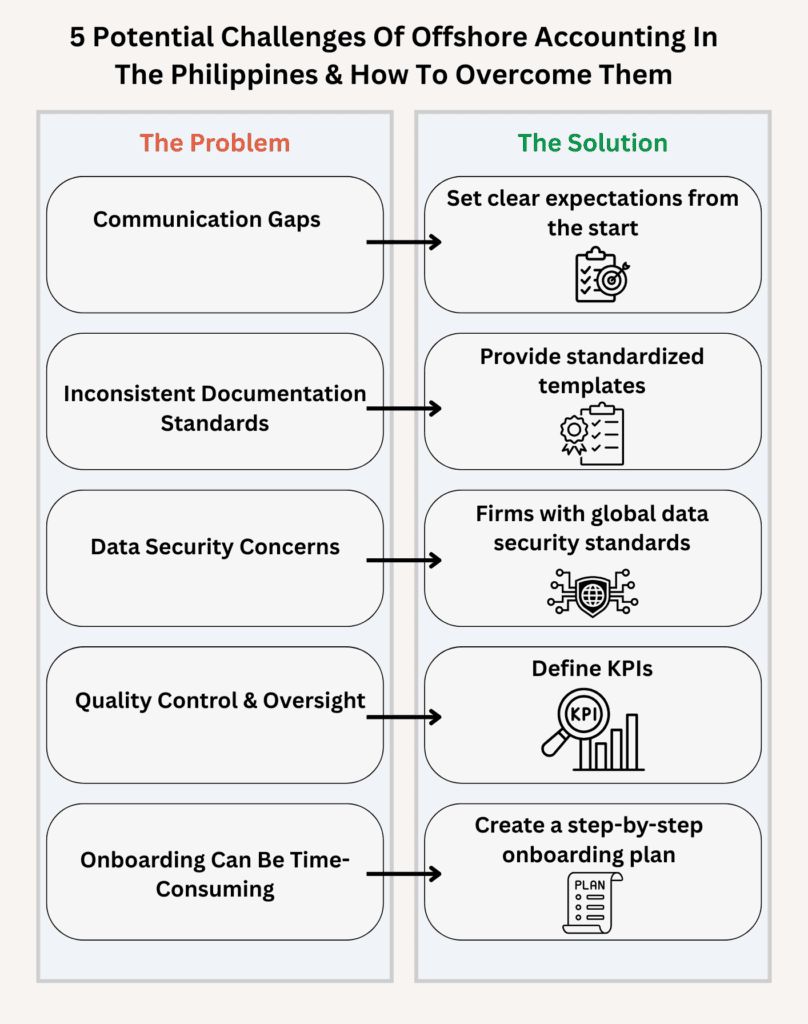
Keep an eye out for these possible roadblocks when working with offshore accounting teams in the Philippines:
1. Communication Gaps
While most Filipino accountants are fluent in English, miscommunication can still happen, especially when explaining financial nuances or deadlines.
How to Overcome It:
Set clear expectations from the start. Use shared documentation, recurring video calls, and project management tools like Asana or ClickUp to keep everyone aligned.
2. Inconsistent Documentation Standards
Different firms may use varying formats, naming conventions, or reporting templates, which can lead to confusion or delays in financial reviews.
How to Overcome It:
Provide standardized templates and naming conventions upfront. Walk your offshore team through your preferred documentation practices during onboarding and reinforce them with regular audits.
3. Data Security Concerns
Outsourcing accounting means sharing sensitive financial data, which raises privacy and compliance concerns.
How to Overcome It:
Partner with firms that follow global data security standards (like ISO 27001) and use encrypted software. Always require NDAs and ask about their data protection policies.
4. Quality Control & Oversight
Without in-person supervision, some worry the work might lack accuracy or consistency.
How to Overcome It:
Define KPIs, request regular reporting, and build a review system. Many top providers already have internal QA processes—verify this before hiring.
5. Onboarding Can Be Time-Consuming
Even experienced offshore teams need time to understand your internal systems, preferences, and workflows. Without structure, onboarding can drag on and lead to early frustration.
How to Overcome It:
Create a step-by-step onboarding plan with tool access, SOPs, reporting templates, and deadlines. Assign an internal point person to guide the offshore team during the first 30 days and review performance weekly to catch gaps early.
🔎 This Is Interesting
61% of businesses outsource their tax functions to ensure compliance and efficiency.
Conclusion
Offshore accounting Philippines might be the smartest move you make this year. Map out your pain points. Are you buried in late reports? Struggling to scale without hiring headaches? Start there. Pick a process like payroll or monthly reconciliations, and outsource it as a 30-day test. Use real metrics to evaluate the results: turnaround time, accuracy, and communication. If it works, scale. If it doesn’t, iterate.
Genius connects you with the top 1% of talent from the Philippines for up to 80% less. There are no bloated monthly fees or middlemen in the way, just direct access to elite candidates sourced through our local recruiting network.
And if you’re wondering about the risk, we’ve removed it. With our 6-month talent guarantee and a 100% refund if you don’t hire, you can move forward with confidence. Start building your high-performance offshore team today.
FAQS
Is the quality of accounting work in the Philippines reliable?
Yes, Filipino accountants are highly skilled, often trained in global standards like GAAP and IFRS. Many hold CPA certifications and have experience serving U.S., UK, and Australian clients through top outsourcing firms.
How long does it take to get started with an accounting team in the Philippines?
You can usually start within 5 to 10 days after signing an agreement and completing onboarding. Some firms also offer faster setup through pre-vetted, ready-to-deploy accounting professionals.
Is there a minimum contract length when outsourcing accounting to the Philippines?
Minimum contract terms vary. Some firms allow month-to-month flexibility, while others may require 3–6 months, especially for full-time roles or bundled service packages.
What qualifications should I look for in a Filipino accountant?
Look for a bachelor’s degree in Accountancy, CPA certification (if needed), and experience with accounting platforms like QuickBooks or Xero. Industry experience and knowledge of your country’s tax laws are also key.