
Hiring has been rough lately. Every time you post a job, it feels like setting money on fire. Local recruiters drain your budget, and your roles stay unfilled. That is where offshore RPO takes the front seat as a cost-efficient, scalable recruitment solution.
But what is that exactly?
If you have just started poking around the idea of offshore RPO but all you have found so far is corporate speak and zero clarity, you are in the right place. We will tell you what it is exactly, how it works, and whether this hiring model makes sense for your business.
TLDR: Everything About Offshore RPO At A Glance
- What Is Offshore RPO: Outsourcing recruitment to expert teams based in low-cost, high-talent countries like the Philippines or India. They handle sourcing to onboarding so you don’t have to.
- Why It Works: Cuts 60–70% of hiring costs, speeds up time-to-hire by over 40%, and gives you access to pre-vetted, global talent.
- Top Roles Filled: Tech (DevOps, backend), customer support, finance, marketing, remote operations, compliance, and admin.
- How It Works: 6-step system: kickoff → market mapping → sourcing → interviews → offers → onboarding. Fully managed.
- Best Use Case: You need 10+ roles filled, want 24/7 sourcing, or your local pipeline’s gone cold.
- Pricing Snapshot: $1,000–$3,500 per hire vs. $10K+ via US recruiters. Project, monthly, and per-stage options are available.
- Major Wins: Faster pipelines. Global reach. Zero ghosting. Lower costs. Flexible scale.
- When To Pass: You hire under 5 roles a year, need in-person culture syncs, or lack scorecards and review bandwidth.
What Is Offshore RPO (Recruitment Process Outsourcing) & How Is It Different From Onshore RPO?

Offshore RPO means handing off part or all of your recruitment process to a team based in another country—usually one where talent is strong and costs are lower. Instead of hiring, screening, and interviewing candidates yourself or through expensive local recruiters, you work with a remote team that does everything for you.
This model works best when you want to scale quickly, cut costs, or hire for roles that your local market struggles to fill.
How Offshore RPO Stacks Up Against Onshore RPO:
| Offshore RPO | Onshore RPO |
| Teams work from countries like the Philippines, India, or Eastern Europe | Teams are based in the same country as your business |
| Saves up to 60–70% in recruitment costs | Higher costs due to local salaries and overhead |
| Covers hard-to-fill or high-volume roles across global markets | Focuses on local market expertise and cultural match |
| Offers 24/7 support due to time zone differences | Works within standard business hours and time zones |
| Great for companies that need scalability, multilingual talent, or tech specialists | Best for roles that demand strong cultural context or compliance-heavy hiring |
Here Are Some More Reads You’ll Like
🎯 RPO Payroll Process: Benefits, Strategies, & Best Practices
🌟 How Much Does RPO Cost? 7 Pricing Models & Rates
💻 RPO Vs In House Recruitment: Pros, Cons, & Best Fit For You
How Offshore RPO Services Work: 6 Crucial Steps

Match your hiring pain points against each of these 6 steps to see how offshore RPO can help.
Step 1: Kickoff & Intake (Week 1)
Your offshore RPO partner digs into your business model, hiring goals, and what “great” looks like in a candidate. This step sets the stage for how they screen, source, and communicate moving forward.
What To Do:
- Pick 2–3 high-impact roles to start with. Use data, not gut feel.
- Share clear hiring volumes, timelines, and budget caps.
- Get on a 60-minute intake call with the offshore lead and your internal hiring manager.
- Hand over recent job descriptions and performance benchmarks.
- Flag any cultural or compliance quirks they need to know upfront.
Step 2: Job Planning & Market Research (Week 1-2)
The RPO team maps out the talent market, including supply, salary bands, and demand trends, and tweaks your job description so it speaks to real candidates. They also decide where to post, who to poach, and how to pitch.
What To Do:
- Approve or tweak the final job description version they send back (same-day turnaround).
- Set a target time-to-hire for each role (e.g., 21–30 days).
- Confirm 2–3 must-have and nice-to-have skills for each role.
- Approve the sourcing strategy, including channels, platforms, and messaging.
- Confirm your preferred tech stack for collaboration (Slack, Trello, ATS, etc.).
Step 3: Sourcing & Screening (Week 2-4)
Your RPO team starts sourcing at scale (think 3x the reach of a local recruiter) and filters candidates with resume reviews, phone screens, and skill tests. You only see profiles that meet your quality standards.
What To Do:
- Approve sample candidate profiles by Day 3 of sourcing.
- Set a daily or weekly limit on how many CVs you want to review.
- Review the pre-screen HR scorecard they use (ideally 4–6 key metrics).
- Ask them to flag passive candidates separately from active ones.
- Provide feedback within 24–48 hours so they can refine quickly.
Step 4: Interview Coordination (Week 3-5)
The offshore RPO schedules and confirms interviews across time zones, handles reminders, and manages rescheduling. You just show up and evaluate.
What To Do:
- Block 2–3 weekly interview slots in advance to keep momentum.
- Confirm which team members should be involved in each round.
- Use a shared tracker or dashboard to monitor interview stages live.
- Ask for weekly progress reports with time-to-fill projections.
- Request help prepping candidates on your company culture and expectations.
Step 5: Offer & Negotiation (Week 4-6)
Once you choose a candidate, the RPO team drafts and shares the offer, collects documentation, and handles basic negotiations. They bridge any gaps on salary, start date, or terms.
What To Do:
- Approve offer ranges and benefits upfront so there’s no delay.
- Set response deadlines to speed up decisions (24–48 hours max).
- Share the onboarding process so they can start prepping candidates early.
- Ask for a backup candidate in case the top choice drops out.
- Keep compensation discussions focused so the offer stays within your original budget.
Step 6: Onboarding & Handoff (Week 5-7)
Your offshore team supports onboarding and sends welcome packets, schedules training, and handles compliance checklists. They stay involved until your new hire is 100% settled.
What To Do:
- Provide your internal onboarding document or checklist in advance.
- Assign an internal buddy or manager to welcome the hire.
- Use one platform (e.g., Notion or ClickUp) for all onboarding steps.
- Ask the RPO team for a post-hire summary that highlights what worked and what didn’t.
- Send a 30-day check-in form to the new hire to spot any red flags early.
Pros & Cons Of Virtual Offshore RPO Services

Scan this list to figure out if recruitment process outsourcing (RPO) works in your favor and what could throw your hiring off track.
Offshore RPO Advantages
- Cut up to 60–70% in hiring costs: Save on salaries, infrastructure, and recruiter fees as you shift sourcing to high-skill, low-cost markets.
- Speed up hiring by 40% or more: Most offshore RPOs run 24/7 cycles with multiple sourcing channels, which cuts your average time-to-hire down to 2–4 weeks.
- Tap into deep, overlooked talent pools: Offshore partners can reach talent in emerging hubs like the Philippines, India, and Latin America, especially in tech, design, and support.
- Quickly scale recruitment up or down: You can launch a 10-role campaign one month and hit pause the next without long-term contracts or team layoffs.
- Improve sourcing quality for hard-to-fill roles: Specialized RPO recruiters know where niche skill sets hide. Think multilingual support, DevOps, and compliance analysts.
- Reduce internal recruiter burnout: Offshore teams can take over repetitive screening, sourcing, and coordination so your in-house team can focus on final interviews and hiring strategy.
- Leverage modern recruiting tech: Most top RPOs use advanced ATS, AI screeners, and automated workflows at no added cost to you.
- Flexible pricing models: You can pay per project, per hire, or monthly, depending on your hiring volume and budget cycle.
📢 Did You Know?
60% of companies say RPO boosts hire quality and speeds up hiring.
Challenges Of Offshore RPO
- Miscommunication due to time zones or language gaps
How to fix: Set core overlap hours and use async tools like Loom or Notion to keep feedback cycles on track. - Harder to control candidate experience
How to fix: Ask for visibility into their engagement process. Use call recordings, dashboards, or weekly recaps to stay in the loop. - Data security concerns
How to fix: Only work with partners that follow GDPR or your local data laws. Request a copy of their information security policies before you sign anything. - Not always suited for culture-first hiring
How to fix: Offshore RPO teams may miss subtle cultural cues if you don’t define your brand voice clearly. Run a short onboarding or playbook workshop upfront.
“Most companies are stuck between overpaying for local talent and gambling on low-cost freelancers. Offshore RPO wins on both speed and quality.”
—Burkhard Berger, Founder & CEO of Genius
12 Offshore RPO Best Practices: What Top Providers Do Differently & How To Confirm
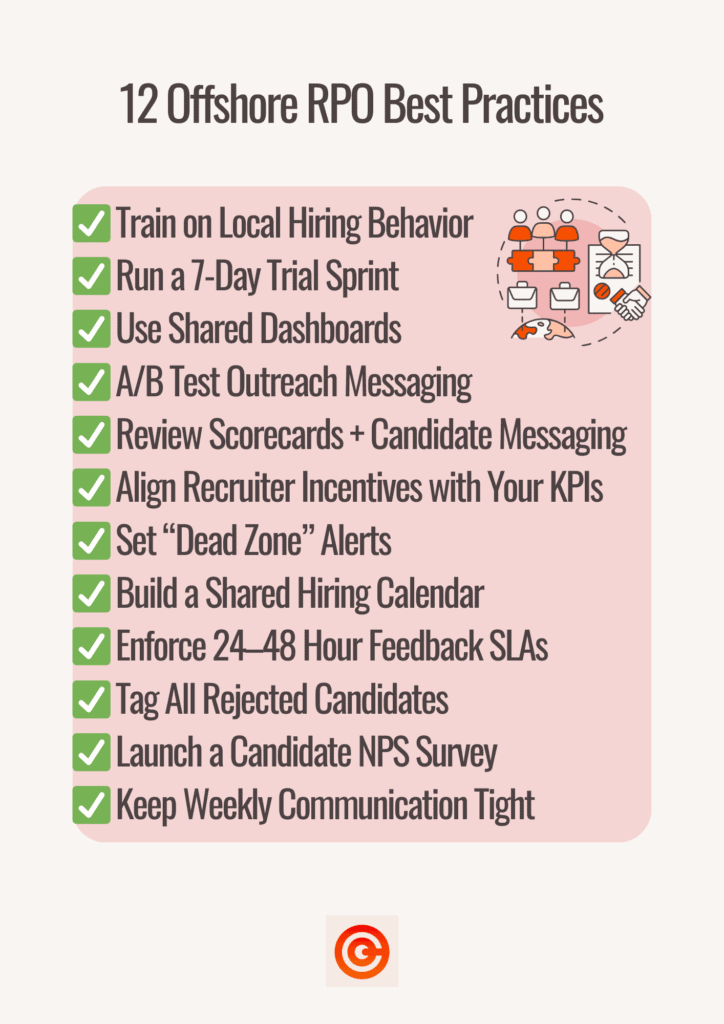
Run through this checklist to pressure-test your offshore RPO setup.
- Run pre-training on local hiring behavior: Ask how recruiters get trained on region-specific norms, salary expectations, drop-off trends, and red flags. This avoids early candidate mismatches.
- Test sourcing quality upfront: Request a 7-day trial sourcing sprint. Provide your job descriptions and measure volume, screening logic, and profile accuracy.
- Set up shared dashboards for live visibility: Great providers use tools like Notion, Trello, or Airtable. Ask for dashboards that show role-by-role status, conversion metrics, and where bottlenecks pop up.
- A/B test job pitches across channels: Smart offshore RPO teams test multiple messages, formats, and headlines across different job platforms. Ask for the data to see what actually works.
- Define custom scorecards and control messaging: You should review their candidate scoring system and outreach copy before launch. Make sure everything reflects what you value in a hire.
- Assign recruiter incentives based on your KPIs: Dig into how your provider motivates their team. If they’re rewarded for volume but you care about quality, you’ll feel the mismatch.
- Set dead zone alerts and review loops: Ask them to flag when a role stalls for too long. Pair that with a weekly check-in to fix slowdowns before they spiral.
- Draft a shared hiring calendar: Build a visual plan that flags upcoming volume spikes, role launches, and trial sprints. Keep it accessible so everyone stays in sync.
- Enforce 24-48-hour feedback SLAs: Set review deadlines for candidate submissions and use Slack or email nudges to keep things moving.
- Share candidate feedback data: Label every rejected candidate with a reason code. This tightens targeting and reduces duplicate misfires.
- Add a candidate NPS feedback loop: Track experience with 3-question surveys post-interview or post-hire. Review results with your RPO team monthly to fix issues early.
- Keep a tight communication rhythm: Use a 30-minute weekly call or async Loom video to review wins, red flags, and hiring volume. Avoid letting issues simmer for weeks.
When Offshore RPO Is The Right Move (And When It Isn’t)

Check your current hiring gaps, capacity, and urgency against these use cases before you go all in.
Offshore RPO Works Best When:
- You need to fill 10+ roles quickly, especially in tech, support, or operations.
- You want to hire for global, remote, or multilingual roles that aren’t easy to source locally.
- Your in-house recruiters are maxed out or stretched across too many roles.
- Your average cost per hire is $5K+ and you need to cut that down fast.
- You want 24/7 sourcing cycles without expanding your internal team.
- You’re in hypergrowth and can’t afford the ramp time for internal headcount.
- Your talent pipeline feels dry, and you’ve hit a wall with local sourcing channels.
Offshore RPO Isn’t The Right Fit When:
- You only hire a few roles a year and already have strong internal recruiters.
- You’re filling roles with heavy in-person interaction or local compliance hurdles (e.g., government, healthcare).
- You lack the internal capacity to manage feedback cycles, scorecards, or cultural onboarding.
- You want full control over every candidate touchpoint and don’t have clear hiring SOPs yet.
Offshore RPO Pricing Models & Realistic Benchmarks
This is what real offshore RPOs actually charge, what you’ll likely pay, and how fast those savings stack up.
| Model | How It Works | Typical Cost Range | Best For |
| Cost-Per-Hire (CPH) | Flat fee per role filled. Paid after hire is confirmed. | $1,000–$3,500 per role | Small to mid-volume hiring (5–25 roles/year) |
| Per Project | Fixed cost for a batch of roles over a fixed time. | $10,000–$30,000 for 5–15 roles | Department launches, market expansions |
| Monthly Retainer (Flat) | Ongoing fee for full-cycle delivery regardless of volume. | $5,000–$15,000/month for 1–3 recruiter pods | High-growth startups or 24/7 sourcing needs |
| Recruiter FTE Model | You “rent” a full-time recruiter or team. | $2,000–$4,500 per recruiter/month | Companies with in-house workflows that just need sourcing horsepower |
| Stage-Based Pricing | Pay per sourcing/screening/interview stage | $200–$800 per stage, per candidate | Niche hires where internal teams want more control |
Benchmark Snapshot
| Scenario | Offshore RPO | Traditional US Recruiting |
| Hire 10 roles at $2,000 each | $20,000 total | $100,000+ at 25% of a $40,000 salary |
| 1 full-time recruiter for 6 months | $15,000–$25,000 | $50,000+ with salary + overhead |
| One-off role sourcing + pre-screening only | $400–$600 | Often not offered by agencies |
How To Choose The Right Offshore RPO Provider
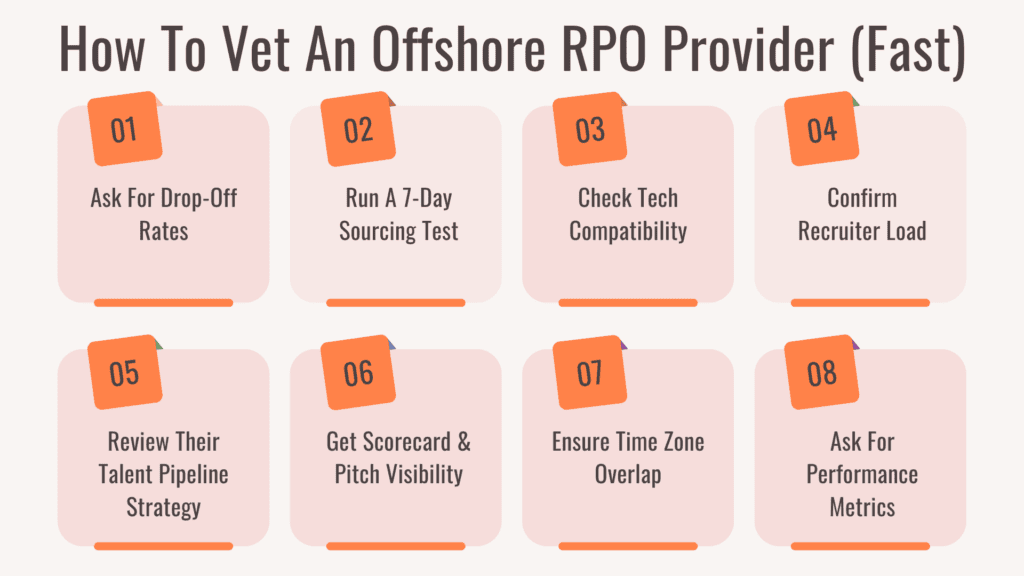
Pressure test RPO providers against this checklist before you commit.
- Ask for their drop-off rate across 3 recent clients. A strong provider keeps the candidate dropout rate under 15% from shortlist to offer. If they can’t show this, walk away.
- Request a 7-day trial sourcing sprint. Have them source for 1–2 roles using your current job descriptions. Track volume, quality, and screening logic. You’ll know in a week if they’re built for speed or fluff.
- Check if they work in your ATS or force theirs. Seamless collaboration depends on tech. If they can’t plug into Greenhouse, Lever, or your current CRM, you’ll lose time chasing updates.
- Confirm recruiter-to-role ratio. Ask how many recruiters will handle your account and how many roles each covers. Anything above 5 roles per recruiter usually leads to candidate quality issues.
- Dig into how they build talent pipelines. Look for providers who build candidate pools 1–2 quarters ahead using sourcing tech (e.g., LinkedIn Recruiter, GitHub, job boards, referrals). Ask to see a sample outreach campaign.
- Demand visibility into scorecards and messaging. If you can’t review their pre-screen criteria or how they pitch your role, you’ll quickly lose control of the candidate experience.
- Match their time zone overlap with your team’s schedule. Make sure there’s at least 2–3 hours of overlap daily so interview coordination and feedback loops don’t lag.
- Insist on real performance data instead of just logos. Ask for actual metrics from the past 6 months, like average time-to-submit, time-to-offer, acceptance rate, and replacement rate.
6 Types Of Offshore RPO Services To Choose From

Use this table to match your hiring needs with the right type of RPO outsourcing services.
| Offshore RPO Type | What It Covers | Best For |
| End-to-End Offshore RPO | Full-cycle support: sourcing, screening, interviews, offers, and onboarding. | High-volume or ongoing hiring where you want to outsource everything. |
| Project-Based Offshore RPO | Short-term or one-off hiring campaigns tied to a specific department or goal. | Startups, seasonal hiring, or launching a new product line or team. |
| Selective Offshore RPO | Offshore team only handles a slice of the process (e.g., sourcing or screening). | Internal teams that need help with bottlenecks or specific hiring stages. |
| On-Demand Offshore RPO | Plug-and-play support for urgent or unpredictable hiring spikes. | Businesses with inconsistent hiring flow or unplanned growth surges. |
| Hybrid Offshore RPO | Combines onshore and offshore teams to balance quality, speed, and cultural fit. | Teams that need cultural nuance but also want cost-effective delivery. |
| Contingent Offshore RPO | Focused exclusively on short-term, freelance, or contract-based roles. | Companies that want to manage large contract workforces or scale with flexible staff. |
Offshore RPO Vs Traditional Recruitment Methods: Quick Overview
Run this side-by-side comparison between offshore RPO vs staffing agencies vs in-house recruitment before you renew your contract with a local staffing agency or expand your in-house team.
| Offshore RPO | In-House Recruitment | Staffing Agencies | |
| Cost Efficiency | Adds short-term volume, but hard to scale long-term or with consistency | High overhead (salaries, tools, training, etc.) | Markups of 25–100% per hire |
| Speed To Hire | 2–4 week hiring cycles with 24/7 sourcing pipelines | Slower, limited by internal bandwidth | Faster for temp roles but inconsistent for niche roles |
| Candidate Quality | Pre-vetted global talent, often with domain expertise | Strong cultural fit but limited sourcing reach | Depends on agency quality; often hit or miss |
| Flexibility & Scalability | Easily scales up or down based on need with project, contract, or volume hiring | Hard to scale quickly; tied to team size and capacity | Shared ownership, clear KPIs, and visibility through dashboards |
| Technology & Tools | Comes with modern ATS, automation, AI screeners at no extra cost | Needs heavy investment in tools and tech licenses | Basic ATS or CRM, often outdated |
| Control Over Process | Shared ownership, clear KPIs and visibility through dashboards | Full control but limited throughput | Little visibility; agency owns most of the process |
| Best Use Case | High-volume, tech, support, or global roles with tight deadlines | Strategic hires, C-suite, or culture-heavy roles | Temp staffing, quick backfills, short-term freelance or hourly roles |
ℹ️ Interesting Fact
36% of employers don’t have a structured onboarding process.
7 Common Global Offshore RPO Myths Debunked
Gut-check these 7 myths before you write off offshore RPO.
Myth 1: It’s only good for low-skill roles.
- Fact: Top companies now use offshore RPO for high-skill roles in tech, finance, and engineering.
Myth 2: Time zones slow everything down.
- Fact: Structured overlap and async tools fix this fast.
Myth 3: Quality takes a hit.
- Fact: Leading RPOs use skill-based tests and multi-step interviews.
Myth 4: It’s not secure.
- Fact: Reputable partners follow ISO 27001, SOC 2, or GDPR rules.
Myth 5: It slows hiring.
- Fact: Offshore RPO can cut time-to-hire by up to 40%.
Myth 6: They won’t get our culture.
- Fact: Behavioral interviews and custom onboarding bridge the gap.
Myth 7: You lose control.
- Fact: Real-time dashboards and weekly reports keep you in charge.
Offshore RPO Trends To Watch In 2025 & Beyond
As you plan your hiring strategies, consider these 5 emerging offshore RPO trends that can enhance your RPO’s talent acquisition services.
1. Shift To Hyper-Specialized RPO Pods
Instead of generic delivery teams, providers now build pods around tech stacks, job families, or departments. This speeds up shortlisting and reduces handoffs. Ask if your provider assigns fixed pods based on domain, not availability.
2. Embedded DEI Protocols In Candidate Screening
Top RPOs use blind screening and inclusive job descriptions to remove unconscious bias at scale, especially in global searches. Request DEI audit results from your RPO or ask to review their screening criteria.
3. Real-Time Visibility Through Shared Dashboards
More offshore RPOs now build live dashboards in Notion, Trello, or Airtable so clients can track progress, bottlenecks, and conversions in real time. Ask for role-level dashboards with time-to-fill, CV-to-interview, and drop-off metrics.
4. AI-Driven Candidate Rediscovery
Smart offshore teams now scrape old databases to resurface talent that fits new roles, which speeds up hiring by 25–35%. Push for “past applicant mining” as part of your sourcing strategy.
5. Surge In Offshore RPO For Growth-Stage Startups
Startups and post-Series A companies now rely on IT RPO firms to scale fast without ballooning internal HR. Use project-based RPOs to test velocity before you scale to end-to-end.
“If a recruiter sends you 50 resumes but none of them fit, they didn’t save you time; they cost you hours. Offshore RPO ensures you only see the candidates you’d actually hire.”
—Christian Cabaluna, Senior Recruiter at Genius
How To Transition From In-House To Offshore RPO Without Disruption
Use this step-by-step roadmap for a seamless shift.
Step 1: Conduct A 30-Day Trial Sourcing Sprint
Before fully committing, initiate a trial period where the offshore RPO partner sources candidates for select roles. This allows you to evaluate their capabilities, assess the quality of candidates, and identify any potential challenges in collaboration.
Step 2: Shadow Current Recruiters for 1–2 Roles
Have the offshore team observe and collaborate with your in-house recruiters on a couple of ongoing roles. This hands-on experience helps them understand your company’s culture, values, and specific hiring nuances, which ensures better alignment in candidate selection.
Step 3: Gradually Transition By Department Or Role Type
Instead of an immediate, company-wide shift, transition to offshore RPO services in phases. Start with specific departments or role types to monitor the process and make necessary adjustments. This minimizes disruptions to your overall operations.
Step 4: Establish Weekly Syncs During the First 60 Days
Set up regular weekly meetings with the offshore team during the initial 2 months. These sessions offer a platform to address concerns, share feedback, and ensure both parties align on objectives and expectations.
💭 Food For Thought
65% of companies use AI in their hiring process.
Offshoring RPO To The Philippines: RPO Services With A Spin Ft. Genius

Most offshore RPOs save you cash but drain your time with junk resumes, ghosting, or culture misfires. Genius flips that. You get all the cost savings, speed, and global reach without any of the usual chaos of offshore outsourcing companies. Here’s what we do differently:
- Top 1% remote talent from the Philippines and LATAM, rigorously vetted for skills and values.
- One-time 25% fee—no retainers, no recurring costs, no strings.
- Hires ready in 5–7 days, not 5–7 weeks.
- Built-in culture screening so you don’t waste time on poor fits.
- 6-month talent guarantee so you can replace hires free of cost without any stress.
Conclusion
If offshore RPO felt like your golden ticket but ended up being another buzzword parade, you’re not imagining things. You just needed the real fix—not another bloated vendor with templated emails and mystery resumes. Genius strips out the fluff. No “solutions” decks. No bait-and-switch recruiters. Just A+ remote talent, handpicked, pre-vetted, and ready to work in your time zone for 80% less than you’re probably paying now.
Tell us what you need and we’ll show you the top 1% within days.
FAQs
What types of roles are best suited for Offshore RPO?
Offshore RPO is effective for various roles, including IT positions, customer support, and administrative functions, especially those that can be performed remotely.
What Are Offshore IT RPO Services?
Offshore IT RPOs specialize in sourcing and screening tech talent like engineers, DevOps, and analysts from global hubs such as the Philippines and India. Expect faster submissions (3–5 days), deeper technical vetting, and built-in compliance for remote hires.
How is data security managed in Offshore RPO engagements?
Providers implement strict data protection protocols and comply with international standards to safeguard sensitive information during the recruitment process.
What is the typical duration of an Offshore RPO engagement?
Engagements can vary from short-term projects to long-term partnerships, depending on the company’s hiring needs and agreements with the provider.