
Designers are often hired for one of two traits. The first is polish: a portfolio of beautiful screens that nobody on the engineering team ever had to defend. The second is agreeableness: someone who says yes to every build constraint until the design quietly becomes whatever was easiest to ship. Neither reliably gets a good design built.
This guide explains how to source designers who can win engineers over without giving the design away. We read the topic as “without losing the design”, meaning its intent and quality. The guide covers what selling to engineers really means, what you must protect, where to find candidates, how to read rationale in a portfolio, what handoff format has to do with it and how to test the skill before you hire. It ends with a table of warning signs. We found no study showing which designers persuade engineers best or which sourcing channel finds them, so treat this as practical reasoning built on related research. It is general information, and the right profile depends on your product and team.
What “Selling to Engineers” Actually Means
Selling here does not mean a pitch. It means getting agreement on trade-offs: why this interaction matters, what can change and what cannot. The research suggests the gap between design and build is where designs get lost.
A 2023 CHI paper by Kevin Feng, Tony Li and Amy Zhang at the University of Washington surveyed 114 UX practitioners at US software organisations. Most of them (92%) shared work with developers. Among respondents, 86% said it was important for the built product to match the design closely, yet 57% saw the two diverge sometimes and 26% almost always. After a divergence, 41% updated their designs to match what had been built. The sample is US-only, mostly designers and self-reported, and the survey is descriptive, so it cannot say why designs diverge. It does show that the design often bends to the build, not the other way round.
Vendor surveys point the same way, with caveats. Telerik, which sells UI tools, reported in 2024 that at least 65% of respondents had challenges in their design-to-development process, and that one in four developers had no designer assigned to their project. The post gives no sample size or method. If you want help with the design side of the search, the guide to hiring an app designer covers that profile.
Decide What Must Not Be Lost
Before you source anyone, write down what the designer will be asked to protect. A useful list has three layers: behaviour that users depend on, such as how a form validates or how an error recovers; the visual system that keeps the product consistent; and accessibility, such as contrast and keyboard use. Then list what can flex, such as spacing on a rarely used screen or an animation that is expensive to build.
This list does two jobs. It tells candidates what the role defends, and it gives interviewers something to score against. Put each item on an HR scorecard so every interviewer rates the same things. A designer who cannot tell you which items are fixed and which can bend is not ready to negotiate with an engineer.

Where to Source Designers Who Can Do This
The best place to start is people who have already shipped alongside engineers: product designers at companies with embedded design and engineering teams, designers who have worked in design system or front-end-adjacent roles, and freelancers whose past clients were engineering-led. Referrals from engineers are useful, because an engineer can tell you whether a designer was easy to work with and whether the design survived. A specialist recruiter can shortlist for you, and the guide to talent sourcing tools covers ways to organise the search.
None of these channels has been shown to produce better results than the others. We looked for evidence and found none, so judge each channel by what it gives you: candidates who can describe specific projects, the engineers they worked with and what changed between design and build. Screen for that early. A candidate who can only describe final visuals belongs in a different role.
Read the Rationale, Not Just the Polish
A portfolio shows what a designer made. It rarely shows how they would defend it to someone who disagrees. To read that, look for rationale.
Research on engineering design reports gives a simple frame. In a 2024 paper in Design Science, Yakira Mirabito and colleagues at UC Berkeley analysed 846 pages of student reports from 28 teams and five industry reports. They describe clear rationale as three elements together: the feature being justified, the requirement it serves and the evidence that informed the decision. Of the 28 student reports, 22 contained clearly communicated rationale, yet 27 also contained rationale coded as missing information.
The earlier 2022 study by Mirabito and Goucher-Lambert found that designers often fill gaps in their reasoning with assumptions. The samples are mostly students at one university and the documents are engineering reports, not UX handoffs, so treat the frame as a checklist and not a measurement.
Apply it to every case study you read. Ask what the feature was, what requirement it served and what evidence showed it worked. A candidate who can answer all three from memory is likely to give an engineer a reason to agree, and one who cannot may rely on taste.

Hand Engineers Something They Can Own
How a design reaches engineering matters as much as how it is argued. If engineers must rebuild the design from a static file, details get lost. If they receive something they can read, run and keep working in, the argument is easier.
Bravo Studio offers one answer, and its claims are the vendor’s own. Its Bravo MCP page says designers tag frames in their design tool as screens, lists, forms or actions, and that the tool reads those tags to build the app. It says the tagged design becomes the app with “no handoff doc, no rewrite”, and that Bravo will export a clean React Native codebase that you fully own, which you can push to GitHub and hand to a developer. The homepage lists Bravo MCP as a beta. The page offers no sources, benchmarks or user figures, so quality, cost and time savings are unverified, and the page says nothing about hiring. Standard Bravo Studio builds are native and do not include source code, so the export applies only to the MCP route.
The point for hiring is general. Ask candidates how they hand work over: whether engineers get one artifact they can follow, how behaviour is annotated and whether the design can be checked against the build. The CHI survey found that full design files confused developers, who could wander to unrelated screens, and that designers relied on text annotations because developers often missed comments. A designer who has solved that problem loses less in translation.
Test It With a Handoff Role-Play
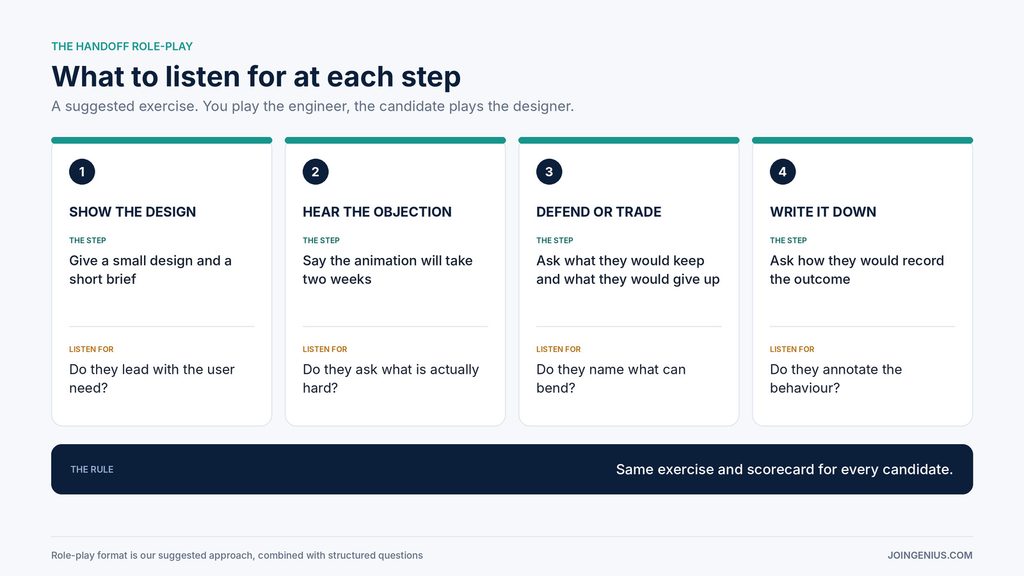
Interviews can reveal reasoning, but a short exercise reveals behaviour. Give the candidate a small design and a realistic engineer’s objection, such as “this animation will take two weeks to build”. Play the engineer. Watch what the candidate does. Do they state the reason, ask what is actually hard, offer an alternative and say what they would give up? Do they write the outcome down?
A 2022 article by Paul Sackett and colleagues in the Journal of Applied Psychology, summarised in SIOP’s TIP, estimated that structured interviews had a mean validity of .42 and work sample tests .33 for predicting job performance. These are averages across many jobs, not figures for designers. The practical reading is to combine both: ask every candidate the same questions about past handoffs, then add the role-play. A consistent interview guide keeps questions comparable, and interview feedback examples help interviewers record evidence rather than impressions.
Score Fairly
Score each candidate on the same criteria, and score independently before you compare notes. Awareness of interviewer bias matters here, because a fluent speaker can look persuasive without protecting anything. Check the result against the scorecard you wrote earlier, not against how the conversation felt.
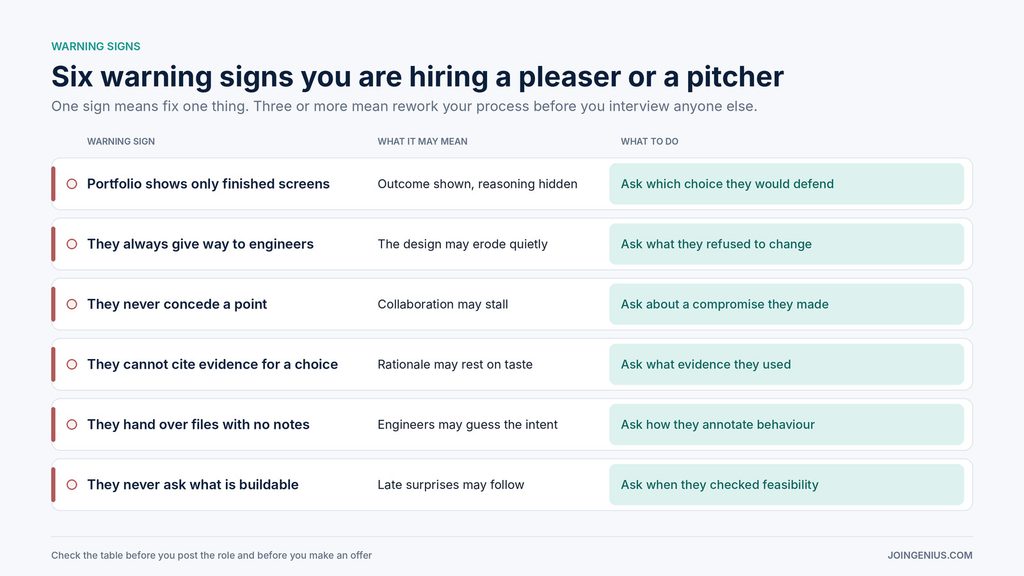
Warning Signs You Are Hiring a Pleaser or a Pitcher, and What to Do About Each
Check this table before you post the role and again before you make an offer. One sign means fix one thing. Three or more mean pause and rework your process before you interview anyone else.
Hire for the Reasoning
The designer worth sourcing is the one who can explain why a decision matters, say what can bend and leave engineers with something they can build from. Write down what must not be lost, read rationale in every case study, check the handoff and test it in a role-play. If the scorecard, the exercise and the references agree, you are probably hiring someone who can protect the design and still get it built.