Partnership managers are easy to hire for the wrong skill. A candidate who sends hundreds of polite messages, builds tidy creator lists and talks fluently about reach can look like the answer. Yet the job that matters is turning a reply into signed terms: agreeing rates, deliverables and usage rights, and getting them in writing. That is closing, and it is a different skill from sourcing creators.
This guide explains how to source partnership managers who actually close creator deals. It covers what the role involves, where to find candidates, how to define closing before you hire, how to test negotiation skill, what interview research suggests and what to check on compliance and references. It ends with a table of warning signs. We found no study showing which sourcing channel produces better closers, so treat the advice as practical reasoning rather than a statistical claim. It is general information, and the right profile depends on your deal types and budget.
What a Partnership Manager Actually Does
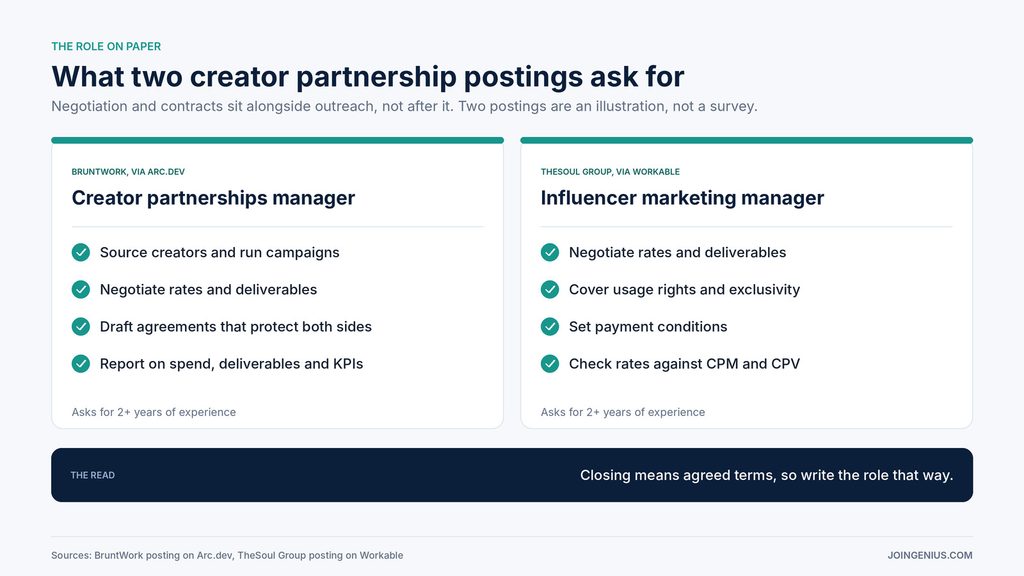
Job postings show how companies write the role down. BruntWork’s posting for a creator partnerships manager, listed on Arc.dev, asks for a track record of “sourcing creators, negotiating deals, and running campaigns from brief to final report”. It expects the person to “negotiate rates and deliverables, and draft agreements that protect both the client and the agency”, to handle usage rights and to report on spend and performance. TheSoul Group’s posting for an influencer marketing manager, listed on Workable, asks for someone who will “negotiate influencer partnership terms, including rates, deliverables, usage rights, exclusivity, and payment conditions” and evaluate proposed rates against benchmarks such as CPM and CPV. Both ask for at least two years of experience.
Two postings are an illustration, not a survey. They do show that negotiation and contracts sit alongside outreach in the role, not after it. If you also hire for sales-style closing elsewhere, the guide to hiring a sales representative covers a related profile.
Where to Source Candidates
Because both postings ask for around two years of campaign experience, the first place to look is people who have already run creator deals, either in-house at a brand or at an agency. A specialist marketing recruitment agency can shortlist for you, and your own network and referrals will often surface people whose closing record someone can vouch for. Searching professional networks for current partnership and influencer roles at brands like yours, and reading what those people say about their deals, gives you a longer list. The guide to talent sourcing tools covers ways to organise that search.
None of these channels has been shown to produce better closers than the others. We looked for evidence and found none, so judge each channel by what it gives you: candidates who can describe specific deals. Whichever channel you use, screen for signed deals early. A candidate who can only describe outreach volume belongs in a different role.
Define Closing Before You Hire
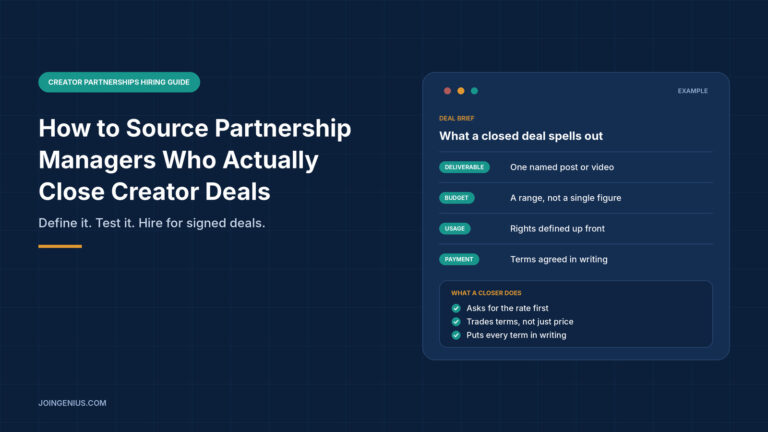
Before you write the job description, decide what closed means. A reasonable definition is agreed terms in writing: a named deliverable, a rate or range, usage rights, payment conditions and a date. The postings above mention flat-fee, affiliate and gifting deals, and each closes differently. A gifted deal may need little more than a clear request, while a paid deal with usage rights needs real negotiation. Say which types the role will handle and who owns the budget.
Then turn that definition into criteria you can score, such as asking for the creator’s rate first, handling usage rights, documenting terms and reporting on results. An HR scorecard keeps those criteria in front of every interviewer.
Test Negotiation Skill: What Closing a Creator Deal Actually Involves
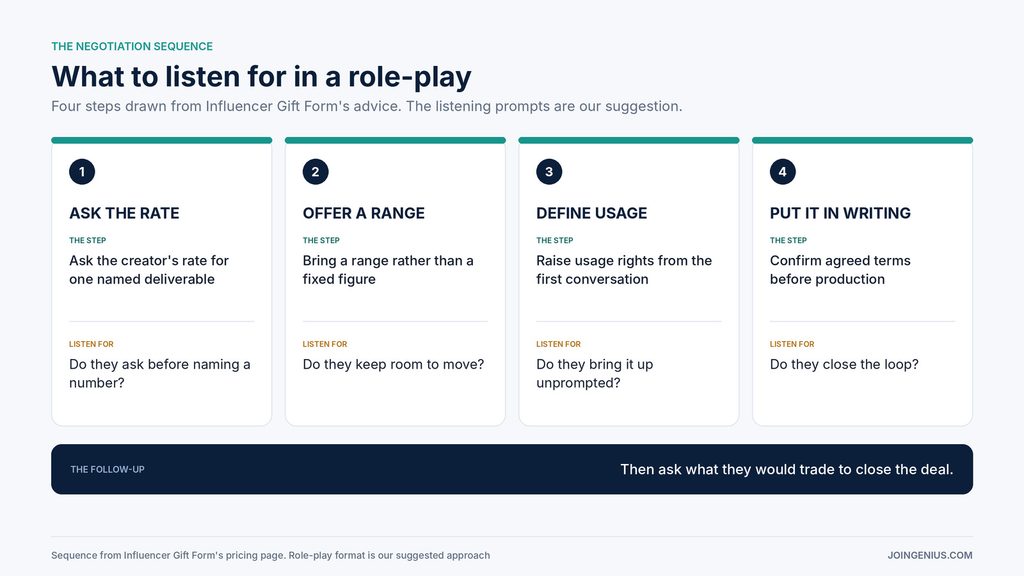
Negotiation is where closers separate from senders, so test it directly. Influencer Gift Form sells a Shopify gifting app, and its page on how much micro influencers charge gives a useful picture of what a deal conversation involves. It advises asking the creator for their rate on a specific deliverable before stating a budget, then bringing a range rather than a fixed number. It also says to define usage rights from the first conversation and to get the agreed terms in writing before production. The page gives rate ranges by tier and format, but most are unsourced, so use it as one vendor’s advice on process rather than a benchmark. It does not say who on a brand team should negotiate or how to hire for it, so the hiring argument here is ours.
Turn that sequence into a role-play. Play a creator with a rate in mind and a question about usage rights, and give the candidate a budget range and a deliverable. Watch what they do first. Do they ask for your rate before naming a number? Do they offer a range? Do they bring up usage rights without being asked? Do they finish by confirming the terms in writing? Afterwards, ask what they would have traded to close, such as a longer timeline, product on top of a fee or narrower usage rights. A candidate who has genuinely negotiated should be able to name a trade-off, so a blank here is worth noting.
Use What Interview Research Says
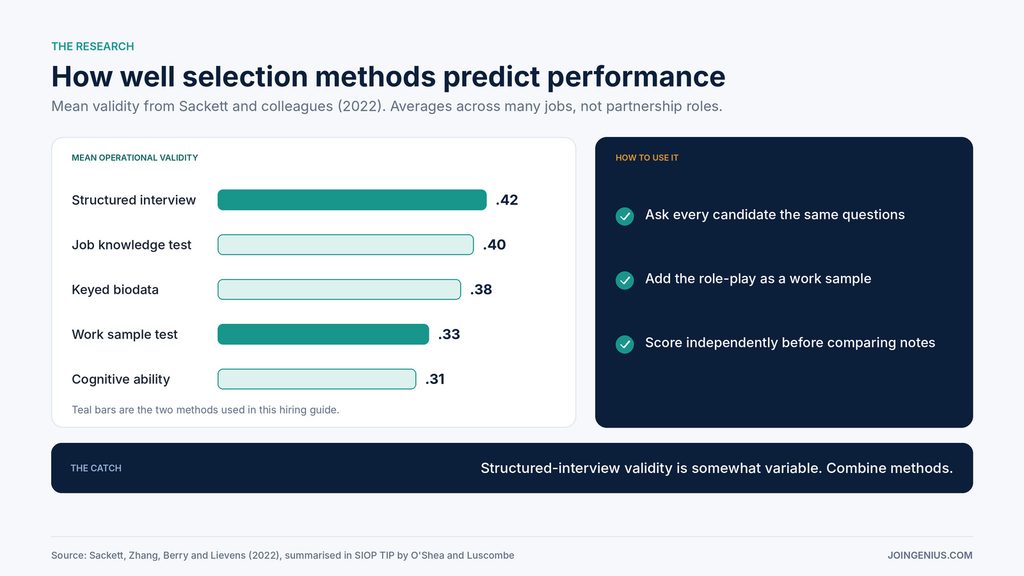
Interview method matters as much as the questions. A 2022 study by Paul Sackett and colleagues in the Journal of Applied Psychology, summarised in SIOP’s TIP by HumRRO researchers, re-estimated how well common selection methods predict job performance. Structured interviews ranked first with a mean validity of .42, ahead of job knowledge tests at .40, empirically keyed biodata at .38, work sample tests at .33 and cognitive ability at .31. The summary notes that structured-interview validities are “somewhat variable”, and these are averages across many jobs, not figures for partnership roles.
The practical reading is to combine methods. Ask every candidate the same structured questions about deals they have closed, then add the role-play as a work sample. Score each against the same scorecard, and score independently before you compare notes. A consistent interview guide helps, and awareness of interviewer bias helps panels avoid favouring the candidate who simply talks well.
Check Compliance Awareness
A partnership manager does not need to be a lawyer, but should know that gifted and paid posts usually need disclosure. In November 2019 the US Federal Trade Commission released “Disclosures 101 for Social Media Influencers”, and its press release said the guidance underscores that the responsibility to make disclosures about endorsements lies with the influencer. The release summarises existing guidance, is several years old and does not address how brands should monitor posts. Rules differ outside the US.
In interviews, ask how the candidate makes sure creators know what to disclose and where that appears in their agreements. Influencer Gift Form’s contract guide, for example, lists FTC disclosure and content usage rights among seven clauses it considers essential. The answer you want is a habit of putting expectations in writing and checking with counsel on anything unclear. This is not legal advice, and you should have your own counsel review your templates.
Reference and Trial Checks
References are most useful when they are specific. Ask a former manager which deals the candidate closed, on what terms and what they gave up. If the budget allows, a short paid trial project, such as sourcing three creators and negotiating one through to agreed terms, shows how the person works under real constraints. Interview feedback examples can help interviewers record evidence rather than impressions.
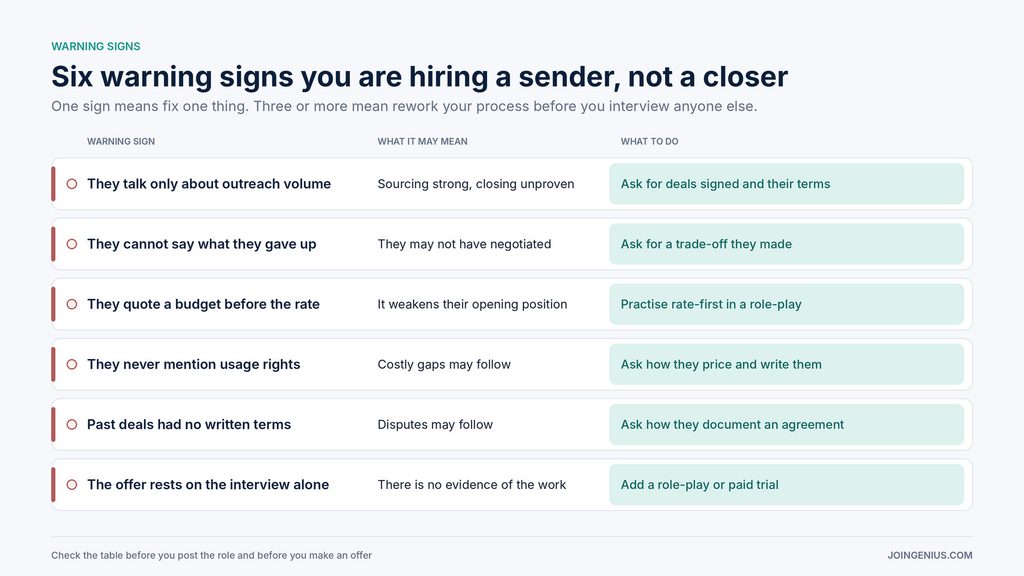
Warning Signs You Are Hiring a Sender, Not a Closer, and What to Do About Each
Check this table before you post the role and again before you make an offer. One sign means fix one thing. Three or more mean pause and rework your process before you interview anyone else.
Hire for Signed Deals
The best partnership manager is the one who can turn a reply into agreed terms. Define closing, source people who can describe real deals, test the negotiation in a role-play and check what they say against references. If the scorecard, the exercise and the offer all point at signed terms, you are probably hiring a closer.