Scrum certification myths are a big reason good candidates skip the exam and bad candidates waste a month of weekend study. Hiring managers interview the wrong people. Seven of these myths repeat in every Reddit thread. The data from recent industry reports says most are wrong.
This piece walks through all seven and cites the numbers behind each. It names the certs that actually matter for the role you want. The goal is not to sell you a course. It is to give you the shortest path to the hiring manager. Start from recent leadership development data, not vendor blogs.
Why These Scrum Certification Myths Won’t Die
Scrum certification myths persist because they contain a grain of truth from 2015. The grain has not been true for a decade, but the Reddit threads repeat the 2015 version.
The 2015 Version Of The Advice Is Still Online
Most of the myths in this piece are version-locked. They were accurate when there was one dominant scrum cert and one dominant exam format. Both of those conditions changed by 2020. The advice online still lives in the year it was written, which is why your search results are a decade of average opinions on a market that has moved.
A candidate reading Reddit threads from 2015 to 2026 gets a seven-year average opinion on a market that has split into four certification tracks. The average is wrong for every specific track. The myths come from reading the average instead of the current version.
Hiring Managers Still Quote The Myths
Even hiring managers repeat the myths back to candidates. They screen for the wrong credential or dismiss the right one. Many still ask about years of experience the role does not actually require, which is a holdover from the Scrum Master job description that was recycled across companies five years ago.
This gets worse for junior and career-switcher candidates, because they do not have the confidence to push back on a bad screen. The myths lock them out of the first round. The piece below gives you the counter-argument for each myth with a cite you can send back.
The Numbers Behind The Scrum Certification Market
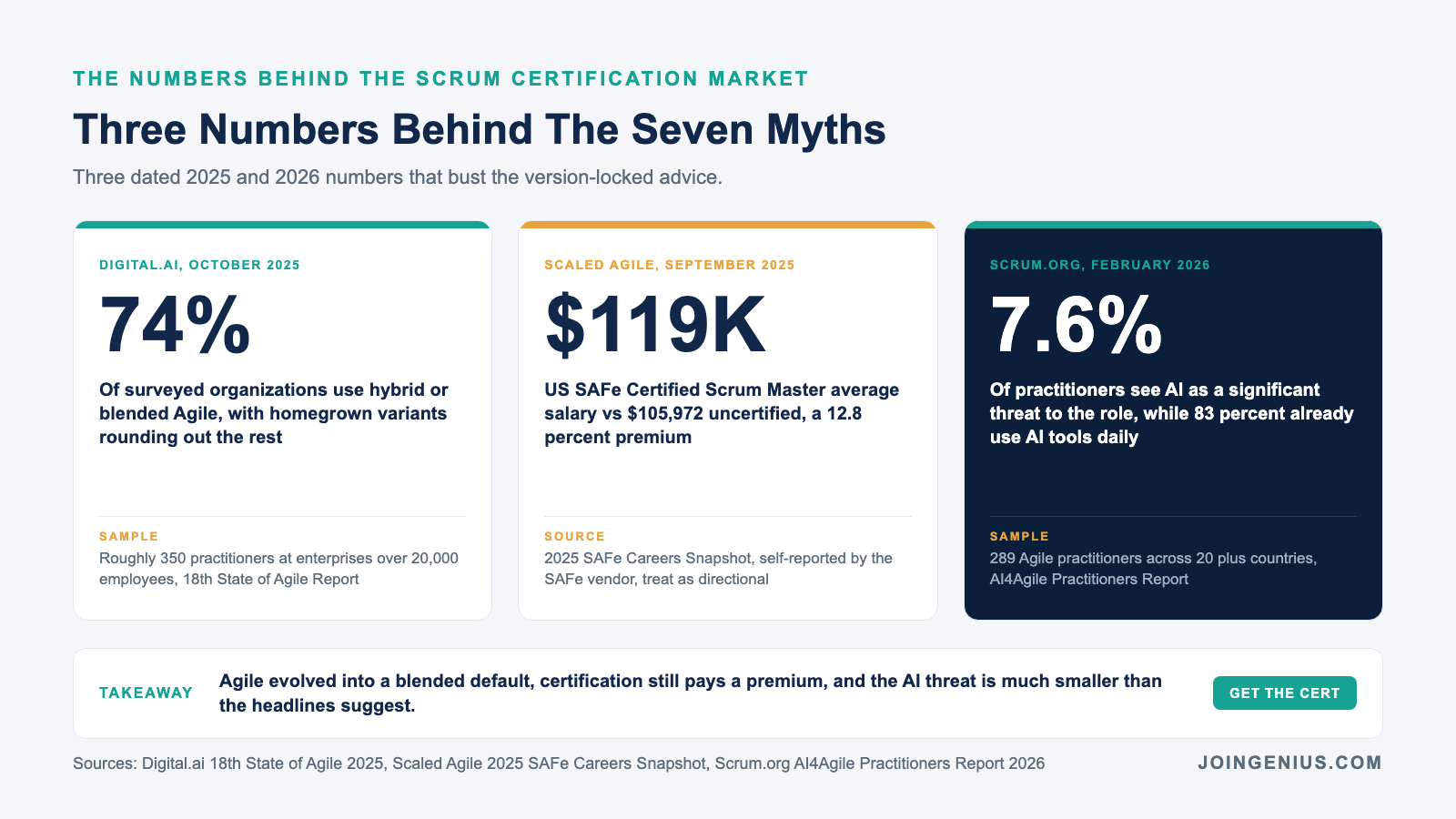
Three recent industry reports reset the baseline. Agile is still dominant and certification still pays. The AI threat the practitioner community actually fears is much smaller than the LinkedIn headlines suggest.
The Digital.ai 18th State of Agile Report, summarized October 28, 2025, found 74 percent of surveyed organizations use hybrid or blended Agile approaches, with homegrown variants rounding out the rest. The sample was roughly 350 practitioners at enterprises over 20,000 employees. Agile is not dying. It evolved into a blended default across the industry.
Scaled Agile’s 2025 SAFe Careers Snapshot, published September 2, 2025, reports a US SAFe Certified Scrum Master average salary of $119,500 versus $105,972 for an uncertified Scrum Master. That is a 12.8 percent premium for the SAFe credential. Scaled Agile is the vendor behind SAFe, so treat the number as directional, not audited.
Scrum.org’s AI4Agile Practitioners Report, published February 8, 2026, surveyed 289 Agile practitioners across 20 plus countries. Only 7.6 percent see AI as a significant threat to their role. 83 percent already use AI tools in their daily Agile work, and the top perceived benefit is increased productivity on sprint-level ceremonies.
The Seven Scrum Certification Myths
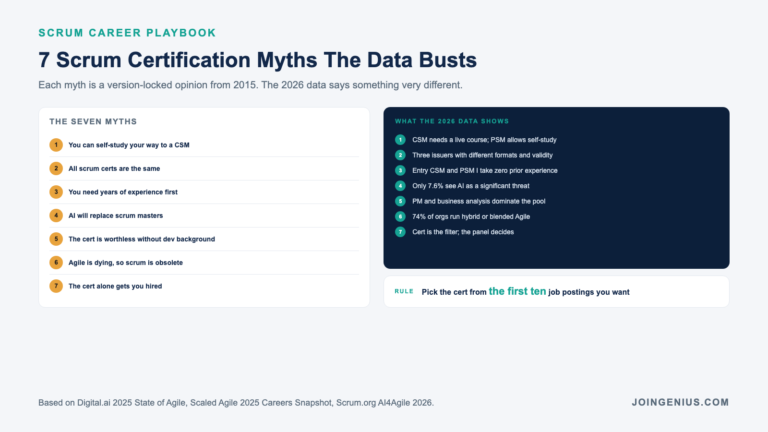
Each myth below gets one counter-paragraph. None of them survive the current data, and none of them should survive your next search.
Myth 1: You Can Self-Study Your Way To A CSM
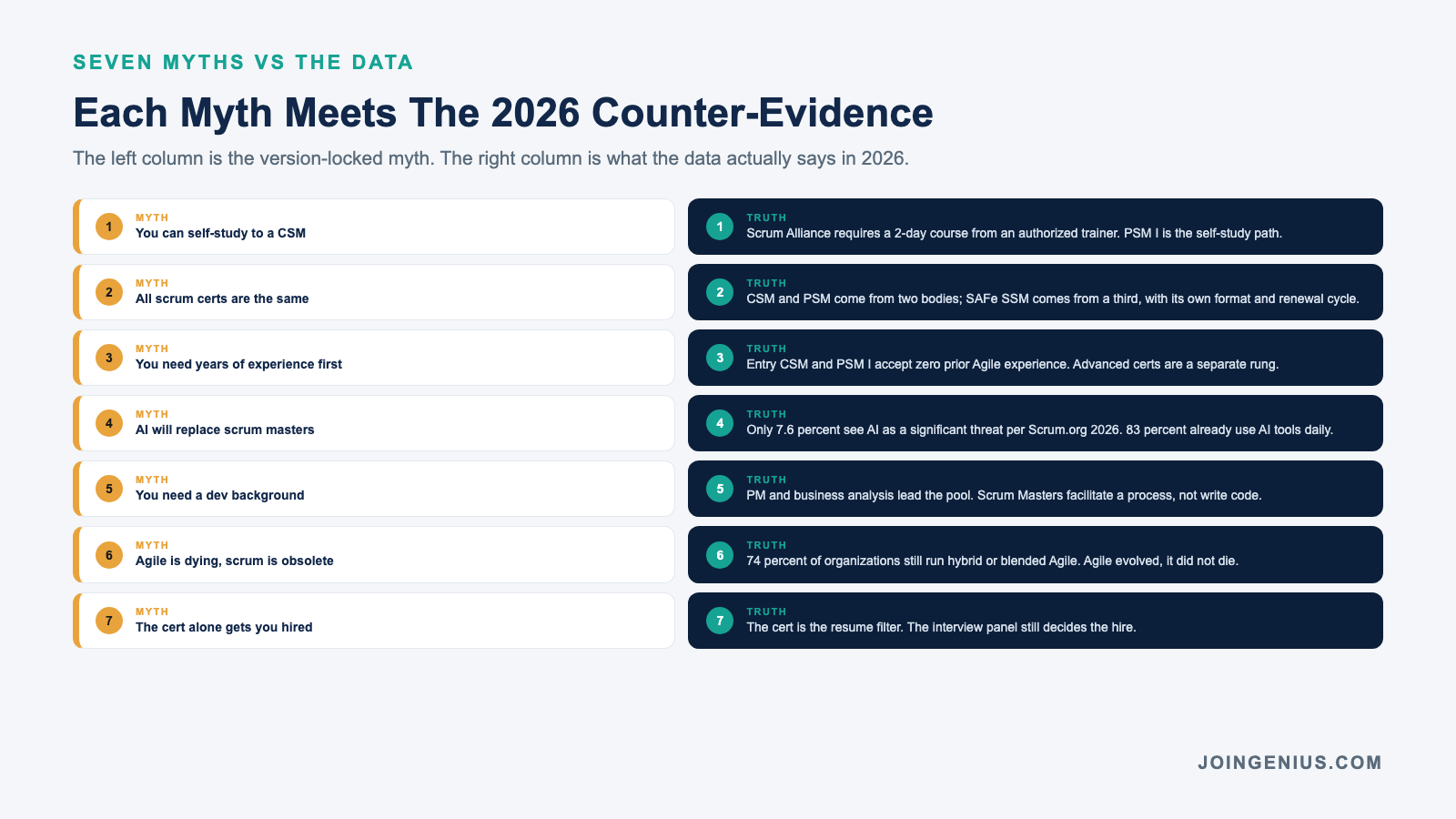
False for the Certified ScrumMaster specifically. Scrum Alliance requires that the candidate attend a 2-day course from a Scrum Alliance-authorized training partner before sitting the 50-question exam. A global online training provider like StarAgile is one Scrum Alliance partner that runs those two days as a live cohort, which is what the CSM training requirement actually looks like.
Self-study is possible for Scrum.org’s PSM I exam, which has no course requirement. Mixing the two tracks up costs candidates a wasted exam fee and a wasted month of weekend study.
Myth 2: All Scrum Certs Are The Same
False. CSM and PSM come from two different bodies, and SAFe SSM comes from a third. Each has a different format. The table below shows the key differences that matter when you pick which one to study for first.
| Cert | Issuer | Format | Validity |
|---|---|---|---|
| CSM | Scrum Alliance | 2-day course required plus exam | 2 years, renewable |
| PSM I | Scrum.org | Self-study plus exam, no course required | Lifetime, no renewal |
| SAFe SSM | Scaled Agile | 2-day course required plus exam | 1 year, renewable |
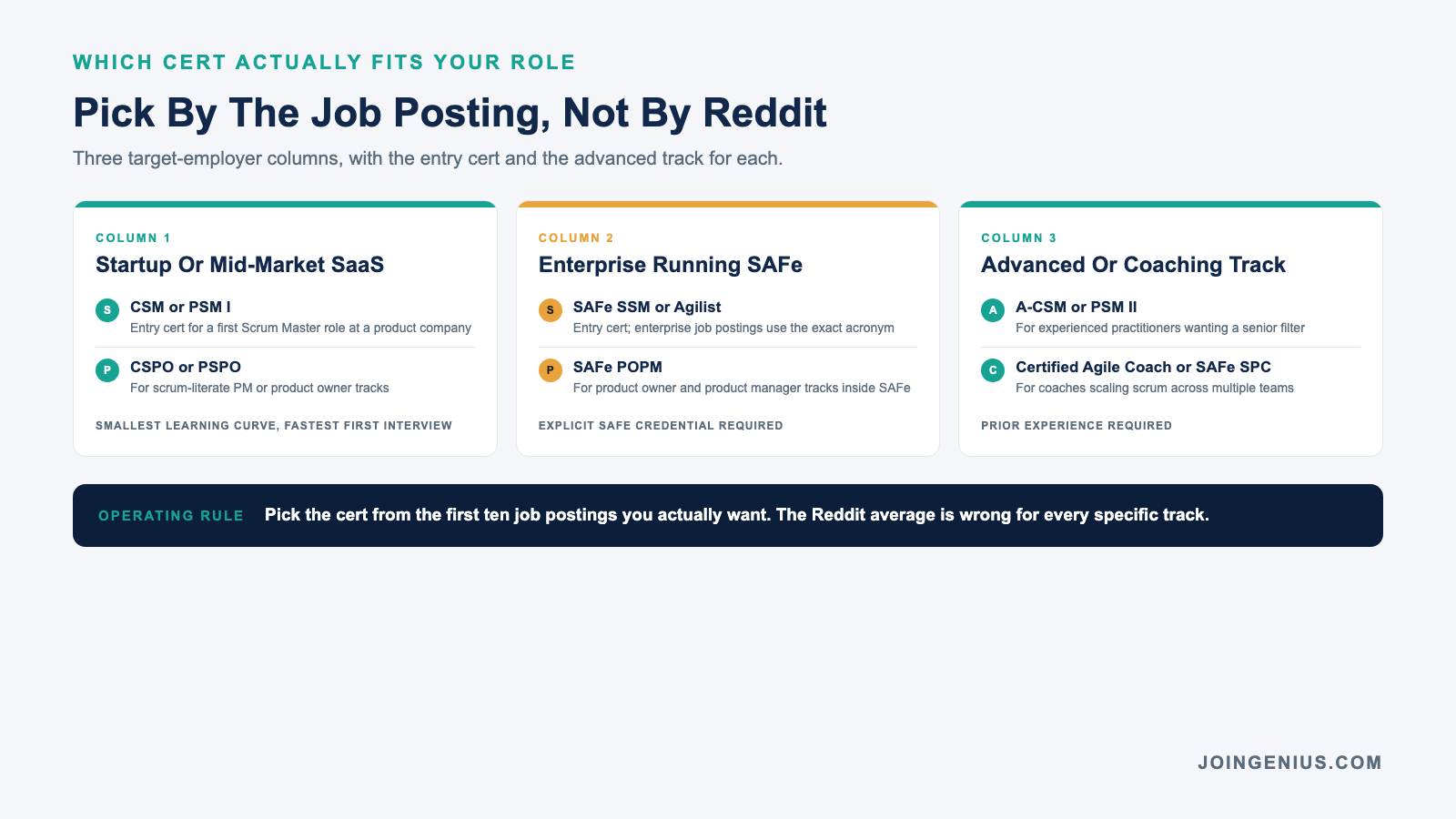
Startups and mid-market SaaS teams tend to ask for CSM or PSM. Enterprise teams running Scaled Agile Framework ask for SAFe SSM specifically. The cert that fits the role depends on where you want to work, not which exam is easier.
Myth 3: You Need Years Of Agile Experience Before The Cert
False for entry-level scrum certs. Both CSM and PSM I accept candidates with zero prior Agile experience. The 2-day course provides the baseline framework and the exam tests on the Scrum Guide. Career switchers from any domain can earn the entry cert in a single weekend.
Advanced certs like A-CSM or PSM II do require prior experience, which is where the myth has a grain of truth. Candidates skipping the entry cert over this myth wait a year unnecessarily, and then interview against people who did not wait.
Myth 4: AI Will Replace Scrum Masters
Partly false. The Scrum.org February 2026 AI4Agile Report found only 7.6 percent of practitioners see AI as a significant threat to the role, with the 0-to-6 threat scale averaging 2.75. 83 percent of respondents already use AI tools in daily work, mostly for sprint note summaries and retrospective synthesis.
The Scrum Master role is adapting to an AI-assisted baseline, not getting deleted. AI in talent acquisition is reshaping the hiring side faster than the operator side right now.
Myth 5: The Cert Is Worthless Without A Dev Background
False. Scrum Alliance’s own community data shows strong representation from non-developer backgrounds, with project management and business analysis leading the pack. Operations and QA follow close behind. Scrum Masters facilitate a process, not write code.
The role rewards pattern recognition from running teams, not familiarity with any one programming language. Candidates coming from operations and product backgrounds report similar or faster time-to-promotion into Scrum Master roles, with consulting and client-services folks right behind pure engineering backgrounds.
Myth 6: Agile Is Dying, So Scrum Is Obsolete
False. The Digital.ai 2025 State of Agile Report puts hybrid or blended Agile at 74 percent of surveyed organizations. The pure Scrum-by-the-book share is smaller than it was five years ago, but the frameworks the industry runs on are all Agile-rooted at the core.
The headline is that Agile evolved, not that it died. The Scrum Master role inside a hybrid shop is still in demand, and the cert is still the fastest filter for recruiters screening resumes at scale.
Myth 7: The Cert Alone Gets You Hired
True for exactly nobody. The cert is a filter, not a decision. A CSM gets your resume past the HR keyword screen. The interview loop still tests whether you can run a stand-up with a difficult engineer and facilitate a retrospective without becoming a complaint hour.
Coaching the product owner into a cleaner backlog is the follow-up test. Practical skills show up in the second round. The cert gets you the call. The call decides the hire. Using delegation examples from your past work is the fastest way to prove the practical side in a 30-minute panel.
Which Cert Actually Fits Your Role Today
The cert you want is the one your target role lists in the posting. Everything else is noise, including the Reddit holy wars about which framework is better.
Startups and mid-market SaaS teams tend to ask for CSM or PSM I. Enterprise teams running SAFe ask for SAFe SSM or SAFe Agilist specifically. Product leaders asking for a scrum-literate PM ask for CSPO or PSPO. The right starter cert is the one on the first ten job postings you want, not the one your friend took.
Hire The Scrum Master Who Already Has The Cert
The myths cost candidates time. They cost hiring teams the same time, routed through the wrong resumes and the wrong keyword screens.
Genius places Scrum Masters and Agile Coaches in the top 1 percent of Philippines and LATAM applicants. US and EU teams pay roughly 80 percent less than a local hire. No monthly fees, and every match comes with a 6-month talent guarantee. The interview rubric is built around the facilitation skills the cert does not actually measure.
Earn the cert for the filter. Hire for the practical skills that show up in round two.