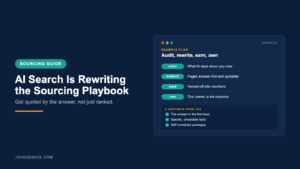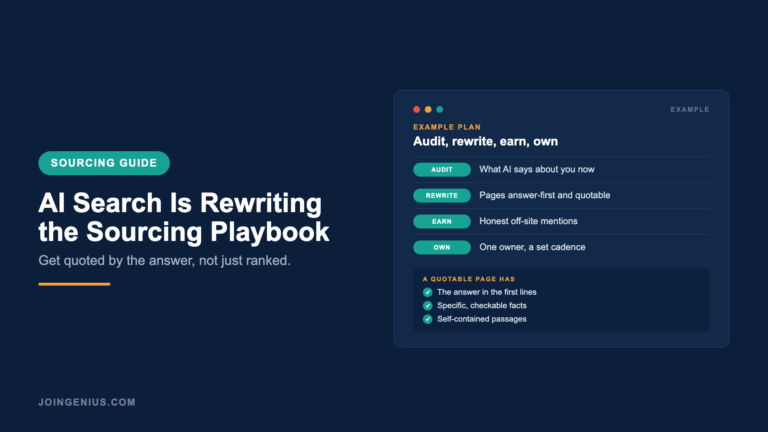
The hiring query has quietly moved. A candidate who used to Google “best companies for backend engineers” now asks ChatGPT or Perplexity the same thing and reads one synthesized answer. If your company is not in that answer, you are invisible to them, no matter how well your careers page ranks. AI search has changed what sourcing has to do.
That is a real break from the old playbook. Ranking first on Google does not mean getting quoted by an answer engine, and the two are optimized very differently. AI is reshaping hiring on both sides of the table. Below, we cover why AI search needs a new sourcing approach and how to build pages these engines will cite.
The Hiring Query Moved From Google to AI
This is not a prediction; it is already how people search. Candidates research employers through AI the same way they research everything else now.
Candidates Ask AI About Your Company, Not Just Google
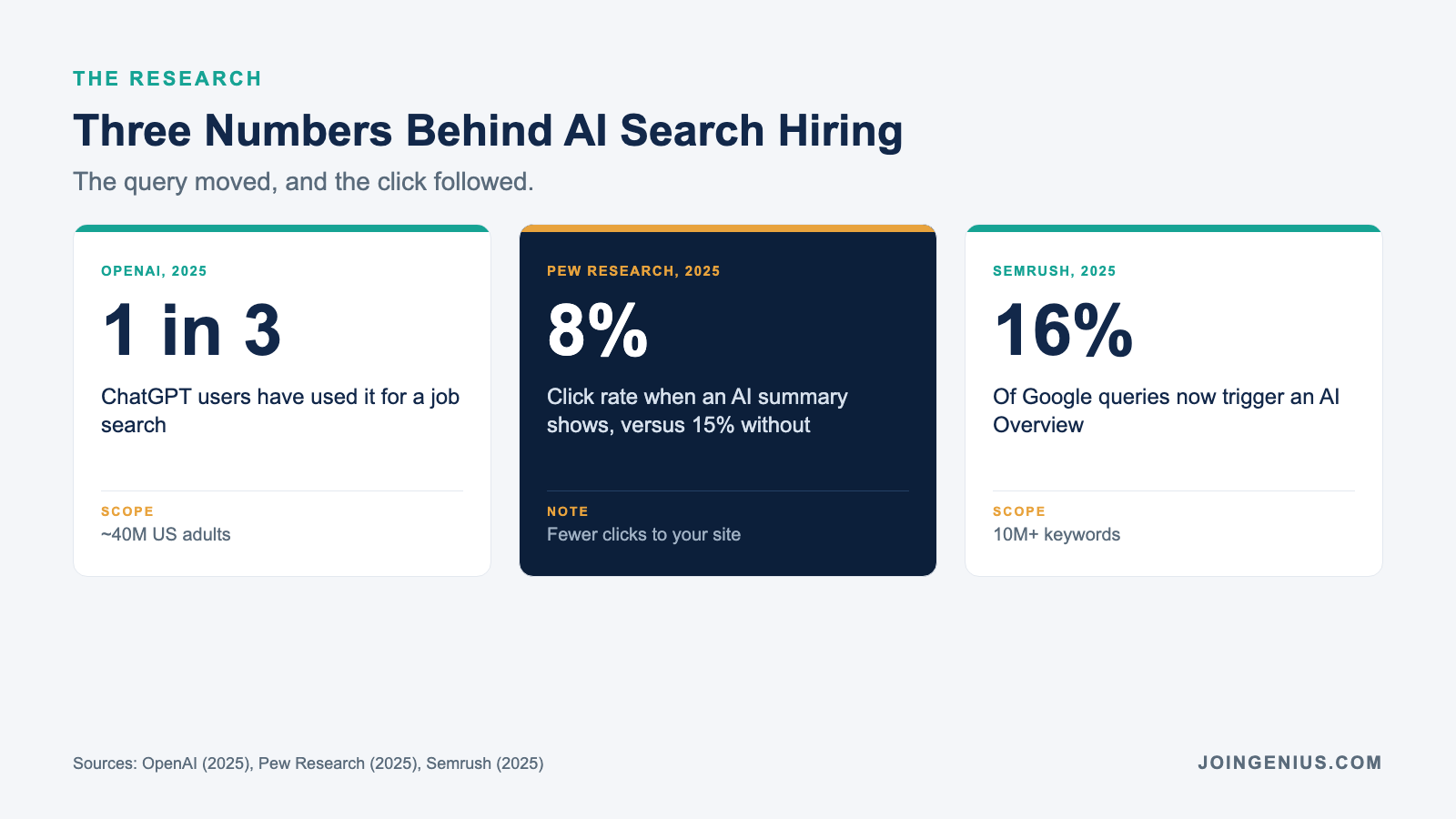
The behavior is mainstream. In OpenAI’s own usage analysis, about one in three ChatGPT users had used it for a job search at least once, roughly 40 million US adults. They ask who is hiring and whether a company is worth working for. The answer is assembled by the model, not a list of links you can rank on.
The Query Is a Question, Not a Keyword
People do not type “senior React developer jobs Austin” into an answer engine. They ask a full question, like which companies in Austin are good for senior React developers and why. That shift matters because the engine returns a judgment, with a few companies named and reasons attached. Your goal is to be one of the named ones.
Sourcing Now Starts Before the Candidate Applies
Old sourcing assumed you reach out or they find your posting. AI search adds a step before both: the candidate forms an opinion of you from an answer you never saw. If that answer is thin or missing, you lose people who never contact you. The top of the funnel now runs through models you do not control.
By the time they reach your form, the pitch has already been made for you, well or badly.
Why Ranking Is No Longer Enough
Plenty of talent teams assume a top Google ranking covers them. The data on AI answers says otherwise.
AI Answers Without Sending a Click
When an answer engine responds, the user often never visits a site. In a 2025 Pew study, searches with an AI summary led to a click just 8% of the time, against 15% without one.
For hiring, that means a candidate can read about you and decide without ever touching your careers page. Ranking to earn a click only helps if the click still happens.
Being Cited Beats Being Ranked
Rank-one on Google and rank-nowhere in an AI answer is now a common, invisible gap. The engine might rank your page highly and still quote a competitor’s clearer one. What gets cited is the content that answers the question cleanly, not the page with the best backlinks. Optimizing only for rank leaves the citation to chance.
The Candidates You Want Are the Ones Using AI
The people most likely to lean on AI search are the ones you compete hardest for: senior and short on time. If you are not in their AI answers, you lose the top of your candidate pool before outreach even starts. This is where attraction quietly breaks.
Write Role and Team Pages That AI Search Can Quote, Not Just Rank
AI search is not a fringe channel. AI Overviews alone triggered on about 16% of Google queries across 2025, so the engines are already reading and reusing your content. The question is whether your role and team pages give them something clean to quote.
Lead With the Answer, Not the Pitch
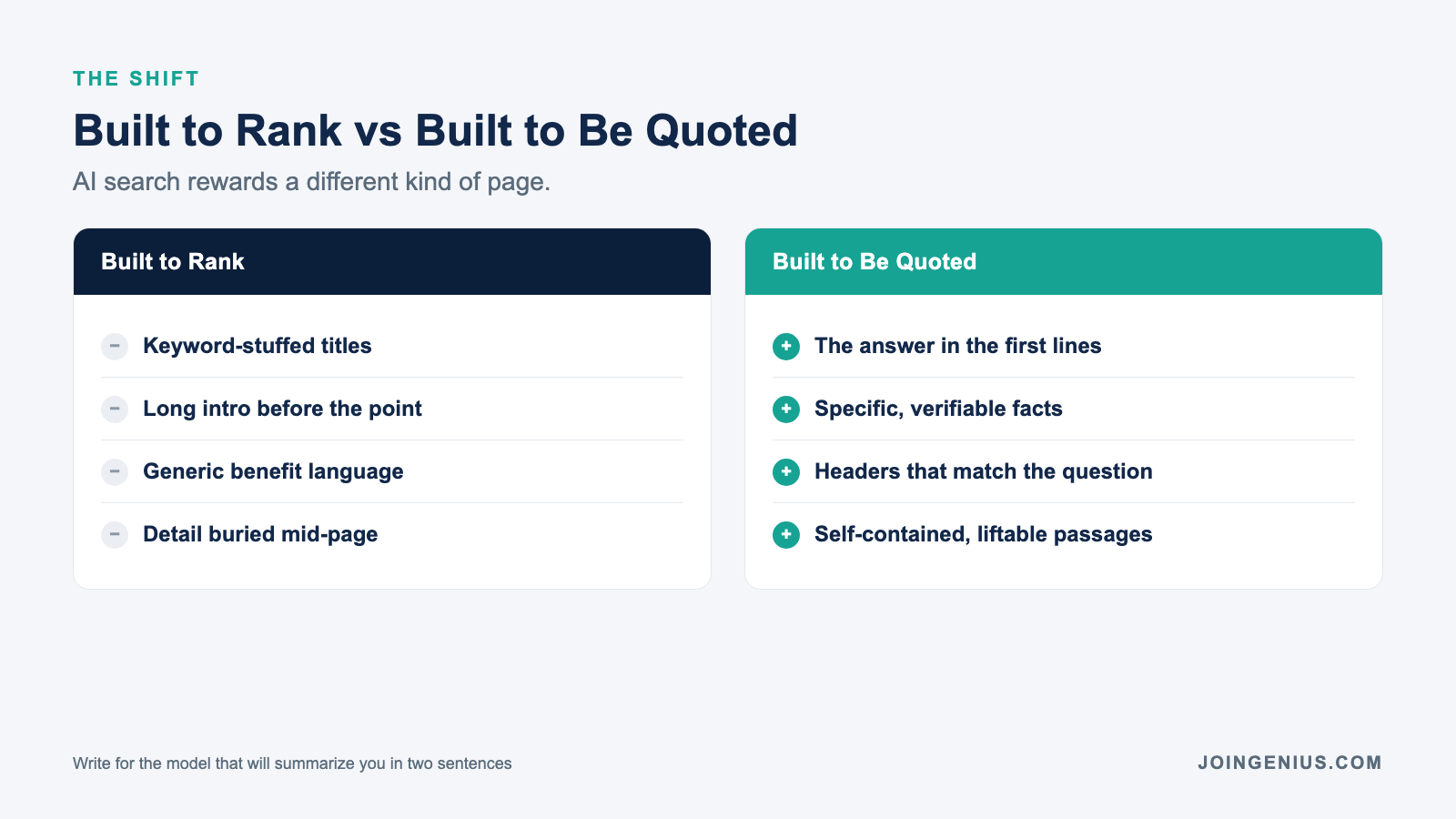
Answer engines lift the sentence that directly answers the question. A role page that opens with mission fluff buries the thing AI would quote. Put the specifics first, like what the role does and why it is worth taking. State it plainly in the first lines so a model can pull it verbatim.
Give AI Facts It Can Trust and Reuse
Models prefer concrete, checkable detail over adjectives. “We move fast” is unquotable; “engineers ship to production in their first week” is the kind of line an answer engine repeats. Fill your role pages with specific, verifiable facts about the work and the people. Vague pages get skipped for a competitor’s precise one.
Specificity is what a model can safely repeat; vagueness is what it drops.
Structure It the Way AEO Rewards
The format matters as much as the content. Answer engines favor direct answers and self-contained passages they can lift without the surrounding context. This is where how AEO differs from SEO becomes practical: the goal shifts from ranking a page to making each passage quotable on its own. Building your content operations around that is the real work.
What AI Search Pulls From Beyond Your Site
Your own pages are only part of the answer. Models synthesize from across the web, which means your reputation off-site shapes what they say about you.
Reddit, Reviews and Third-Party Lists Shape the Answer
Answer engines lean heavily on places people trust, like Reddit threads and review sites. A single candid Reddit comment about your interview process can outweigh your polished careers page in an AI answer. You cannot write these yourself, but you can earn them by being worth talking about and engaging honestly where the conversation happens.
Consistency Across Sources Builds Trust
Models cross-check. If your careers page says one thing and your Glassdoor reviews say another, the engine notices the gap and hedges or picks the less flattering version. Keeping your story consistent across your site and your public profiles makes you easier to quote with confidence. Contradictions make you easy to skip.
One honest, consistent story is easier to quote than a polished but contradicted one.
A Modern Talent Strategy Treats This as Sourcing
This is not PR; it is sourcing. The off-site signals that feed AI answers are now part of your talent strategy, not a side project for the brand team. Treat your presence in AI answers as a channel you actively manage, with an owner and a cadence. Ignored, it just reflects whatever the internet last said about you.
In practice, a few sources do most of the work:
| Where AI pulls from | What to do about it |
|---|---|
| Your careers and role pages | Answer the question in the first lines |
| Reddit and forums | Earn honest mentions, never astroturf |
| Review sites like Glassdoor | Keep them current and specific |
| “Best places to work” lists | Get included with real data |
Cover these and you shape the answer; ignore them and the internet writes it for you.
How to Rebuild Your Sourcing Playbook for AI Search
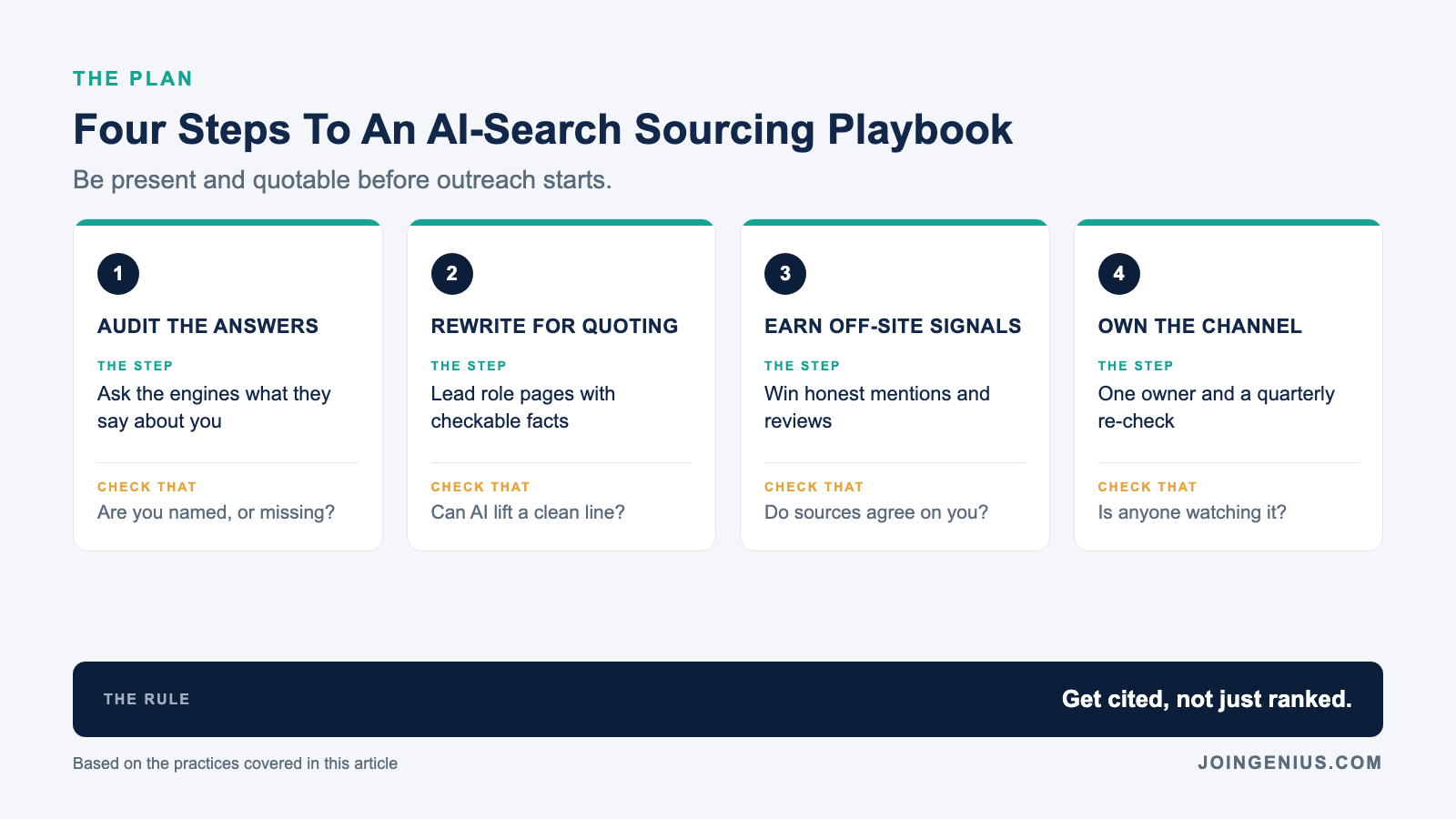
None of this replaces outreach and job posts; it sits in front of them. The playbook change is about being present and quotable before a candidate ever engages.
Audit What AI Already Says About You
You cannot fix an answer you have not read. Start by seeing what the engines say about your company and roles today.
- Ask ChatGPT, Perplexity and Gemini the questions your candidates actually ask.
- Note which companies get named for your roles and why they win.
- Check whether your own pages are quoted, paraphrased or ignored entirely.
- Flag any wrong or outdated claims the models repeat about you.
Rewrite Your Key Pages to Be Quotable
Take your top role and team pages and rebuild them answer-first. Lead with the specific, checkable facts a model would cite, and cut the fluff that buries them. You are not writing for a ranking algorithm anymore; you are writing for a model that will summarize you in two sentences. Make those two sentences easy to get right.
Make It Someone’s Job, With the Right Tools
AI-search presence slips the moment no one owns it. Assign an owner, set a quarterly re-check and fold it into your sourcing tools and workflow. The teams that win here treat AI visibility as an ongoing channel, not a one-time rewrite. The rest get whatever answer the model happens to assemble.
Conclusion
AI search did not just add a channel; it moved the first impression of your company to a place you do not control. Candidates now meet you inside an AI answer, and your sourcing playbook has to earn a spot in it.
Write pages worth quoting and keep your off-site story straight. Rank where you can, but make sure you get cited where it counts.
If the deeper constraint is that you do not have the people to build and run this kind of content engine, that is worth solving at the source. At Genius, we help companies hire the top 1% of marketing and recruiting talent from the Philippines and Latin America, at around 80% less than comparable local hires.
You get vetted specialists you can keep, with no monthly agency fees and a 6-month replacement guarantee. If showing up in AI search is the sourcing problem you keep hitting, see how we source and place talent.