Event promotion looks like a dream job from the outside. The work is visible, social and full of variety, and plenty of people join for exactly that reason. Then a familiar pattern sets in: a few busy seasons, a growing list of extra duties and, eventually, a resignation.
The research on this covers the events sector as a whole, not promotion roles alone, and none of it proves these roles turn over faster than every other job. But the reasons people give for leaving are consistent, and most of them are fixable. This guide covers what drives people out, which parts of the role you can change, and a table of warning signs to check before someone hands in notice.
The Job Is Built Around Peaks
Most jobs have busy and quiet periods. Event promotion has peaks that are fixed by the calendar. Marketing has to be in place weeks before the date, details change right up to the moment doors open, and the event itself often lands on an evening or weekend. The workload does not spread out. It bunches up.
A 2025 survey from the Meetings Industry Association, reported by Workplace Journal, found that 53% of respondents had seen an increase in burnout, stress or wellbeing issues over the past year, with high workloads and tight deadlines named as the main causes. Nine in 10 said work-life balance expectations were a key reason staff were leaving the sector. The report does not give its sample size, so treat the figures as a signal and not a precise measure.
Peaks are part of the job and will not disappear. What matters is whether recovery time is built in afterwards, whether someone else can cover, and whether the team knows the peak is coming. A team that plans for peaks gives people something to hold on to. One that treats every busy week as a surprise does not. Practical ideas for keeping people engaged between peaks are in these employee engagement examples.
Cut the Repetitive Event-Listing Work That Wears Promotion Staff Down
Not all of the pressure comes from big events. A lot of it comes from small tasks that repeat every week: searching for what is happening locally, copying details into a calendar, checking dates and fixing listings that went out of date. In-house staff at chambers of commerce, tourism bureaus and local media often carry this on top of the promotion work that actually uses their skills.
That kind of routine is a good candidate for automation. An automated event calendar gathers local events from websites, social media and public calendars and publishes them on your site, so nobody is retyping listings. Yodel is one example. Its site says that marketing teams spend hours each week searching websites and social media for local events, and that its calendar drops onto any CMS with a single embed code. Those are the vendor’s own claims, and we have not tested them.
Tools like this do not fix a heavy workload, low pay or a missing career path. What they can do is remove one low-value task so the hours go to the work people joined for, such as partnerships, campaigns and audience growth. When you look at a role, ask how much of the week goes on upkeep a tool could handle, and how much goes on work that needs judgement.
A simple audit takes one week:
- Ask each person to log their tasks for five working days.
- Mark every task that repeats and follows fixed rules.
- Decide which of those a tool, a template or a schedule could take over, and which genuinely need a person.
The result is a concrete list to act on, which is far more useful than a general feeling that the team is stretched.

Extra Responsibilities, Same Pay
Peaks are tolerable when the job stays the same size. They are harder when duties keep growing. IBTM World’s Culture Creators Report 2023, covered by Skift Meetings, found that 79% of event professionals said their roles were more stressful than before the pandemic, 61% had taken on extra responsibilities and 90% reported no change to their compensation. The article does not state a sample size either.
Extra duties without extra reward send a clear message about how the role is valued, and the same article, citing the American Psychological Association, notes that people who feel undervalued start to look for new roles. Before you add a responsibility, decide what comes off the list or what changes in pay, title or scope.
If nothing does, expect the person to notice. A useful test is to compare the role as advertised with the role as practised. If the job description lists five duties and the person is doing nine, the gap is a retention risk. Either trim the work or update the role and its pay so both sides agree on what the job is. Tracking your employee retention rate by team will show whether the problem is company-wide or concentrated in one role.
Plan Cover and Recovery Before the Peak
Peaks hurt most when only one person can handle them. Before each busy period, put three things in writing:
- Cover: who steps in for each task if its owner is unavailable
- Recovery: when the team gets time back after the event, agreed before it starts
- Boundaries: which messages and tasks can wait until the next working day
Writing this down turns a favour into a rule. People can work a hard week more easily when they know the recovery is protected and a colleague knows their tasks. Review the plan after each event and change whatever did not hold up, so the next peak starts from a better place.
Hear the Reasons Before They Leave
Most teams learn why someone left from the exit interview, which is the latest possible moment. A stay interview asks current staff what keeps them and what would make them leave. A short list of stay interview questions works well for event teams if it covers four themes: workload, growth, recognition and tools. Pair it with exit interview questions for the people who do go, and look for the same reason appearing twice.
- Workload: Which weeks of the last quarter felt unsustainable, and what would have helped?
- Growth: What is the next role you can see for yourself here?
- Recognition: When did you last feel your work was noticed?
- Tools: Which task would you stop doing by hand tomorrow?
Keep notes, act on one thing quickly and tell people what changed. Asking without acting teaches staff that the questions are a formality.

Build a Path That Is Not Just More Events
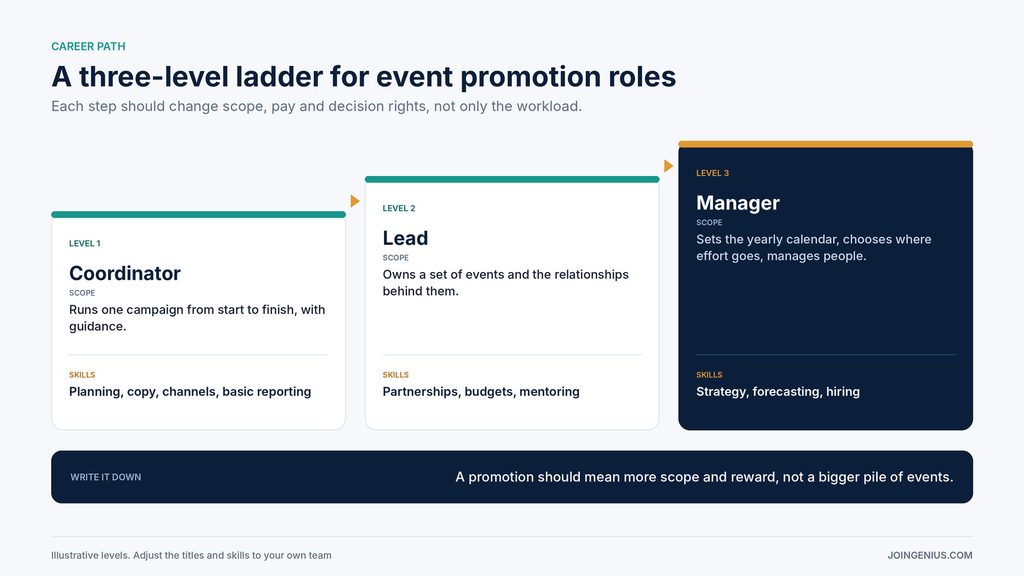
Event promotion roles often have no obvious next step. A coordinator who runs ten events well is simply handed an eleventh. A simple ladder fixes that. A career progression framework shows how to define levels, and a three-level version for a promotion team might look like this:
- Coordinator: runs a single campaign from start to finish with guidance. Skills: planning, copy, channels and basic reporting.
- Lead: owns a set of events and the relationships behind them. Skills: partnerships, budgets and mentoring.
- Manager: sets the calendar for the year, chooses where effort goes and manages people. Skills: strategy, forecasting and hiring.
Each level should say what changes in scope, pay and decision rights, so a promotion means more than a bigger workload.
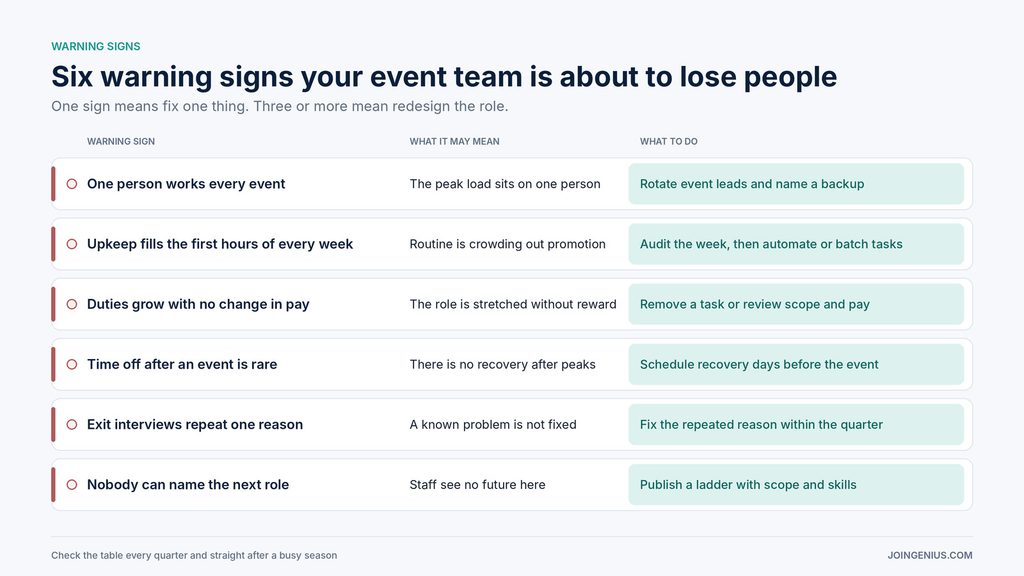
Warning Signs Your Event Team Is About to Lose People, and What to Do About Each
Check this table every quarter and straight after a busy season. One sign means fix one thing. Three or more mean the role is at risk and needs redesigning, not another push.
Keep the Best People Between Peaks
Event promotion will always have peaks. People rarely leave over one hard week. They leave when hard weeks pile up with no recovery, when duties grow with no reward, and when nobody can say what comes next. Start with a stay interview, take one repetitive task off the list and write down the next step for each role.