A brand team hires someone to track how the company appears in AI answers. A month later the first report says the brand is “number two” in a chatbot’s list. It came from one run of one prompt. A rerun the next day puts the brand fourth, and a competitor is cited where the brand was. That is an illustration, not a case study, but it shows the risk this guide covers: a monitoring hire who cannot tell a result from noise.
This guide explains how brand teams can hire for AI monitoring. It covers what the role involves, why measurement skill matters more than tool skill, what research says about visibility, how to test candidates and a table of warning signs. We found no study showing what predicts a good AI monitoring hire, or that the test below predicts performance. “AI monitoring” is our label for the role. The advice rests on a variability study, a generative engine paper, one vendor’s guide, selection research and our reasoning.
What an AI Monitoring Role Involves
We define AI monitoring as tracking how a brand and its competitors show up in AI-generated answers: which prompts mention them, which sources the answers cite and what that suggests the team should change. We found no standard definition, so treat that as ours. The work has three parts: collecting answers in a controlled way, judging what they show and turning findings into actions for content, outreach or technical teams.
Brand teams often split the role between PR, SEO and analytics, so decide who owns the numbers and who owns the fixes before you write the posting. A candidate can be strong at one part and weak at another. A good analyst may build clean spreadsheets and never question a single run. A good writer may suggest fixes and never check whether the data supports them. Our guide to how AI search engines work covers the background, and our piece on hiring data analysts covers the measurement side.
Why Measurement Skill Matters More Than Tool Skill
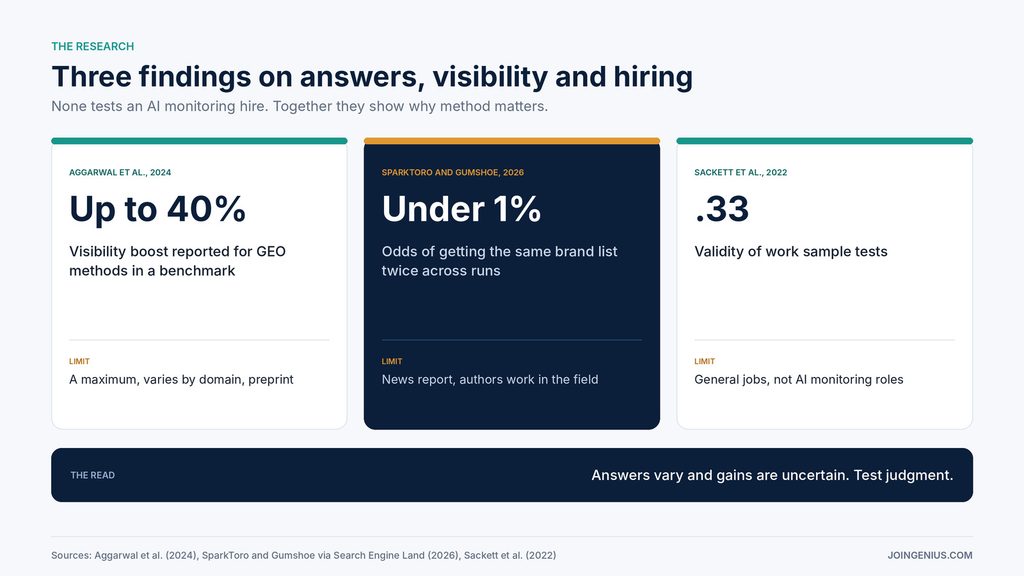
AI answers vary from run to run. In January 2026, Search Engine Land reported a study by Rand Fishkin and Patrick O’Donnell in which 600 volunteers ran 12 identical prompts through ChatGPT, Claude and Google’s AI nearly 3,000 times. The odds of getting the same list of brands twice were under 1 in 100, and the odds of the same list in the same order were closer to 1 in 1,000. Some brands still appeared in 60% to 90% of responses for a given intent, even as their positions moved.
There are limits. We read a news report, not the study itself. Both authors work in search and AI visibility, and the article lists open questions such as how many runs are needed and whether APIs behave like real users. Our reasoning is that a candidate who reports a rank from one run is reporting noise, and a better hire reports how often a brand appears across repeated runs and treats position cautiously.
What the Research Says About Improving Visibility
Research on improving visibility is early. A paper by Pranjal Aggarwal and colleagues introduced generative engine optimization and a benchmark of queries across domains. Its abstract says the methods can boost visibility by up to 40% in generative engine responses, and that efficacy varies across domains. The words “up to” mark a maximum, not a typical gain. The page we read is a preprint abstract, and it does not state the number of queries or say how results hold on today’s products.
Our reasoning is that these results should make a hiring manager wary of certainty. A candidate who promises a fix will work, or a guaranteed ranking, is claiming more than the research supports. A candidate who says what they would test and what would prove them wrong is showing the right habits.
Test Candidates With a Mini Citation and Competitor Gap Analysis
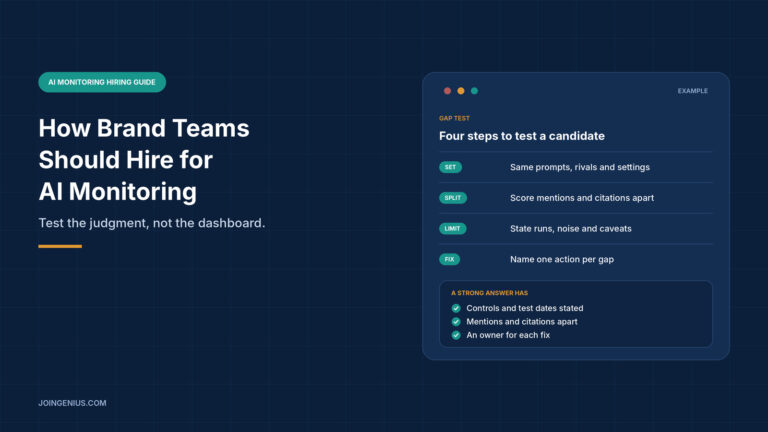
A gap analysis shows how a candidate handles messy data and weak evidence. Trakkr’s guide to AI citation gap analysis defines a citation gap as “an observed answer where a relevant competitor or third-party source is cited.” It sets out seven steps: scope prompts, freeze controls such as model, surface, geography and test date, capture answers, separate brand mentions from citations, classify the cited sources, score the gaps and assign a fix with a recheck. The guide also warns that “a citation proves that a source appeared in one observed answer,” and that you should not declare success from one changed answer.
Trakkr sells monitoring software, and the guide is vendor content. It gives no number of prompts or runs behind its examples, does not say how it handles answer variation beyond fixing controls and does not show how its scoring weights were chosen. We use the method as a task outline, not as proof that it works.
To run the test, capture a set of answers yourself so every candidate sees the same data: about a dozen prompts, two or three named competitors and the cited sources. Give each candidate the same sheet, the same brief and a time limit such as three hours, and pay for the time. Unpaid tests ask people to work for nothing and may put off experienced candidates. That is our view, not a finding. Ask them to separate mentions from citations, classify sources, rank two or three gaps and propose one action for each. Then ask what they could not conclude from one capture. A strong candidate will also ask which prompts matter to buyers and which models and countries you care about, since the guide says the controls must stay fixed between a baseline and a recheck.
Score Judgment, Not the Dashboard
Selection research supports a shared, realistic task, with a limit. A HumRRO summary of Sackett, Zhang, Berry and Lievens (2022) reports revised validity estimates in which structured interviews were highest at .42 and work sample tests were .33. The authors argue that earlier estimates were inflated by range restriction corrections, and they note that structured interview validity varies considerably. These figures concern job performance in general, not AI monitoring. They support a modest point: the same realistic task, scored the same way, beats improvising. Our interview guide covers how to structure the conversation.
Write the rubric before you read any answers. Useful criteria are stated controls and dates, mentions and citations kept apart, competitors included, limits stated and one clear action per gap. Our guide to competitive analysis covers how to turn comparisons into strategy, and our piece on hiring developer-first product marketers covers a related role.
A Four-Step Plan to Hire for AI Monitoring
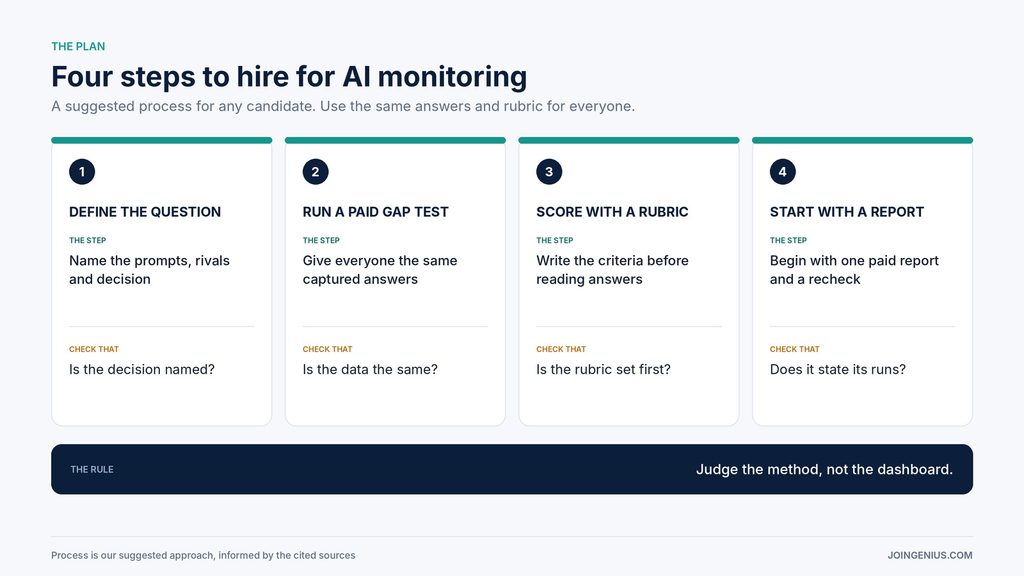
Use this four-step plan for every AI monitoring role. It is our suggested process, informed by the sources above.
- Define the question. Name the prompts, competitors and decision the monitoring supports.
- Run a paid gap test. Give every candidate the same captured answers and pay for their time.
- Score with a rubric. Write the criteria before you read any answers.
- Start with one report. Begin with one paid report and a recheck before a longer commitment.
The last step matters because a test shows how someone reads one capture, and a first report with a recheck shows how they handle repeat runs, stakeholders and feedback.
Measure Whether the Hire Works
Check whether each report states its controls, test dates and number of runs, whether mentions and citations are counted separately, whether each gap has an owner and a recheck date and whether the analyst repeats a measurement before calling a win. Judge over several months, since one report proves little, and be careful about crediting a content change for a shift that may be noise. Small brands may have few relevant prompts, so keep the prompt set stable and add new ones slowly. These measures are our suggestions, not findings.
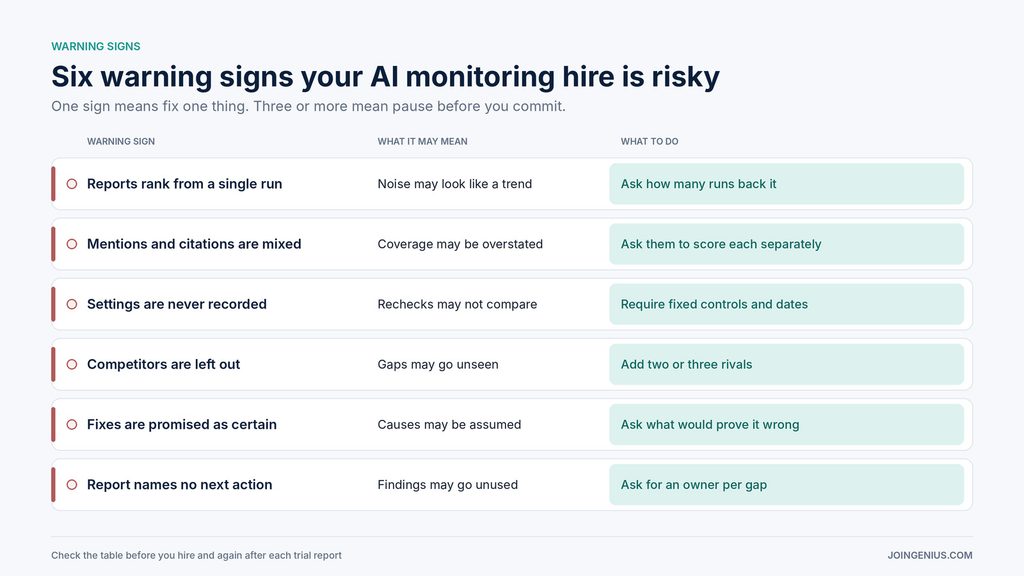
Warning Signs Your AI Monitoring Hire Is Risky, and What to Do About Each
Check this table before you hire and again after each trial report. One sign means fix one thing. Three or more mean pause before you commit.
Hire for Method, Then Check the Method
A good AI monitoring hire is one who controls what they capture, separates what they saw from what they infer and says how sure they are. Define the question first, give every candidate the same paid gap test, score the results against a rubric written in advance and start with one report and a recheck. We found no study proving that this method picks better hires, but each step replaces a guess with evidence. If the first report states its limits and survives a rerun, you have a better reason to keep the analyst than a confident dashboard.