Hiring a remote accessibility testing team is the easy part. Keeping one is where companies lose the game. The first great tester you hire does three clean audits and writes beautiful tickets. Six months later they take a product-company QA role, and the audit queue is back to one person juggling four codebases.
That is not bad luck or the remote part. The role is specialized and the ticket pressure is high. Retention on a remote accessibility testing team has to be designed around that. How to attract and retain top talent is a solved problem for most roles. This one is not.
Why Accessibility Testing Breaks The Remote Hiring Playbook
Accessibility testing is not standard QA with a different checklist. The hiring playbook you would use for a general QA role misses what makes this one hard. Three things in particular do not fit the playbook.
The first is the pool. People who read React components with WCAG 2.2 fluency and write a fix a developer will act on are rare. AI has reshaped most hiring. Accessibility is still bottlenecked by human expertise, so every hire counts twice as much. Our list of IT staffing agencies is a starting point for sourcing deeper.
The second is the mix. A great accessibility tester reads code and understands how a blind user experiences a page. Most QA interviews screen for one or the other. Hire only for code and you get testers who miss usability issues. Hire only for empathy and you get testers who cannot describe the fix.
The third is isolation. Remote accessibility testers have fewer peers inside most companies than any other role. They are often the only person who runs assistive tech daily. Isolation is a retention killer for any specialist, and this one in particular.
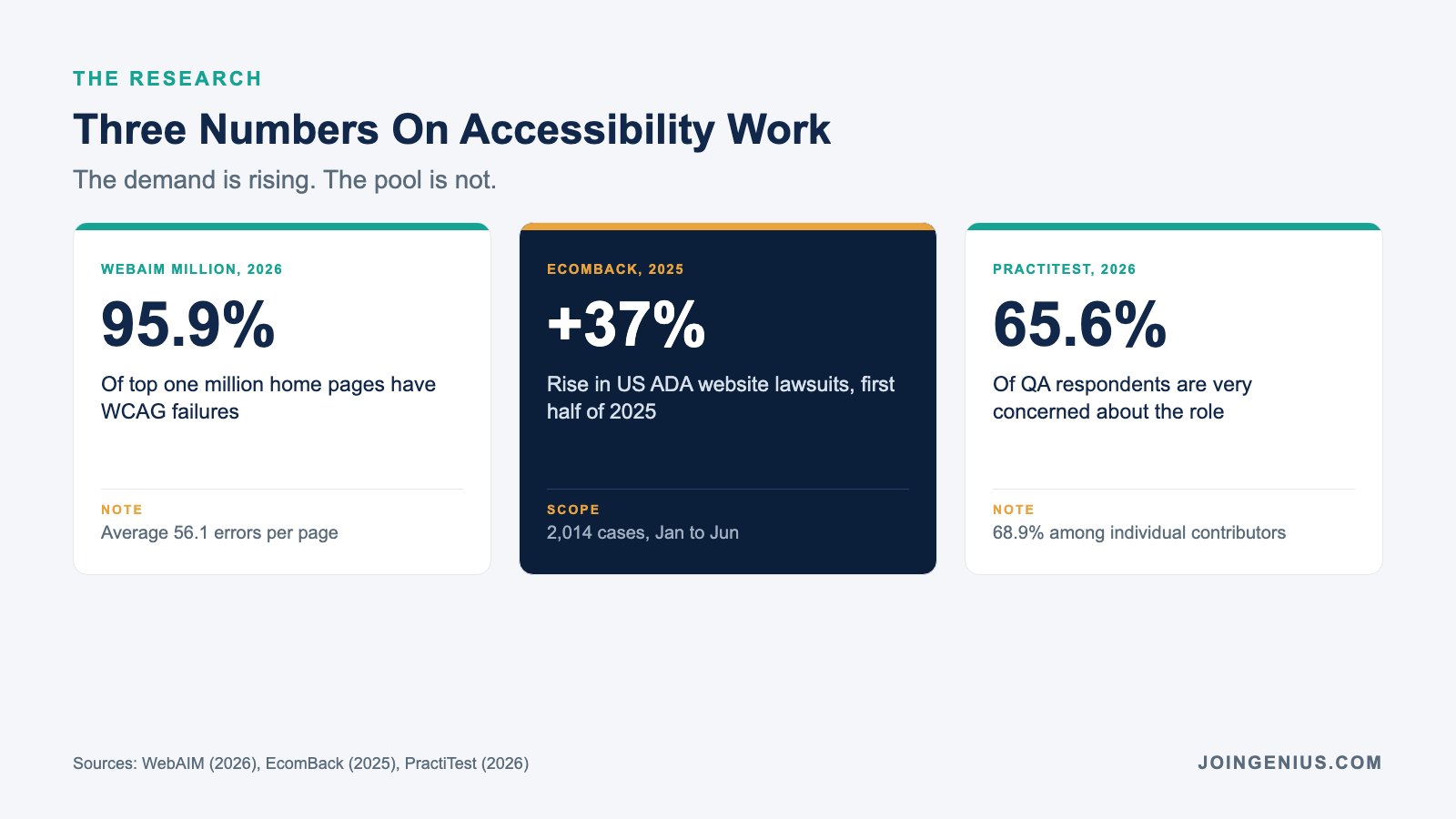
In WebAIM’s 2026 Million report, 95.9% of the top one million home pages had detected WCAG 2 failures, with an average of 56.1 errors per page. The rate rose from 94.8% the year before. Demand for the people who can read and fix those failures is not slowing.
Why Accessibility Testers Burn Out Faster Than Other QA
The retention question for a remote accessibility testing team is really a workload question. The shape of the work matters more than the pay. Two things about that shape push testers out faster than most QA roles.
A trained accessibility tester opens a page and runs the same automated scan tools. The output is the same alt-text and contrast tickets every day. The first three hours of the day are repetition. The last hour is the actual expertise. Any job that gives people four days of repetition to one day of judgment loses them quickly.
Then there is the weight of each ticket. Accessibility bugs are not aesthetic. A missing label or an inaccessible menu is an ADA exposure, and the tester knows it. Carrying that pressure solo and remote, with no one checking the triage, is heavy. A healthy team shares the load across more than one person.
When low morale shows up on an accessibility team, it looks like a tester logging fewer tickets, not one filing complaints. The audit cadence slows. The careful audits thin out. The team is still working. The quality of the work is just lower.
The highest-leverage move is taking the repetitive scan work off the team’s plate. Automated accessibility checks catch the easy WCAG violations fast, so running a scanner like WebAbility on every build hands the human testers back the judgment work. The scanner handles the obvious. The person handles the judgment calls the scanner cannot make.
What To Screen For In A Remote Accessibility Tester
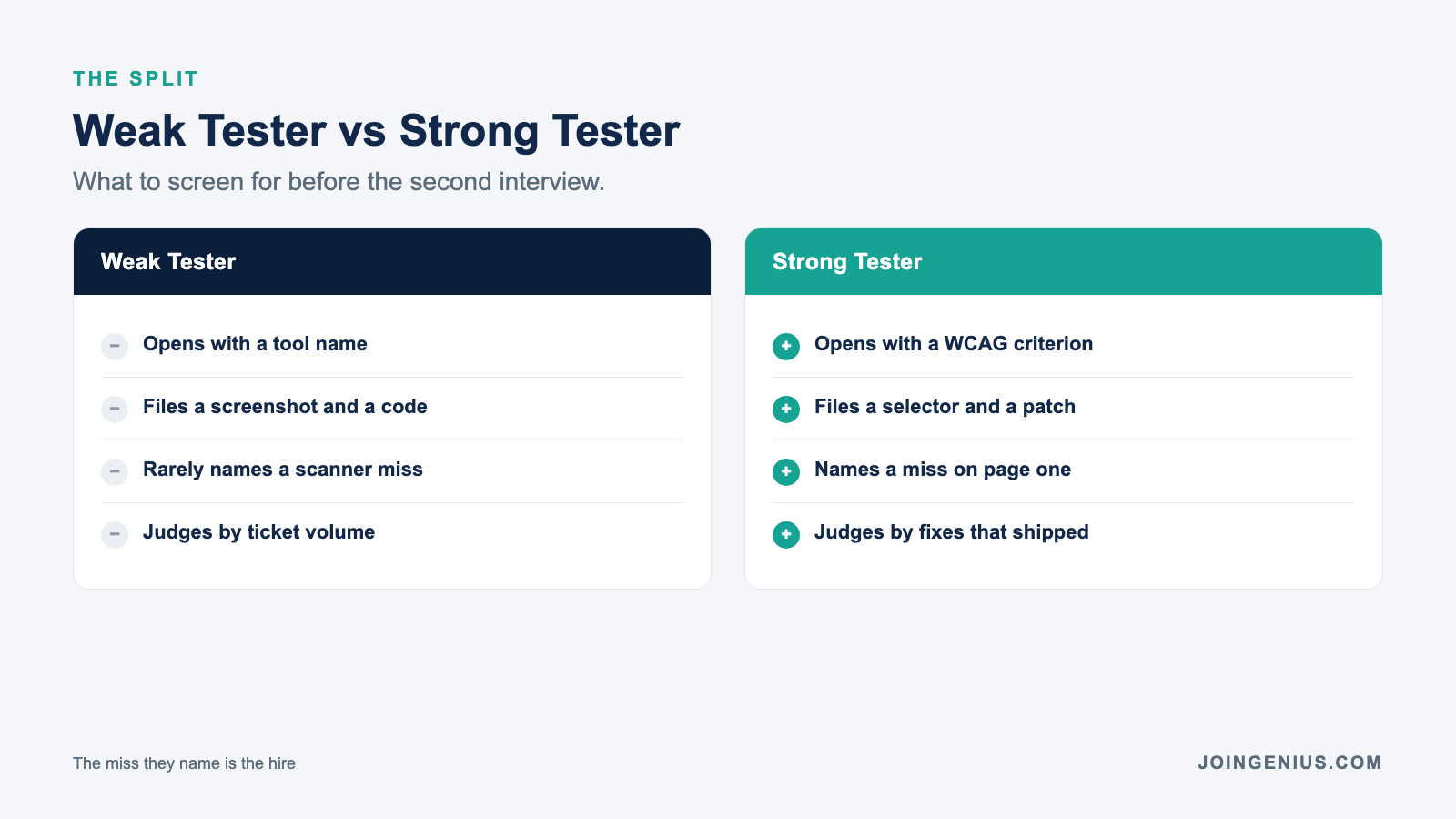
A hiring playbook for a remote accessibility testing team should start with how a candidate reads a page, not which scanner they list on a resume. Four screens separate strong testers from the rest.
Open the screen on a WCAG 2.2 success criterion, something like 2.4.7 focus visible. Ask the candidate to describe failure modes in plain language. Score higher on candidates who name the criterion behind the check than those who reach for an automated scanner.
A candidate whose first move is a tool name tends to file duplicate tickets and get stuck when the scanner is wrong. The habit scales badly across a team.
The second screen is bug-writing. Review a sample ticket the candidate wrote and look for the exact selector and the shippable patch, with the WCAG reference attached. Reject tickets that are a screenshot plus a WCAG code. Those stall developer action and generate re-work. One shippable fix beats five vague reports.
The third screen is a paid test on a real page. Pay the candidate for two hours and hand over a staging URL with eight accessibility issues pre-planted. Ask them to find five and name one the scanner would miss. The miss they name is the hire. The gap between scanner output and human judgment is the signal.
The fourth screen is a short reference table. Keep weak and strong signals written down so three different hiring managers rate the same candidate the same way.
| Signal | Weak Tester | Strong Tester |
|---|---|---|
| Opens the test with | A tool name | A WCAG success criterion |
| Writes the ticket as | A screenshot plus a code | A selector plus a shippable patch |
| Names a scanner miss | Rarely or never | On the first page they open |
| Judges their own output by | Volume of tickets filed | Fixes that shipped |
How To Structure The Team So It Stays
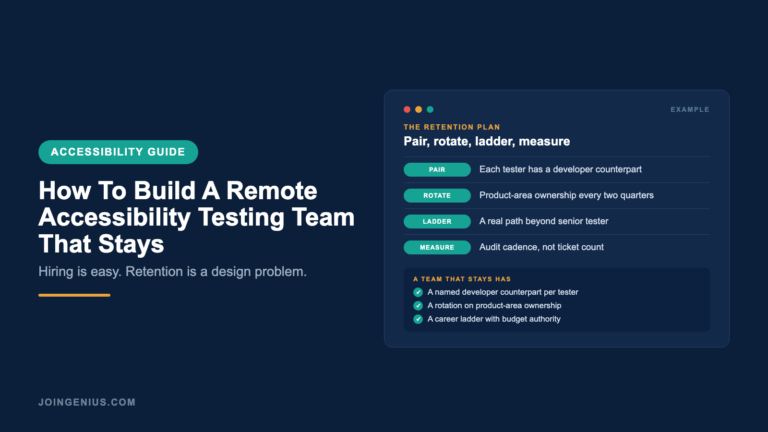
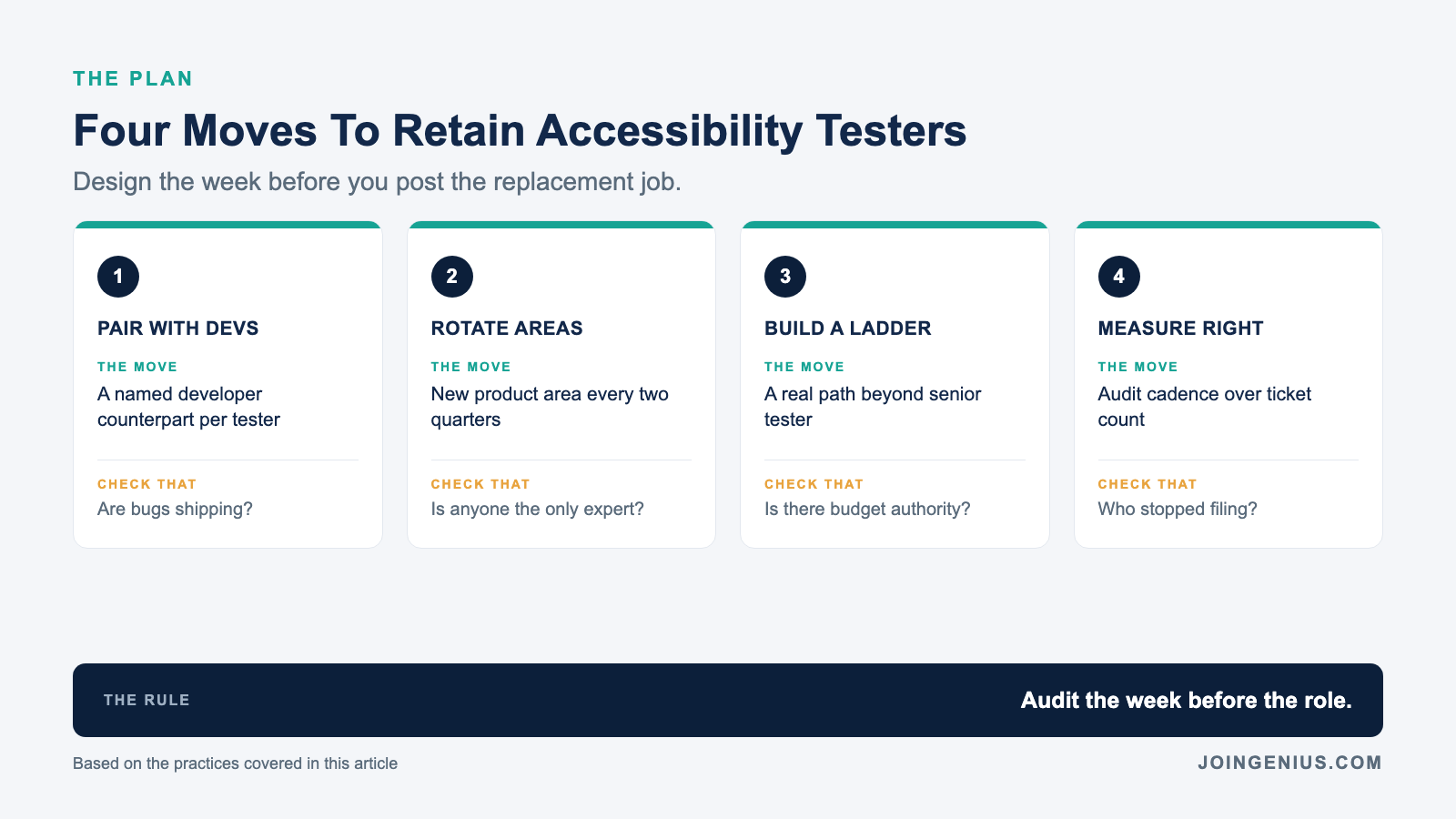
A team that stays is one where every tester has a developer counterpart and a rotating product area, with a career path that is not called “senior tester” at every level. All three cost less than a comp bump.
Give every tester one named developer counterpart they talk to weekly, with a running list of open bugs. Testers who see their bugs ship stay. Testers who file into a void stop filing. Grouping testers together without any developer thread accelerates disengagement faster than any other structure.
Rotate product-area ownership every two quarters so no one tester is the only person who understands a flow. The team’s knowledge spreads. The work stays interesting for the individual. Rotation is the cheapest retention tool a remote team has, and it does not require a comp bump.
Build a real path beyond “senior tester” — accessibility architect or cross-functional lead, with budget authority and roadmap input attached. Our write-up on why attracting and retaining talent matters covers why a real next step beats a title bump. A pay bump without a role change keeps people for a few months, then they leave anyway.
Hiring at the same seniority as everyone else on the team is also a mistake. One senior accessibility engineer paired with two mid-level testers is a stronger structure than three mid-level testers. The senior catches the hard calls so the mids are not running every triage alone.
Measure Retention Before It Is A Problem
PractiTest’s 2026 State Of Testing report found 65.6% of QA respondents are “very concerned” about the future of the role, rising to 68.9% among individual contributors. On an accessibility team, that concern shows up quietly before it shows up in a resignation.
Track audit cadence, not ticket count. Ticket count rewards volume and masks fatigue. A tired tester can still log tickets. Audit cadence is how often each tester runs a full audit and how deep they go. A quiet drop in audit depth is the first retention warning most managers miss.
Watch the tester who stopped filing bugs. A tester who files 30 bugs a week drops to five and the manager thinks they got efficient. The drop usually means they stopped caring. Our breakdown of why ops hires don’t stay past 18 months walks the same curve. Hold the one-on-one before the resignation note.
Pull the data on who handled urgent audit requests each quarter. The person answering every live ticket will leave on their own schedule otherwise. EcomBack’s mid-year report found ADA website accessibility lawsuits surged 37% in the first half of 2025. Urgent audit volume is not shrinking. Rebalance the on-call load before the next quarter starts, not after someone quits.
These measures are not performance metrics. They are retention metrics. Look at them on a two-quarter rolling view and the first quiet signals surface before the resignation does.
Conclusion
A remote accessibility testing team stays together when the work has shape and the ticket pressure is shared, with a real next step in the role. Pay is table stakes. Structure is the lift. The pattern that keeps a specialist team together is not comp, and it is not perks. It is week-shape.
If the first great hire disengages quietly, the problem is almost never the person. It is the shape of the week you gave them. Audit the week before you post the replacement job.
We built Genius to place the top 1% of QA and operations talent from the Philippines and LATAM, at roughly 80% less than an equivalent local hire. There are no monthly agency fees, and every hire ships with a six-month replacement guarantee if the fit is wrong.
Design the week and share the load, with a real second rung on the role. The hires will do their part.