
Distributed contractors arrive on day one with real work to do. The paperwork is signed and the project is already a week in. What they usually get is a login that acts like they will be there for a decade. That is security theater, and it is where the risk lives when you onboard distributed contractors across time zones.
The theater has a cost. A contractor who needs to open two documents gets a full user account and the same group memberships as a permanent engineer. The account outlives the engagement. The access outlives the account.
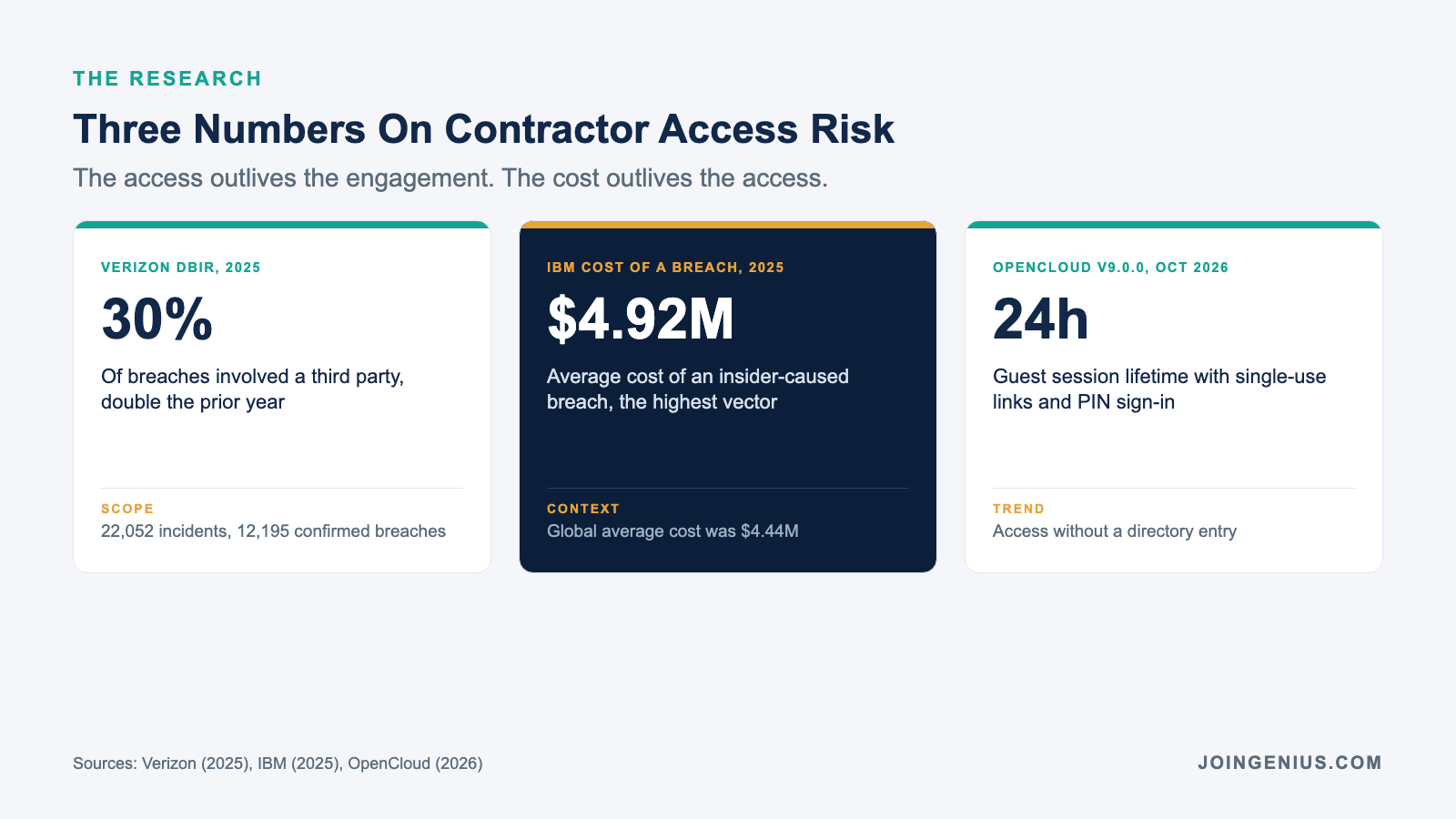
In 2025, Verizon reported that third-party involvement in breaches doubled to 30 percent of all cases studied, up from about 15 percent the year before. In 2026, provisioning contractors as if they are permanent staff does not survive a serious audit.
The rest of this guide lays out how to onboard them so day one matches the work and day thirty still does.
Why Contractor Onboarding Fails On Day One
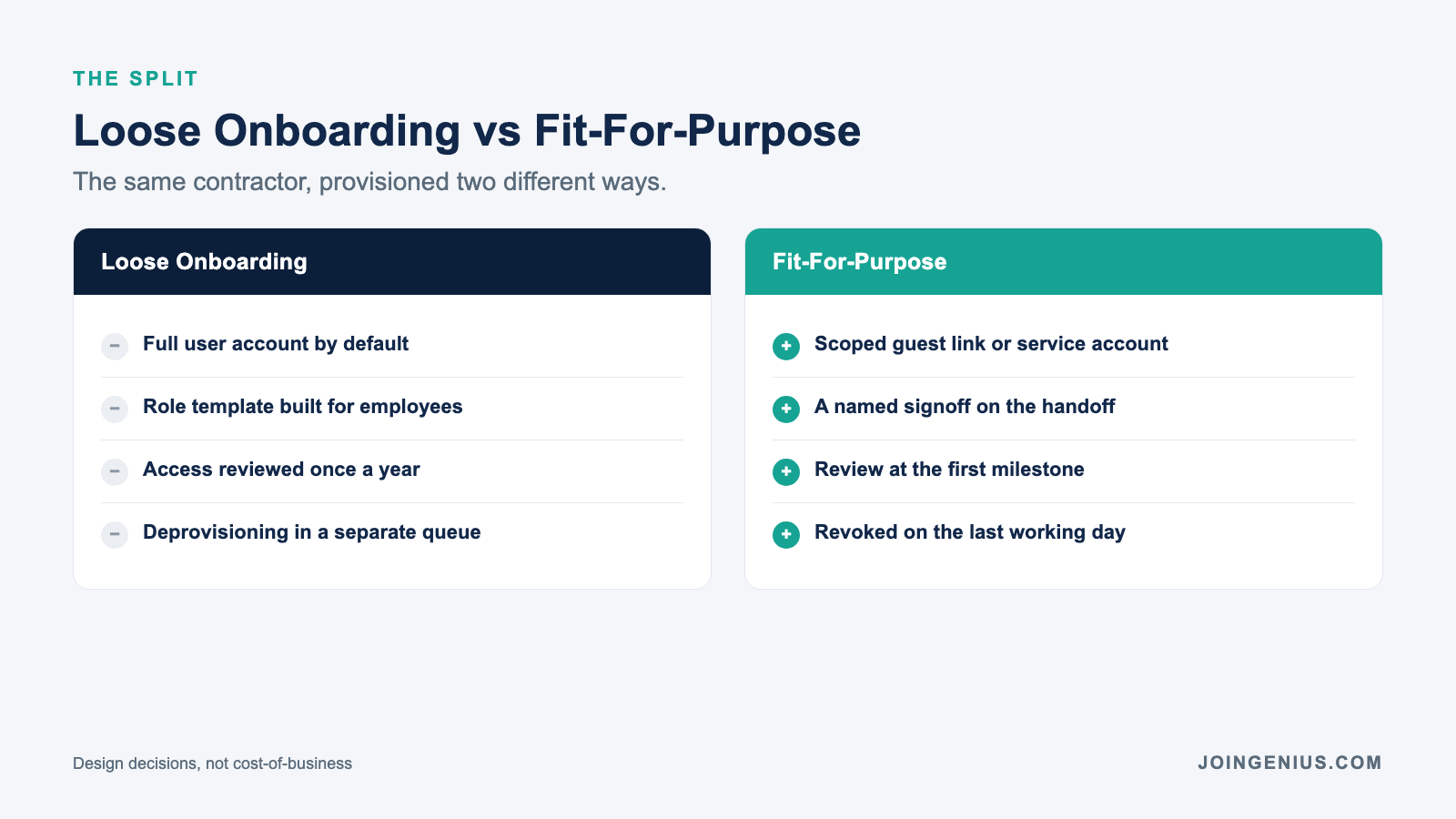
The first failure happens before the contractor logs in. The hiring manager picks a role from a dropdown that was designed for employees. The contractor inherits the group memberships and the file-share permissions that come with that role. Day one looks fast. Day thirty looks like a problem.
The second failure is deprovisioning. A contractor who finishes a six-week sprint rarely gets a formal exit on the same day as their last commit. The project manager marks the ticket done. The IT ticket for access removal lives in a separate queue, often further down a backlog nobody sees.
Verizon’s 2025 Data Breach Investigations Report analyzed 22,052 incidents and 12,195 confirmed breaches. Nearly one in three of those breaches involved a third party. The gap between “project done” and “access revoked” is where that number is made, and the gap is wider for contractors than it is for staff.
The third failure is that nobody owns the review. Employees get an annual access review signed by their manager. Contractors often sit outside that cadence. If no one is accountable for the scope the contractor still carries at week eight, the scope keeps growing until the engagement ends.
Each of these failures is a process problem, not a trust problem. The contractor did nothing wrong. The onboarding was built for an employee and bent to fit a contractor. The bend is where the risk sits.
Access Without Accounts: Where Guest Links Fit
Not every contractor needs a user account at all. A designer reviewing three brand files for a week does not need a mailbox or a permanent identity in your directory. A tax advisor pulling four quarterly reports does not need a group in your SSO. What they need is scoped, time-bound access to specific files.
OpenCloud’s guest access, shipped in v9.0.0 on October 27, 2026, is a working example of this pattern in a European open-source stack. Guests get a personal link by email with no account. They sign in through a one-time PIN and keep a session that lasts 24 hours before it has to be renewed.
Links are single-use and valid for 30 minutes. The admin controls session lifetime and renewal rate. The guest’s identity is tied to their email address, so the audit trail is real without a directory entry. Access has a hard expiry date, not a renewal that defaults to permanent.
The model is web-only. There is no desktop sync to a laptop you cannot image, and no mobile client to a device you cannot wipe. For file review and document delivery with external specialists, pulling that work out of the full account pipeline removes most of the exit-day risk by design.
Guest links are not a universal answer. A contractor shipping production code still needs a tracked identity with proper access. But for short-cycle work on a defined set of files, the scoped-link model is the pattern that fits the engagement.
Pick the mechanism by the scope, not by the vendor. Short-cycle, file-only work on known documents fits a guest-link flow. Multi-week engineering work on your source tree fits a time-boxed service account tied to the hiring manager. The point is that the contractor sees exactly one surface, with a built-in end date on it.
The Four Checks That Replace Security Theater
A fit-for-purpose contractor onboarding has four checks. None of them are new. All four are usually skipped on the handoff.
Check one is scope at intake. Before any account or link is created, the hiring manager writes down the three systems the contractor will touch and the end date of the engagement. If the three systems do not fit on one line, the scope is wrong and the role needs splitting.
Check two is a named signoff on the handoff. One person on the hiring team owns the access decision and signs the ticket. “The team” is not a signoff. A ticket that cannot name a human is a ticket that will not survive a real audit.
Check three is a review cadence that matches the engagement length. A six-week project gets a review at week three. A six-month project gets one every month. The review is a two-minute scope check, not a quarterly ritual that nobody has time for.
Check four is a hard close. The contractor’s last day is the day the access is revoked. Not the day after. Not when the IT queue clears. If the last day is Friday, the Friday ticket closes the loop. See our global outsourcing guide for the operational version of this.
A Four Stage Playbook For Contractor Access
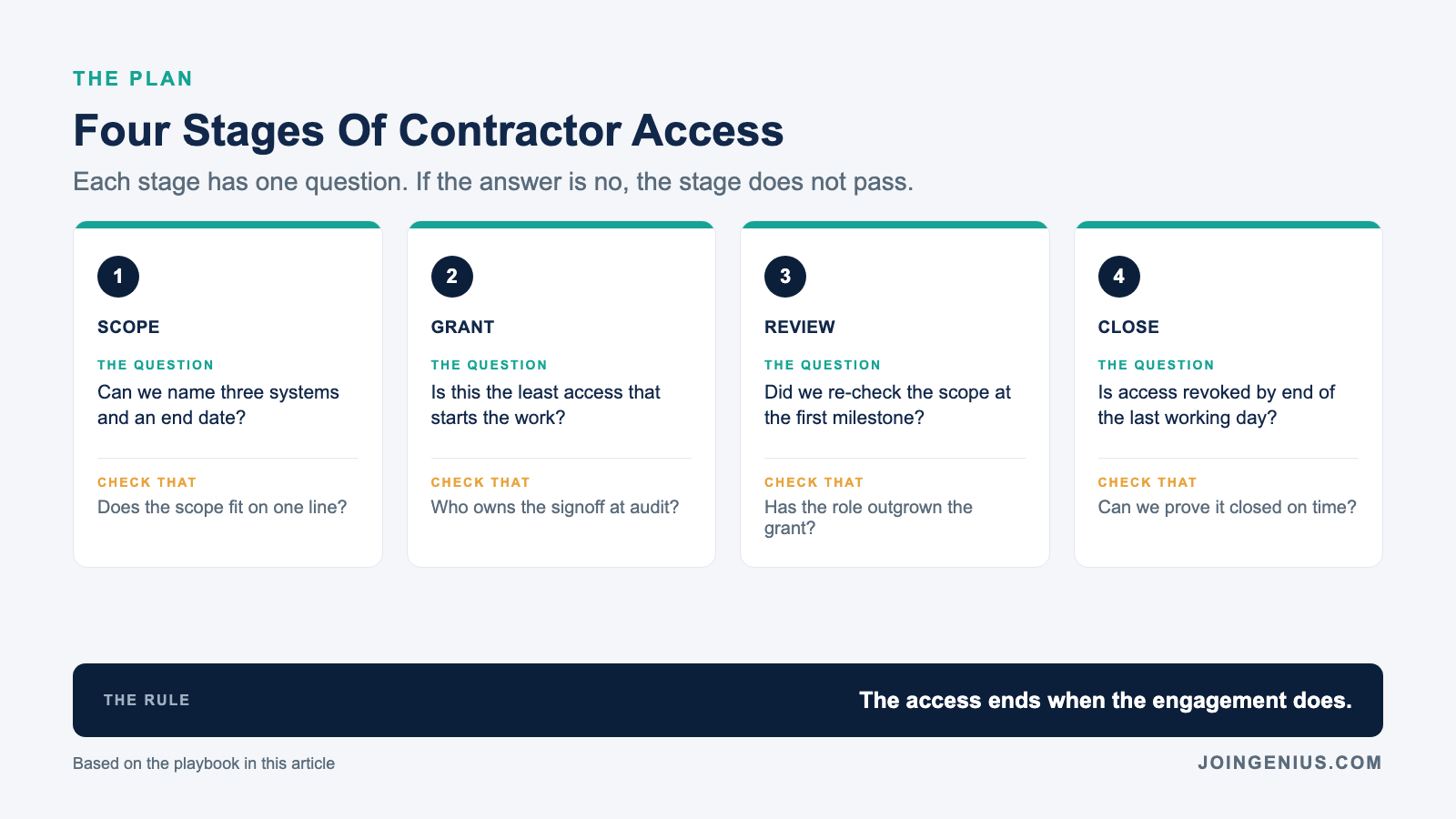
The playbook is four stages and each stage has one question. If the answer is no, the stage does not pass. The playbook travels well because it does not depend on which tools you run.
| Stage | The Question |
|---|---|
| Scope | Can we name the three systems and the end date? |
| Grant | Is this the least access that lets the contractor start? |
| Review | Did we check the scope again at the first milestone? |
| Close | Is the account or link revoked by end of the last working day? |
The same four questions work for a Google Workspace file share and for an OpenCloud guest link. What changes is the mechanism and not the discipline. Our payroll outsourcing explainer covers the pay side of the same handoff.
The step cards below show the four stages at a glance. Put the playbook on your handoff ticket, not in your head. A handoff ticket that answers the four questions in writing is a handoff ticket a security team can actually audit against the engagement that follows.
Why Overprovisioning Keeps Winning
Overprovisioning wins because it is easier than scoping. A manager who gives the contractor the full employee group avoids one awkward conversation about what they do not need. The audit that catches it, if it ever does, is months away. The cost is not visible until something breaks.
IBM’s Cost of a Data Breach Report 2025, released in August 2025, found that insider attacks had the highest average breach cost among initial threat vectors at $4.92 million per incident. The global average breach cost was $4.44 million. Insiders are not only your employees.
A contractor on an overprovisioned account is an insider in every operational sense. The cost math treats them the same way, and the controls should too. If a stale contractor account on your file share could cost that much, treating it like a short-lived utility is cheaper than treating it like a permanent user.
The practical fix is not more fear of contractors. The fix is to design the account like it will end. Set default expiry dates on every contractor identity. Use scoped groups and not role templates built for permanent staff. Open a deprovisioning ticket on the day the contract is signed with the close date already filled in.
Pair that with a weekly scan for contractor accounts that are past their expiry. A short script that lists expired identities and their last login is a cheaper control than an annual review. See our talent acquisition guide for the hiring loop that fits this.
Hire Distributed Contractors With Access That Fits
Security theater on contractor onboarding is a tax you pay on every engagement. It gets paid in audit findings and sometimes in a breach number you did not need to earn. The fix is not more process. It is less process, tightened at the four points where it matters most.
Genius places the top 1 percent of remote talent from the Philippines and Latin America into roles that would otherwise cost roughly 80 percent more locally. There are no monthly platform fees and a six-month replacement guarantee if the fit is wrong.
For long engagements that still deserve a tight onboarding, our types of HR outsourcing guide covers which model fits which role, and how to size the access against the scope of the work before day one.
The contractors are not the problem. The account is. Fix the account and the theater goes away.