Most B2B companies are sitting on a lead generation problem they don’t even realize they have. They’re getting leads. But not the right ones.
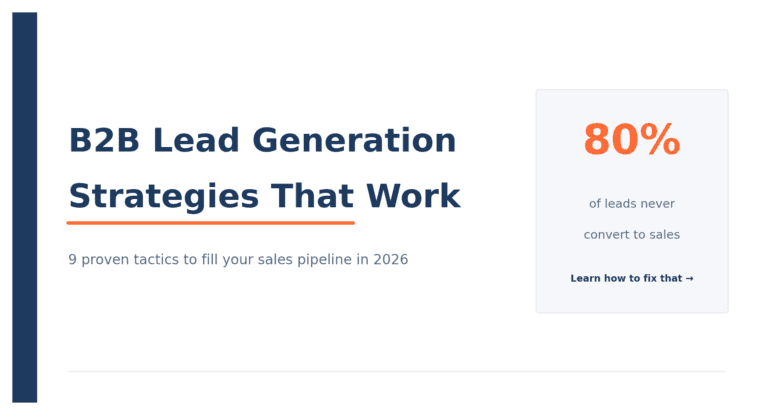
Here’s what the data shows: 80% of new leads never convert to sales. Not because they weren’t interested. Because the strategy that captured them wasn’t built to attract buyers ready to take action. The companies winning at B2B marketing right now have figured out something simple. Quality beats quantity every single time.
This guide breaks down nine lead generation tactics that consistently deliver qualified leads. You’ll learn exactly how to implement each one without wasting months on strategies that don’t move the needle.
What Makes B2B Lead Generation Different
B2B lead generation plays by different rules than B2C. Your buyers aren’t making impulse purchases. They’re building business cases, getting sign-offs from multiple stakeholders, and comparing you against three other vendors before a single meeting gets scheduled.
The typical B2B sales funnel looks something like this: 10,000 website visitors become 3,000 leads. Those 3,000 leads become 800 marketing-qualified leads. And those MQLs narrow down to 200 sales-ready opportunities that your team can actually work.

This means your lead generation strategies need to do two things well. First, they need to attract people who match your ideal customer profile. Second, they need to move those people through a nurturing process that builds trust before your sales team ever picks up the phone.
The talent acquisition process follows similar principles. You’re not just looking for any candidates. You want the right ones who fit your specific criteria. Lead generation works the same way.
📌 Key Takeaway
B2B lead generation isn’t a numbers game. A smaller pool of qualified leads will always outperform a massive list of people who were never going to buy. Focus your strategy on attracting prospects who match your ideal customer profile.
1. Content Marketing That Attracts Buyer-Ready Leads
Content marketing remains the most cost-effective lead generation tactic for B2B companies. But there’s a catch. Generic blog posts about industry trends won’t cut it anymore.
The content that generates qualified leads solves specific problems your buyers face right now. It answers the questions they’re typing into Google at 10 pm when they’re researching solutions for tomorrow’s meeting.
Create Content for Every Stage of the Sales Funnel
Top-of-funnel content builds awareness. Think educational guides, industry reports, how-to articles, and video content. YouTube has become a major B2B discovery channel, but new channels struggle with the cold-start problem. Some companies jumpstart their subscriber base to overcome the credibility gap that makes viewers skip channels with low follower counts. Once the foundation is there, quality content does the rest.
Middle-of-funnel content nurtures interest. Case studies, comparison guides, and detailed tutorials help prospects evaluate their options. They know they have a problem. Now they’re figuring out how to solve it.
Bottom-of-funnel content converts. Product demos, free trials, ROI calculators, and pricing pages target people ready to make a decision.
Build Lead Magnets Worth Trading an Email For
Your lead magnets need to deliver immediate value. Nobody’s handing over their work email for a generic ebook they could have found on the first page of Google.
Effective lead magnets include original research and industry benchmarks. Look at how Medical Alert Buyers Guide built their entire lead generation strategy around comprehensive comparison content. They’ve become the go-to resource in their space by helping buyers make informed decisions. That trust translates directly into qualified leads.
Other effective lead magnets include:
- Templates and worksheets they can use today
- Free tools or calculators that solve a real problem
- Video training that teaches a valuable skill
The hiring statistics page is a good example of content that provides genuine research value. It gives readers data they can actually use in their own decision-making.
💡 Quick Tip
Test your lead magnet by asking: Would I pay $20 for this? If the answer is no, your prospects won’t trade their contact information for it either. The bar for gated content is higher than ever.
2. Inbound Marketing Through SEO and Organic Search
Inbound marketing through search engines delivers leads who are actively looking for solutions. These aren’t cold prospects. They’ve already identified a problem, and they’re researching answers.
The key is targeting keywords with commercial intent. Informational queries like “what is CRM software” attract researchers. But “best CRM for small sales teams” attracts buyers.
Optimize Your Landing Pages for Conversions
Your landing pages need to do one job: convert visitors into leads. Every element should support that goal.
Strong landing pages include:
- A headline that matches the visitor’s search intent
- Social proof through testimonials or client logos
- A clear value proposition in the first paragraph
- A simple form that doesn’t ask for unnecessary information
- A compelling call-to-action that tells them exactly what happens next
The conversion rate difference between an optimized landing page and a generic one can be dramatic. Companies that test and refine their pages regularly see 2-3x improvements in lead capture.
Target Long-Tail Keywords Your Competitors Miss
Broad keywords are expensive to rank for and often attract the wrong traffic. Long-tail keywords are more specific, less competitive, and typically signal higher purchase intent.
Instead of targeting “project management software,” go after “project management software for marketing agencies” or “project management tool with client portals.” These searches come from buyers who know exactly what they need.
3. LinkedIn Prospecting and Social Selling
LinkedIn has become the primary hunting ground for B2B leads. Over 80% of B2B leads from social media come through this single platform. But most companies are using it wrong.
The mistake is treating LinkedIn like a billboard. Posting company updates and job listings doesn’t generate leads. Building relationships does.
Create a Consistent Outreach Process
Cold outreach on LinkedIn works when it’s personalized and value-driven. The spray-and-pray approach of sending identical connection requests to hundreds of people generates nothing but ignored messages.
Effective LinkedIn prospecting follows this pattern:
- Research before reaching out. Look at their recent posts, company news, and shared connections.
- Send a personalized connection request. Reference something specific about them or their company.
- Deliver value before asking for anything. Share relevant content, offer insights, or make an introduction.
- Start a conversation, not a pitch. Ask questions about their challenges instead of pushing your solution.
The teams that treat LinkedIn prospecting as relationship-building rather than cold outreach consistently outperform those running automated campaigns.
📊 By the Numbers
LinkedIn InMail messages with fewer than 400 characters see a 22% higher response rate than longer messages. The people you’re reaching out to are busy. Get to the point quickly and focus on them, not your product features.
4. Account-Based Marketing for High-Value Targets
Account-based marketing flips the traditional lead generation model. Instead of casting a wide net and hoping the right fish swim in, you identify your ideal accounts first and build campaigns specifically for them.
This approach works especially well when you’re selling high-ticket B2B solutions where each deal represents significant revenue. Why waste marketing budget attracting thousands of unqualified leads when you could focus on the 50 companies that actually fit your ideal customer profile?
Define Your Ideal Customer Profile First
Before launching any ABM campaigns, you need clarity on exactly who you’re targeting. For example, this company selling professional dress forms to fashion schools and retail chains would have a highly specific ICP. Their target accounts might number in the hundreds, not thousands. That’s exactly when ABM makes sense.
This goes beyond basic demographics like company size and industry. Your ideal customer profile should include firmographic data like revenue, employee count, industry, and location. A luxury retailer like Ice Cartel, which sells high-end timepieces, would have a completely different ICP than a SaaS company. Their ideal B2B customers might be jewelry boutiques or high-net-worth wealth managers looking to offer exclusive pieces to clients.
Your ICP should also include:
- Technographic data: What tools and platforms they currently use
- Behavioral signals: Content they engage with, events they attend
- Pain points: Specific challenges your solution addresses
- Buying triggers: Events that typically precede a purchase decision
The process mirrors how smart companies approach talent acquisition management. You define exactly who you’re looking for before you start searching.
Coordinate Marketing and Sales on Target Accounts
ABM only works when marketing and sales are aligned. Marketing creates personalized content and campaigns for target accounts. Sales uses that content in their outreach and follows up on engagement signals.
This coordination requires shared visibility into account activity. When a prospect from a target account downloads a case study, both teams should know about it immediately.
5. Email Marketing and Lead Nurturing Sequences
Email marketing remains one of the highest-ROI lead generation tactics available. But the days of batch-and-blast newsletters are over. Modern email marketing is about delivering the right message to the right person at the right time.
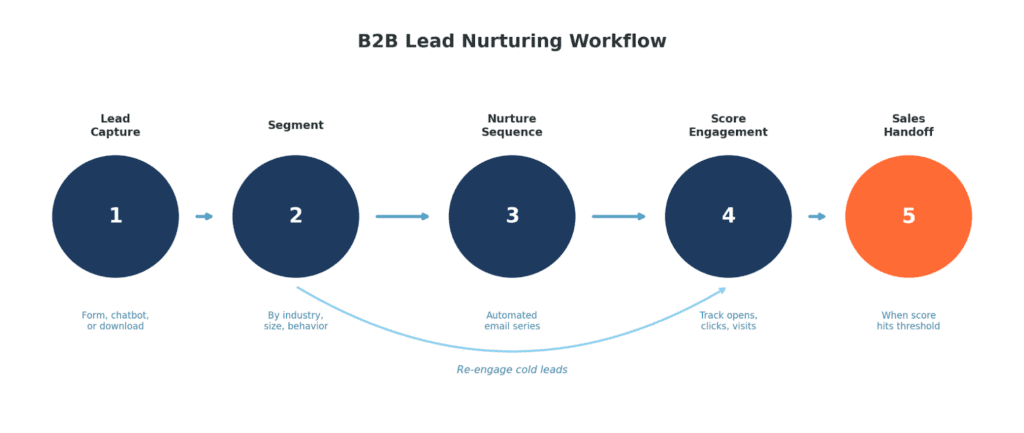
The leads in your database aren’t all ready to buy today. Research shows that 50% of leads are qualified but not ready to make a purchase decision. Lead nurturing keeps you top of mind until they are.
Build Automated Nurture Sequences
The best nurturing sequences feel personal even though they’re automated. They respond to what prospects actually do rather than just running on a fixed schedule.
A basic nurturing sequence might look like this:
- Day 1: Deliver the lead magnet they requested
- Day 3: Share a related blog post or resource
- Day 7: Send a case study showing results
- Day 14: Offer a tool or template they can use
- Day 21: Invite them to a webinar or demo
Marketing automation makes this scalable. You create the sequence once, and it runs automatically for every new lead.
⚠️ Common Mistake
Don’t over-email your prospects. Sending daily messages doesn’t accelerate the buying process. It accelerates unsubscribes. Space your nurturing emails 3-7 days apart and always prioritize value over frequency.
Segment Your List for Relevance
Generic emails get ignored. Segmented campaigns get opened.
Segment your email list based on:
- Industry or company type
- Role or job function
- Content they’ve engaged with
- Stage in the buying process
- Previous purchases or interactions
The more relevant your emails feel, the higher your conversion rates will be.
6. Lead Scoring to Prioritize Your Best Opportunities
Not all leads deserve equal attention. Lead scoring assigns point values based on prospect characteristics and behaviors, helping your sales team focus on the opportunities most likely to close.
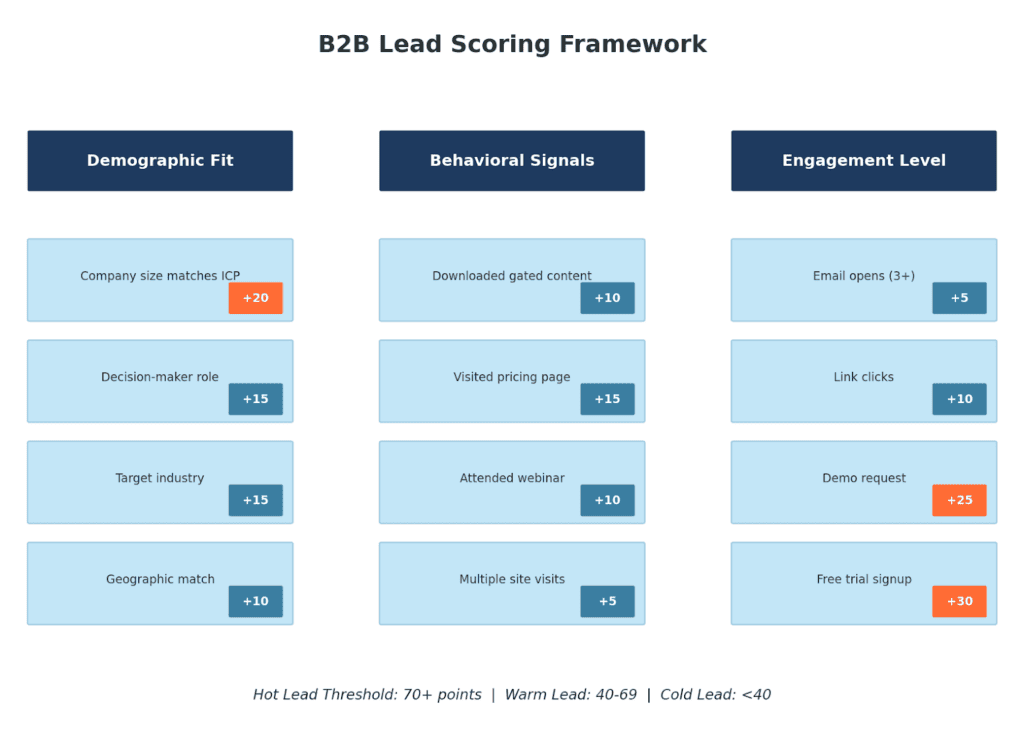
Without lead scoring, your sales team wastes time chasing leads who were never going to buy, while hot prospects go cold waiting for follow-up.
Score Based on Fit and Engagement
Effective lead scoring combines two factors. Demographic fit measures how well a lead matches your ideal customer profile. Behavioral engagement measures how interested they seem based on their actions.
| Criteria Type | Example Signals | Point Value |
| Demographic Fit | Company size matches ICP | +20 points |
| Demographic Fit | Decision-maker job title | +15 points |
| Demographic Fit | Target industry | +15 points |
| Behavioral | Downloaded gated content | +10 points |
| Behavioral | Visited pricing page | +15 points |
| Behavioral | Attended webinar | +10 points |
| Behavioral | Requested demo | +25 points |
| Negative | Competitor email domain | -50 points |
| Negative | Student or intern title | -30 points |
When a lead crosses your threshold score, they automatically get flagged for sales follow-up. This ensures your best opportunities never slip through the cracks.
The same principle applies in talent sourcing. You score candidates based on fit and interest to prioritize who deserves immediate attention.
7. Outbound Prospecting Done Right
Cold outreach still works in B2B. But it requires a fundamentally different approach than it did five years ago. Prospects are drowning in generic emails. The ones that get responses feel personal, relevant, and focused on the buyer’s challenges rather than your product features.
Personalize Beyond the First Name
True personalization goes way beyond “Hi {{FirstName}}.” Your prospects can spot a mail merge from a mile away.
Effective personalization includes:
- Referencing their recent company news or announcements
- Mentioning a specific challenge common in their industry
- Connecting your outreach to content they’ve published
- Noting a mutual connection or shared experience
This level of personalization takes more time per prospect. But the response rates make it worth it. A thoughtful 50-email campaign will outperform a generic 500-email blast every time.
💡 Quick Tip
Use the “Before-After-Bridge” framework for cold emails. Describe their current situation (Before), paint a picture of what’s possible (After), then show how you can help them get there (Bridge). This structure keeps the focus on them, not you.
Combine Channels for Multi-Touch Sequences
The most effective outbound campaigns don’t rely on a single channel. They combine email, LinkedIn, phone calls, and sometimes even direct mail into coordinated sequences.
A typical multi-touch sequence might include:
- LinkedIn connection request
- Email introduction
- LinkedIn engagement with their content
- Follow-up email with relevant resource
- Phone call attempt
- Final email with a different angle
This approach reaches prospects where they’re most likely to respond and builds familiarity through multiple touchpoints.
8. Webinars and Virtual Events
Webinars have become a staple of B2B lead generation. They combine content marketing with lead capture and give you an hour of undivided attention from qualified prospects. That’s valuable attention you can’t buy through any other channel.
Choose Topics That Attract Buyers
The topic determines who shows up. Educational webinars attract researchers. Solution-focused webinars attract buyers.
Topics that generate qualified leads typically:
- Address a specific pain point your product solves
- Feature case studies or customer success stories
- Include actionable frameworks or processes
- Showcase your expertise without being a product demo
The best webinar topics come from conversations with your sales team. What questions do prospects ask most frequently? What objections keep coming up? Those are your webinar ideas.
Maximize Post-Webinar Follow-Up
The webinar itself is just the beginning. The real lead generation happens in the follow-up.
Your post-webinar sequence should include:
- Recording and slides sent within 24 hours
- Segmented follow-up based on attendance and engagement
- Personalized outreach to highly engaged attendees
- Offers to continue the conversation for interested prospects
Companies that treat webinar attendees like warm leads rather than newsletter subscribers see significantly higher conversion rates.
9. Referral Programs and Partner Marketing
Referrals consistently deliver the highest quality leads with the shortest sales cycles. When a trusted colleague recommends your solution, the prospect arrives pre-sold on your credibility.
Create a Structured Referral Program
Referrals don’t happen by accident. You need a system that makes it easy for happy customers to send business your way.
An effective referral program includes:
- Clear incentives for both the referrer and the new customer
- Simple mechanics that don’t require much effort
- Timely recognition and rewards
- Regular reminders to keep the program top of mind
The outsourcing space provides a good example. Companies that build strong referral networks often grow faster than those relying solely on advertising.
Partner With Complementary Businesses
Strategic partnerships extend your reach to audiences you couldn’t access on your own. Some companies accelerate this by acquiring established Facebook pages with built-in audiences in their target niche. Instead of building from zero, they start with an engaged community that already matches their ideal customer profile.
The key is finding partners who serve the same customers without competing directly. Look for partners who:
- Target your ideal customer profile
- Offer complementary (not competing) solutions
- Have strong credibility with their audience
- Are willing to co-market and share leads
Co-hosted webinars, joint content pieces, and mutual referral agreements can all generate significant lead flow.
🎯 Pro Insight
The most valuable partnerships feel like natural extensions rather than forced collaborations. When your partner genuinely believes in your product, their referrals carry authentic enthusiasm that prospects can feel.
Choosing the Right Lead Generation Channels
Not every strategy works for every business. Your ideal lead generation mix depends on your sales cycle length, average deal size, target audience, and internal resources.
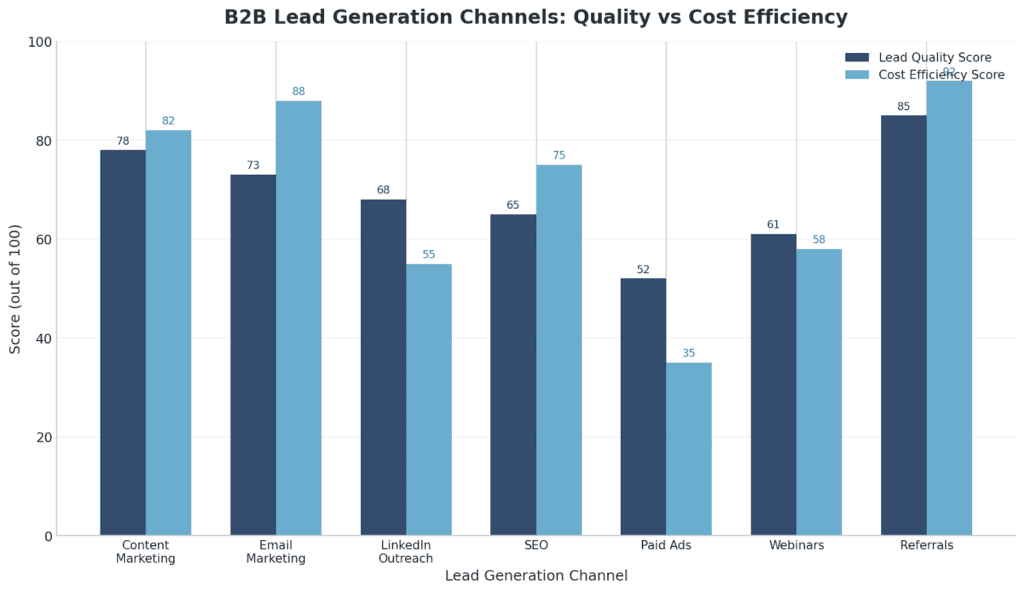
| Channel | Best For | Typical Time to Results | Resource Level |
| Content Marketing | Long sales cycles, thought leadership | 6-12 months | Medium-High |
| SEO | Consistent pipeline building | 6-12 months | Medium |
| LinkedIn Outreach | Targeted prospecting | 1-3 months | Medium |
| Account-Based Marketing | High-value accounts | 3-6 months | High |
| Email Nurturing | Converting existing leads | 1-3 months | Low-Medium |
| Outbound Prospecting | Fast pipeline growth | 1-2 months | High |
| Webinars | Building authority | 2-4 months | Medium |
| Referrals | Highest quality leads | Ongoing | Low |
Start with one or two channels you can execute well. Adding more complexity before you’ve mastered the basics just dilutes your efforts.
The talent acquisition tools landscape shows similar patterns. Companies that try to use every available tool often get worse results than those who master a focused set of approaches.
Measuring What Matters
You can’t improve what you don’t measure. But measuring everything creates noise that hides the signals that actually matter.
Focus on These Lead Generation Metrics
Lead volume: How many new leads are you generating per month?
Lead quality: What percentage of leads match your ideal customer profile?
Conversion rates: How many leads become MQLs? MQLs to SQLs? SQLs to customers?
Cost per lead: What are you spending to generate each qualified lead?
Time to conversion: How long does it take for leads to move through your pipeline?
Track these metrics by channel so you know which strategies are actually working. Double down on what’s performing and cut what isn’t.
📌 Key Takeaway
The ultimate metric is revenue generated, not leads captured. A strategy that generates 100 leads converting to 10 customers beats a strategy generating 1,000 leads converting to 5 customers. Always connect your lead generation efforts back to closed business.
Putting It All Together
Building a B2B lead generation engine takes time. The strategies that generate the most qualified leads require consistent execution over months, not quick wins over weeks.
Start by picking two or three approaches that align with your resources and target audience. Execute them consistently for at least 90 days before adding anything new. Test, measure, and optimize based on what the data tells you.
The companies winning at B2B lead generation in 2026 aren’t chasing every new tactic that comes along. They’re building systematic processes that reliably fill their sales pipeline with qualified prospects month after month.
Your leads are out there. Now go get them.